NASA officially ends failed Lunar Trailblazer mission

NASA on August 4, 2025 officially ended its months-long effort to recover its Lunar Trailblazer mission that failed almost immediately after launch in February.

Lunar Trailblazer shared a ride on the second Intuitive Machines robotic lunar lander mission, IM-2, which lifted off at 7:16 p.m. EST on Feb. 26 aboard a SpaceX Falcon 9 rocket from the agency’s Kennedy Space Center in Florida. The small satellite separated as planned from the rocket about 48 minutes after launch to begin its flight to the Moon. Mission operators at Caltech’s IPAC in Pasadena established communications with the small spacecraft at 8:13 p.m. EST. Contact was lost the next day.

Without two-way communications, the team was unable to fully diagnose the spacecraft or perform the thruster operations needed to keep Lunar Trailblazer on its flight path.

This failure of a NASA-built and operated lunar orbiter contrasts starkly with the success of the privately-built and operated Capstone mission. Contact with that spacecraft, built by Rocket Lab, was also lost soon after launch, but the company doing mission control, Advanced Space, was able to re-establish contract and get the spacecraft into lunar orbit, where it continues to function as planned.


0 comments

Astroscale awarded patent for its space junk removal technology

Astroscale's patented design
Astroscale’s patented design. Click for original.

The Japanese orbital tug and space junk removal startup Astroscale was awarded a U.S. patent in late July for its space junk removal technology.

Under this new patented method, the servicer docks with a debris object (the “client”) and transfers it to a reentry shepherd vehicle in a lower orbit. Once the client is docked with the shepherd, the servicer separates and proceeds to engage a new client, while the shepherd safely guides the initial client into Earth’s atmosphere for reentry. This process repeats, allowing the servicer to remove multiple large debris objects over the course of its mission.

Astroscale’s architecture also supports flexible mission profiles: the shepherd can remain docked through reentry, undocked after performing reentry insertion and returned to orbit, or in some cases, missions can proceed without a shepherd vehicle at all. This adaptability is essential in addressing the diverse size and risk profile of objects in orbit.

The company notes that this technology, which the image suggests will use robot arms to grab its targets, will allow its spacecraft to remove not only inactive satellites that were launched with docking equipment already attached but also rocket bodies and older satellites without that docking capability.

2 comments

Duffy touts nuclear power for lunar base

Sean Duffy
Sean Duffy, transportation secretary and interim
NASA administrator

NASA’s interim administrator Sean Duffy yesterday issued a directive touting the need to develop nuclear power for NASA’s planned lunar base. His comments during a press conference yesterday underlined his position.

Listen, this is not a new concept. This has been discussed under Trump One, under Biden, but we are in a race, we’re in a race to the Moon, in a race with China to the Moon. And to have a base on the Moon, we need energy. And some of the key locations on the Moon, we’re going to get solar power. But this fission technology is critically important, and so we’ve spent hundreds of millions of dollars studying can we do it? We are now going to move beyond studying and we are going, we have given direction to go. Let’s start to deploy our technology, to move, to actually make this a reality.

And I think the stat we have is 100 kilowatt output. That’s the same amount of energy a 2,000 square foot home uses every three-and-a-half days. So we’re not talking about massive technology. We’re not launching this live, that’s obviously, if you have any questions about that, no, we’re not launching it live [activated].

This is all blather designed to push Artemis and SLS and Orion. Duffy also once again touted the next Artemis mission, Artemis-2, that will use SLS and Orion to send astronauts around the Moon in April 2026, acting as if he had no idea about the mission’s known technical risks. He also insisted the lunar landing would follow soon thereafter.

More and more it appears to me that Trump dumped Jared Isaacman because it was almost certain Isaacman — with his own personal experience as an astronaut — would have likely refused to permit astronauts to fly on Artemis-2 because of Orion’s heat shield issues as well as its untested environmental systems. Duffy meanwhile is acting as a company man, pushing the program hard while ignoring the real risks. It appears Trump wants that manned lunar landing before he leaves office, and will brook no hesitation from anyone.

Welcome to Challenger and Columbia, all over again. Politics and scheduling has become paramount, while engineering takes a back seat.

4 comments

NASA awards small orbital tug study contracts to six companies

NASA yesterday awarded six companies small study contracts in connection with orbital tug operations, with some to study using their rocket upper stage for this purpose while others to see how they can refine the use of their tugs.

The press release was not entirely clear on how much money was involved in each contract, though in each case the amounts are relatively small.

The firm-fixed-price awards comprise nine studies with a maximum total value of approximately $1.4 million. The awardees are:

Arrow Science and Technology LLC, Webster, Texas [tug study]
Blue Origin LLC, Merritt Island, Florida [both tug and upper stage studies]
Firefly Aerospace Inc., Cedar Park, Texas [tug study]
Impulse Space Inc., Redondo Beach, California [tug study]
Rocket Lab, Long Beach, California [both tug and upper stage studies]
United Launch Services LLC, Centennial, Colorado [upper stage study]

The studies are expected to be finished by September 2025, and will be used by NASA to determine how it will get some of its future spacecraft to their intended orbits.

0 comments

Echostar issues contract to build satellites for direct-to-phone constellation

Echostar has awarded the satellite company MDA Space a $1.3 billion contract to build the first 100 satellites in its proposed direct-to-phone constellation that will compete directly with the constellations of SpaceX’s Starlink and AST SpaceMobile.

The initial contract, valued at approximately US$1.3 billion (approx. C$1.8 billion), includes the design, manufacturing and testing of over 100 software-defined MDA AURORA™ D2D satellites. With contract options, enabling a full initial configuration of a network of over 200 satellites, the value of the contract would increase to an approximate total value of US$2.5 billion (approx. C$3.5 billion). EchoStar envisions future growth to thousands of satellites, as demand requires, to provide global talk, text and broadband services directly to standard 5G handheld devices.

The constellation will be fully compliant with the newly created NTN and 3GPP standards, allowing EchoStar to provide messaging, voice, broadband data, and video services upon launch to all phones configured to this standard, without modifications. Additionally, the constellation will connect to an array of sensor and mobile vehicles.

All three constellations are designed to provide cell service in areas where there are no cell towers. The satellites themselves become the cell towers, in orbit.

Since most people today access the internet via their smartphones, I can see these direct-to-phone constellations eventually becoming the prime method for accessing the web. Why have a separate provider for your web services when these constellations can give you that as well as phone service. It is for this reason I suspect Echostar is jumping on the bandwagon.

This move also suggests the older Starlink and Kuiper constellations, that only provide web service, are going to eventually get superseded. For Starlink this isn’t really a threat, as it is already beginning the transition to this new technology and can likely shift its millions of customers to it easily when the time comes. For Amazon’s Kuiper constellation, however, it appears it might be arriving too late in the game.

More proof that in capitalism speed is essential. Amazon has simply moved too slowly in launching its constellation.

Hat tip Btb’s stringer Jay.

0 comments

Endeavour launched successfully, carrying four astronauts to ISS

SpaceX’s Endeavour Dragon capsule has been successfully placed in orbit carrying four astronauts to ISS, its Falcon 9 rocket lifting off from Kennedy in Florida.

This is Endeavour’s sixth flight. It will dock at ISS in the early hours tomorrow. The first stage completed third flight, landing back in Florida.

The leaders in the 2025 launch race:

96 SpaceX
41 China
10 Rocket Lab
9 Russia

SpaceX now leads the rest of the world in successful launches, 96 to 71.

1 comment

SpaceX launches 19 more Starlink satellites

Only a few hours after it scrubbed the launch of its Endeavour capsule carrying four astronauts to ISS because of weather at Kennedy in Florida, SpaceX proceeded to successfully launch 19 more Starlink satellites, its Falcon 9 rocket lifting off from Vandenberg in California.

The relatively low number of Starlink satellites on this launch appears related to the higher orbit in which they were placed. The first stage completed its 27th flight, landing on a drone ship in the Pacific. SpaceX now has four boosters that have flown more than 25 times, respectively 29, 27, 26, and 26.

The leaders in the 2025 launch race:

95 SpaceX
41 China
10 Rocket Lab
9 Russia

SpaceX now leads the rest of the world in successful launches, 95 to 71. Meanwhile, the manned Endeavour launch has now been rescheduled for tomorrow morning.

4 comments

Ontario cancels Starlink contract in retaliation to Trump’s tariffs

Cutting off your nose to spite your face: The Ontario government yesterday canceled a $100 million Starlink contract it had with SpaceX to provide internet service to remote areas, doing so in retaliation to Trump’s tariffs.

Ontario Premier Doug Ford threatened to cancel the contract in February if U.S. tariffs on Canadian goods were imposed. He killed the deal in March when U.S. President Donald Trump moved ahead with tariffs. “It’s done, it’s gone,” Ford said at the time. “We won’t award contracts to people who enable and encourage economic attacks on our province … and our country.”

…Ford’s cancellation of the deal came as part of a suite of measures in retaliation to Trump’s tariffs. He pulled American booze off the shelves of LCBO stores in March and has said the U.S. booze ban will be kept in place until Trump removes his tariffs on Canada. Ford also banned American companies from bidding on $30 billion worth of procurement contracts the province awards each year. He also banned U.S. companies from bidding on contracts related to his $200-billion infrastructure plan to build highways, tunnels, transit, hospitals, and jails.

It appears the province had to pay SpaceX a penalty for canceling the contract, but the amount has not been revealed. The cancellation also leaves those rural areas stranded, as the government presently has no alternative service to offer.

8 comments

China launches Earth observation satellite for Pakistan

China today successfully launched an Earth observation satellite for Pakistan, its solid-fueled Kuaizhou-1A rocket lifting off from its Xichang spaceport in southwest China.

No word on where the rocket’s lower stages crashed inside China.

94 SpaceX
41 China
10 Rocket Lab
9 Russia

SpaceX still leads the rest of the world in successful launches, 94 to 71. It also has another Starlink launch scheduled this morning.

0 comments

India and China complete launches

Two more launches today. First, India’s space agency ISRO successfully placed a joint NASA-ISRO radar satellite into orbit, its GSLV rocket lifting off from its Sriharikota spaceport on the eastern coast of India.

This was India’s first fully successful launch in 2025. On the first launch in January, the GSLV rocket performed as planned, but the satellite’s own engines failed to put it into the right orbit. Then in May the third stage of its PSLV rocket failed during launch.

Next China placed the sixth group of nine satellites for one of its mega-constellations designed to compete with Starlink, its Long March 8A rocket lifting off from its Wenchang coastal spaceport.

The leaders in the 2025 launch race:

94 SpaceX
40 China
10 Rocket Lab
9 Russia

SpaceX still leads the rest of the world in successful launches, 94 to 70.

0 comments

Curiosity looks back

Curiosity looks back
Click for original image.

Cool image time! The picture to the right, reduced and enhanced to post here, was taken on July 28, 2025 by the left navigation camera on the Mars rover Curiosity. It looks to the north, down the flanks of Mount Sharp and across the floor of Gale Crater to its mountainous rim about 30 miles way, seen on the horizon.

The view is so clear because of the season, as noted in the science team’s blog post today:

We’re still in the time of year where the atmosphere at Gale is reasonably dust-free (at least, compared to later in the year), allowing us to look all the way out to and beyond the Gale crater rim. The upper slopes of Mount Sharp have also re-emerged to our east after spending months hidden behind the walls of Gediz Vallis. There’s a bit more sand and dust in this location than we’ve seen recently, so we can also see the trail left behind by the rover’s wheels as we drove to this location

The ridge in the foreground is an example of the boxwork Curiosity is presently traversing. It is now on one of those ridges, and will be moving along it in short drives as the science team studies the geology here. The rover’s tracks leading up to this position can be seen clearly.
» Read more

1 comment

A Webb false color image of a planetary nebula

A Webb false color image of a planetary nebula
Click for original image.

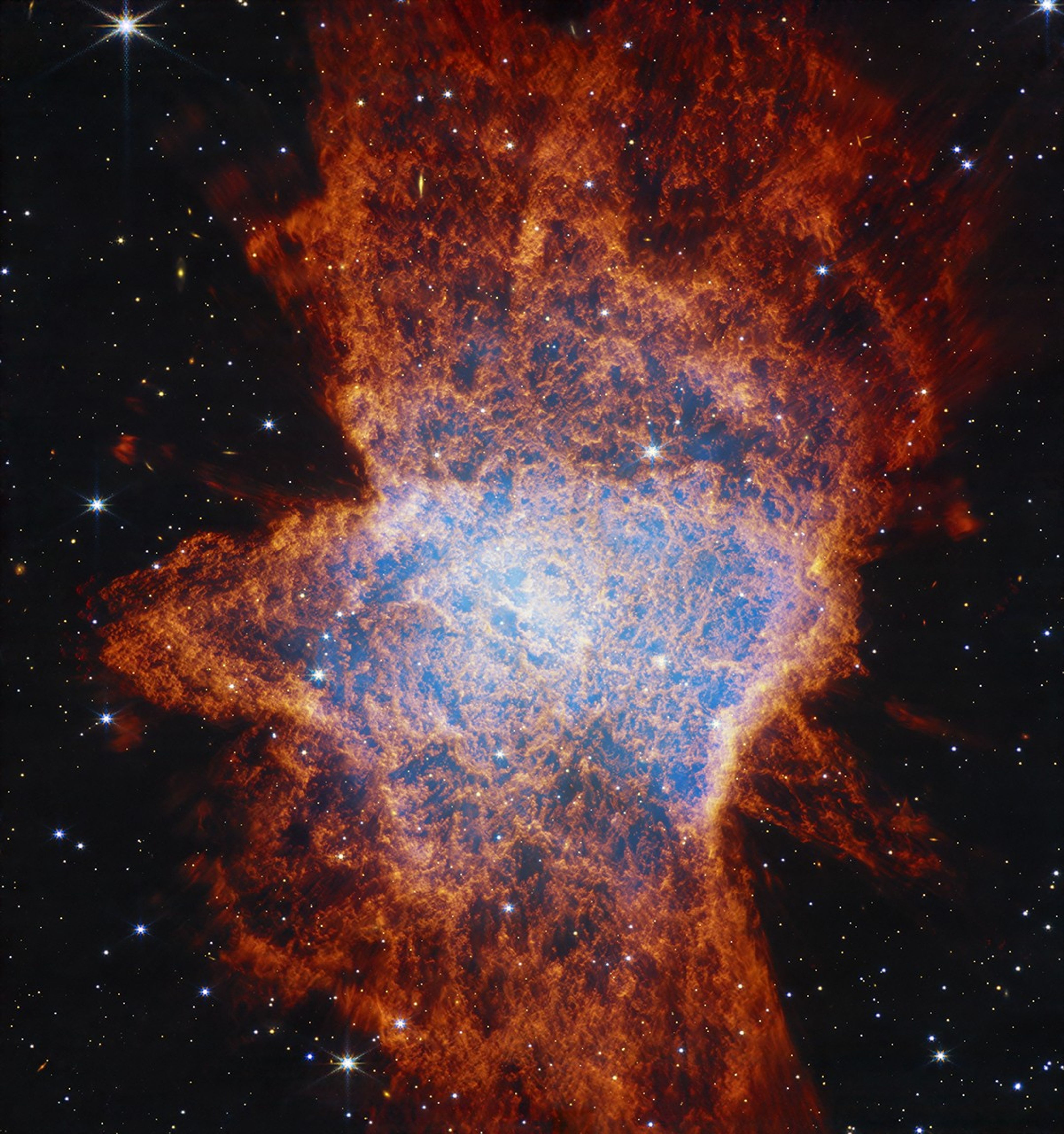
Cool image time! The picture to the right, reduced and sharpened to post here, was released today by the science team of the Webb Space Telescope, showing the planetary nebula NGC 6072 in infrared false color.

This particular image was one of two taken by Webb, and looked at the nebula in the near infrared.

[I]t’s readily apparent that this nebula is multi-polar. This means there are several different elliptical outflows jetting out either way from the center, one from 11 o’clock to 5 o’clock, another from 1 o’clock to 7 o’clock, and possibly a third from 12 o’clock to 6 o’clock. The outflows may compress material as they go, resulting in a disk seen perpendicular to it. Astronomers say this is evidence that there are likely at least two stars at the center of this scene. Specifically, a companion star is interacting with an aging star that had already begun to shed some of its outer layers of gas and dust.

The central region of the planetary nebula glows from the hot stellar core, seen as a light blue hue in near-infrared light. The dark orange material, which is made up of gas and dust, follows pockets or open areas that appear dark blue. This clumpiness could be created when dense molecular clouds formed while being shielded from hot radiation from the central star. There could also be a time element at play. Over thousands of years, inner fast winds could be ploughing through the halo cast off from the main star when it first started to lose mass.

The second image, taken in the mid-infrared, shows expanding dust shells, with some forming an encircling ring around the central nebula.

It is believed that the two stars at the center of this nebula act to churn the expanding material to form this complex shape. Imagine them functioning almost like the blades in a blender.

0 comments

Next Starship moves to launchpad for static fire testing

SpaceX has now finished work adapting the Boca Chica launchpad for Starship and has installed the next Starship prototype there for static fire testing prior to the tenth orbital test flight expected in the next few weeks.

The pad is normally configured for Superheavy. SpaceX engineers have quickly jury-rigged it to fit Starship to it for static fire tests because the normal Massey test stand was badly damaged in an explosion during static fire tests of the previous prototype in June.

With this setup, SpaceX is going to be able to static fire a ship on Pad 1 (A). SpaceX will likely do some quick pressure and leak checks; however, no tanking tests appear to be planned. SpaceX seems confident enough in this setup that crews are aiming for a static fire on Wednesday, July 30, and a second static fire on Thursday, July 31. Both of these days have testing closures set for 7 am – 7 pm CDT.

If these go as planned and there are no issues, which, considering how makeshift this setup is, would be a massive achievement. Once its engine testing is completed, SpaceX will roll Ship 37 back to Mega Bay 2 for final work and return the pad to launch configuration; this process could take approximately two weeks.

The company will then do its standard static fire tests of Superheavy, stack Starship on top, and be ready for launch, hopefully by mid- to late August.

This Starship is one of the last two version-2 Starships being prepped for test flights. After they have flown, the company will move to version-3, which hopefully will have a better flight success record than version-2.

1 comment

Thales Alenia ships the orbit insertion module for the Mars sample return mission

Though the entire project remains in limbo at NASA and might be cancelled, the European aerospace company Thales Alenia this week completed construction of the orbit insertion module for the Mars sample return mission that will place the orbiter — also built by European companies — in Mars orbit and will eventually bring the samples back to Earth.

On 28 July, Thales Alenia Space announced that the module had passed its test campaign with “excellent results.” According to the update, the company had packed and shipped the Orbit Insertion Module from its Turin facilities to Airbus in Stevenage a few days earlier. The delivery marks a key milestone in the development of the Mars Return Orbiter.

The broader Earth Return Orbiter project passed a key milestone in July 2024 with the completion of the Platform Critical Design Review. This review confirmed the performance, quality, and reliability of the mission’s systems. With its successful conclusion, Airbus advanced to full spacecraft development, including the integration and testing of its various components, among them the Orbit Insertion Module.

Under the project’s present very complex design, NASA is supposed to provide the ascent rocket and capsule to bring the samples to Europe’s return orbiter. At the moment it is unclear who will build this, or even if it will ever get built. Thus, Europe might be building a very expensive Mars orbiter with no clear mission.

4 comments

Firefly wins new NASA lunar lander contract, worth $176.7 million

NASA announced yesterday that it has awarded Firefly a $176.7 million contract to use the company’s Blue Ghost lunar lander to deliver two rovers and three other science instruments to the Moon’s south pole region.

Under the new CLPS task order, Firefly is tasked with delivering end-to-end payload services to the lunar surface, with a period of performance from Tuesday to March 29, 2030. The company’s lunar lander is targeted to land at the Moon’s South Pole region in 2029.

This is Firefly’s fifth task order award and fourth lunar mission through CLPS. Firefly’s first delivery successfully landed on the Moon’s near side in March 2025 with 10 NASA payloads. The company’s second mission, targeting a launch in 2026, includes a lunar orbit drop-off of a satellite combined with a delivery to the lunar surface on the far side. Firefly’s third lunar mission will target landing in the Gruithuisen Domes on the near side of the Moon in 2028, delivering six experiments to study that enigmatic lunar volcanic terrain.

One of the rovers is being built in partnership with Canada.

2 comments

Gilmour’s first launch a failure

Eris rocket launch and failure
Click for video, cued to just before launch.

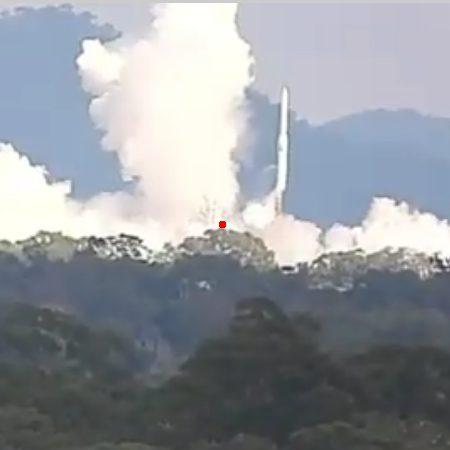
The first launch of the Australian rocket startup Gilmour Space’s Eris rocket ended in failure today when the rocket started drifting sideways after rising about 150 feet and then crashing near the launchpad.

The picture to the right is a screen capture from an independent live steam of the launch posted on youtube by Aussienaut, captured about 20 seconds after liftoff. The red dot indicates the location of the launchpad where the rocket took off to make clear the rocket’s sideways motion. Ten seconds after this, the rocket fell to the ground and exploded.

This launch attempt was the first ever by a private commercial Australian rocket company, so the failure itself is not surprising. It was also the first orbital test launch from a privately owned Australian spaceport. Whether the company has the resources to recover remains to be seen, but I suspect it will try again.

6 comments

Starlab partners with the interior design company Journey

Starlab design in 2025
The Starlab design in 2025. Click
for original image.

The consortium designing the commercial Starlab space station has now signed a partnership deal with the interior design company Journey for the latter to design the station’s habitable interior.

Journey brings a deep portfolio of globally recognized projects, including the Sphere in Las Vegas, the Empire State Building observatory in New York City and the Sun Princess Dome for Princess Cruises. The agency will be working closely with Hilton, one of the original strategic partners in the Starlab program, designing the Starlab hospitality and crew experience. Journey’s role adds a vital layer of design and experiential innovation, shaping a space that reflects both function and humanity.

Much of the press release is similar blather. It is good that Starlab is thinking about making the living space in its station “both a cutting-edge research platform and a welcoming, livable habitat,” but this deal doesn’t include any actual design work. Apparently nothing concrete will be done until Starlab wins the big NASA construction project — assuming it does so. Thus, I still rank Starlab low in my rankings of the four commercials stations being built or proposed, but this deal has convinced me to raise its ranking above Orbital Reef. Both have built little, but Starlab is at least making a lot of partnership deals with others, strengthening the quality of its team.

  • Haven-1, being built by Vast, with no NASA funds. The company is moving fast, with Haven-1 to launch and be occupied in 2026 for an estimated 30 days total. It hopes this actual hardware and manned mission will put it in the lead to win NASA’s phase 2 contract, from which it will build its much larger mult-module Haven-2 station..
  • Axiom, being built by Axiom, has launched four tourist flights to ISS, with the fourth carrying government passengers from India, Hungary, and Poland. Though there have been rumors it has cash flow issues, development of its first module has been proceeding more or less as planned.
  • Starlab, being built by a consortium led by Voyager Space, Airbus, and Northrop Grumman, with an extensive partnership agreements with the European Space Agency and others. It recently had its station design approved by NASA, but it has built nothing. The company however has now raised $383 million in a public stock offering, which in addition to the $217.5 million provided by NASA gives it the capital to begin some construction.
  • Orbital Reef, being built by a consortium led by Blue Origin and Sierra Space. Overall, Blue Origin has built almost nothing, while Sierra Space has successfully tested its inflatable modules, including a full scale version, and appears ready to start building its module for launch.

Hat tip to BtB’s stringer Jay.

1 comment
1 61 62 63 64 65 822