Trump picks oil industry ally and global warming skeptic for EPA

President-elect Donald Trump has chosen Oklahoma’s Attorney General, Scott Pruitt, to run the EPA.

An ally to the fossil fuel industry, Pruitt has aggressively fought against environmental regulations, becoming one of a number of attorneys general to craft a 28-state lawsuit against the Obama administration’s rules to curb carbon emissions. The case is currently awaiting a decision from the United States Court of Appeals for the District of Columbia, which heard oral arguments in September.

Pruitt, who questions the impact of climate change, along with Alabama Attorney General Luther Strange, penned an op-ed in the Tulsa World earlier this year that called criticism they’ve received “un-American.” “Healthy debate is the lifeblood of American democracy, and global warming has inspired one of the major policy debates of our time,” states the op-ed. “That debate is far from settled. Scientists continue to disagree about the degree and extent of global warming and its connection to the actions of mankind… Dissent is not a crime.”

Not surprisingly, environmentalists have already begun the campaign to destroy him, based on the quotes at the link.

4 comments

Republican Congress passes National Park bill that raises fees

More bull from the House Republicans: In an effort to fix budget problems at the National Park Service, caused by years of Congressional and Presidential budget malfeasance, the lame-duck Republican-run House today passed a bill that would raise the lifetime fees for a park senior pass.

The House of Representatives moved quickly Tuesday to pass legislation designed to provide the National Park Service with badly needed funds to help the agency chip away at a staggering $12 billion maintenance backlog. However, without concurrence by the Senate by week’s end, the measure could die.

As passed by the House, the National Park Service Centennial Act would increase the price of a lifetime pass for senior citizens 62 and older to $80 from its current $10 lifetime fee. Seniors who don’t want to pay the $80 could purchase an annual pass for $20. Park Service staff estimate that the increase in the cost of a senior pass would generate $20 million a year.

It appears that already purchased lifetime passes would still be valid, though I am willing to bet that, given time, these bastards will change that as well. What really annoys me about this is that the reason the Park Service is short of funds is not really because they don’t have enough money. The budget isn’t really any smaller than it’s been for decades. The reason it is short of money is that the federal government, and the Park Service, wastes enormous amounts on things that are not essential, on pork (such as dozens and dozens of tiny park facilities spread throughout the country that are really outside the Park Service’s original purpose and exist mostly because some elected official pushed for their creation).

What these idiots never do is find ways to reduce or rearrange spending to pay for things that are important. Instead, they constantly work to suck more money from the taxpayer, endlessly. And they wonder why they got Trump.

4 comments

Sunspot activity continues to drop

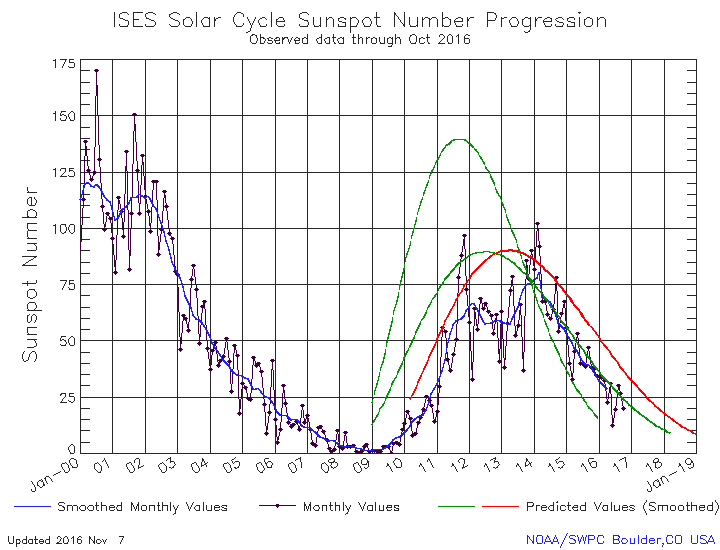
NOAA yesterday posted its monthly update of the solar cycle, covering sunspot activity for November. Below is my monthly annotated version of that update.

November 2016 Solar Cycle graph

The graph above has been modified to show the predictions of the solar science community. The green curves show the community’s two original predictions from April 2007, with half the scientists predicting a very strong maximum and half predicting a weak one. The red curve is their revised May 2009 prediction.

In November sunspot activity dropped again, to the second lowest point seen since 2010. Essentially, activity today is about where it was in 2010 when the solar minimum was finally ending. Now, the solar maximum is ending and we are beginning the next solar minimum.

Throughout the entire just completed solar maximum, the Sun continuously under-performed all predictions. Even now, despite following almost precisely the prediction of the 2007 low prediction during 2014 and 2015, in 2016 the ramp down has begun to slip below that prediction. The trend continues to suggest the arrival of solar minimum will be early, possibly as early as sometime late next year.

2 comments

NASA global warming advocate Gavin Schmidt fights back

The head of NASA’s Goddard Institute of Space Studies (GISS), Gavin Schmidt, declared in a newspaper interview on Thursday that “Global warming doesn’t care about the election.”

The science community and environmental campaigners in the US have already begun efforts to persuade Mr Trump that climate change is actually real before he takes office next year. Dr Gavin Schmidt, the director of Nasa’s Goddard Institute for Space Studies, signalled they would have allies among the federal science agencies. He tweeted a graph including new data from Nasa showing that last month was the second warmest October on record, putting 2016 firmly on course to be the warmest year. “No surprise here, planetary warming does not care about the election,” he wrote.

I would not be surprised if Schmidt ends up getting fired by Trump. His monthly graphs showing each month to be the hottest on record, such as the one he tweeted in the quote above, have been absurd campaigning, not science. For one thing, the differences from month to month have been in the hundredths of a degrees, well within the margins of error and essentially insignificant in value. To claim that his data has determined the “hottest” month on record from this is demonstrating that he is not a scientist, but a political activist.

Gavin Schmidt vs the satellite data

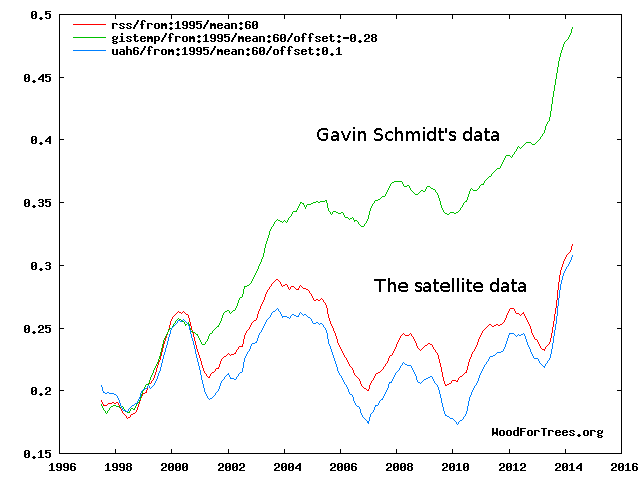
Secondly, his data is not trustworthy to begin with. Schmidt has been in charge of all of the data tampering at NASA that has consistently altered the decades-old surface temperature record — without any clear scientific justification — to cool the past and warm the present so that the amount of warming is emphasized. While his graphs show the climate to be warming, based on surface data that he has been adjusting, the satellite data that NASA gathers that he (a NASA scientist) generally ignores, does not. The image to the right illustrates this, and shows that the divergence between his adjusted surface data and the satellite data has been increasing steadily over the years.

I fully expect Schmidt and the other global warming scientists in NASA and NOAA to team up with the press, as Schmidt does here, to defy Trump. Whether Trump will have the courage to fight back, something no Republican has been willing to do for decades, will be the key question.

8 comments

The pushback against Trump begins

Articles today in the science journals Science and Nature give us a taste of the upcoming resistance by the science community to any policy changes put forth by the new Trump administration.

Both articles assume that the Paris climate agreement is already the law of the land, despite the basic fact that the Senate has not approved it. In fact, if Trump and Congress decide to cut all American ties with it, they can. Right now it is merely something that Obama has agreed to, and under our Constitution, the legalities binding us to that agreement are weak, at best.

This quote from the Science article outlines how the science community plans to structure its resistance:

With oilmen like Harold Hamm, CEO of Continental Resources, and Forrest Lucas, the founder of Lucas Oil, named as potential candidates to lead the Departments of Energy and the Interior, respectively, in a Trump administration, the mostly likely historical analogue for the next few years could be the start of Ronald Reagan’s presidency, when he appointed senior officials who were often hostile to the policies of their own agencies. For example, Reagan’s Secretary of the Interior, James Watt, wanted to sell off public lands and reduce forest protections, and his EPA head, Anne Gorsuch, moved to soften clear air and water rules. Some agency staff fought back, and there were frequent leaks, resignations, and lawsuits. Both Watt and Gorsuch ultimately resigned amidst political chaos, and were replaced by less polarizing appointments. If Trump follows a similar path, “there could be a whole lot of churn,” Victor predicts.

Indeed, Trump may quickly learn the limits of the presidency, Victor adds. “The Oval Office will be a lonely place,” he says, if the White House attempts to make radical changes that agency professional staff fiercely opposes. [emphasis mine]

And then there is this quote from the Nature article:

“Trump will be the first anti-science president we have ever had,” says Michael Lubell, director of public affairs for the American Physical Society in Washington DC. “The consequences are going to be very, very severe.”

Calling Trump “the first anti-science president” is the kind of name-calling that is typical of the left and the Democratic Party. Not only is it a silly statement, based merely on the partisan hatred of Republicans by scientists, almost all of whom are Democratic Party loyalists, it has nothing to do with reality. Scientists have no more right to a blank check from the government than anyone else. They need to justify their research, and show that it is worthwhile. Since the 1990s they have not had to do this, which has resulted in blooming budgets and a lot of questionable results. And I say this as a science guy. Unlike these partisans, however, I also recognize that there is a gigantic amount of needless spending in the science budgets of numerous government agencies. Their budgets have grown significantly since 2000, with little to show for it. It is time to bring that spending under some control.

This is only the first shot across the bow. I have no doubt that the science community plans to link up with the partisan mainstream press to create a full-court press against any policy changes or budget cuts that either Trump or Congress may propose. These people do not respect the concept of democracy, and will resist the will of the public in every way they can.

5 comments

Decline in sunspots continues

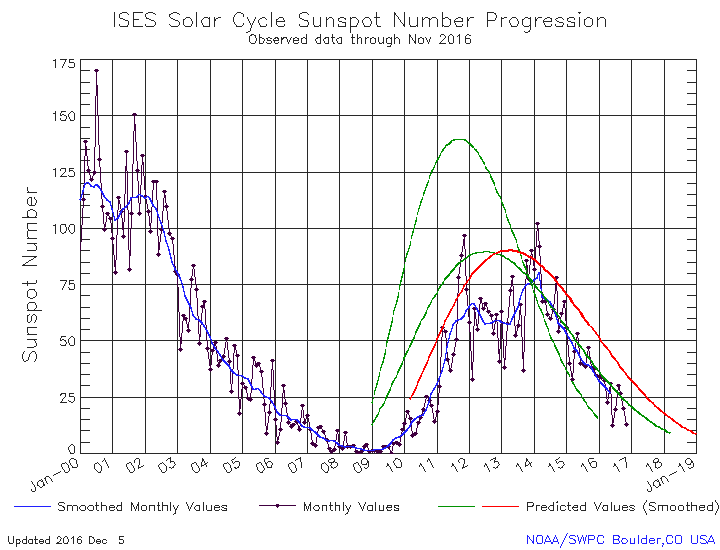
Late Sunday NOAA posted its monthly update of the solar cycle, covering sunspot activity for October. As I do every month, I am posting it here with annotations to give it context.

October 2016 Solar Cycle graph

The graph above has been modified to show the predictions of the solar science community. The green curves show the community’s two original predictions from April 2007, with half the scientists predicting a very strong maximum and half predicting a weak one. The red curve is their revised May 2009 prediction.

The sunspot decline continued in October, dropping the sunspot number for the month to below the 2007 low prediction. Though the decline continues to track that low prediction, the sunspot count for November has been even lower, suggesting that the ramp down to solar minimum will continue to under perform that prediction and will arrive at minimum sooner than expected. As I noted last month, this fast decline will also mean that the ending solar cycle will be a both a weak and a short cycle, two phenomenon that in the past never went together. In the past, a short cycle meant the maximum was strong, while a long cycle would correspond with a weak maximum.

The Sun continues to behave in a manner that is unprecedented, and suggests the possibility that a Grand Minimum might be coming.

1 comment

More climate fear-mongering

This article from the journal Nature yesterday, Climate change could flip Mediterranean lands to desert, about a new Science journal paper, is very typical of too much of the climate research and reporting these days.

First, they outline the coming and certain disaster:

Maintaining the historic ranges of the region’s ecosystems would require limiting warming to just 1.5 ºC, by making substantial cuts to the world’s greenhouse-gas emissions, the analysis concludes. Otherwise, the vegetation and ecosystems of the Mediterranean basin will shift as temperatures rise. Increasing desertification in southern Europe is just one of the changes that would result. “Everything is moving in parallel. Shrubby vegetation will move into the deciduous forests, while the forests move to higher elevation in the mountains,” says Joel Guiot, a palaeoclimatologist at the European Centre for Geoscience Research and Education in Aix-en-Provence, France, and lead author of the study.

Then they point out the necessary political solution, which of course requires us to agree to an odious international agreement that will limit our individual freedoms and give more power to international governments:

“I like that they’re doing this comparison across different warming scenarios in line with the Paris agreement, to start to gauge the sensitivity to them,” says Benjamin Cook, a climate scientist at the NASA Goddard Institute for Space Studies in New York City. The study confirms the vulnerability of many ecosystems, and could guide policymakers’ efforts to help natural systems adapt to climate change, says Patrick Gonzalez, principal climate-change scientist at the US National Park Service based at the University of California, Berkeley. “This study shows how essential it is for nations to meet their Paris commitments.”

Only at the very end of the article, almost as an aside, do they note these inconvenient facts about the limitations of the paper (which also happens to be based entirely on computer models):
» Read more

1 comment

London university pockets millions for fake global warming research

Follow the money: The research center at a major London university has obtained millions in government grants for global warming research it did not do.

A global warming research center at the London School of Economics got millions of dollars from UK taxpayers by taking credit for research it didn’t perform, an investigation by The Daily Mail revealed. The UK government gave $11 million dollars to the Centre for Climate Change Economics and Policy (CCCEP) in exchange for research that the organization reportedly never actually did.

Many papers CCCEP claimed to have published to get government money weren’t about global warming, were written before the organization was even founded, or were written by researchers unaffiliated with CCCEP. The government never checked CCCEP’s supposed publication lists, saying they were “taken on trust,” according to the report. “It is serious misconduct to claim credit for a paper you haven’t supported, and it’s fraud to use that in a bid to renew a grant,” Professor Richard Tol, a climate economics expert from Sussex University whose research was reportedly stolen by CCCEP, told The Daily Mail. “I’ve never come across anything like it before. It stinks.”

The crime here is not just the fraud committed by the research center. The negligence of the government in handing out these grants without doing any due diligence is equally criminal. And I am being kind. I suspect that it wasn’t negligence but straightforward corruption. I think these grants were likely given for political reasons. Rather than fund real research, the money was intentionally handed out to political supporters in order to advocate global warming politics.

7 comments

Big warming, or no warming, depending on dataset

The uncertainty of science: Depending on the dataset, the most up-to-date climate data now shows either no warming since 1993, no warming since 1996, or significant warming continuously since then.

On several different data sets, there has been no statistically significant warming for between 0 and 23 years…. Cl stands for the confidence limits at the 95% level.

The details for several sets are below.

  • For UAH6.0: Since August 1993: Cl from -0.006 to 1.810. This is 23 years and 1 month.
  • For RSS: Since December 1993: Cl from -0.008 to 1.746. This is 22 years and 9 months.
  • For Hadsst3: Since December 1996: Cl from -0.022 to 2.162 This is 19 years and 9 months.
  • For Hadcrut4.4: The warming is statistically significant for all periods above three years.
  • For GISS: The warming is statistically significant for all periods above three years.

The quote above lists all the major climate datasets that everyone in the climate field uses. I’ve rearranged the order from the original to put similar datasets together and thus make it easier to digest the information.

The first two datasets are from satellite data. The Hadcrut datasets both use historical ground and sea surface temperature records and are both produced by the Climate Research Unit headed by Phil Jones, who when other scientists asked him for his raw original data in order to check it admitted that he had lost it. Jones was also one of the scientists whose climategate emails revealed a desire to destroy the careers of any skeptics, prevent their work from being published, and an effort to conceal or change data that contradicted the theory of global warming. GISS is the Goddard Institute for Space Sciences, run for decades by global warming advocate James Hansen and now the source of today’s claims that every month of every year is the hottest ever recorded. GISS is also the NASA institute that has been adjusting past datasets to cool the past and warm the present, thus creating a significantly steeper rise in global temperature than is shown by the original raw data.

Of these datasets, three show no significant warming in the past two decades, while two show significant warming. Which is it? Your guess is as good as mine. However, I must point out that the two datasets that show statistically significant warming have both come under question in the past few years because of questionable science practices, which from my perspective makes their conclusions suspect.

Regardless, even if we accept all of these datasets as completely sincere and honestly obtained, they still are in conflict with each other. Under any reasonably scientific analysis, this tells us that the science here is definitely not settled, and that a lot more work needs to be done before anyone can hazard a guess as to what’s going on with the climate.

11 comments

Federal agencies question establishment of SpaceX spaceport and three liquefied natural gas plants in Brownsville

Two federal agencies are questioning the safety of establishing three liquefied natural gas (LNG) plants near SpaceX’s new spaceport in Boca Chica, Texas.

The Federal Energy Regulatory Commission is reviewing the applications for the LNG export terminals, which plan to take natural gas from the Eagle Ford south of San Antonio, liquefy it and export the LNG to overseas customers.

The Federal Aviation Administration hosted an Aug. 18 meeting to discuss space launch activities near the proposed LNG facilities, according to a FERC filing released on Thursday. During the meeting, FAA officials discussed their role and regulations regarding commercial space launches, as well as the agency’s licensing and public safety requirements prior to the launch of any future mission.

While it makes perfect sense to keep a rocket launchpad safely away from large amounts of liquefied natural gas, I found the article’s concluding paragraphs to be most revealing:

Meanwhile, environmentalists, who were critical of the SpaceX project and oppose the LNG plants, said the launch site is too close to the proposed export terminals. “This announcement should be a wake-up call and warning that putting LNG terminals within six miles of the SpaceX launch site is a bad idea,” Lower Rio Grande Valley Sierra Club Chair Jim Chapman told the Business Journal. “Furthermore, Annova LNG wants to put its facility within the SpaceX launch closure area. You don’t have to be a rocket scientist to know that idea won’t fly.” [emphasis mine]

Note how the environmentalists are essentially against everything. They really aren’t opposed to having these two facilities being placed too close to each other, what they really want is that nothing gets built at all. Most instructive.

1 comment

Suspicious climate data manipulation at NASA

The uncertainty of modern climate science isn’t merely because of the overall complexity of the data and the climate. Though there are numerous factors that contribute to the long term fluctuations of the climate that we do not yet completely understand or can quantify with any precision (the sun, dust, soot, volcanoes, carbon dioxide increase, to name just a few), there is a more tragic uncertainty that global warming scientists at NASA and NOAA have added to the mix, one that is entirely unjustified and harmful to the field of science and the questions that it is trying to answer.

In the case of this post, that tragic uncertainty has to do with sea level rise and the “adjustments,” without explanation, that NASA is making to its sea level data. Below is a graph taken from the link, showing the changes that have been made to published data from 1982 in order to eliminate a long period of almost no sea level rise from the mid 1950s through 1980.
» Read more

28 comments
1 26 27 28 29 30 82