Europe approves construction of giant telescope

Europe has approved the construction of the European Extremely Large Telescope (E-ELT), which when completed will be the largest ground-based telescope.

The E-ELT will have a mirror 39 meters across, almost four times bigger than the world’s largest telescope today.

A word to the wise: This very month Sky & Telescope’s cover article, written by yours truly, describes the many difficulties the world’s present generation of giant telescopes have faced. Four out of five have not produced the science promised. Two of the four were dogged by so many technical problems that they required complete reconstruction. The builders of E-ELT will face even greater engineering challenges. Do not be surprised if this telescope does not get completed by 2025 as promised, and even if it does, do not be surprised if it takes another half decade or more before the engineers work out all the kinks.

0 comments

Europe agrees to build Ariane 6

The heat of competition: Faced with a stiff challenge from SpaceX, the European partners in Arianespace have worked out a deal to replace the Ariane 5 rocket with Ariane 6.

The official announcement will be made in next few days, but with Germany agreeing to the French proposal, the partnership can now proceed.

The result will be a government rocket which will likely only launch government payloads, since it will likely also cost too much to compete with SpaceX and the other new lower cost commercial companies like Stratolaunch, now developing in the U.S.

3 comments

Italy’s legislature rejects additional funding for space

The Italian legislature has refused to add an additional $250 million to the budget of its space program, money requested to help pay the country’s share in the development of Arianespace’s next generation commercial rocket, Ariane 6.

The money was also needed for several other ESA space projects. Not having it puts a question mark on Italy’s future in space. The article also illustrates how the committee nature of Europe’s cooperative space effort makes it almost impossible for it to compete in the commercial market.

5 comments

SpaceX vs Arianespace, according to the TV industry

The heat of competition: A television industry trade journal looks at Arianespace’s future plans and finds them wanting, when compared to SpaceX.

Compare that [SpaceX’s] success with the money that’s been poured into Arianespace, and the lack of progress (perhaps wholly understandable when being managed by a Euro-committee!). Ariane’s mid-way ME version (for Midlife Extension) has been on the drawing board since 1995. And at a considerable investment, and for an initial scheduled flight of only 2017-2018.

The Ariane-62/64 concept calls for as much of the “ME” design to be incorporated into the 62/64 versions. But the planned launch of the first A-62 is not for some time; some observers suggest at best 2021-22. That’s more than 20 years of planning, development and immense costs.

Read the whole thing. It illustrates the almost impossible challenge faced by Arianespace — a company designed by a committee of nations and run to distribute funding as widely as possible to those nations. For that company to successfully reshape its approach quickly so that it can successfully compete with SpaceX seems quite unlikely, and will likely result in Arianespace evolving into Europe’s government launch service, with the commercial market shifting back to the U.S.

0 comments

The November 12 timeline of events for Philae’s landing on a comet

ESA has released a detailed timeline of events on November 11-12, when Rosetta’s Philae lander will be released and land on Comet 67P/C-G. They have also released a much more readable summary of the most critical events, describing what will be happening.

For Americans, these events will be occurring from around 3 pm (Eastern) November 11, when the process begins, to 12 pm (Eastern) November 12, when Philae will send back the first signals after landing. Much of the most critical events will take place in the wee hours of the morning.

Meanwhile, one of Rosetta’s instruments has confirmed the presence of water vapor and carbon dioxide in the jets seen near the comet’s narrow neck.

0 comments

Controversy surrounding IXV flight cancellation

Italian officials are suggesting politics or incompetence for the sudden cancellation Wednesday of the November test flight of Europe’s IXV experimental spaceplane.

ESA and CNES officials up to now have either declined to comment or, in the case of ESA, said they were at a loss to explain why a program whose mission profile has not changed in several years is now suddenly stalled for [range] safety issues that in principle should have been aired and resolved long ago.

One official, saying he could not believe that the two agencies simply forgot to evaluate the safety issues, said he preferred to suspect political motives. “Look, we are about to send a spacecraft and lander to Mars, in one year,” this official said. “Europe has rendezvoused with a comet a decade after the [Rosetta comet-chaser] satellite was launched. You want me to believe that somehow the agencies just forgot to evaluate safety? That is too far-fetched. I would rather believe there is some political motive.”

The claim is that no one ever evaluated the range issues in sending the Vega rocket to the east instead of its normal polar orbit trajectory. The Italian officials are suggesting that either the officials who cancelled the mission are incompetent, or that their competition with France within ESA over launch vehicles (Ariane 6 vs Vega) prompted the cancellation.

Europe’s lead launch-vehicle nation is France, which initially balked at participating in the Vega program. A French minister said that in Europe, launch vehicles are French. The French government declined to allow the export, to Italy, of the avionics suite that guides Vega, forcing Italy to develop its own. Italy has since done so and successfully flown it on Vega. As it stands now, one official said, France must accept the idea that with Vega, Italy has led development of a vehicle that at least in principle resembles an intercontinental ballistic missile. “Some people don’t like that,” this official said.

Either way, this cancellation combined with the difficult and extended disagreements within ESA over replacing Ariane 5 suggest that the future of this European partnership is becoming increasingly shaky.

0 comments

Test flight of European space plane delayed

The November suborbital test flight of Europe’s Intermediate eXperimental Vehicle (IXV) has been delayed to allow additional preparation.

For this mission, instead of heading north into a polar orbit, as on previous flights, Vega will head eastwards to release the spaceplane into a suborbital path reaching all the way to the Pacific Ocean to test new technologies for future autonomous controlled reentry for return missions. This trajectory is unprecedented for Vega and therefore more information is being generated on the performance of the launch vehicle, should an anomaly occur after liftoff.

ESA will not only be testing the flight characteristics of the space plane, they will be testing their new Vega rocket, which has only been launched a handful of times.

0 comments

More quality control problems in Russia

The investigation into the failure of a Russian Soyuz rocket to place two European Galileo GPS satellites into the correct orbit has found that it was caused by the faulty installation of fuel lines on the Fregat upper stage.

The failure was as simple as clamping together a cold helium line with the hydrazine fuel line, causing the hydrazine to freeze long enough to upset the Fregat stage’s orientation and cause the two satellites’ release into an orbit that is both too low and in the wrong inclination, officials said. One official said the Euro-Russian board of inquiry into the failure discovered that one in four Fregat upper stages at prime contractor Moscow-based NPO Lavochkin had the same faulty installation. ,,,,

Government and officials said the commission is debating how to proceed now that it knows that, as expected, the Fregat failure was not one of design, but of assembly and quality control. [emphasis mine]

In other words, 1 in 4 Fregat upper stations were routinely assembled improperly and no one noticed. The investigation also found that this assembly problem had existed on several past launches but because of the orbital requirements it had fortunately not caused any problems.

I want to emphasize that these kind of sloppy assembly issues have been occurring at a number of different Russian factories and different Russian companies. It seems to be systemic to the entire Russian aerospace industry, and it also appears to be getting worse.

3 comments

Europe struggles to contain costs on its next generation rocket

New budget estimates for replacing Arianespace’s Ariane 5 rocket now say that they will have to include the construction of an entirely new launchpad, raising costs.

Nonetheless, Europe is trying to keep its per launch cost down and competitive.

ESA and the Airbus-Safran joint venture that proposes to manage Ariane development also floated per-launch costs that were lower than previous estimates. The lighter-version Ariane 62, with two solid-rocket boosters, could be built for as little as 65 million euros assuming a nine-per-year launch rhythm, officials said. The heavier Ariane 64, intended mainly for the commercial market and capable of carrying two satellites weighing a combined 11,000 kilograms into geostationary transfer orbit, could be built for 85 million euros each, again assuming a nine-per-year production rate.

These numbers are tiny compared to what they have charged in the past, and though higher than SpaceX’s, are within a price range that will keep them in business, assuming they can achieve them.

0 comments

Philae’s mission at Comet 67P/C-G

With the decision to pick a landing site for their Philae lander coming up this weekend, the Rosetta science team today released a press announcement describing in detail the lander’s mission.

The details are fascinating. Not only will Philae take images from the surface as well as get data of the surface and its surrounding environment, the probe will also literally pound the surface to measure its temperature as well as get seismic readings.

The MUPUS hammer is released and embeds itself into the ground so that it can measure the temperature at various depths in the subsurface. The acoustic signals of the vibrations of the hammer action will be detected by acoustic sensors in the feet of SESAME/CASSE and will be used to measure the mechanical properties of the nucleus.

If all goes well, they hope that Philae will remain operational on the surface through March.

2 comments

Indecision in Europe about their future commercial rocket

The competition is burning them up! With Germany and France unable to come to an agreement about the next Arianespace commercial rocket, the company is considering cancelling a December conference that was supposed to settle the issue.

The basic division remains despite the German government’s alignment with the French view that Europe needs a lower-cost rocket to maintain its viability in the commercial market — which in turn provides European governments with a viable launch industry.

Despite the consensus over the longer term, the two sides remain split on whether European Space Agency governments should spend 1.2 billion euros ($1.6 billion) to complete work on a new upper stage for the existing Ariane 5 rocket, which could fly in 2018-2019, or abandon the upgrade to focus spending on a new Ariane 6 rocket, whose development would cost upwards of 3 billion euros over 7-8 years. [emphasis mine]

Though SpaceX is not mentioned in this particular article, numerous previous articles on this subject (such as this one) have made it very clear that it is SpaceX’s low prices that are driving the need for Arianespace to cut costs. The problem, as this article makes very clear, is that Arianespace’s partners can’t figure out how to do it, at least in a manner that will still provide them all an acceptable share in the pie. The result might be that the entire partnership falls apart.

2 comments

Rosetta’s camera zooms in

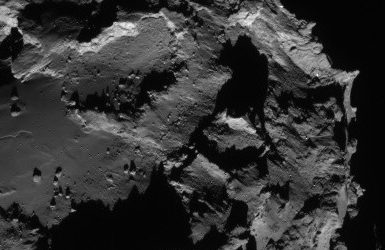
67P/C-G on August 23, 2014
Comet 67P/C-G as seen on August 23, 2014 from 38 miles.
Click on image for uncropped version.

The Rosetta team has begun releasing more close-up images of Comet 67P/C-G taken by the spacecraft. The image to the right was taken by the navigation camera, but rather than capture the entire nucleus in a single image the camera is now zoomed in and taking a mosaic of four images. This picture is one quarter of that mosaic.

Note the boulders and the sharp peaks in the image. The boulders are important to map for planning Philae’s landing site. The sharp peaks suggest recent outgassing.

0 comments

Arianespace and ESA sign contract for three launches

Arianespace and the European Space Agency (ESA) signed a contract on Thursday for the Ariane 5 rocket to launch 12 more of Europe’s Galileo GPS satellites on three launches.

This contract is a perfect example of European pork. Europe’s Galileo system might provide competition to the U.S. GPS and Russian Glonass systems, but I am not sure what additional capabilities it provides that will convince GPS users to switch to it. Instead, building it provides European jobs, while using the Ariane 5 rocket to launch it gives that increasingly uncompetitive rocket some work to do. In fact, this situation really reminds me of the U.S. launch market in the 1990s, when Boeing and Lockheed Martin decided that, rather than compete with Russia and ESA for the launch market, they instead decided to rely entirely on U.S. government contracts, since those contracts didn’t really demand that they reduce their costs significantly to compete.

Europe now appears to be heading down that same road.

1 comment

NASA admits that it is struggling to meet the 2017 launch date for SLS

Delays in the construction of Orion’s European-built service module as well as cracks in the spacecraft’s heat shield are threatening the planned 2017 launch date for Orion’s first test flight, unmanned, beyond Earth orbit.

Note that this program, costing anywhere from $10 to $20 billion, is only building a handful of capsules for flying three or four test flights. Beyond that, there is no money.

I have predicted this before, and I will predict it again: SLS will never take any humans anywhere. The cost is too high, the bureaucracy too complex, and the schedule is too slow. It will vanish when the new private companies begin flying humans into space in the next three years.

4 comments

ExoMars will likely miss 2018 launch date

Because of technical and financial issues the European/Russian ExoMars rover mission is expected to miss its 2018 launch window.

The main reason for the delay would be the ExoMars’ brand-new landing system, which is designed to safely take the rover through a fiery descent in the Martian atmosphere and then softly land it on the surface of the Red Planet.

In addition to its late development start, the landing system has a complicated share of responsibilities between Russia and Europe, which greatly slows down the work. For example, the overall landing system is being developed by NPO Lavochkin in Moscow, while its parachute system will be provided by Europe. Many other aspects of the mission are similarly intertwined.

To further complicate matters, NPO Lavochkin, which traditionally builds all Russian planetary probes, but also some of the highly classified military satellites, is notorious for its Soviet-style secrecy. As a result, it is harder for the two sides to coordinate the work, Europeans sources said. Finally, the translation of documents between Russian and English further delays the work on the project.

The program is also significantly over budget.

1 comment
1 17 18 19 20 21 25