
Test flight of European space plane delayed

The November suborbital test flight of Europe’s Intermediate eXperimental Vehicle (IXV) has been delayed to allow additional preparation.

For this mission, instead of heading north into a polar orbit, as on previous flights, Vega will head eastwards to release the spaceplane into a suborbital path reaching all the way to the Pacific Ocean to test new technologies for future autonomous controlled reentry for return missions. This trajectory is unprecedented for Vega and therefore more information is being generated on the performance of the launch vehicle, should an anomaly occur after liftoff.

ESA will not only be testing the flight characteristics of the space plane, they will be testing their new Vega rocket, which has only been launched a handful of times.
0 comments

More quality control problems in Russia

The investigation into the failure of a Russian Soyuz rocket to place two European Galileo GPS satellites into the correct orbit has found that it was caused by the faulty installation of fuel lines on the Fregat upper stage.

The failure was as simple as clamping together a cold helium line with the hydrazine fuel line, causing the hydrazine to freeze long enough to upset the Fregat stageโ€™s orientation and cause the two satellitesโ€™ release into an orbit that is both too low and in the wrong inclination, officials said. One official said the Euro-Russian board of inquiry into the failure discovered that one in four Fregat upper stages at prime contractor Moscow-based NPO Lavochkin had the same faulty installation. ,,,,

Government and officials said the commission is debating how to proceed now that it knows that, as expected, the Fregat failure was not one of design, but of assembly and quality control. [emphasis mine]

In other words, 1 in 4 Fregat upper stations were routinely assembled improperly and no one noticed. The investigation also found that this assembly problem had existed on several past launches but because of the orbital requirements it had fortunately not caused any problems.

I want to emphasize that these kind of sloppy assembly issues have been occurring at a number of different Russian factories and different Russian companies. It seems to be systemic to the entire Russian aerospace industry, and it also appears to be getting worse.

3 comments

Europe struggles to contain costs on its next generation rocket

New budget estimates for replacing Arianespace’s Ariane 5 rocket now say that they will have to include the construction of an entirely new launchpad, raising costs.

Nonetheless, Europe is trying to keep its per launch cost down and competitive.

ESA and the Airbus-Safran joint venture that proposes to manage Ariane development also floated per-launch costs that were lower than previous estimates. The lighter-version Ariane 62, with two solid-rocket boosters, could be built for as little as 65 million euros assuming a nine-per-year launch rhythm, officials said. The heavier Ariane 64, intended mainly for the commercial market and capable of carrying two satellites weighing a combined 11,000 kilograms into geostationary transfer orbit, could be built for 85 million euros each, again assuming a nine-per-year production rate.

These numbers are tiny compared to what they have charged in the past, and though higher than SpaceX’s, are within a price range that will keep them in business, assuming they can achieve them.

0 comments

Philae’s mission at Comet 67P/C-G

With the decision to pick a landing site for their Philae lander coming up this weekend, the Rosetta science team today released a press announcement describing in detail the lander’s mission.

The details are fascinating. Not only will Philae take images from the surface as well as get data of the surface and its surrounding environment, the probe will also literally pound the surface to measure its temperature as well as get seismic readings.

The MUPUS hammer is released and embeds itself into the ground so that it can measure the temperature at various depths in the subsurface. The acoustic signals of the vibrations of the hammer action will be detected by acoustic sensors in the feet of SESAME/CASSE and will be used to measure the mechanical properties of the nucleus.

If all goes well, they hope that Philae will remain operational on the surface through March.

2 comments

Indecision in Europe about their future commercial rocket

The competition is burning them up! With Germany and France unable to come to an agreement about the next Arianespace commercial rocket, the company is considering cancelling a December conference that was supposed to settle the issue.

The basic division remains despite the German governmentโ€™s alignment with the French view that Europe needs a lower-cost rocket to maintain its viability in the commercial market โ€” which in turn provides European governments with a viable launch industry.

Despite the consensus over the longer term, the two sides remain split on whether European Space Agency governments should spend 1.2 billion euros ($1.6 billion) to complete work on a new upper stage for the existing Ariane 5 rocket, which could fly in 2018-2019, or abandon the upgrade to focus spending on a new Ariane 6 rocket, whose development would cost upwards of 3 billion euros over 7-8 years. [emphasis mine]

Though SpaceX is not mentioned in this particular article, numerous previous articles on this subject (such as this one) have made it very clear that it is SpaceX’s low prices that are driving the need for Arianespace to cut costs. The problem, as this article makes very clear, is that Arianespace’s partners can’t figure out how to do it, at least in a manner that will still provide them all an acceptable share in the pie. The result might be that the entire partnership falls apart.

2 comments

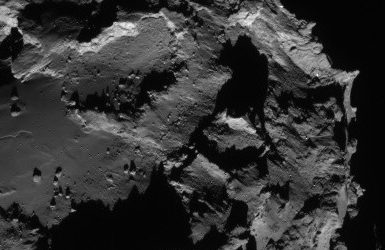
Rosetta’s camera zooms in

67P/C-G on August 23, 2014
Comet 67P/C-G as seen on August 23, 2014 from 38 miles.
Click on image for uncropped version.

The Rosetta team has begun releasing more close-up images of Comet 67P/C-G taken by the spacecraft. The image to the right was taken by the navigation camera, but rather than capture the entire nucleus in a single image the camera is now zoomed in and taking a mosaic of four images. This picture is one quarter of that mosaic.

Note the boulders and the sharp peaks in the image. The boulders are important to map for planning Philae’s landing site. The sharp peaks suggest recent outgassing.

0 comments

Arianespace and ESA sign contract for three launches

Arianespace and the European Space Agency (ESA) signed a contract on Thursday for the Ariane 5 rocket to launch 12 more of Europe’s Galileo GPS satellites on three launches.

This contract is a perfect example of European pork. Europe’s Galileo system might provide competition to the U.S. GPS and Russian Glonass systems, but I am not sure what additional capabilities it provides that will convince GPS users to switch to it. Instead, building it provides European jobs, while using the Ariane 5 rocket to launch it gives that increasingly uncompetitive rocket some work to do. In fact, this situation really reminds me of the U.S. launch market in the 1990s, when Boeing and Lockheed Martin decided that, rather than compete with Russia and ESA for the launch market, they instead decided to rely entirely on U.S. government contracts, since those contracts didn’t really demand that they reduce their costs significantly to compete.

Europe now appears to be heading down that same road.

1 comment
1 29 30 31 32 33 40