European sea-level satellite releases first data

First data from Sentinel-6B
Click for original.

The European Space Agency’s (ESA) Sentinel 6B satellite, launched a month ago, has now released its first sea-level data.

Following its launch on 17 November 2025, the first data from Sentinel-6B was captured on 26 November by the satellite’s Poseidon-4 altimeter. The image [to the right] is a combination of altimeter data from both the Sentinel-6 sea-level tracking satellites: Sentinel-6B and its twin, Sentinel-6 Michael Freilich, which was launched in 2020. The image shows the Gulf Stream current in the North Atlantic Ocean, off the eastern coasts of the US and Canada.

The Gulf Stream is a hugely important area of the North Atlantic Ocean, not only for the role it plays in global weather patterns and climate, but also because it’s a busy shipping route as well as a key ecosystem for marine species and therefore an important fishing zone.

What makes this particular government press release unusual is that though it is about a climate-related satellite, it makes no mention of global warming and how the sea level rise that has been recorded by the string of similar orbital satellites going back to 1993 is going to eventually drown us all. Maybe that’s because that total rise measured since 1993 equals only about 4 inches. That’s 4 inches of rise detected in more than three decades. At that rate, a little over an inch per decade, it will take centuries to drown anyone, but only those who refuse to walk a few feet to higher ground.

It could be the scientists and government PR hacks that are involved in writing this release also realized that the gig is up, and everyone now knows it, and it would only embarrass them further to push the global-warming hoax again.

4 comments

The hurricane season in 2024 confounded the predictions again

The trail of bad global warming predictions

The uncertainty of science: Though the climate science community had predicted that last year’s hurricane season was going to be one of the most active ever, a new study published two weeks ago in Geophysical Research Letters of the American Geophysical Union (AGU) found that the 2024 season did not behave as predicted. It ended up producing about the predicted number of hurricanes, but did so only because of a sudden rise in activity near the end of the season, after a long lull with almost no activity. From the study’s conclusion:

As has been noted throughout this study, the lull was immediately followed by one of the busiest ends to an Atlantic hurricane season on record, including two major hurricane landfalls in Florida (Helene and Milton), resulting in more than 250 fatalities and $100 billion in damage (National Centers for Environmental Information, 2025). Though the final overall number of hurricanes and major hurricanes were aligned with the seasonal forecasts, the extremely busy beginning and end to the season and marked lull in the middle highlight just how unusual the season was.

Last year’s prediction was not the first to be incorrect, though this time the error was in how the season unfolded instead of the total numbers. In the past two decades — since Al Gore prophesied that global warming would cause a gigantic increase in violent storms — NOAA has repeatedly called for very active hurricane seasons, and repeatedly those predictions have turned out wrong. In fact, from 2006 until 2018 there were almost no major hurricanes at all, the exact opposite to what Gore had foretold. Since then the seasons have returned to more normal numbers, but the predictions of the scientists have continued to be no better than throwing a dart at a wall while wearing a blindfold.

The ongoing 2025 hurricane season is following this same pattern. In May 2025 NOAA predicted this year would be a very active hurricane season. Instead, this season has matched those from 2006 to 2016, in which no hurricanes made landfall in the U.S. and the number of strong hurricanes was almost nil.

The season of course is not yet over. We could see a burst of activity in the next few months, similar to what happened in 2024. Nonetheless, the important takeaway from this story is that the scientists who claim to know what is going to happen simply don’t know anything. They are guessing, because as the paper above admits, the Earth’s weather and climate are incredibly complex, and our understanding of it is still in its infancy.

Remember this when you read the next “We’re all gonna die!” prediction touted in the propaganda press.

20 comments

Climategate global-warming activist Michael Mann resigns from PennU after celebrating murder of Charlie Kirk

Michael Mann
Climate activist Michael Mann

Though he has claimed to be a climate scientist for decades, Michael Mann at the University of Pennsylvania has been proven time and again to merely be a leftwing global-warming activist, faking data to make it appear the increase of carbon dioxide in the atmosphere is causing global warming, falsely claiming he was a Nobel laureate winner, and acting to destroy the careers of anyone who challenged the veracity of his research.

Sadly, when these facts were discovered almost two decades ago, about the time the climategate emails were released, the climate science community ignored the facts (a very bad thing for scientists to do) and acted to defend Mann. Thus he was able to continue to publish while keeping his job as a professor in academia, first at Pennsylvania State University and then at the University of Pennsylvania.

Mann’s ability to survive fraud and abuse of power however has finally come to an end, and it did so because he decided to go on line after Charlie Kirk was assassinated to joke about that murder and to slander Kirk by reposting comments that called Kirk “head of Trump’s Hitler Youth.”

Though Mann subsequently denied that was what he was doing, deleting some of his worst tweets while claiming to condemn such violence, it appears no one believes him. As a result, he announced yesterday that he resigning his position at Pennsylvania University in order to become a full time political activist. From his resignation statement:
» Read more

41 comments

Sunspot update: Activity rises slightly in April

It is the start of the month, so it is of course time for my monthly report on sunspot activity, based on the update that NOAA posts each month to its own graph of sunspots activity. As I have done since the start of Behind the Black in 2010, I take that graph each month and annotate it with extra information to illustrate the larger scientific context.

Sunspot activity in April did nothing to tell us anything about the Sun’s future activity. It rose slightly, but not by enough to suggest that the prediction put forth last month by NOAA scientists that the ramp down to solar minimum has begun is wrong.
» Read more

4 comments

Trump cuts apparently shutting down NASA’s climate office in New York

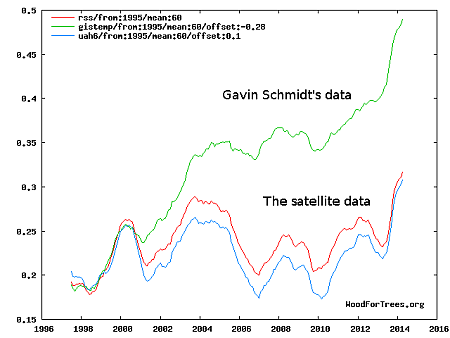
Schmidt's data tampering, as documented in 2017
Schmidt’s data tampering, as documented in 2016.

As part of the Trump administration’s aggressive effort to trim the federal budget as well as shift the research focus at the federal government’s many science agencies, on April 24, 2025 it revealed that it has canceled the building lease for the Goddard Institute for Space Studies (GISS) in New York that has existed since 1961 and in 2016 and 2017 was found to be tampering with past climate data with no explanation, lowering past temperature numbers while raising more recent ones in order to make the data fit the as-yet unproven theory that human activity is causing global warming.

Those “adjustments” have never been justified in any way. Nor has Gavin Schmidt, the man who heads GISS, ever done anything to correct them. Moreover, when his office was accused of this tampering in 2016 he not only refused to fix or justify the changes, he responded by claiming “planetary warming does not care about the election.” In the years since it has been his office that annually declares each year “the hottest on record,” using these tampered numbers to do so and demonstrating that he has been acting not as a real researcher but as a political operative of the global warming crowd.

Though the office lease is being canceled, GISS has not been shut down, as of now.

While NASA is terminating the lease on the GISS offices, it is not closing the institute itself. Lystrup said in the email that it will help employees move “to remote work agreements in the short-term as the agency seeks a new, permanent space for the team.”

I suspect this statement is merely designed by Trump officials to dampen the screams of opposition against its actions. It is very likely GISS is going away, and most of its employees will have to find new jobs.

The hope is that new scientists can be hired to review these tampered numbers and get them fixed so that climate research in the future can proceed with reliable data.

8 comments

Trump cuts to NOAA include major shake-up on how it gathers weather data

According to the budget data that was leaked anonymous last week, the Trump administration is proposing a major restructuring of NOAA’s satellite operations, shifting from building geosynchronous weather/climate satellites in partnership with NASA to focusing on buying weather data from commercial smallsats.

The plan would initially reduce NOAA’s program by two-thirds.

The document suggests NOAA’s National Environmental Satellite, Data and Information Service (NESDIS) “immediately cancel all major instrument and spacecraft contracts on the GeoXO program,” saying the projected costs are “unstainable, lack support of Congress, and are out of step with international peers.”

GeoXO is a $19.6 billion program that includes six satellites and ground infrastructure to significantly enhance NOAA’s ability to monitor weather, map lightning, and track ocean and atmospheric conditions over decades. To maintain observations from geostationary orbit at the conclusion of the Geostationary Operational Environmental Satellite (GOES)-R Series, the White House memo calls on NOAA to “immediately institute a major overhaul to lower lifecycle costs by 50 percent” with annual costs below $500 million, while remaining on schedule to launch the first satellite in 2032.

Rather than expanding the geostationary constellation to include satellites over the East, West and Central United States, the proposal includes only East and West satellites like the GOES-R Series. OMB also recommends an immediate end to NOAA relying on NASA to help it acquire weather satellites.

Maybe the most controversial recommendation calls for NOAA to focus on gathering daily weather data while ending its monitoring of long term ocean and atmospheric climate trends.

The shift from NOAA-built satellites to purchasing weather data from commercially launched and built satellites makes great sense, and is the most likely part of this plan to get implemented. Similarly, ending NOAA’s reliance on NASA will help streamline the fat from both agencies.

Whether the Trump administration can force an end to NOAA’s climate gathering operations is less clear. The politics suggest this will be difficult. The realities however suggest that a major house-cleaning in this area is in order, as there is ample evidence that the scientists running this work have been playing games with the data, manipulating it in order to support their theories of human-caused global warming.

9 comments

Sunspot update: NOAA scientists try to hide how wrong they have gotten things

My monthly sunspot update today will have less to do with the Sun’s sunspot activity itself — which continues to show a very very slow decline from a peak in August 2024 — and more to do with more games-playing by NOAA solar scientists to fool the public into believing they know more than they do.

Below is my annotated version of NOAA’s monthly graph showing the amount of sunspot activity on the Earth-facing hemisphere of the Sun. This graph is significantly different from the graph that NOAA’s scientists have issued for the past few years, with all the changes designed to make it seem as if these scientists’ predictions are on the money, when they have been entirely wrong now for two solar cycles in a row.
» Read more

10 comments

Sunspot update: Sunspot activity remains high but stable

The uncertainty of science Time for my monthly update on our Sun’s sunspot cycle, based on NOAA’s monthly graph of the sunspot activity on the Earth-facing hemisphere of the Sun, but annotated by me with additional information.

The graph below shows that the number of sunspots in February continued the trend during this solar maximum of being significantly higher than the consensus prediction by a panel of NOAA solar scientists, as indicated by the red curve. At the same time, the count in February was well below the high point during the summer of 2024. Instead, though it went up slightly in February it remains at about the same level we have seen since September.
» Read more

1 comment

Sunspot update: Sunspot activity continued its decline in January

Another month has passed, meaning it is time for another update on the Sun’s sunspot cycle, based on NOAA’s monthly graph tracking that activity but annotated by me with additional information.

In January the decline in sunspot activity on the hemisphere facing Earth since August 2024 continued, with the number of sunspots dropping to a level not seen since May 2023, when the Sun’s was ramping up from solar minimum to solar maximum.
» Read more

5 comments

Sunspot update: Is this sunspot maximum over, or will it become another doubled peaked maximum?

Well, after almost fifteen years it had to happen at last. In preparing to do my monthly sunspot update today, which I had done every month since I started Behind the Black in 2010, I discovered that I had completely forgotten to do the update in December. Sorry about that.

No matter, the changes from month-to-month are not often significant, and fortunately that turned out to be the case in November and December of 2024. Since my last update at the beginning of November 2024, sunspot activity on the Earth-facing hemisphere of the Sun has been relatively stable, based on NOAA’s monthly graph tracking that activity. In November the activity dropped slightly, only to recover a small amount in December.
» Read more

2 comments

A review of the last half century of major ice calving events in Antarctica detects no trend

47-year trend of large iceberg calving events in Antarctica
Click for original image.

The uncertainty of science: A review by scientists of major ice calving events in Antarctica that have occurred in the last 47 years has detected absolutely no trend either up or down, despite decades of predictions that human caused global warming would cause huge sections of the icecap to break off and catastrophically change the Earth’s climate.

The graph to the right comes from figure 4 of the paper, and illustrates the lack of trend. Note how the actual observations, the blue dots, show no increase in large calving events. From the abstract:

We use 47 years of iceberg size from satellite observations. Our analysis reveals no upward trend in the surface area of the largest annual iceberg over this time frame. This finding suggests that extreme calving events such as the recent 2017 Larsen C iceberg, A68, are statistically unexceptional and that extreme calving events are not necessarily a consequence of climate change.

The researchers of course genuflect to human-caused global warming in their conclusion by stating that the shrinkage predicted in the Antarctic ice cap (but not yet seen in any significant amount) could instead be occurring due to an increase in small calving events.

The lack of an upward trend in annual maximum iceberg area could be attributed to an overall increase in the number of smaller calving events, which may inhibit the development of extremely large calving events. As such, small calving events pose the greatest threat to the current stability of Antarctic ice shelves.

Since there is no detailed or reliable data of the number of smaller calving events, this hypothesis is entirely made up, and carries no weight. It is simply a fantasy created to maintain the fiction of global warming. A more open-minded look at these results would say that the larger events provide an excellent guide to the overall trend, and that the icecap simply isn’t shrinking as predicted.

11 comments

Sunspot update: in October solar activity increased after September’s crash

Time for this month’s sunspot update. As I have done every month since I started this website in 2010, I am posting NOAA’s most recent update of its monthly graph tracking the number of sunspots on the Sun’s Earth-facing hemisphere, adding some additional details to provide context.

In October, following a crash in activity in September, the Sun showed a slight increase the number of sunspots. The increase did not match the drop from the month before, but it brought the activity back up to the level seen during the summer.
» Read more

1 comment
1 2 3 57