
Sunspot update: Sunspot activity crashes in September

As it is the start of the month, it is time another monthly sunspot update, in which I provide some context and analysis to NOAA’s most recent update of its monthly graph tracking the number of sunspots on the Sun’s Earth-facing hemisphere.

After several months in which the number of sunspots rose considerably each month, in September the sunspot count crashed, dropping precipitously to levels closer to the various predictions of solar scientists, but still far above what they had all expected at this time of the solar maximum.

» Read more

4 comments

Sunspot update: The Sun continues to boom!

It is time for my monthly sunspot update, taking NOAA’s most recent update of its monthly graph tracking the number of sunspots on the Sun’s Earth-facing hemisphere and adding my own analysis as well as some additional details to provide the larger context.

During August the Sun continued to confound the experts, with the number of sunspots not only greater than July’s high count. the August count exceeded the numbers from December 2001 (215.5 vs 213.4), the last time the Sun was this active.

None of the predictions by anyone in the solar science community had predicted this level of activity.
» Read more

14 comments

Sunspot update: In July the Sun produced the most sunspots in almost a quarter century

Every month since this website began fourteen years ago, when NOAA posts its update of its monthly graph tracking the number of sunspots on the Sun’s Earth-facing hemisphere, I post my own analysis, adding some details to provide the larger context.

Of all those updates — numbering about 168 — this month’s is possibly the most significant. Since around 2008, the Sun began a long period where it was unusually quiet, with the solar maximum that occurred in 2014 possibly the weakest in two hundred years. Before that weak maximum begun, half the solar science community predicted it would be a very powerful maximum, while half predicted a weak maximum. Both got it wrong, though the weak prediction was closer though still too high.

When it came time to predict the next solar maximum, expected around 2025, that same solar science community was once again in disagreement. Most approved a NOAA science panel prediction in April 2020 calling for another weak minimum, similar to the one in 2014. A few dissented, however, and instead predicted in June 2020 that the maximum would be one of the strongest ever. In April 2023 however those dissenters chickened out, and revised their prediction downward, still forecasting a peak higher than the NOAA prediction but no longer anywhere as intense.

Based on what happened on the Sun in July, they should have had more faith in their earlier prediction.
» Read more

9 comments

Sunspot update: The Sun keeps its boom going

Time for my monthly analysis of NOAA’s monthly tracking of the number of sunspots on the Sun’s Earth-facing hemisphere. As always, I have posted NOAA’s updated graph below, adding some details to provide the larger context.

In June the Sun continued the high activity from May, with the sunspot count significantly higher than predicted, 164.2 compared to the prediction of 104.9.
» Read more

5 comments

More garbage science about wildfires and global warming from Nature

Nature: the science journal that no longer does real science
The science journal which no longer
understands how real science is done

The once highly respected science journal Nature continues its descent into propaganda and bad science, all because it bows unskeptically before the altar of global warming and leftist science fantasies.

Today’s example is an article this week entitled “Youโ€™re not imagining it: extreme wildfires are now more common,” describing a new Nature paper that attempted to use satellite data to prove that the intensity of wildfires has increased in the past two decades.

For the current study, published in Nature Ecology and Evolution on 24 June, Cunningham and his colleagues scoured global satellite data for fire activity. They used infrared records to measure the energy intensity of nearly 31 million daily fire events over two decades, focusing on the most extreme ones โ€” roughly 2,900 events. The researchers calculated that there was a 2.2-fold increase in the frequency of extreme events globally in 2003โ€“23, and a 2.3-fold boost in the average intensity of the top 20 most intense fires each year.

We’re all gonna die! As is usual for these crap climate-related studies, the entire goal is to drum up some manufactured new crisis that justifies the claim that the climate is warming. This study is no different, as the article eagerly notes:

Although the study doesnโ€™t directly connect the fire trend to global warming, Cunningham [the study’s lead author] says โ€œthereโ€™s almost certainly a significant signal of climate changeโ€. Research has shown that rising temperatures are drying out ecosystems โ€” such as coniferous forests โ€” that are naturally prone to fire. This provides fuel that can boost the firesโ€™ size and longevity. The latest study also found that the energy intensity of the fires increased faster during the night-time over the past two decades than during the daytime, which aligns with evidence4 that rising night-time temperatures are contributing to fire risk.

Not surprisingly, the New York Times immediately jumped on the bandwagon with its own article that accepts the conclusions of this research with utter naivety.

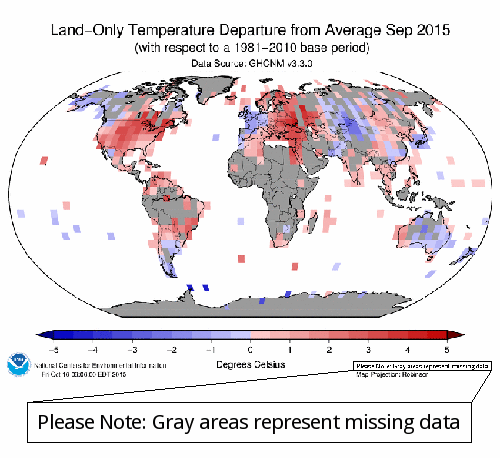
What junk. First, Cunningham fails to note this minor fact mentioned in the abstract of his own paper:
» Read more

11 comments

Sunspot update: In May the Sun went boom!

As I have done at the start of every month since I begun this webpage back in 2010, I am posting NOAA’smonthly update of its graph tracking the number of sunspots on the Sun’s Earth-facing hemisphere, adding to it several additional details to provide some larger context.

While April had showed only a small uptick in sunspot activity, in May the sunspot activity on the Sun went boom, setting a new high for sunspots during this solar maximum as well as the highest sunspot count since September 2002. The sunspot count of 171.7 smashed the previous high of 160 this cycle, set in June 2023. This new high underlined was by the large solar flare on May 9th that sent the most powerful geomagnetic storm to hit the Earth’s magnetic field in many decades, producing spectacular auroras in many low latitudes.
» Read more

4 comments

SpaceX launches European/Japanese climate satellite

SpaceX today successfully launched a joint European/Japanese satellite designed to study the climate, its Falcon 9 rocket lifting off from Vandenberg in California.

The first stage completed its seventh flight, landing safely back at Vandenberg. This was also SpaceX’s second launch today, from opposite coasts.

The leaders in the 2024 launch race:

57 SpaceX
23 China
7 Russia
6 Rocket Lab

American private enterprise now leads the world combined in successful launches, 65 to 36, while SpaceX by itself leads the entire world, including other American companies, 57 to 44.

4 comments

Rocket Lab launches NASA climate satellite

Rocket Lab today successfully launched the first of two NASA PREFIRE climate satellites, its Electron rocket lifting off from its launchpad in New Zealand.

The leaders in the 2024 launch race:

55 SpaceX
23 China
7 Russia
6 Rocket Lab

American private enterprise now leads the world combined in successful launches, 63 to 36, while SpaceX by itself leads the entire world, including other American companies, 55 to 44.

2 comments

Sunspot update: A minor uptick in sunspot activity in April

It is that time of the month again. Yesterday NOAA posted its monthly update of its graph tracking the number of sunspots on the Sun’s Earth-facing hemisphere. As I have done now for every month since I began this website in 2010, I have posted this updated graph below, with several additional details to provide some larger context.

In April the number of sunspots on the Sun went up somewhat, the count rising to the highest level since the count hit its peak of activity last summer. The sunspot number in April, 136.5, was however still significantly less than the 2023 peak of 160. Thus it appears the Sun is likely still the middle saddle of a doubled-peaked relatively weak solar maximum, with the Sun doing what I predicted in February 2024:
» Read more

1 comment

Remember: The climate data foisted on us by NOAA is based 30% on nonexistent weather stations

The uselessness of the global temperature record

A story yesterday at Zero Hedge noted once again that the yearly global data that NOAA inflicts on us, each year claiming that a new record has been set as the hottest year ever, is all based on fake data, with about one-third of the data created from weather stations that no longer exist.

The problem, say experts, is that an increasing number of USHCNโ€™s stations donโ€™t exist anymore. โ€œThey are physically goneโ€”but still report dataโ€”like magic,โ€ said Lt. Col. John Shewchuk, a certified consulting meteorologist. โ€œNOAA fabricates temperature data for more than 30 percent of the 1,218 USHCN reporting stations that no longer exist.โ€

He calls them โ€œghostโ€ stations.

Mr. Shewchuck said USHCN stations reached a maximum of 1,218 stations in 1957, but after 1990 the number of active stations began declining due to aging equipment and personnel retirements. NOAA still records data from these ghost stations by taking the temperature readings from surrounding stations, and recording their average for the ghost station, followed by an โ€œE,โ€ for estimate.

This is not a new story. » Read more

16 comments

Sunspot update: The weak solar maximum continues

NOAA yesterday posted its updated monthly graph tracking the number of sunspots on the Sun’s Earth-facing hemisphere. As I do every month, I have posted this graph below, with several additional details to provide some larger context.

The sunspot activity in March dropped, continuing the pattern of the last five months, where the Sun appears to be in a stable plateau after reaching a high peak in the summer of 2023. It continues to appear that we are in the middle low saddle of a double-peaked relatively weak solar maximum, with the Sun doing what I predicted in February:

If we are now in maximum, sunspot activity throughout the rest of 2024 should fluctuate at the level it is right now, with it suddenly rising again near the end of the year for a period lasting through the first half of 2025. After that it should begin its ramp down to solar minimum.

» Read more

0 comments

Sunspot update: The Sun continues what appears will be a weak maximum

As I have done each month since 2011, I am now posting an annotated version of NOAA’s monthly graph, tracking the solar sunspot activity on the Earth-facing hemisphere of the Sun. The NOAA updated graph was posted at the start of March, covering activity through the end of February, so this report is a little later than normal.

That graph is below. In February sunspot activity remained essentially steady, only slightly higher than the activity from the month before. Those numbers also hovered at about the same level seen since August 2023.
» Read more

1 comment
1 2 3 4 57