Could Japan’s Hayabusa-2 next target asteroid be instead a failed Soviet Mars probe?
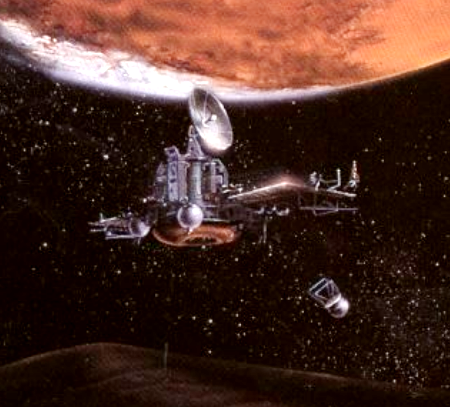
Artist rendering of Phobos-1 in orbit around Mars

Scientists reviewing the data known about the asteroid 1998 KY26, the next goal of Japan’s Hayabusa-2 asteroid probe, now speculate that it might not be an asteroid at all but could instead be the failed Soviet Mars probe, Phobos-1.

The researchers came up with this possibility due to 1998 KY26 small size, its inexplicable orbital shifts, and the fact that its solar orbit closely matches that of Phobos-1 after it failed to enter Mars orbit when a mistyped command shut down its systems.

Hibberd points out that the 10-metre (32.8ft) span of its solar panels matches the estimated size of 1998 KY26 and that the craft would be expected to have a high albedo. The non-gravitational acceleration of the object would be explained by solar radiation pressure as sunlight reflects off the probe’s shiny metallic surfaces.

For the interplanetary trajectory of Phobos 1 to fit the measured orbit of 1998 KY26, the probe would need to have subsequently fired its rocket twice, say the team: once on 2 September 1988 (shortly after contact was lost) and then again on 19 May 1996. This isn’t impossible for a malfunctioning spacecraft and there is some evidence that Phobos 1 did indeed fire its rocket without being commanded.

The last supposition, that the spacecraft fired its engines on its own, is the most implausible part of this theory, but not impossible.

Hayabusa-2 is scheduled to arrive at 1998 KY26 in 2031, assuming its last ion thruster does not fail. We shall then find out if this wild theory is right. If so, the probe will have an entirely different job. Rather than studying a very small asteroid, it will be studying a piece of human space history.

UPDATE: I just realized that one of the scientists putting out this theory is Avi Loeb, the Harvard hack who relentless pushed the idea that Comet 3I/Atlas was an alien spaceship long after data showed it was nothing more than a comet. His name on this work makes this hypothesis far less creditable.
0 comments

Japan’s Hayabusa-2 successfully flies past asteroid Torifune

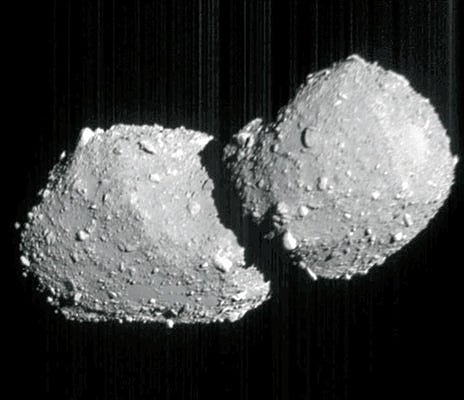
Torifune as seen by Hayabusa-2

Japan’s Hayabusa-2 asteroid probe successfully flew past the asteroid Torifune yesterday, getting less than 2,000 feet from its surface as it zipped past at a relative speed of more than 10,000 miles per hour.

The picture to the right is the first image released by Japan’s space agency, JAXA. It shows that Torifune appears to be a contact binary, made up of two rubble-pile asteroids that gentle fused together in their dance in space. Contact binaries are presently thought to comprise about 15% of all asteroids, but that estimate might prove to be an understatement as we gather more information. This is the first seen close-up that appears made up of two rubble piles.

While Japan’s press and its space agency touted this fly-by success loudly, both failed to mention the technical problems facing Hayabusa-2, which made the fly-by even more impressive. The spacecraft, which was launched in 2014, rendezvoused and grabbed samples from the asteroid Ryugu from 2018 to 2019, and then returned those samples to Earth in 2020, has been flying somewhat crippled. It has four ion engines for maneuvering, three of which no longer work and a fourth that is showing signs of failure. Thus, it could not do much during this fly-by to control its path or orientation. That it could grab this image as it zipped by is a testament to its engineers.

Hayabusa-2 is on its way to asteroid 1998 KY26 in 2031. Whether it will be capable of doing much when it gets there remains at this moment an unknown.

3 comments

Hayabusa-2 to fly past asteroid July 5, 2026

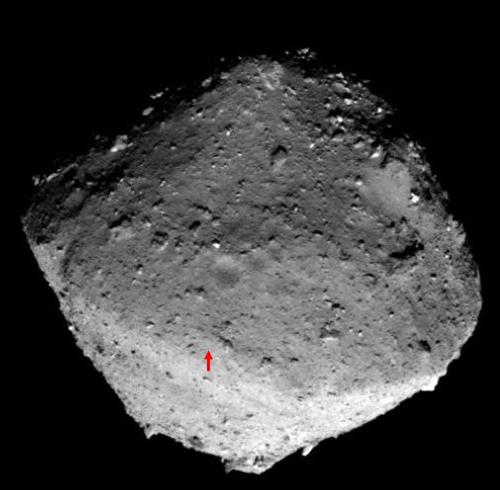
Ryugu's northern hemisphere
Ryugu as seen by Hayabusa-2 shortly before it grabbed
samples from the surface in 2019. Arrow indicates planned touchdown
site.

Despite having only one working ion engine, Japan’s Hayabusa-2 asteroid probe will do a fast and extremely close fly-by of the asteroid Torifune on July 5, 2026.

The flyby will see Hayabusa2 get within 1 to 10 kilometers (0.62 to 6.2 miles) of Torifune, using its instrument suite to study the roughly 450-meter-wide (1,476 feet) asteroid as it whizzes past at 5.3 kilometers per second (3.3 miles per second).

Not much is known about Torifune, so a fly-by this close carries risk. In addition, three of Hayabusa’s four ion engines no longer work, and the fourth is starting to degrade.

If successful, however, the fly-by will not only tell us something more about Torifune, it will increase the chances Hayabusa-2 can reach asteroid 1998 KY26 in 2031. That asteroid is small, only about 35 feet across. The plan would be for Hayabusa- to fly in formation for a period, and even attempt a touch down.

2 comments

Scientists detect the five chemicals that make up DNA/RNA inside Ryugu samples

Ryugu's northern hemisphere
Ryugu as seen by Hayabusa-2 shortly before it grabbed
samples from the surface. Arrow indicates planned touchdown
site.

Scientists studying the samples brought back from the asteroid Ryugu by Japan’s probe Hayabusa-2 have found therein a full set of the five fundamental chemicals that make up either DNA or RNA: adenine, guanine, cytosine, thymine and uracil. From the paper’s [pdf] abstract:

Organic molecules delivered from extraterrestrial materials may have played a key role in supplying building blocks for life on Earth. Here we report all five canonical nucleobases—purines (adenine and guanine) and pyrimidines (cytosine, thymine and uracil)—in samples returned from the C-type asteroid (162173) Ryugu by JAXA’s Hayabusa2 mission and compare the results with data from similar extraterrestrial material.

Ryugu samples contain nearly equal amounts of purines and pyrimidines, whereas Murchison is enriched in purines and Bennu and Orgueil in pyrimidines. Samples from Ryugu, Bennu and Orgueil, which have a similar mineralogy and elemental composition, show purine-to-pyrimidine ratios negatively correlating with ammonia.

These observations indicate that the nucleobases in these samples may have formed via a shared pathway depending on the physicochemical environment of the respective parent bodies. The detection of diverse nucleobases in asteroid and meteorite materials demonstrates their widespread presence throughout the Solar System and reinforces the hypothesis that carbonaceous asteroids contributed to the prebiotic chemical inventory of early Earth.

In other words, the data from these samples suggests that the formation of life on Earth was greatly aided by the deposition of these carbon molecules from asteroids onto the Earth.

At the same time, some caution must be exercised. At present we only have samples from three asteroids, one of which (Orgueil) was obtained shortly after it crashed on Earth. It will take a much larger census of many in-space asteroids to confirm this hypothesis.

5 comments

Astronomers refine the spin and size of Hayabusa-2’s next target asteroid

Using a number of ground-based telescopes, astronomers have determined that asteroid 1998 KY26, which Japan’s Hayabusa-2 probe will visit in 2031, spins much faster and is much smaller than previously estimated.

The new observations, combined with previous radar data, have revealed that the asteroid, 1998 KY26, is just 11 meters wide. It is also spinning about twice as fast as previously thought: “One day on this asteroid lasts only five minutes!” he says. Previous data indicated that the asteroid was around 30 meters in diameter and completed a rotation in approximately 10 minutes. The smaller size and faster rotation will make the spacecraft’s touchdown maneuver more difficult to perform than anticipated.

The observations also found that 1998 KY26 is bright, suggesting it is a solid object, not a rubble pile. Its fast rotation adds weight to this conclusion.

4 comments

Scientists link near Earth asteroids Bennu and Ryugu to much larger main belt asteroid

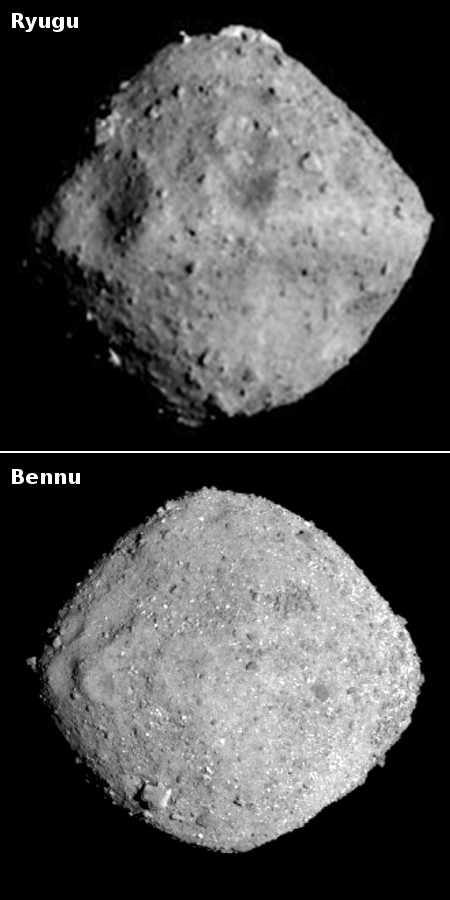
Ryugu and Bennu

Scientists comparing the spectroscopy of samples returned from the near Earth asteroids Bennu and Ryugu have found they closely resemble the much larger main belt asteroid Polana, suggesting all three formed at the same time and place.

You can read the paper here [pdf] From the press release:

The study compared spectroscopy data from Polana with spacecraft and laboratory data from Bennu and Ryugu samples, discovering similarities in their near-infrared spectrum sufficient to support the theory that they originate from the same parent asteroid. “Very early in the formation of the solar system, we believe large asteroids collided and broke into pieces to form an ‘asteroid family’ with Polana as the largest remaining body,” said SwRI’s Dr. Anicia Arredondo, lead author of the study. “Theories suggest that remnants of that collision not only created Polana, but also Bennu and Ryugu as well.”

While the similarities are great, the paper notes there are differences, possibly from “space weathering, particle size, surface texture, or different compositions.” The scientists believe the differences were caused by the asteroids’ different environments, with the 33-mile-wide and much older Polana in the asteroid belt beyond Mars, and Ryugu and Bennu, both less than a mile wide, orbiting the Sun inside Mars.

It is also possible the asteroids have little to do with each other, and the similar spectroscopy only informs us of some of the more common components of the early solar system.

0 comments

Scientists discover unexpected mineral in Ryugu asteroid sample

Scientists analyzing the samples brought back from the rubble pile asteroid Ryugu by Japan’s Hayabusa-2 spacecraft have now discovered an unexpected mineral, dubbed djerfisherite, that the formation theories of the asteroid say should not be there.

“Djerfisherite is a mineral that typically forms in very reduced environments, like those found in enstatite chondrites, and has never been reported in CI chondrites or other Ryugu grains,” says first and corresponding author Masaaki Miyahara, associate professor at the Graduate School of Advanced Science and Engineering, Hiroshima University. “Its occurrence is like finding a tropical seed in Arctic ice—indicating either an unexpected local environment or long-distance transport in the early solar system.”

At present the scientists propose two hypotheses for explaining the mineral. Either it came from another asteroid as Ryugu was congealing, or it formed in Ryugu when conditions raised its temperature above 350 degrees Celsius. The researchers now favor the latter theory, even though the generally accepted histories of Ryugu’s formation never included such conditions.

2 comments

Japan’s Hayabusa-2 asteroid probe in safe mode

Japan’s Hayabusa-2 asteroid probe, which had successfully dropped off samples from the rubble-pile asteroid Ryugu in 2020 and then was sent on a long journey to visit two more asteroids, has suffered an unknown anomaly and shifted into safe mode to protect its instruments.

Communications between Earth and the spacecraft were stable, however, and teams were investigating the situation and its impact on the extended mission, a machine translation of the post read. JAXA has yet to provide a new update since posting about the anomaly.

If engineers can identify the problem and bring the spacecraft back into full operations, the hope is that it will fly past another asteroid in 2026 on its way to a third in 2031, where it will remain for a period of time doing more detailed observations.

0 comments

Samples from the asteroid Bennu reshape entirely our understanding of the solar system’s early make-up

Nightingale landing site on Bennu
The sample site on Bennu, with OSIRIS-REx
superimposed for scale. Click for full image.

First, I hope my readers will notice that — unlike NASA and the entire press — I make no mention in my headline above of the discovery of a “mix of life’s ingredients” or “the key building blocks of life” from the samples brought back by the probe OSIRIS-REx from the asteroid Bennu.

This is the game NASA does all the time, to hint at the discovery of life when this is not the real discovery. NASA does it because it knows that if you hint at such a discovery, the press will go crazy and give you lots of press.

The real news from the two papers published this week, available here and here, however, is more fundamental. Before the samples from Bennu and Ryugu (brought back by the Japanese probe Hayabusa-2) had arrived, our understanding of the make-up and chemistry of the early solar system was very incomplete and badly biased. The only asteroid samples we had of carbonaceous chondrite asteroids, the most primitive and fragile carbon-rich asteroids in the solar system, had came from meteorites that had survived the journey through the Earth’s atmosphere. Thus, the only material that survived was robust enough to do so. The more fragile molecules however were always destroyed and thus missing from meteorites, even though it was very clear from spectroscopy of these asteroids in the solar system that such molecules did exist, and likely formed the majority of these asteroids’ make-up.

Thus, though carbonaceous chondrite asteroids represent the early solar system, our understanding of them was warped and very incomplete. The whole point of both missions to Bennu and Ryugu was to fill in this data, to get a more complete census of the real make-up of the early solar system.

The two papers published this week have given us that. That’s their real discovery.
» Read more

3 comments

Scientists try to model what would happen if Ryugu hit Earth

Ryugu's northen hemisphere
Ryugu’s northen hemisphere. The arrow marks the spot Hayabusa-2
gathered samples

Scientists, using the data and rock samples gathered by the Japanese probe Hayabusa-2, have attempted to predict what what would happen if the rubble-pile asteroid Ryugu hit the Earth.

Without diversion intervention, Tanaka explained, if the Ryugu asteroid was heading to Earth and entered the planet’s atmosphere at an angle of 45 degrees and at a speed of around 38,000 miles per hour (17 kilometers per second), the rubble pile asteroid would break up at an altitude of around 25 to 21 miles (40 to 35 km) over the surface of the planet.

This would result in an “airburst” similar to that seen over Russia in February 2013 when the Chelyabinsk meteor erupted at an altitude of around 19 miles (30 kilometers) over Earth. The result of the Chelyabinsk blast was a bright flash of light and an atmospheric blast equivalent to the detonation of 400–500 kilotons of TNT. This is as much as 33 times the energy released by the atomic bomb that devastated Hiroshima at the end of the Second World War.

The Chelyabinsk meteor caused about 1,500 injuries, mostly from people injured by glass thrown out by breaking windows when it suddenly and unexpectedly exploded during re-entry. With Ryugu this would not be a surprise, so these injuries could be reduced, though not eliminated. The damage and injuries from pieces that survived the breakup and hit the ground remains unknown because scientists don’t know how much of the asteroid would survive the break up.

Ryugu of course poses no threat, because it is not on a collision course with Earth. Whether an asteroid like Ryugu could be diverted however remains unknown, since any such diversion must not cause the asteroid to break apart as well.

7 comments

Samples from Ryugu found to contain uracil, one of the four nucleobases in RNA

Japanese researchers analyzing the samples returned by Hayabusa-2 from the rubble-pile asteroid Ryugu have identified the molecule uracil, one of the four nucleobases that form the molecule RNA.

Hayabusa 2 collected 5.4 grams from two spots on Ryugu and delivered them to Earth on December 6, 2020. Early studies showed the samples contained many organic compounds. That led Oba’s group to analyze two 10-milligram samples using the same sensitive technique they had used earlier on meteorites. The technique can detect nucleic acid bases at levels down to parts per trillion in small samples.

Now, they report in Nature Communications that uracil is present at a level of parts per billion in both Ryugu samples. While this concentration is different than they’d previously found in meteorites, Oba says that might be because the parent bodies of the meteorites and of Ryugu underwent different levels of aqueous alteration and other processes. They also detected niacin (vitamin B3) as well as other organic molecules, but they didn’t find any other nucleobases.

RNA is formed from four nucleobases, uracil, adenine, cytosine, and guanine. To form DNA, the fundamental building block of life, uracil is replaced by thymine.

This data reinforces other data that suggests the formation of these essential molecules for life is relatively common and easy, at least in our solar system.

0 comments

Many carbon-based molecules identified in Ryugu samples

Researchers in Japan, Europe, and the U.S. have now identified many carbon-based molecules in the Ryugu samples brought back to Earth by Japan’s Hayabusa-2 asteroid probe. From their paper, published in Science yesterday:

We identified numerous organic molecules in the Ryugu samples. Mass spectroscopy detected hundreds of thousands of ion signals, which we assigned to ~20,000 elementary compositions consisting of carbon, hydrogen, nitrogen, oxygen, and/or sulfur. Fifteen amino acids, including glycine, alanine, and α-aminobutyric acid, were identified. These were present as racemic mixtures (equal right- and left-handed abundances), consistent with an abiotic origin. Aliphatic amines (such as methylamine) and carboxylic acids (such as acetic acid) were also detected, likely retained on Ryugu as organic salts.

The presence of aromatic hydrocarbons, including alkylbenzenes, fluoranthene, and pyrene, implies hydrothermal processing on Ryugu’s parent body and/or presolar synthesis in the interstellar medium. Nitrogen-containing heterocyclic compounds were identified as their alkylated homologs, which could have been synthesized from simple aldehydes and ammonia. In situ analysis of a grain surface showed heterogeneous spatial distribution of alkylated homologs of nitrogen- and/or oxygen-containing compounds.

The large number of carbon-based molecules is not unlike data from similar carbonaceous chondrite meteorites, though the differences appear to suggest Ryugu experienced chemical processes in connection with water during its lifetime.

Note for clarity: Organic molecules are not life. This is a term scientists use for any carbon-based molecule.

1 comment

Samples from Ryugu prove the truly delicate and long-lived nature of the rubble-pile asteroid

Two new studies of samples brought back from the rubble-pile asteroid Ryugu by the Japanese probe Hayabusa-2 have found that the asteroid not only was never heated above 86 degrees Fahrenheit, it also contained dust grains older than the solar system itself.

The evidence from the first study, completed by Japanese scientists, suggested that:

  • 1.Asteroid Ryugu accreted some components that originated in the outer Solar System and contained abundant water and organics. The asteroid then traveled to the inner Solar System.
  • 2.Organics associated with coarse-grained phyllosilicates may serve as one of the potential sources of water and organics to the Earth.

The second study, using samples provided to American scientists, found two tiny dust grains that must have come from the material that existed before the formation of our solar system.

The team detected all the previously known types of presolar grains—including one surprise, a silicate that is easily destroyed by chemical processing that is expected to have occurred on the asteroid’s parent body. It was found in a less-chemically-altered fragment that likely shielded it from such activity.

This is not the first discovery of presolar grains, but their delicate existence in Ryugu confirms the conclusions of the first study, that Ryugu had to have formed in the outer solar system and then migrated inward over eons.

The second study also reviewed the make-up of the sample and concluded that Ryugu appears to most closely match the family of carbonaceous Ivuna-type (CI) chondrites, thought to be among the most primitive asteroids known, of which very few have been studied because of they rarely survive the journey through the Earth’s atmosphere.

1 comment

Amino acids found in asteroid samples brought back from Ryugu

Japanese scientists revealed this week that they have detected more than 20 types of amino acids in the asteroid samples brought back from Ryugu by the probe Hayabusa-2.

Kensei Kobayashi, professor emeritus of astrobiology at Yokohama National University, said the unprecedented discovery of multiple types of amino acids on an extraterrestrial body could even hint at the existence of life outside of Earth. “Proving amino acids exist in the subsurface of asteroids increases the likelihood that the compounds arrived on Earth from space,” he said.

It also means amino acids can likely be found on other planets and natural satellites, hinting that “life could have been born in more places in the universe than previously thought,” Kobayashi added.

Let me emphasize that this is not a discovery of life on Ryugu, only chemistry that is found in life on Earth. Such chemistry however can be found outside of life as well. What this detection suggests however that it is relatively common to produce such complex chemistry in hostile space environments, which increases greatly the possibility of life everywhere in the universe.

0 comments

Japanese scientists complete inventory of Ryugu asteroid samples

In a press conference yesterday the Japanese space agency JAXA announced that scientists have completed their inventory of the samples brought back from the asteroid Ryugu by the Hayabusa-2 spacecraft, and are now ready to begin distributing those samples to scientists around the world for more detailed research.

JAXA has cataloged the soil samples brought back by Hayabusa 2 last December, by size, color and shape. From now, 269 researchers from 14 countries, including Japan and the United States, will conduct an in-depth analysis of the soil’s structures and components over the course of about a year.

As expected, the inventory found the samples had a large amount of hydrogen, oxygen, and carbon atoms. Even before Hayabusa-2’s arrival, Ryugu had been catalogued as a “hydrated” asteroid, which means it was thought to contain a lot of hydrogen and oxygen, the basic elements of water. The inventory has now confirmed this.

1 comment

Ryugu’s most primitive boulders

In a just published paper scientists reveal how they think they have identified the oldest rocks on the rubble pile asteroid Ryugu, and found them to be distributed across the entire face of the asteroid.

These boulders are light enough that they would float on water.

Ryugu is thought to have initially formed as a fluffy planetesimal that coalesced from accumulated dust in the early Solar System, and subsequently underwent processes such as thermal evolution and compression. This parent body was then later destroyed in a collision and fragments of this reaccumulated into the asteroid. However, planetesimals have never been seen, so whether they really existed or what they may have looked like is one of the biggest challenges in understanding the planet formation process. The boulders discovered in this research are thought to be a material that most strongly retains the appearance of the fluffy planetesimals that triggered the birth of the planets in the Solar System.

Additionally, the data from all the scientific instruments onboard Hayabusa2 that were used to examine the surface of Ryugu revealed that fragments of material similar to those of the ultra-high porosity boulders are globally distributed over the asteroid surface, and may have been collected in the sample taken by Hayabusa2. If highly primitive material with the ultra-high porosity discovered here is also found in the collected samples, it will both clarify the formation and evolutional history of Ryugu’s parent body, and also provide evidence of planetesimal formation in the early stage of the Solar System formation process.

There is no word yet from the scientists studying the Hayabusa-2 samples on what they have found. This paper gives them an idea of what could be the most important type of rock to look for.

0 comments

Hayabusa-2 begins journey to two asteroids

On January 5, 2021, after successfully delivering its samples of Ryugu to Earth, Hayabusa-2 fired up its ion engines and began its ten-year journey to two different asteroids.

Hayabusa2’s first extended-mission destination is the roughly 2,300-foot-wide (700 meters) asteroid (98943) 2001 CC21, which the probe will fly by at high speed in 2026, if all goes according to plan. A more in-depth rendezvous with yet another space rock, 1998 KY26, is scheduled to follow in 2031.

In a previous post I had mistakenly left out the first target asteroid. However, their primary target remains the tiny 100-foot-wide 1998 KY26, since it is so small. This will be the first close-up view of such a small asteroid, in space. Since such asteroids are many, it will tell us much about the make-up and history of the solar system.

2 comments

First look at Ryugu samples

Japanese scientists have taken their first look at the Ryugu sample material brought back by Hayabusa-2 and found they resemble charcoal.

The samples Japanese space officials described Thursday are as big as 1 centimeter (0.4 inch) and rock hard, not breaking when picked up or poured into another container. Smaller black, sandy granules the spacecraft collected and returned separately were described last week.

…The sandy granules the Japan Aerospace Exploration Agency described last week were from the spacecraft’s first touchdown in April 2019.

The larger fragments were from the compartment allocated for the second touchdown on Ryugu, said Tomohiro Usui, space materials scientist. To get the second set of samples in July last year, Hayabusa2 dropped an impactor to blast below the asteroid’s surface, collecting material from the crafter so it would be unaffected by space radiation and other environmental factors.

Usui said the size differences suggest different hardness of the bedrock on the asteroid. “One possibility is that the place of the second touchdown was a hard bedrock and larger particles broke and entered the compartment.”

The analysis of these samples has only just begun. Dating them is likely next, and that will probably reveal some startling results.

7 comments

Samples from space!

Scientists from both the Japanese Hayabusa-2 mission to the asteroid Ryugu and the Chinese Chang’e-5 mission to the Moon announced yesterday the total amount of material they successfully recovered.

The numbers appear to diminish the Japanese success, but that is a mistake. Getting anything back from a rubble-pile asteroid that had never been touched before and is much farther away from Earth than the Moon was a very great achievement. The 5.4 grams is also more than fifty times the minimum amount they had hoped for.

This is also not to diminish the Chinese achievement, They not only returned almost four pounds, some of that material also came from a core sample. They thus got material both from the surface and the interior of the Moon, no small feat from an unmanned robot craft.

Scientists from both nations will now begin studying their samples. Both have said that some samples will be made available to scientists from other countries, though in the case of China it will be tricky for any American scientist to partner with China in this research, since it is by federal law illegal for them to do so.

9 comments

Subaru Telescope photographs Hayabusa-2’s next target asteroid

In order to better constrain its orbit, the Subaru Telescope in Hawaii has obtained new photographs of Hayabusa-2’s next target asteroid, 100-foot-wide 1998 KY26.

This asteroid is predicted to approach to within 0.47 AU of Earth in mid to late December 2020, giving us a rare opportunity that comes only once every three and a half years. However, the diameter of 1998 KY26 is estimated to be no more than 30 meters, and thus its brightness is so dim that ground-based observations of the asteroid are difficult without a very large telescope.

The observations with the Subaru Telescope were conducted upon the request of the Institute for Space and Astronautical Science (ISAS), JAXA. And as a result, 1998 KY26 was photographed in the direction of the constellation Gemini as a 25.4-magnitude point of light with a measurement uncertainty of 0.7 mag. The positional data collected during these observations will be used to improve the accuracy of the orbital elements of the asteroid. Similar observations were conducted with the Very Large Telescope (VLT) of the European Southern Observatory (ESO).

If all goes right Hayabusa-2 will rendezvous with 1998 KY26 in the summer of 2031.

4 comments
1 2 3 6