Galaxies in a row

Galaxies in a row
Click for original image.

Cool image time from Hubble! The picture to the right, cropped, reduced, and sharpened to post here, was taken by the Hubble Space Telescope as part of a survey of nearby “pecular” galaxies. What makes it unusual is the line of distant galaxies below the largest on the left.

The wonderful quality of this image also reveals several further galaxies, not associated with this system but fortuitously positioned in such a way that they appear to be forming a line that approaches the leftmost (in this image) component of Arp-Madore 2105-332, which is known individually as 2MASX J21080752-3314337. The rightmost galaxy, meanwhile, is known as 2MASX J21080362-3313196. These hefty names do not lend themselves to easy memorisation, but they do actually contain valuable information: they are coordinates in the right ascension and declination system used widely by astronomers to locate astronomical objects.

Both larger galaxies are thought to be about 200 million light years away, with the smaller ones far more distant. If you look at the full resolution image, you will see that there are at least six galaxies in that line, one that appears to be an elliptical galaxy with all the rest a variety of different types of spiral galaxies. The detail provided by Hubble is truly astonishing.

Though they are not linked to the larger galaxies, it is not clear if they are linked to each other.

2 comments

Hubble to resume science operations using three gyros

Engineers have apparently figured out the issues with one of the Hubble Space Telescope’s three gyroscopes, and plan to resume science operations today using all three gyros.

After analyzing the data, the team has determined science operations can resume under three-gyro control. Based on the performance observed during the tests, the team has decided to operate the gyros in a higher-precision mode during science observations. Hubble’s instruments and the observatory itself remain stable and in good health.

This is excellent news. If it had been determined that the funky gyro was no longer functional, the telescope would have shifted into what the engineers call “one-gyro mode.” By using only one of the two remaining gyros, Hubble’s life could be extended. However, while it would allow the telescope to point and continue observations, the images would no longer be as sharp.

9 comments

Hubble in safe mode due to gyroscope problem

One of the three working gyroscopes (three have already failed0 on the Hubble Space Telescope experienced repeated problems in mid-November, and has now put the telescope in safe mode while engineers trouble-shoot the problem.

Hubble first went into safe mode Nov. 19. Although the operations team successfully recovered the spacecraft to resume observations the following day, the unstable gyro caused the observatory to suspend science operations once again Nov. 21. Following a successful recovery, Hubble entered safe mode again Nov. 23.

The team is now running tests to characterize the issue and develop solutions. If necessary, the spacecraft can be re-configured to operate with only one gyro. The spacecraft had six new gyros installed during the fifth and final space shuttle servicing mission in 2009. To date, three of those gyros remain operational, including the gyro currently experiencing fluctuations. Hubble uses three gyros to maximize efficiency, but could continue to make science observations with only one gyro if required.

The long term plan when the telescope only has two working gyros, assuming no improvised maintenance mission is flown to Hubble to give it new gyroscopes, is to work with only one (treating the second as a back-up) in order to extend the telescope’s life as long as possible.

And though it is true that Hubble could continue to do science with only one gyro, images from that point will likely not be as sharp, and thus will end more than three decades of imagery that changed our perception of the universe.

The Chinese 2-meter Xuntian optical space telescope, now scheduled for launch in 2025, will likely then replace Hubble as the world’s top optical telescope. American astronomers better start learning Chinese, assuming China even allows them access. They will not have a right to complain, however, as it was their decision to not build a Hubble replacement, in their 2000, 2010, and 2020 decadal reports.

2 comments

Galaxies within galaxies within galaxies

Galaxies within galaxies
Click for original image.

Time another cool galaxy image! The picture to the right, cropped, reduced, sharpened, and annotated to post here, was taken by the Hubble Space Telescope as part of a survey project of galaxies where past supernovae had occurred. From the caption:

The location of this faded supernova was observed as part of a study of multiple hydrogen-rich supernovae, also known as type II supernovae, in order to better understand the environments in which certain types of supernovae take place.

Though the picture’s resolution was reduced to post here, I have also included insets at the full released resolution of three of background galaxies, one of which (on the uppermost right) appears to have a second smaller galaxy either associated with it or is another background galaxy even farther away. Such background galaxies are always seen Hubble images, which starkly tell us that the universe is far vaster than we can imaging, with more stars than we can conceive.

The galaxy featured here is interesting in its own right. Though it appears to be a spiral galaxy, its arms are very indistinct, suggesting that is sits between that of an elliptical galaxy (no arms, just a cloud of stars) and a spiral (with well-defined arms).

3 comments

Hubble snaps an ultra-violet view of Jupiter

Jupiter in ultra-violet

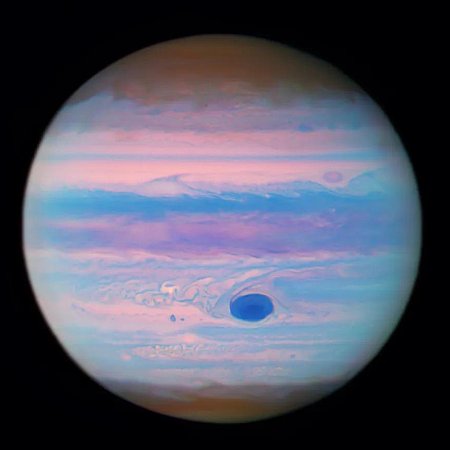
Cool image time! Using the Hubble Space Telescope, scientists have taken a false-color ultra-violet image of Jupiter. That picture is to the right, cropped, reduced and sharpened to post here.

This newly released image from the NASA Hubble Space Telescope shows the planet Jupiter in a color composite of ultraviolet wavelengths. Released in honor of Jupiter reaching opposition, which occurs when the planet and the Sun are in opposite sides of the sky, this view of the gas giant planet includes the iconic, massive storm called the “Great Red Spot.” Though the storm appears red to the human eye, in this ultraviolet image it appears darker because high altitude haze particles absorb light at these wavelengths. The reddish, wavy polar hazes are absorbing slightly less of this light due to differences in either particle size, composition, or altitude.

The data used to create this ultraviolet image is part of a Hubble proposal that looked at Jupiter’s stealthy superstorm system. The researchers plan to map deep water clouds using the Hubble data to define 3D cloud structures in Jupiter’s atmosphere.

By comparing this ultra-violet image with Hubble’s optical view as well as Webb’s infrared view, scientists can study Jupiter’s atmosphere much like meteologists study the Earth’s, using multi-wave satellite observations.

0 comments

A spiral galaxy giving birth to a lot of stars

A spiral galaxy giving birth to a lot of stars
Click for original image.

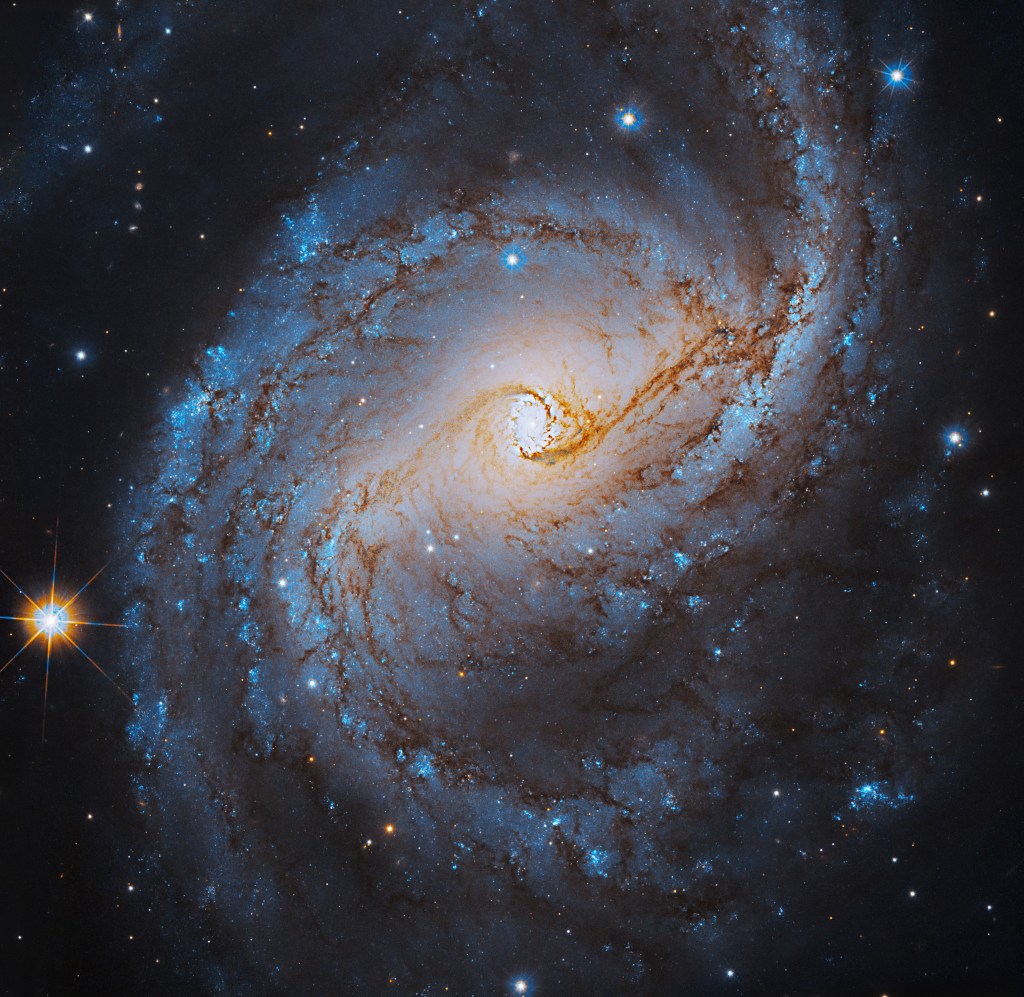
Time for another cool galaxy image! The picture to the right, reduced and sharpened to post here, was taken by the Hubble Space Telescope, and shows what some informally refer to as the “‘Spanish Dancer Galaxy’ because the “vivid and dramatic swirling lines of its spiral arms … evoke the shapes and colours of a dancer’s moving form. ”

Though this galaxy’s two main arms cause it to resemble a barred galaxy, it lacks a central bar, suggesting it is young. The numerous reddish and pink regions in the arms, all of which are thought to be star-forming regions, also suggest the galaxy is young, still giving birth to many stars.

It is located about 60 million light years away, and is part of what scientists label the Doradus galaxy group, which contains less than a hundred galaxies. In comparison, a galaxy cluster is much larger, containing hundreds to thousands of galaxies.

1 comment

An infrared view of the Crab Nebula by Webb

Webb's image of the Crabb compared to Hubble's
Click for original image.

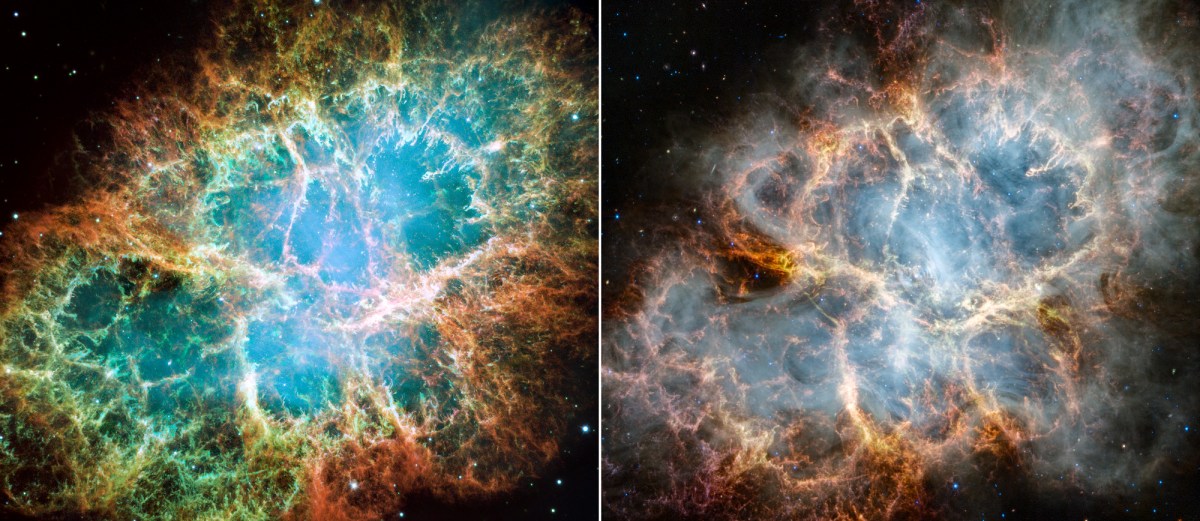
Using the Webb Space Telescope astronomers have taken the first detailed infrared image of the Crab Nebula, the remnant from a supernova that occurred in 1054 AD.

The two pictures on the right compare Webb’s false color infrared view with a natural light Hubble image in optical wavelengths, taken in 2005. From the press release:

The supernova remnant is comprised of several different components, including doubly ionized sulfur (represented in red-orange), ionized iron (blue), dust (yellow-white and green), and synchrotron emission (white). In this image, colors were assigned to different filters from Webb’s NIRCam and MIRI: blue (F162M), light blue (F480M), cyan (F560W), green (F1130W), orange (F1800W), and red (F2100W).

In comparing the images, it appears the scientists chose colors for the Webb image to more or less match those of Hubble’s natural color picture. However, as the press release notes:

Additional aspects of the inner workings of the Crab Nebula become more prominent and are seen in greater detail in the infrared light captured by Webb. In particular, Webb highlights what is known as synchrotron radiation: emission produced from charged particles, like electrons, moving around magnetic field lines at relativistic speeds. The radiation appears here as milky smoke-like material throughout the majority of the Crab Nebula’s interior.

This feature is a product of the nebula’s pulsar, a rapidly rotating neutron star. The pulsar’s strong magnetic field accelerates particles to extremely high speeds and causes them to emit radiation as they wind around magnetic field lines. Though emitted across the electromagnetic spectrum, the synchrotron radiation is seen in unprecedented detail with Webb’s NIRCam instrument.

The release also notes this remarkable but somewhat unfortunate fact:

Scientists will have newer Hubble data to review within the next year or so from the telescope’s reimaging of the supernova remnant. This will mark Hubble’s first look at emission lines from the Crab Nebula in over 20 years, and will enable astronomers to more accurately compare Webb and Hubble’s findings.

In 2005 repeated Hubble images of the Crab revealed that its filaments and radiation were stormy, with constant activity. The scientists actually produced a movie of those changes. It was expected that new images would be taken at regular intervals to track that activity. Apparently it was not, either because no scientist was interested or the committee that assigns time on Hubble decided this wasn’t important enough reseach.

0 comments

A dance of three galaxies

Three galaxies merging
Click for original image.

Cool image time! The picture to the right, cropped, reduced, and sharpened to post here, was taken by the Hubble Space Telescope. Though it appears to show two galaxies interacting with each other, other spectroscopic data proves there are actually three large galaxies in the picture. From the caption:

The two clearly defined galaxies are NGC 7733 (smaller, lower right) and NGC 7734 (larger, upper left). The third galaxy is currently referred to as NGC 7733N, and can actually be spotted in this picture if you look carefully at the upper arm of NGC 7733, where there is a visually notable knot-like structure, glowing with a different colour to the arm and obscured by dark dust. This could easily pass as part of NGC 7733, but analysis of the velocities (speed, but also considering direction) involved in the galaxy shows that this knot has a considerable additional redshift, meaning that it is very likely its own entity and not part of NGC 7733.

All three galaxies are quite close to each other, which means they are in the long process of merging together into one larger galaxy.

1 comment

NASA: Budget cuts to Hubble/Chandra under consideration

In what is likely a negotiating ploy with Congress to prevent any budget cuts at all at NASA, the agency revealed late last week that it is considering cutting the budgets to both the Hubble and Chandra space telescopes in order to meet proposed budget limits.

In an Oct. 13 presentation to the National Academies’ Committee on Astronomy and Astrophysics, Mark Clampin, director of NASA’s astrophysics division, said he was studying unspecified cuts in the operating budgets of the Chandra X-Ray Observatory and Hubble Space Telescope to preserve funding for other priorities in the division.

The potential cuts, he said, are driven by the expectation that his division will not receive the full request of nearly $1.56 billion for fiscal year (FY) 2024 because of legislation passed in June that caps non-defense discretionary spending for 2024 at 2023 levels, with only a 1% increase for 2025. “We’re working with the expectation that FY24 budgets stay at the ’23 levels,” he said. “That means that we have decided to reduce the budget for missions in extended operations, and that is Chandra and Hubble.”

That he provided no details suggests this is merely a lobbying tactic. Essentially he is saying to Congress, “If you don’t give me more money I will be forced to shut down our most popular programs. That won’t sit well with your constituents!”

That the House in its appropriations to NASA for 2024 did not cut the agency’s budget significantly also suggests this is mere lobbying. There should be no reason to trim Hubble or Chandra, which are two of the agency’s most successful projects, unless the cost overruns on SLS/Orion and the Mars Sample Return missions are forcing NASA to grab money from other programs. If so, that problem is not Congress’s, but NASA’s. The agency should reconsider those failed projects in order to keep what works working.

6 comments

Astronomers detect nano-sized quartz crystals in atmosphere of exoplanet

Using both the Hubble and Webb space telescopes in space, astronomers have detected nano-sized quartz crystals in the atmosphere of a Jupiter-class exoplanet orbiting its star every 3.7 days.

Silicates (minerals rich in silicon and oxygen) make up the bulk of Earth and the Moon as well as other rocky objects in our solar system, and are extremely common across the galaxy. But the silicate grains previously detected in the atmospheres of exoplanets and brown dwarfs appear to be made of magnesium-rich silicates like olivine and pyroxene, not quartz alone – which is pure SiO2.

The result from this team, which also includes researchers from NASA’s Ames Research Center and NASA’s Goddard Space Flight Center, puts a new spin on our understanding of how exoplanet clouds form and evolve. “We fully expected to see magnesium silicates,” said co-author Hannah Wakeford, also from the University of Bristol. “But what we’re seeing instead are likely the building blocks of those, the tiny ‘seed’ particles needed to form the larger silicate grains we detect in cooler exoplanets and brown dwarfs.”

These tiny quartz crystals are condensing out in the clouds themselves, due to the high temperatures and pressures there. The exoplanet itself is unusual because though its mass is one half that of Jupiter, its volume is seven times larger. This gives it a very large and deep atmosphere, thus providing the environment for crystal formation.

0 comments

A nearby active galaxy, viewed head on by Hubble

Active galaxy
Click for original image.

Cool image time! The picture to the right, reduced and sharpened to post here, was taken by the Hubble Space Telescope and is the third of a seven-day celebration of galaxies by the Hubble science team. Previous images in the series can be found here. From the caption for this particular image:

At the center of NGC 6951 lies a supermassive black hole surrounded by a ring of stars, gas, and dust about 3,700 light-years across. This “circumnuclear ring” is between 1 and 1.5 billion years old and has been forming stars for most of that time. Scientists hypothesize that interstellar gas flows through the dense, starry bar of the galaxy to the circumnuclear ring, which supplies new material for star formation. Up to 40 percent of the mass in the ring comes from relatively new stars that are less than 100 million years old. Spiral lanes of dust, shown in dark orange, connect the center of the galaxy to its outer regions, contributing more material for future star formation.

This galaxy, located about 78 million light years away, has also seen six different supernovae in the past quarter century. Compare that with the Milky Way, which has not seen a supernova now in more than four hundred years.

4 comments

Hubble data shows expansion of supernova remnant

Cygnus loop filament

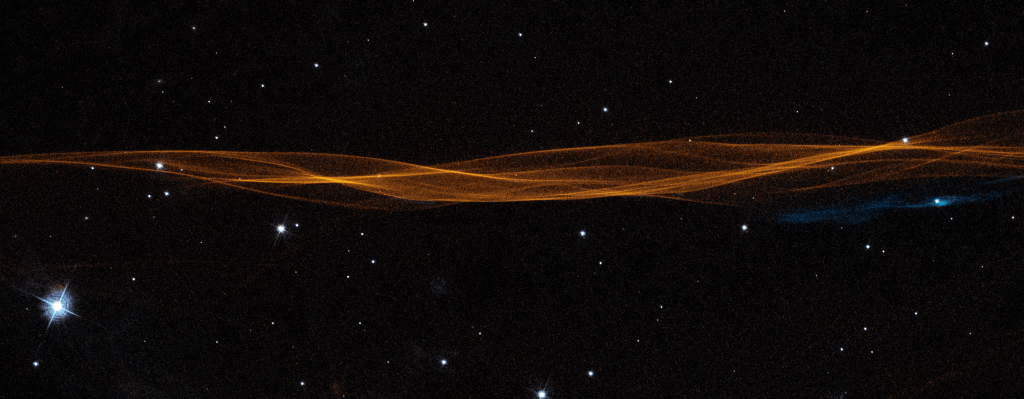
Astronomers have created a four-second long movie using Hubble images collected over twenty years that shows the expansion of one filament in the Cygnus Loop supernova remnant, the explosion of which is thought to have occurred 20,000 years ago.

The picture above is one frame of that movie. The filament is estimated to be two light years in length.

By analyzing the shock’s location, astronomers found that the shock hasn’t slowed down at all in the last 20 years, and is speeding into interstellar space at over half a million miles per hour – fast enough to travel from Earth to the Moon in less than half an hour. While this seems incredibly fast, it’s actually on the slow end for the speed of a supernova shock wave.

Two versions of the movie are at the link, with the longer providing excellent context.

2 comments

Two galaxies merging

Merging galaxies
Click for original image.

Cool image time! The picture to the right, cropped, reduced, and sharpened to post here, was taken by the Hubble Space Telescope as part of a survey project to photograph the entire Arp catalog of 338 “peculiar galaxies,” put together by astronomer Halton Arp in 1966. From the caption:

The larger galaxy (in the left of this image) is an extremely energetic galaxy type known as a Seyfert galaxy, which house active galactic nuclei at their cores. Seyfert galaxies are notable because despite the immense brightness of the active core, radiation from the entire galaxy can be observed. This is evident in this image, where the spiraling whorls of the whole galaxy are readily visible. The smaller companion is connected to the larger by a tenuous-seeming ‘bridge’, composed of dust and gas. The colliding galactic duo lie about 465 million light-years from Earth.

Note that if you ignore the blue whorls of the left galaxy, the two bright cores of these merging galaxies are about the same size. As it is unclear how long this merger has been on-going, it is possible that the galaxy on the right, in circling the left galaxy, drew out those whorls and that tenuous bridge. Other scenarios are also possible, however, such as the galaxy on the left stripping and scattering the arms of the galaxy on the right.

1 comment

A galactic cloud

A galactic cloud
Click for original image.

Cool image time! The picture to the right, cropped, reduced, and sharpened to post here, was taken by the Hubble Space Telescope. It shows what scientists dub a lenticular galaxy, with features that put it somewhere between a spiral galaxy and an elliptical (which has no structure a appears instead a cloud of stars), sitting about 73 million light years away.

NGC 3156 has been studied in many ways … from its cohort of globular clusters, to its relatively recent star formation, to the stars that are being destroyed by the supermassive black hole at its centre.

Why this galaxy has no spiral arms is somehow related to its age and its central black hole, but the detailed theories that astronomers have to explain this are far from confirmed.

The image is interesting also because of its lack of foreground stars or background galaxies. Its location in the sky explains this, as Hubble was looking at right angle to the Milky Way’s galactic plane, essentially looking directly into the vast emptiness between the galaxies.

2 comments

A triangular spiral galaxy

A triangular spiral galaxy
Click for original image.

Cool image time! The picture to the right, cropped, reduced, and sharpened to post here, was taken by the Hubble Space Telescope as part of a follow-up observations of a supernova that occurred in this galaxy in 2015. The galaxy, dubbed IC 1776, is about 150 million light years away.

Hubble investigated the aftermath of the supernova SN 2015ap during two different observing programmes, both designed to comb through the debris left by supernovae explosions in order to better understand these energetic events. A variety of telescopes automatically follow up the detection of supernovae to obtain early measurements of these events’ brightnesses and spectra. Complementing these measurements with later observations which reveal the lingering energy of supernovae can shed light on the systems which gave rise to these cosmic cataclysms in the first place.

As the caption notes, the spiral arms of this galaxy “are difficult to distinguish.” At first glance the galaxy instead appears triangular in shape, an impression that dissolves with a closer look.

0 comments

A ghostly bullseye galaxy

A ghostly bullseye
Click for original image.

A cool image to start the week! The picture to the right, cropped and reduced to post here, was taken by the Hubble Space Telescope as part of a survey scientists are doing using Hubble, attempting to get high resolution images of every galaxy within about 30 million light years of the Milky Way. Prior to this census Hubble had covered about 75% of these galaxies. This particular galaxy is called a lenticular galaxy.

Lenticular galaxies like NGC 6684 (lenticular means lens-shaped) possess a large disc but lack the prominent spiral arms of galaxies like the Andromeda Galaxy. This leaves them somewhere between elliptical galaxies and spiral galaxies, and lends these galaxies a diffuse, ghostly experience. NGC 6684 also lacks the dark dust lanes that thread through other galaxies, adding to its spectral, insubstantial appearance.

The unknown is whether this is the state of a galaxy prior to becoming a spiral, or it is what it looks like as it transitions from a spiral to an elliptical. This particular galaxy is likely the latter, as it lacks the dust, but this does not have to be the rule.

0 comments

Spirals within spirals

Spirals within spirals
Click for original image.

Cool image time! The picture to the right, cropped, reduced, and annotated to post here, was taken by the Hubble Space Telescope as part of two different research projects that are studying galaxies where supernovae previously occurred. This particular galaxy is estimated to be about 192 million light years away, and is a classic example of a barred spiral.

Despite appearing as an island of tranquillity in this image, UGC 12295 played host to a catastrophically violent explosion — a supernova — that was first detected in 2015. This supernova prompted two different teams of astronomers to propose Hubble observations of UGC 12295 that would sift through the wreckage of this vast stellar explosion.

Supernovae are the explosive deaths of massive stars, and are responsible for forging many of the elements found here on Earth. The first team of astronomers used Hubble’s Wide Field Camera 3 (WFC3) to examine the detritus left behind by the supernova in order to better understand the evolution of matter in our Universe.

The second team of astronomers also used WFC3 to explore the aftermath of UGC 12295’s supernova, but their investigation focused on returning to the sites of some of the best-studied nearby supernovae. Hubble’s keen vision can reveal lingering traces of these energetic events, shedding light on the nature of the systems that host supernovae.

What struck me about this picture however were the many smaller spiral galaxies scattered nearby and behind UGC 12295, with one face-on spiral highlighted near the top. I can count at least three or four other background spiral galaxies, all reddish in color likely because their light has been shifted to the red due to their distance.

5 comments

A spiral galaxy as seen by Hubble

A spiral galaxy as seen by Hubble
Click for original image.

Cool image time! The picture to the right, cropped, reduced, and sharpened to post here, was taken as part of a research project to use the Hubble Space Telescope to photograph galaxies where supernovae had recently occurred. From the caption:

UGC 11860 lies around 184 million light-years away in the constellation Pegasus, and its untroubled appearance can be deceiving; this galaxy recently played host to an almost unimaginably energetic stellar explosion.

A supernova explosion — the catastrophically violent end of a massive star’s life — was detected in UGC 11860 in 2014 by a robotic telescope dedicated to scouring the skies for transient astronomical phenomena; astronomical objects which are only visible for a short period of time. Two different teams of astronomers used Hubble’s Wide Field Camera 3 to search through the aftermath and unpick the lingering remnants of this vast cosmic explosion.

This Hubble image once again illustrates the vastness of the universe. Note that every single dot surrounding UGC 11860 in this picture is another far more distant galaxy. As much as UGC 11860 is in our local intergalactic neighborhood, it is still so distant that this field of view is small enough that it contains no stars.

2 comments

A faint irregular cloud of stars

A faint irregular cloud of stars
Click for original picture.

Cool image time! The picture to the right, cropped, reduced, and sharpened to post here, was released today by the science team of the Hubble Space Telescope. It shows an irregular galaxy thought to be about 44 million light years away.

Alongside its hazy shape, NGC 7292 is remarkably faint. As a result, astronomers classify NGC 7292 as a low surface brightness galaxy, barely distinguishable against the backdrop of the night sky. Such galaxies are typically dominated by gas and dark matter rather than stars.

Astronomers directed Hubble to inspect NGC 7292 during an observational campaign studying the aftermath of Type II supernovae. These colossal explosions happen when a massive star collapses and then violently rebounds in a catastrophic explosion that tears the star apart. Astronomers hope to learn more about the diversity of Type II supernovae they have observed by scrutinising the aftermath and remaining nearby stars of a large sample of historical Type II supernovae.

NGC 7292’s supernova was observed in 1964 and accordingly given the identifier SN 1964H. Studying the stellar neighbourhood of SN 1964H helps astronomers estimate the initial mass of the star that went supernova, and could uncover surviving stellar companions that once shared a system with the star that would become SN 1964H.

I searched but was unable to locate any 1964 images of this galaxy when the supernova was still visible, so I could not pinpoint its location in the picture. It has long since faded away.

Note that the reddish smudges scattered throughout the picture are likely galaxies so far distant that their light has shifted entirely into the reddish spectrum. This likely places them one to several billions of light years away, not millions.

2 comments

Hubble snaps picture of another jellyfish galaxy

Another jellyfish galaxy
Click for original image.

Astronomers today released another picture of a jellyfish galaxy taken by the Hubble Space Telescope, with that picture to the right, cropped, reduced, and sharpened to post here. From the caption:

The jellyfish galaxy JO206 trails across this image from the NASA/ESA Hubble Space Telescope, showcasing a colourful star-forming disc surrounded by a pale, luminous cloud of dust. A handful of bright stars with criss-cross diffraction spikes stand out against an inky black backdrop at the bottom of the image. JO206 lies over 700 million light-years from Earth in the constellation Aquarius.

This image is the sixth and final such photograph in this survey. You can view all of these images here. The study has found that star formation does not seem to be significantly different inside the galaxy versus the tentacles that stretch out beyond due to pressure from the intergalactic material. This suggests that the influence of this intergalactic material on the formation of stars is relatively minor.

0 comments
1 4 5 6 7 8 15