
NASA clarifies air leak situation yesterday on ISS
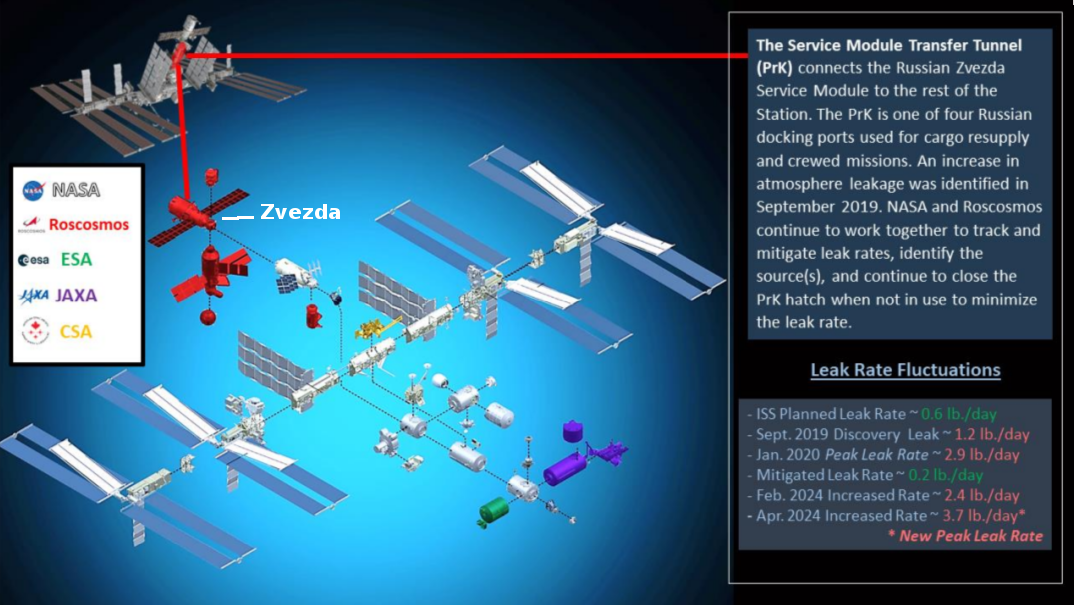
Figure 3 from September 2024 Inspector General report, showing Zvezda’s location on ISS, as well as the station’s leak rate at that time.
According to a NASA update posted late yesterday, the agency had cause to order its astronauts to shelter in place within their Dragon capsule due to planned repair work proposed by the Russians.
The week of June 1, during Progress 95 spacecraft cargo operations, Roscosmos noted an increase of the previous leak rate to two pounds per day and identified new suspected leak areas in the PrK. Following this observation, Roscosmos made the decision to begin work toward a more extensive inspection and structural repair effort Friday morning. This revised approach involved cutting a bracket to better access an area identified as a possible leak source for further inspection, using a method that could have resulted in elevated risk to the structure in the area. In response, NASA directed the four SpaceX Crew-12 members and NASA astronaut Chris Williams, who flew to station aboard the Soyuz MS-28 spacecraft, to take a heightened safety posture, known as a safe haven, inside the SpaceX Dragon spacecraft during the procedure.
Later Friday morning, Roscosmos paused and did not perform the structural repair work in favor of conducting additional measurements and data assessments, which included inspection of suspected areas of interest and review of areas where sealant was previously applied. NASA strongly supported that decision, and as a result, following that decision, Crew-12 and Williams ended their safe haven activities and returned to normal operations aboard the orbiting laboratory.
In other words, the leak rate had increased to match the high rates seen from 2019 to 2025, and the Russians were planning work that threatened the structure of the module. It appears NASA objected, and eventually the Russians acceded to those objections.
What happens next however remains unclear. If the leak rate has suddenly jumped from one pound per day to two pounds a day, that suggests the situation is worsening, and doing so at an alarming rate. As this new leak occurred shortly after a Progress freighter docked at Zvezda, it suggested the docking instigated it. It also suggests any further dockings there are likely to worsen the situation even more.

On Christmas Eve 1968 three Americans became the first humans to visit another world. What they did to celebrate was unexpected and profound, and will be remembered throughout all human history. Genesis: the Story of Apollo 8, Robert Zimmerman's classic history of humanity's first journey to another world, tells that story, and it is now available as both an ebook and an audiobook, both with a foreword by Valerie Anders and a new introduction by Robert Zimmerman.
The print edition can be purchased at Amazon or from any other book seller. If you want an autographed copy the price is $60 for the hardback and $45 for the paperback, plus $8 shipping for each. Go here for purchasing details. The ebook is available everywhere for $5.99 (before discount) at amazon, or direct from my ebook publisher, ebookit. If you buy it from ebookit you don't support the big tech companies and the author gets a bigger cut much sooner.
The audiobook is also available at all these vendors, and is also free with a 30-day trial membership to Audible.
"Not simply about one mission, [Genesis] is also the history of America's quest for the moon... Zimmerman has done a masterful job of tying disparate events together into a solid account of one of America's greatest human triumphs."--San Antonio Express-News
Well I guess everything has been said about this problem.
I guess NASA is just going to let things be, leave the door closed all the time and let the Russians dock less.
But what about the Russian module docked to the leaking module? Or any of the utilities going through it?
Just launch another private station “test” module and use that for the Russians living area.
Dragon can do all the station keeping duties from another docking port.
The most obvious answer, of course, is what our host is implying: to minimize, or better yet, eliminate, use of the aft docking port of Zvezda, so as to reduce stress on that area of the module.
Pzatchok hints at the difficulty in this solution, though: Roscosmos has a Progress perform station-keeping and reboost burns on ISS using that aft port of the Zvezda. They can do it on other ports, but those ports are not through the main axis, so they’d be a less efficient.
Dragon can do this work, too, as he says, but its capability in this regard is more limited.
There likely is no neat fix here. It’s likely going to be a combination of measures to minimize and mitigate the problem, combined with effusive prayers that it does not become catastrophic before it’s time to deorbit the station. And likewise hope that no other modules spring a leak, either.
Praise the Lord and pass the duct tape.
I know the duck tape comment was meant as a joke, but listening to a former space station commander this week on public radio talking about the current leak problems, admitted they’ve used epoxy, glue, and “silver tape” to stop the leak.
No joke
I seem to remember a Babylon Bee Picture with the entire segment covered in duct tape?
When searching for the recent interview, I came across this from 2019 in which I was unaware of…. The hole in the Soviet capsule was perhaps “sabotage by the United States”.
“Alexander Gerst, who had been commander of the mission before passing the role on to Oleg Kononenko in December, has scotched suggestions aired in sections of the Russian media that the hole was the work of U.S. astronauts on a previous mission.”
https://nationalpost.com/news/world/international-space-station-leak-was-botched-repair-job-ex-commander-suggests
I guess they had to blame someone?
Max: The drilled hole in that Soyuz capsule was done before launch, then patched badly, with the patch hidden in an improvised manner. It was done by someone in Russia, which Roscosmos has admitted it had discovered but never outlined in detail, including what it did to eliminate it happening again.
Please try not to post links to old stories without checking some facts first.
Note that the Russians have actually used duct tape in the past to successfully seal a hole in the leg of a spacesuit, allowing several spacewalks to proceed on their Salyut 7 station in the early 1980s. See chapter 6 in Leaving Earth.
When the Zvezda segment pops like a tick, do they have to admit the Russians into the rest of the station, or can they just watch?
The Russians in such a case would need a way back home, and their best bet for that is their docked Soyuz, which I believe protocol dictates they would immediately try to enter and secure.
If there’s no way to do that, and it’s literally “get into the US segment or die”. . . well, NASA has a procedure for everything. But it would be less optimal. A Soyuz can’t dock with any port on the US segment.
Oy vey.
I would think someone would hand Musk the blueprints for the module, a few billion dollars, and tell him he had 6 months to build a viable replacement. Then replace it in orbit.
Alternatively, Russia would just ship a boatload of Flex Seal and Flex Tape and just wrap the doggone craft in it until it’s time to let it burn up.
Can’t say I have ever loved the ISS. I’d be happy to hear that the timetable for its retirement is being accelerated.
Thanks, Robert. Invaluable.