
A nearby active galaxy, viewed head on by Hubble
Active galaxy
Click for original image.

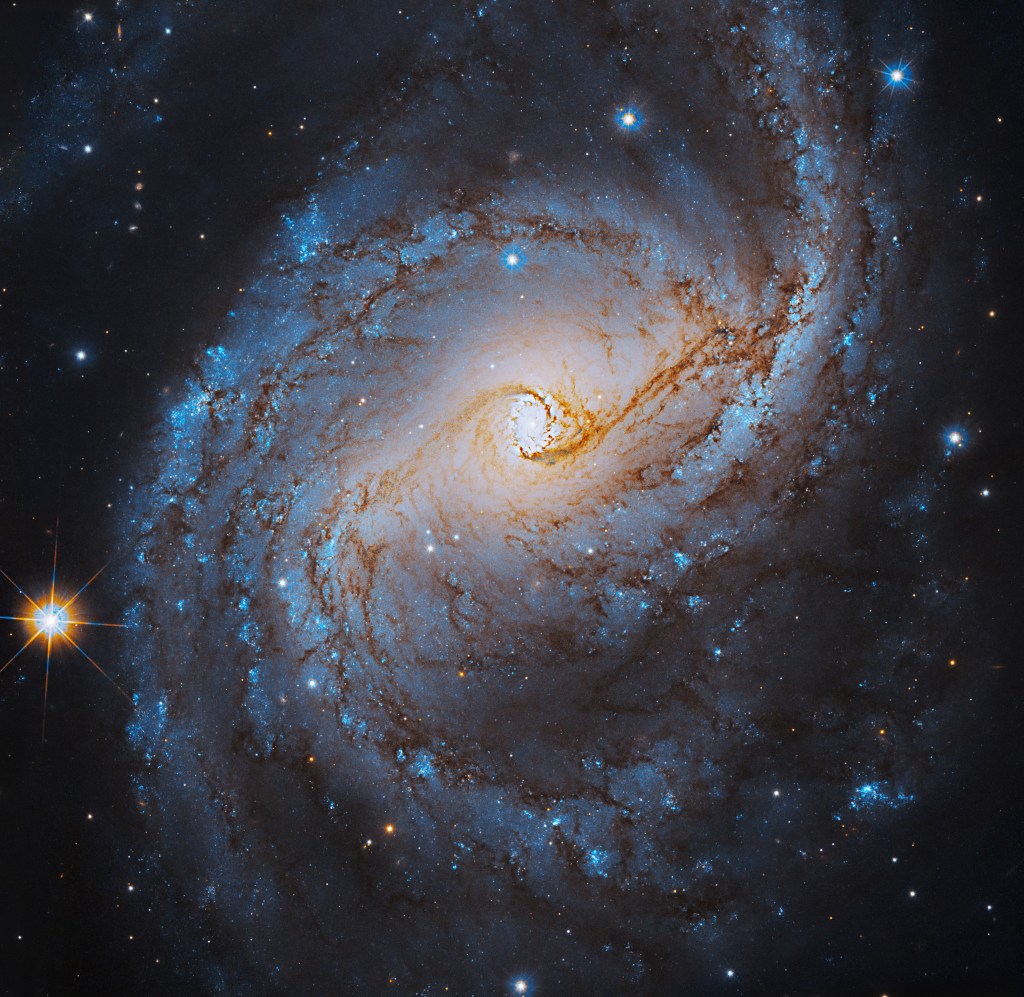
Cool image time! The picture to the right, reduced and sharpened to post here, was taken by the Hubble Space Telescope and is the third of a seven-day celebration of galaxies by the Hubble science team. Previous images in the series can be found here. From the caption for this particular image:

At the center of NGC 6951 lies a supermassive black hole surrounded by a ring of stars, gas, and dust about 3,700 light-years across. This “circumnuclear ring” is between 1 and 1.5 billion years old and has been forming stars for most of that time. Scientists hypothesize that interstellar gas flows through the dense, starry bar of the galaxy to the circumnuclear ring, which supplies new material for star formation. Up to 40 percent of the mass in the ring comes from relatively new stars that are less than 100 million years old. Spiral lanes of dust, shown in dark orange, connect the center of the galaxy to its outer regions, contributing more material for future star formation.

This galaxy, located about 78 million light years away, has also seen six different supernovae in the past quarter century. Compare that with the Milky Way, which has not seen a supernova now in more than four hundred years.
4 comments

Hubble data shows expansion of supernova remnant

Cygnus loop filament

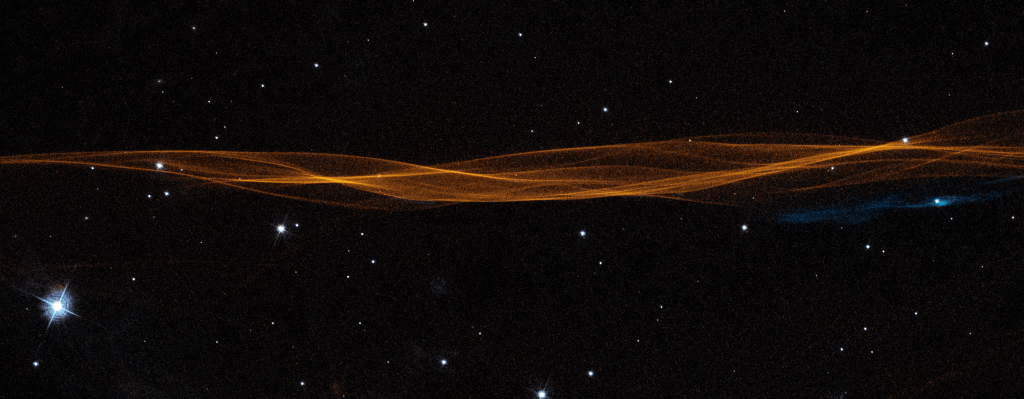
Astronomers have created a four-second long movie using Hubble images collected over twenty years that shows the expansion of one filament in the Cygnus Loop supernova remnant, the explosion of which is thought to have occurred 20,000 years ago.

The picture above is one frame of that movie. The filament is estimated to be two light years in length.

By analyzing the shock’s location, astronomers found that the shock hasn’t slowed down at all in the last 20 years, and is speeding into interstellar space at over half a million miles per hour – fast enough to travel from Earth to the Moon in less than half an hour. While this seems incredibly fast, it’s actually on the slow end for the speed of a supernova shock wave.

Two versions of the movie are at the link, with the longer providing excellent context.

2 comments

Two galaxies merging

Merging galaxies
Click for original image.

Cool image time! The picture to the right, cropped, reduced, and sharpened to post here, was taken by the Hubble Space Telescope as part of a survey project to photograph the entire Arp catalog of 338 “peculiar galaxies,” put together by astronomer Halton Arp in 1966. From the caption:

The larger galaxy (in the left of this image) is an extremely energetic galaxy type known as a Seyfert galaxy, which house active galactic nuclei at their cores. Seyfert galaxies are notable because despite the immense brightness of the active core, radiation from the entire galaxy can be observed. This is evident in this image, where the spiraling whorls of the whole galaxy are readily visible. The smaller companion is connected to the larger by a tenuous-seeming ‘bridge’, composed of dust and gas. The colliding galactic duo lie about 465 million light-years from Earth.

Note that if you ignore the blue whorls of the left galaxy, the two bright cores of these merging galaxies are about the same size. As it is unclear how long this merger has been on-going, it is possible that the galaxy on the right, in circling the left galaxy, drew out those whorls and that tenuous bridge. Other scenarios are also possible, however, such as the galaxy on the left stripping and scattering the arms of the galaxy on the right.

1 comment

A galactic cloud

A galactic cloud
Click for original image.

Cool image time! The picture to the right, cropped, reduced, and sharpened to post here, was taken by the Hubble Space Telescope. It shows what scientists dub a lenticular galaxy, with features that put it somewhere between a spiral galaxy and an elliptical (which has no structure a appears instead a cloud of stars), sitting about 73 million light years away.

NGC 3156 has been studied in many ways … from its cohort of globular clusters, to its relatively recent star formation, to the stars that are being destroyed by the supermassive black hole at its centre.

Why this galaxy has no spiral arms is somehow related to its age and its central black hole, but the detailed theories that astronomers have to explain this are far from confirmed.

The image is interesting also because of its lack of foreground stars or background galaxies. Its location in the sky explains this, as Hubble was looking at right angle to the Milky Way’s galactic plane, essentially looking directly into the vast emptiness between the galaxies.

2 comments

A triangular spiral galaxy

A triangular spiral galaxy
Click for original image.

Cool image time! The picture to the right, cropped, reduced, and sharpened to post here, was taken by the Hubble Space Telescope as part of a follow-up observations of a supernova that occurred in this galaxy in 2015. The galaxy, dubbed IC 1776, is about 150 million light years away.

Hubble investigated the aftermath of the supernova SN 2015ap during two different observing programmes, both designed to comb through the debris left by supernovae explosions in order to better understand these energetic events. A variety of telescopes automatically follow up the detection of supernovae to obtain early measurements of these events’ brightnesses and spectra. Complementing these measurements with later observations which reveal the lingering energy of supernovae can shed light on the systems which gave rise to these cosmic cataclysms in the first place.

As the caption notes, the spiral arms of this galaxy “are difficult to distinguish.” At first glance the galaxy instead appears triangular in shape, an impression that dissolves with a closer look.

0 comments

A ghostly bullseye galaxy

A ghostly bullseye
Click for original image.

A cool image to start the week! The picture to the right, cropped and reduced to post here, was taken by the Hubble Space Telescope as part of a survey scientists are doing using Hubble, attempting to get high resolution images of every galaxy within about 30 million light years of the Milky Way. Prior to this census Hubble had covered about 75% of these galaxies. This particular galaxy is called a lenticular galaxy.

Lenticular galaxies like NGC 6684 (lenticular means lens-shaped) possess a large disc but lack the prominent spiral arms of galaxies like the Andromeda Galaxy. This leaves them somewhere between elliptical galaxies and spiral galaxies, and lends these galaxies a diffuse, ghostly experience. NGC 6684 also lacks the dark dust lanes that thread through other galaxies, adding to its spectral, insubstantial appearance.

The unknown is whether this is the state of a galaxy prior to becoming a spiral, or it is what it looks like as it transitions from a spiral to an elliptical. This particular galaxy is likely the latter, as it lacks the dust, but this does not have to be the rule.

0 comments

Spirals within spirals

Spirals within spirals
Click for original image.

Cool image time! The picture to the right, cropped, reduced, and annotated to post here, was taken by the Hubble Space Telescope as part of two different research projects that are studying galaxies where supernovae previously occurred. This particular galaxy is estimated to be about 192 million light years away, and is a classic example of a barred spiral.

Despite appearing as an island of tranquillity in this image, UGC 12295 played host to a catastrophically violent explosion — a supernova — that was first detected in 2015. This supernova prompted two different teams of astronomers to propose Hubble observations of UGC 12295 that would sift through the wreckage of this vast stellar explosion.

Supernovae are the explosive deaths of massive stars, and are responsible for forging many of the elements found here on Earth. The first team of astronomers used Hubble’s Wide Field Camera 3 (WFC3) to examine the detritus left behind by the supernova in order to better understand the evolution of matter in our Universe.

The second team of astronomers also used WFC3 to explore the aftermath of UGC 12295’s supernova, but their investigation focused on returning to the sites of some of the best-studied nearby supernovae. Hubble’s keen vision can reveal lingering traces of these energetic events, shedding light on the nature of the systems that host supernovae.

What struck me about this picture however were the many smaller spiral galaxies scattered nearby and behind UGC 12295, with one face-on spiral highlighted near the top. I can count at least three or four other background spiral galaxies, all reddish in color likely because their light has been shifted to the red due to their distance.

5 comments

A spiral galaxy as seen by Hubble

A spiral galaxy as seen by Hubble
Click for original image.

Cool image time! The picture to the right, cropped, reduced, and sharpened to post here, was taken as part of a research project to use the Hubble Space Telescope to photograph galaxies where supernovae had recently occurred. From the caption:

UGC 11860 lies around 184 million light-years away in the constellation Pegasus, and its untroubled appearance can be deceiving; this galaxy recently played host to an almost unimaginably energetic stellar explosion.

A supernova explosion — the catastrophically violent end of a massive star’s life — was detected in UGC 11860 in 2014 by a robotic telescope dedicated to scouring the skies for transient astronomical phenomena; astronomical objects which are only visible for a short period of time. Two different teams of astronomers used Hubble’s Wide Field Camera 3 to search through the aftermath and unpick the lingering remnants of this vast cosmic explosion.

This Hubble image once again illustrates the vastness of the universe. Note that every single dot surrounding UGC 11860 in this picture is another far more distant galaxy. As much as UGC 11860 is in our local intergalactic neighborhood, it is still so distant that this field of view is small enough that it contains no stars.

2 comments

A faint irregular cloud of stars

A faint irregular cloud of stars
Click for original picture.

Cool image time! The picture to the right, cropped, reduced, and sharpened to post here, was released today by the science team of the Hubble Space Telescope. It shows an irregular galaxy thought to be about 44 million light years away.

Alongside its hazy shape, NGC 7292 is remarkably faint. As a result, astronomers classify NGC 7292 as a low surface brightness galaxy, barely distinguishable against the backdrop of the night sky. Such galaxies are typically dominated by gas and dark matter rather than stars.

Astronomers directed Hubble to inspect NGC 7292 during an observational campaign studying the aftermath of Type II supernovae. These colossal explosions happen when a massive star collapses and then violently rebounds in a catastrophic explosion that tears the star apart. Astronomers hope to learn more about the diversity of Type II supernovae they have observed by scrutinising the aftermath and remaining nearby stars of a large sample of historical Type II supernovae.

NGC 7292’s supernova was observed in 1964 and accordingly given the identifier SN 1964H. Studying the stellar neighbourhood of SN 1964H helps astronomers estimate the initial mass of the star that went supernova, and could uncover surviving stellar companions that once shared a system with the star that would become SN 1964H.

I searched but was unable to locate any 1964 images of this galaxy when the supernova was still visible, so I could not pinpoint its location in the picture. It has long since faded away.

Note that the reddish smudges scattered throughout the picture are likely galaxies so far distant that their light has shifted entirely into the reddish spectrum. This likely places them one to several billions of light years away, not millions.

2 comments

Hubble snaps picture of another jellyfish galaxy

Another jellyfish galaxy
Click for original image.

Astronomers today released another picture of a jellyfish galaxy taken by the Hubble Space Telescope, with that picture to the right, cropped, reduced, and sharpened to post here. From the caption:

The jellyfish galaxy JO206 trails across this image from the NASA/ESA Hubble Space Telescope, showcasing a colourful star-forming disc surrounded by a pale, luminous cloud of dust. A handful of bright stars with criss-cross diffraction spikes stand out against an inky black backdrop at the bottom of the image. JO206 lies over 700 million light-years from Earth in the constellation Aquarius.

This image is the sixth and final such photograph in this survey. You can view all of these images here. The study has found that star formation does not seem to be significantly different inside the galaxy versus the tentacles that stretch out beyond due to pressure from the intergalactic material. This suggests that the influence of this intergalactic material on the formation of stars is relatively minor.

0 comments

Jellyfish galaxy plowing its way through the intercluster medium

Jellyfish galaxy plowing through the intercluster medium
Click for original image.

The European Space Agency (ESA) today released another in a series of images taken by the Hubble Space Telescope during the past two years of what astronomers call jellyfish galaxies, so named because such galaxies have tendrils that extend out beyond the galaxy like the tendrils of jellyfish. This new picture is to the right, cropped, reduced, and sharpened to post here, and shows a galaxy about 900 million light years away.

[T]he space between galaxies in a cluster is … pervaded with a searingly hot plasma known as the intracluster medium. While this plasma is extremely tenuous, galaxies moving through it experience it almost like swimmers fighting against a current, and this interaction can strip galaxies of their star-forming gas. This interaction between the intracluster medium and the galaxies is called ram-pressure stripping, and is the process responsible for the trailing tendrils of this jellyfish galaxy.

The arrow in the image indicates the galaxy’s direction of travel through the intercluster medium, resulting in the outer parts of the leading arm to be pushed backward above the galaxy, while material at its rear trail behind. Note also the blue star-forming regions at the galaxy’s bow. The ram pressure is also apparently causing more star formation in this part of the galaxy compared to elsewhere.

5 comments

Momentus and Astroscale team up to propose Hubble servicing mission

Capitalism in space: The two orbital tug companies Momentus and Astroscale announced today that they have partnered to propose a servicing mission to the Hubble Space Telescope, designed to boost the telescope and extend its life.

The proposed mission concept, a commercial solution to extend the life of this important national asset without risk to humans, includes launching a Momentus Vigoride Orbital Service Vehicle (OSV) to low-Earth orbit on a small launch vehicle. Once on orbit, Astroscale’s RPOD technology built into the OSV would be used to safely rendezvous, approach and then complete a robotic capture of the telescope. Once mated, the OSV would perform a series of maneuvers to raise the Hubble by 50 km. Removal of surrounding and threatening space debris in Hubble’s new orbit using the Vigoride and Astroscale’s RPOD capabilities will be prioritized after the completion of the primary reboost mission.

As I have written repeatedly, Hubble is a telescope that refuses to die. I predicted that come the 2030s, when its orbit had decayed to a point that it either had to be de-orbited (NASA’s preferred option in the past when it ran everything) or be lifted to a higher orbit to extend its life, people would find a way to lift it.

Now that private enterprise is running the show, NASA is taking advantage of that to ask for private solutions to save Hubble, and not surprisingly it is quickly getting them.

4 comments
1 8 9 10 11 12 15