Hubble captures shadows on star’s outer accretion disk cast by inner accretion disk

Shadows cast on star's accretion disk
Click for original image.

Astronomers using the Hubble Space Telescope’s images taken five years apart have captured the changing shadows cast by a star’s inner accretion disk onto its outer accretion disk.

Those images are to the right, reduced and rearranged to post here. From the caption:

Comparison images from the NASA/ESA Hubble Space Telescope, taken several years apart, have uncovered two eerie shadows moving counterclockwise across a disc of gas and dust encircling the young star TW Hydrae. The discs are tilted face-on as seen from Earth and so give astronomers a bird’s-eye view of what’s happening around the star.

The [top] image, taken in 2016, shows just one shadow [A] at the 11 o’clock position. This shadow is cast by an inner disc that is slightly inclined to the outer disc and so blocks starlight. The picture on the [bottom] shows a second shadow that emerged from yet another nested disc at the 7 o’clock position, as photographed in 2021. What was originally the inner disc is marked [B] in this later view.

The shadows rotate around the star at different rates like the hand on a clock. They are evidence for two unseen planets that have pulled dust into their orbits. This makes them slightly inclined to each other. This is a visible-light photo taken with the Space Telescope Imaging Spectrograph. Artificial colour has been added to enhance details.

An artist’s conception of the system, as seen from an oblique angle, is available here. All told, this solar system of disks kind of resembles a spinning gyroscope, with its different rings tilted at different angles to conserve angular momentum.

2 comments

Two interacting galaxies, both with active supermassive black holes at their center

Interacting galaxies
Click for original image.

Cool image time! The picture to the right, cropped and reduced to post here, was taken by the Hubble Space Telescope and released today. From the caption:

This new image from NASA’s Hubble Space Telescope shows interacting galaxies known as AM 1214-255. These galaxies contain active galactic nuclei, or AGNs. An AGN is an extraordinarily luminous central region of a galaxy. Its extreme brightness is caused by matter whirling into a supermassive black hole at the galaxy’s heart.

Hubble observed the galaxy [on the right] as part of an AGN survey, with the aim of compiling a dataset about nearby AGNs to be used as a resource for astronomers investigating AGN physics, black holes, host galaxy structure, and more.

Note how the outer arms of both galaxies appear warped, with long streams of stars being pulled towards the other galaxy. Imagine living on a planet orbiting one of those stars as it finds itself over time farther and farther from its home galaxy, out in the vast emptiness of intergalactic space. While this sounds lonely, it has advantages for life, because isolated from the galaxy the star will not be threatened by supernovae, gamma ray bursts, and the host of other events that happen inside galaxies that can threaten biology.

It also means your night sky will be heralded by the rising and setting of two nearby giant galaxies.

5 comments

A nearby aging galaxy with an active supermassive black hole at its center

aging galaxy
Click for original image.

Cool image time! The picture to the right, reduced and sharpened to post here, was taken by the Hubble Space Telescope and released today. It shows a galaxy only 30 million light years away, making almost our neighbor. From the caption:

NGC 3489 has an active galactic nucleus, or AGN. The AGN sits at the center of the galaxy, is extremely bright, and emits radiation across the entire electromagnetic spectrum as the black hole devours material that gets too close to it.

This lenticular galaxy is a Seyfert galaxy, which is a class of AGN that is dimmer than other types of AGNs. They generally don’t outshine the rest of the galaxy, so the galaxy surrounding the black hole is clearly visible. Other types of AGNs emit so much radiation that it is almost impossible to observe the host galaxy.

That active nucleus is the bright dominate sphere at the galaxy’s center, large enough to overwhelm a large percentage of the rest of the galaxy. Its existence and dominance suggests that this galaxy is aging, and is beginning the transition from a spiral to an elliptical. In fact, its arms have already mostly vanished, and there is at present little star-formation on-going.

2 comments

Galaxies without end

Galaxies without end
Click for full image.

Cool image time! The picture to the right has been significantly reduced but also significantly sharpened to post here. It was taken by the Hubble Space Telescope as part of a recent survey of “jellyfish” galaxies, galaxies located in galaxy clusters where there is a large concentration of galaxies whose combined gravity and intergalactic environment acts to pull material or “tendrils” out from the galaxy.

Rather than crop the image to focus on that single large central jellyfish galaxy, I have instead sharpened the much-reduced full photo to bring out clearly the number of surrounding galaxies. There is only one Milky Way star in this picture, the object with the four diffraction spikes in the lower-right. Every other dot is a galaxy, many of which can be seen to be very strangely shaped in the original full resolution image. In fact, I strongly recommend you click on the picture to explore that original image, just to see the variety of galaxy shapes.

The point of this picture today however is not to illustrate the wide variety of galaxies that can exist, but to underline the vast and largely incomprehensible scale of the universe. The large galaxy is thought to be 650 million light years away, which means it took light traveling at 186,000 miles per second that many years to get here. The surrounding galaxies are also all tens to hundreds of millions of light years from each other. Yet, their combined gravity, almost infinitesimal in strength, is enough to warp the shape of each.

We understand these numbers and facts intellectually, but do we understand them in reality? I think it is difficult, even if you work hard to come up with a scaled comparison. For example, it took nine years for the New Horizons spacecraft to get from Earth to Pluto, a distance of about 4.5 light hours. And New Horizons was the fastest traveling probe ever launched, moving at 36,400 miles per hour when it left Earth. Yet, this distance is nothing compared to the distance between these galaxies.

The vastness of existence really is beyond our comprehension. That we try to comprehend it speaks well of the human desire to achieve the impossible.

4 comments

A classic spiral galaxy

A classic spiral galaxy
Click for original image.

Cool image time! The photo to the right, cropped, reduced, and sharpened to post here, was taken by the Hubble Space Telescope and released today as the European Space Agency’s (ESA) Hubble picture of the week.

A large spiral galaxy. It has many narrow arms that are tightly-twisted in the centre, but at the ends they point out in different directions. The galaxy’s core glows brightly, while its disc is mostly faint, but with bright blue spots throughout the arms. A few smaller spiral galaxies at varying angles are visible in front, and it is surrounded by other tiny stars and galaxies, on a black background.

This galaxy is believed to be 260 million light years away, and was home to a supernova in 2020. This image was taken as a follow-up to that explosion.

0 comments

Webb snaps infrared picture of Uranus

Uranus as seen in the infrared by Webb
Click for original Webb false-color image.

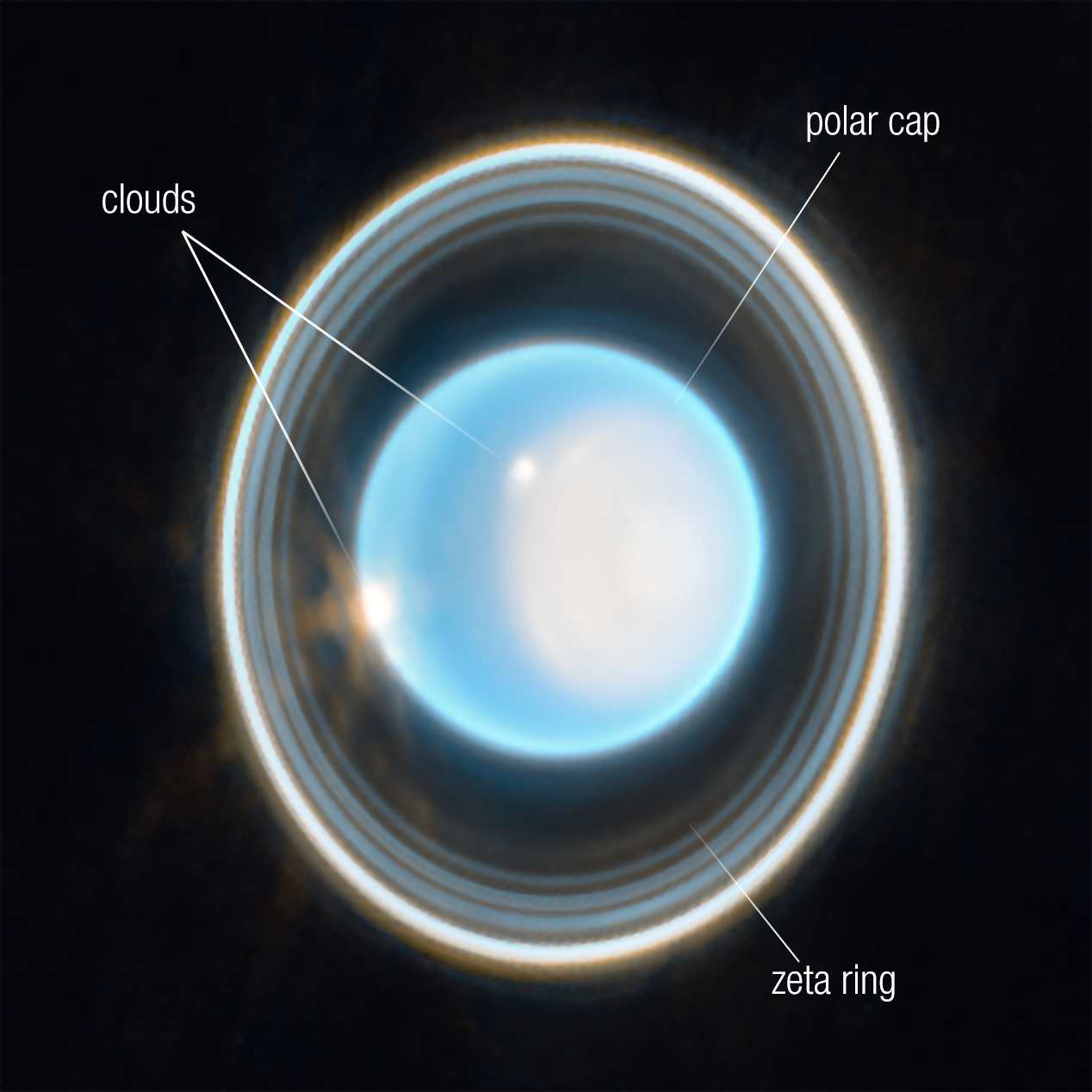
In a follow-up to a recent Hubble Space Telescope optical image of Uranus, scientists have now used the Webb Space Telescope to take a comparable picture in the infrared of the gas giant.

Both pictures are to the right, with the Webb picture at the top including the scientists’ annotations.

On the right side of the planet there’s an area of brightening at the pole facing the Sun, known as a polar cap. This polar cap is unique to Uranus – it seems to appear when the pole enters direct sunlight in the summer and vanish in the fall; these Webb data will help scientists understand the currently mysterious mechanism. Webb revealed a surprising aspect of the polar cap: a subtle enhanced brightening at the center of the cap. The sensitivity and longer wavelengths of Webb’s NIRCam may be why we can see this enhanced Uranus polar feature when it has not been seen as clearly with other powerful telescopes like the Hubble Space Telescope and Keck Observatory.

At the edge of the polar cap lies a bright cloud as well as a few fainter extended features just beyond the cap’s edge, and a second very bright cloud is seen at the planet’s left limb. Such clouds are typical for Uranus in infrared wavelengths, and likely are connected to storm activity.

The Webb image also captures 11 of Uranus’s 13 rings, which appear much brighter in the infrared than in the optical.

Unlike all other planets in the solar system, Uranus’s rotation is tilted so much that it actually rolls as it orbits the Sun, a motion that is obvious by comparing these pictures with Hubble’s 2014 optical picture.

3 comments

First binary quasar found

Double quasar as seen by the Hubble Space Telescope

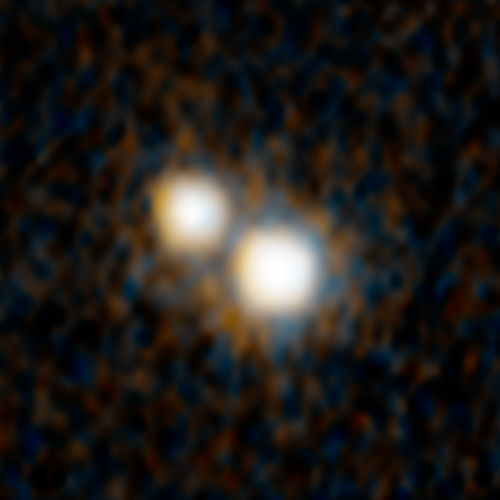
Using a suite of telescopes on the ground and in orbit, astronomers have found the first galaxy made up of two quasars, supermassive black holes that are very active in eating material from around them.

ESA’s (European Space Agency) Gaia space observatory first detected the unresolved double quasar, capturing images that indicate two closely aligned beacons of light in the young universe. Chen and his team then used NASA’s Hubble Space Telescope to verify the points of light were in fact coming from a pair of supermassive black holes.

Multi-wavelength observations followed; using Keck Observatory’s second generation Near-Infrared Camera (NIRC2) paired with its adaptive optics system, as well as Gemini North, NASA’s Chandra X-ray Observatory, and the Very Large Array network of radio telescopes in New Mexico, the researchers confirmed the double quasar was not two images of the same quasar created by gravitational lensing.

The two quasars are estimated to be only about 10,000 light years apart. Scientists estimate that this galaxy is about ten billion light years away, and exists in this state only about three billion years after the Big Bang.

0 comments

A multitude of strange galaxies

A multitude of strange galaxies
Click for original image.

Cool image time! The picture to the right, reduced and sharpened to post here, was taken by the Hubble Space Telescope and released today. From the caption:

Z 229-15 is one of those interesting celestial objects that, should you choose to research it, you will find defined as several different things: sometimes as an active galactic nucleus (an AGN); sometimes as a quasar; and sometimes as a Seyfert galaxy. Which of these is Z 229-15 really? The answer is that it is all of these things all at once, because these three definitions have significant overlap.

All three classifications involve galaxies with nuclei that are brighter, more energetic, and more massive than the rest of the galaxy. Z229-15 itself is estimated to be 390 million light years away.

Normally I would have cropped the image to center on Z229-15. However, I was struck by the number of other strange galaxies in the distance and on the periphery of the picture. Near the top is a trio of three, none of which appear spiral- or elliptical-shaped. On the right is a galaxy that could be a standard spiral seen edge-on, but its red nucleus is very unusual. And scattered across the bottom half of the image are a number of weirdly shaped galaxies of all types, none of which appear typical.

Be sure to look at the high resolution original. There are more weird galaxies visible there.

1 comment

Hubble spots long term seasonal changes on Uranus

Uranus as seen by Hubble in 2014 and 2022
Click for original image.

Using images of Uranus taken eight years apart by the Hubble Space Telescope, astronomers have detected significant seasonal changes in the atmosphere of the gas giant, caused by its unusual sideways rotation.

The two pictures to the left, realigned and reduced to post here, show the changes. If you look closely you can see the planet’s ring system and its shift to almost face on at present.

[top] — This is a Hubble view of Uranus taken in 2014, seven years after northern spring equinox when the Sun was shining directly over the planet’s equator, and shows one of the first images from the OPAL program. Multiple storms with methane ice-crystal clouds appear at mid-northern latitudes above the planet’s cyan-tinted lower atmosphere. Hubble photographed the ring system edge-on in 2007, but the rings are seen starting to open up seven years later in this view. At this time, the planet had multiple small storms and even some faint cloud bands.

[bottom] — As seen in 2022, Uranus’ north pole shows a thickened photochemical haze that looks similar to the smog over cities. Several little storms can be seen near the edge of the polar haze boundary. Hubble has been tracking the size and brightness of the north polar cap and it continues to get brighter year after year. Astronomers are disentangling multiple effects – from atmospheric circulation, particle properties, and chemical processes – that control how the atmospheric polar cap changes with the seasons. At the Uranian equinox in 2007, neither pole was particularly bright.

To really understand the long term climate of Uranus will likely take centuries, since its year lasts 84 Earth years. Since the beginning of space exploration, we have only had now about forty years of good imagery of the planet, and even that has been sporadic and very incomplete.

8 comments

Blobs and jellyfish in space

Blobs and Jellyfish
Click for original image.

Cool image time! The picture to the right, cropped and reduced to post here, was taken by the Hubble Space Telescope and released today.

The galaxy JW100 features prominently in this image from the NASA/ESA Hubble Space Telescope, with streams of star-forming gas dripping from the disc of the galaxy like streaks of fresh paint. These tendrils of bright gas are formed by a process called ram pressure stripping, and their resemblance to dangling tentacles has led astronomers to refer to JW100 as a ‘jellyfish’ galaxy. It is located in the constellation Pegasus, over 800 million light-years away.

Ram pressure stripping occurs when galaxies encounter the diffuse gas that pervades galaxy clusters. As galaxies plough through this tenuous gas it acts like a headwind, stripping gas and dust from the galaxy and creating the trailing streamers that prominently adorn JW100. The bright elliptical patches in the image are other galaxies in the cluster that hosts JW100.

The image was part of a research project studying star formation in the tendrils of jellyfish galaxies.

The blob near the top of the image is another galaxy in this same galaxy cluster. It is an elliptical galaxy that also happens to have two central nuclei, caused when two smaller galaxies merged. The central regions of each have not yet merged into one.

5 comments

Hubble looks at a nearby dwarf galaxy

A nearby dwarf galaxy
Click for original image.

Cool image time! The photo to the right, cropped, reduced, and sharpened to post here, was taken by the Hubble Space Telescope as part of a continuing project to capture high resolution images of every nearby galaxy, which in this particular case the caption describes as follows:

UGCA 307 hangs against an irregular backdrop of distant galaxies in this image from the NASA/ESA Hubble Space Telescope. The small galaxy consists of a diffuse band of stars containing red bubbles of gas that mark regions of recent star formation, and lies roughly 26 million light-years from Earth in the constellation Corvus. Appearing as just a small patch of stars, UGCA 307 is a diminutive dwarf galaxy without a defined structure — resembling nothing more than a hazy patch of passing cloud.

The red regions of star formation are significant, as they indicate that even in a tiny galaxy like this it is possible for there to be enough gas and dust to coalesce into new stars.

Astronomers living on a world inside this galaxy have an advantage over astronomers on Earth. There is no large galaxy like the Milky Way blocking their view of the cosmos in one direction. They can see it all, even in directions looking through UGCA 307.

11 comments

A confused spiral galaxy

An irregular spiral galaxy

Cool image time! The picture to the right, cropped and reduced to post here, was taken by the Hubble Space Telescope and released today. From the caption:

The irregular spiral galaxy NGC 5486 hangs against a background of dim, distant galaxies in this image from the NASA/ESA Hubble Space Telescope. The tenuous disc of the galaxy is threaded through with pink wisps of star formation, which stand out from the diffuse glow of the galaxy’s bright core. While this particular galaxy has indistinct, meandering spiral arms it lies close to the much larger Pinwheel Galaxy, one of the best known examples of ‘grand design’ spiral galaxies with prominent and well-defined spiral arms. In 2006 Hubble captured an image of the Pinwheel Galaxy which was — at the time — the largest and most detailed photo of a spiral galaxy ever taken with Hubble.

This galaxy is defined I think as an irregular spiral because if you look close, you can see a very faint hint of a central bar and two large arms spiraling away at its ends. It is faint however, and might simply be caused by the human mind’s natural desire to see patterns. To my eye this galaxy could just as well be a patchy elliptical galaxy, with no arms at all.

0 comments
1 9 10 11 12 13 15