Webb takes infrared image of Hubble’s Pillars of Creation

The Pillars of Creation, as seen by Hubble and Webb
Click for original image.

Not unexpectedly, astronomers have quickly begun aiming the Webb Space Telescope’s infrared eye at some of the most famous targets previously imaged in optical wavelengths by the Hubble Space Telescope.

The newest example is shown to the right and reduced and labeled to post here. It shows what NASA officials dubbed “The Pillars of Creation” when Hubble first photographed this nebula in 1995, with a later 2014 Hubble optical image at the top and the new 2022 Webb infrared image on the bottom. From this image’s caption:

A new, near-infrared-light view from NASA’s James Webb Space Telescope, at [bottom], helps us peer through more of the dust in this star-forming region. The thick, dusty brown pillars are no longer as opaque and many more red stars that are still forming come into view.

While the pillars of gas and dust seem darker and less penetrable in Hubble’s view [top], they appear more diaphanous in Webb’s. The background of this Hubble image is like a sunrise, beginning in yellows at the bottom, before transitioning to light green and deeper blues at the top. These colors highlight the thickness of the dust all around the pillars, which obscures many more stars in the overall region.

In contrast, the background light in Webb’s image appears in blue hues, which highlights the hydrogen atoms, and reveals an abundance of stars spread across the scene. By penetrating the dusty pillars, Webb also allows us to identify stars that have recently – or are about to – burst free. Near-infrared light can penetrate thick dust clouds, allowing us to learn so much more about this incredible scene.

While the Hubble colors attempt to mimic the colors seen by the human eye, the colors in the Webb image are all false colors, chosen by the scientists to distinguish the different infrared wavelengths produced by different features in the picture.
2 comments

Chandra takes an X-ray look at early Webb infrared observations

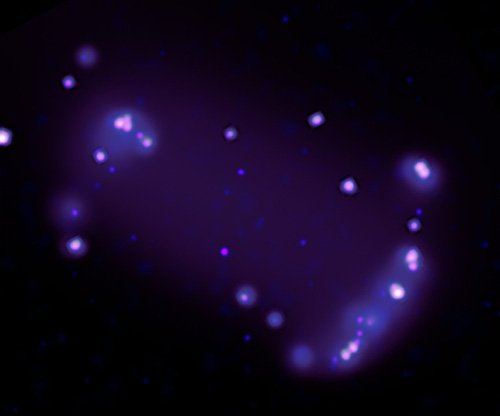
Chandra's X-ray vision of the Cartwheel Galaxy
Chandra’s X-ray view of the Cartwheel Galaxy

Webb's view of the Cartwheel Galaxy
Webb’s infrared view of the Cartwheel Galaxy
Click for full image.

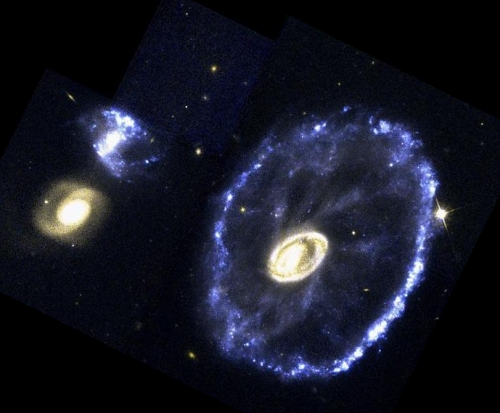
Hubble's optical view of the Cartwheel Galaxy
Hubble’s optical view of the Cartwheel Galaxy. Click for original image.

Astronomers have now taken X-ray images using the orbital Chandra X-ray Observatory of four of the first Webb Space Telescope observations. The four targets were the Cartwheel Galaxy, Stephan’s Quintet, galaxy cluster SMACS 0723.3–7327, and the Carina Nebula.

The three images to the right illustrate the importance of studying astronomy across the entire electromagnetic spectrum. Each shows the Cartwheel Galaxy as seen by three of the world’s most important space-based telescopes, each looking at the galaxy in a different wavelength.

The top picture is Chandra’s new X-ray observations. As the press release notes,

Chandra data generally show higher-energy phenomena (like superheated gas and the remnants of exploded stars) than Webb’s infrared view. … X-rays seen by Chandra (blue and purple) come from superheated gas, individual exploded stars, and neutron stars and black holes pulling material from companion stars.

The middle picture was produced by Webb, shortly after the start of its science operations. It looks at the galaxy in the infrared.

In this near- and mid-infrared composite image, MIRI data are colored red while NIRCam data are colored blue, orange, and yellow. Amidst the red swirls of dust, there are many individual blue dots, which represent individual stars or pockets of star formation. NIRCam also defines the difference between the older star populations and dense dust in the core and the younger star populations outside of it.

The bottom picture was taken by the Hubble Space Telescope in 1995. I have rotated the image to match the others. It looks at the galaxy in optical wavelengths, the wavelengths that our eyes perceive.

Note how bright the central galactic region is in the infrared and optical, but is invisible in X-rays. Chandra is telling us that all the most active regions in the Cartwheel are located in that outer ring, not in its center.

2 comments

Interacting galaxies

Interacting galaxies
Click for full image.

The news is light this morning, so this cool image will be the first of three. The picture to the right, cropped and reduced to post here, was taken by the Hubble Space Telescope and released today. From the caption:

The two interacting galaxies making up the pair known as Arp-Madore 608-333 seem to float side by side in this image from the NASA/ESA Hubble Space Telescope. Though they appear serene and unperturbed, the two are subtly warping one another through a mutual gravitational interaction that is disrupting and distorting both galaxies.

I did a search for any research of this galaxy pair, and found that its identification was only part of a larger survey, with only a little research done on its spectroscopy. Thus, I can’t tell you the size or distance, or how far apart from each other these galaxies lie.

0 comments

SpaceX and Jared Isaacman offer private mission to NASA to raise Hubble’s orbit

Capitalism in space: In a press release issued yesterday, NASA revealed that it has signed an unfunded agreement with SpaceX and Jared Isaacman’s Polaris program (which has purchased a series of manned missions on Dragon) to study the possibility of sending one of those private manned missions to the Hubble Space Telescope to raise its orbit.

SpaceX – in partnership with the Polaris Program – proposed this study to better understand the technical challenges associated with servicing missions. This study is non-exclusive, and other companies may propose similar studies with different rockets or spacecraft as their model.

Teams expect the study to take up to six months, collecting technical data from both Hubble and the SpaceX Dragon spacecraft. This data will help determine whether it would be possible to safely rendezvous, dock, and move the telescope into a more stable orbit.

In my book describing the history of the people who created Hubble, The Universe in a Mirror, I repeatedly noted how throughout its history people have tried to kill it, first in the design phase, then in the budget, then during construction, then after it was launched and the mirror was found to be ground incorrectly, and then after the Columbia accident when NASA management tried to cancel its last shuttle servicing mission.

Every attempt failed. As I have noted in that book and many times since its publication, Hubble is a telescope that will not die. NASA has for years intended to launch a mission to de-orbit it when its orbit had decayed enough that it was unstable. I’ve always said that when that time came, someone would propose and push for a mission to instead raise that orbit.

That prediction is now coming true. Though no robot arm exists yet for Dragon to use to grab Hubble in any rendezvous attempt, creating one is hardly difficult. At that point raising the telescope’s orbit becomes relatively trivial.

Whether such a mission could do more, such as replace Hubble’s ailing gyroscopes, is unknown. It would be foolish however not to review that possibility as well.

12 comments

Hubble & Webb make first coordinated observations, tracking DART impact of Dimorphus

Webb and Hubble together look at DART impact of Dimorphus
Click for full image.

For the first time scientists have used both the Hubble Space Telescope and the James Webb Space Telescope to observe the same astronomical event, in this case the impact of the DART spacecraft on the asteroid Dimorphus on September 26, 2022.

The two images to the right show the asteroid several hours after impact. Both telescopes also captured images before the impact as well. From the press release:

Observations from Webb and Hubble together will allow scientists to gain knowledge about the nature of the surface of Dimorphos, how much material was ejected by the collision, and how fast it was ejected. Additionally, Webb and Hubble captured the impact in different wavelengths of light – Webb in infrared and Hubble in visible. Observing the impact across a wide array of wavelengths will reveal the distribution of particle sizes in the expanding dust cloud, helping to determine whether it threw off lots of big chunks or mostly fine dust. Combining this information, along with ground-based telescope observations, will help scientists to understand how effectively a kinetic impact can modify an asteroid’s orbit.

When Webb was first conceived in the late 1990s, it was exactly for this reason, to combine Hubble’s optical vision with Webb’s infrared view. Though more than a decade late, it has finally happened.

It will be months before scientists begin to decipher the data produced by all the telescopes and spacecraft used to observe the DART impact. What we are seeing now are merely hints at what has been learned.

10 comments

A galaxy slowly being eaten by its black hole

Spiral galaxy
Click for full image.

Cool image time! The photo to the right, rotated and reduced to post here, was taken by the Hubble Space Telescope. From the caption:

NGC 5495, which lies around 300 million light-years from Earth in the constellation Hydra, is a Seyfert galaxy, a type of galaxy with a particularly bright central region. These luminous cores — known to astronomers as active galactic nuclei — are dominated by the light emitted by dust and gas falling into a supermassive black hole. This image is drawn from a series of observations captured by astronomers studying supermassive black holes lurking in the hearts of other galaxies.

Essentially Seyfert galaxies are galaxies whose central supermassive black hole has become dominant, large enough that its gravity is slowly eating up the rest of the galaxy. As it increasingly swallows stars and gas, the black hole emits more and more energy, thus becoming an active galactic nuclei.

Two stars from our own galaxy also dominate this picture, one inside and to the right of the galaxy’s center, and the other the bright star at the bottom of the picture, both identified by the diffraction spikes.

1 comment

Interstellar clouds backlit by nearby massive star

Interstellar clouds backlit by nearby massive star
Click for full image.

Cool image time! The photo to the right, cropped and reduce to post here, was taken by the Hubble Space Telescope of what astronomers believe is a newly formed massive star about 9,000 light years away that has periodically spewed out material during eruptions.

The scientists hope to use Hubble to determine the speed in which this material is flying away from the star by taking pictures at intervals and then measuring the amount of change from image to image. This data will also allow the scientists to better gauge the distance to this star, as well as its actual mass, information that will help them better understand what is happening.

I highlight this picture however simply because of its beauty. The interstellar clouds on the left are all apparently backlit by the brightest star on the right, and thus their shape is easy to perceive.

1 comment

A pair of spiral galaxies

IC 4271, or AP 40, a pair of active galaxies
Click for full image.

Another cool image to herald in the weekend! The photo to the right, cropped and reduced to post here, was taken by the Hubble Space Telescope and shows a pair of spiral galaxies about 800 million light years away.

The smaller galaxy is superimposed on the larger one, which is a type of active galaxy called a Seyfert galaxy.

Seyfert galaxies are named for astronomer Carl K. Seyfert who, in 1943, published a paper about spiral galaxies with very bright emission lines. Today we know that about 10% of all galaxies may be Seyfert galaxies. They belong to the class of “active galaxies” – galaxies that have supermassive black holes at their centers accreting material, which releases vast amounts of radiation. The active cores of Seyfert galaxies are at their brightest when observed in light outside the visible spectrum. The larger galaxy in this pair is a Type II Seyfert galaxy, which means it is a very bright source of infrared and visible light.

In other words, both of these galaxies emit a lot of radiation in the infrared, radio, and X-rays due to activity taking place at the supermassive black holes believed to be at their cores.

5 comments

Colliding galaxies

Merging galaxies

The string of amazing galaxy images coming from the Hubble Space Telescope continues. The photo to the right, cropped and reduced to post here, was released today and shows an object dubbed VV-689 that is believed to be two galaxies in the process of colliding and merging.

The angelic image comes from a set of Hubble observations that took a closer look at “Zoo Gems,” interesting galaxies from the Galaxy Zoo citizen science project. This crowdsourced program relies on hundreds of thousands of volunteers to classify galaxies and help astronomers wade through a deluge of data from robotic telescopes. In the process, volunteers discovered a gallery of weird and wonderful galaxy types, some not previously studied.

This image will lay the groundwork for more detailed research. Right now it appears no one has even estimated its distance.

4 comments

The spiral galaxy M91

spiral galaxy M91
Click for full release image.

Cool image time! The image to the right, reduced to post here, was released today by the Space Telescope Science Institute as part of a regular program using the Hubble Space Telescope to photograph galaxies.

This observation is part of an effort to build a treasure trove of astronomical data exploring the connections between young stars and the clouds of cold gas in which they form. To do this, astronomers used Hubble to obtain ultraviolet and visible observations of galaxies already seen at radio wavelengths by the ground-based Atacama Large Millimeter/submillimeter Array.

The galaxy is estimated to be about 55 million light years away, and is thought to have a supermassive black hole at its center with a mass somewhere between 9 and 38 million times the mass of the Sun.

9 comments

Hugging galaxies

Hugging galaxies
Click for full image.

Cool image time! The Hubble Space Telescope science team today released the photo to the right, cropped and reduced to post here, of the interaction of three galaxies, the larger two of which look like they are hugging each other.

This galaxy triplet is estimated to be about just under 700 million light years away. It was taken as part of a program aimed at producing high quality images of strange looking galaxies.

Using Hubble’s powerful Advanced Camera for Surveys, astronomers took a closer look at some of the more unusual galaxies that volunteers identified. The original Galaxy Zoo project was the largest galaxy census ever carried out and relied on crowdsourcing time from more than 100,000 volunteers to classify 900,000 unexamined galaxies. The project achieved what would have been years of work for a professional astronomer in only 175 days and has led to a steady stream of similar astronomical citizen science projects. Later Galaxy Zoo projects have included the largest ever studies of galaxy mergers and tidal dwarf galaxies, as well as the discovery of entirely new types of compact star-forming galaxies.

If you want to do some real science, you should definitely check out the Galaxy Zoo webpage. Anyone can join in, using images produced by the Victor Blanco 156 inch (4 meter) telescope in Chile to find cool stuff that needs closer examination using better telescopes like Hubble.

7 comments

A galactic starship Enterprise

A galactic starship Enterprise
Click for full image.

Cool image time! The image to the right, cropped and reduced to post here, was taken by cameras on the Hubble Space Telescope. From the caption:

The subject of this image is a group of three galaxies, collectively known as NGC 7764A. They were imaged by the NASA/ESA Hubble Space Telescope, using both its Advanced Camera for Surveys and Wide Field Camera 3. The two galaxies in the upper right of the image appear to be interacting with one another. The long trails of stars and gas extending from them give the impression that they have both just been struck at great speed, thrown into disarray by the bowling-ball-shaped galaxy to the lower left of the image. In reality, interactions between galaxies happen over very long time periods, and galaxies rarely collide head-on with one another. It is also unclear whether the galaxy to the lower left is interacting with the other two, although they are so relatively close in space that it seems possible that they are.

This galaxy group is estimated to be about 425 million light years away, though that number might be different for the galaxy in the lower left.

5 comments
1 11 12 13 14 15