India’s Mangalyaan Mars probe working fine

After three months in orbit around Mars, India’s Mangalyaan spacecraft continues to function as designed, and is expected to operate beyond its planned six month mission.

In the last three months, Mangalyaan has captured nearly 300 pictures. On an average the spacecraft takes four pictures in three days. Besides capturing the images of dust storm activities, it has also taken images of comet Siding Spring.

Because of Mangalyaan’s orbit and the wide-angle nature of its camera the pictures are generally global. This output also is not spectacular compared to other probes. Nonetheless, this is an achievement for which India should be proud.

0 comments

Countdown begins for the suborbital test flight of India’s new rocket

Link here. The launch is scheduled for 11 pm Eastern tonight.

Thursday’s test launch will check the performance of the GSLV Mk. 3’s first stage and strap-on boosters, which will carry the rocket out of the atmosphere beyond the boundary of space. The launcher’s cryogenic upper stage, which will be active and fueled by liquid hydrogen on future missions, will be dormant on Thursday’s flight.

…After the rocket’s propulsion shuts down, a gumdrop-shaped capsule will separate from the GSLV Mk. 3’s dummy upper segment about five-and-a-half minutes after liftoff, according to the Times of India, another English-language paper in India. The capsule weighs about 8,000 pounds — about 3.6 metric tons. Indian engineers from Hindustan Aeronautics Ltd. fabricated the car-sized module, and ISRO added sensors, strain gauges, a guidance and control system and a heat shield for the suborbital flight, which is called the Crew Module Atmospheric Re-entry Experiment, or CARE.

0 comments

India’s manned space program

This short article gives us a short but detailed look at India’s plans for manned space, describing both the first test flight of a engineering version of their manned capsule in a little more than a month and the program’s overall goals.

The test flight:

“The first test trial, that of the crew module, will be undertaken in November last week or December first week on the GSLV MK-III,” [Isro chairman K Radhakrishnan told Deccan Herald.] The crew module will be injected into orbit by the GSLV at a height of 110-120 km in space from where it will fall towards the earth and be recovered from sea. Isro will examine how the crew module and thermal shield around it handle the heat and temperatures during re-entry into the earth’s atmosphere.

Their eventual goal is to put two astronauts in orbit for seven days. To do that they will first have to complete at least four to six test launches of their new GSLV MK-III rocket, which has only completed one successful launch after literally two decades of failures. If successful, the test flight described above will be GSLV’s second successful launch.

Note that because of poor writing the article gives the improper impression that the test flight will be manned. It will not. Also, the article states incorrectly that the space shuttle Columbia broke up during re-entry because “the thermal heat shields could not withstand the heat.” This is false. The heat shield would have worked fine, as it had done on numerous previous launches, except that there were gaping holes in it that were put there by pieces of foam during launch.

1 comment

India begins tests of larger rocket engine

The competition heats up: Indian engineers have successfully completed their first tests of a new more powerful upper stage engine for their biggest launch rocket.

Taking a big step forward in the development of bigger and more powerful locally-built rocket engines, the Liquid Propulsion Systems Centre (LPSC) on Monday successfully conducted the first ‘cold flow test’ on the CE-20 cryogenic engine, which will power the upper stage of the Geosynchronous Satellite Launch Vehicle-Mk III (GSLV-Mk III). “It’s a milestone,” LPSC director Dr K Sivan told ‘Express’ here on Tuesday, confirming that the test had gone as planned at the LPSC facility in Mahendragiri, Tamil Nadu. The first ‘hot test’ – where the engine will be fired for a few seconds- will be performed in three weeks’ time, Sivan said.

In a cold test, the propellants are not ignited. On Monday, the fuel, Liquid Hydrogen (LH2), and the oxidiser, Liquid Oxygen (LOX), were injected into the chambers for the checking of various parameters.

In related news, Mangalyaan has taken another global view of Mars.

0 comments

Another succesful rocket launch for India

The competition heats up: India today successfully launched the third of seven home-built GPS satellites.

The head of ISRO, India’s NASA, also noted after the launch that the next test flight of their much larger GSLV rocket should occur within the next six weeks. If things go as expected, that flight will also include a test flight of an engineering prototype of an India-built manned capsule.

0 comments

India gets Canadian launch contract

The competition heats up: Because of the Russian situation in the Ukraine, Canada has rejected a launch contract with Russia and signed India to do the launch instead.

No word on the rocket Canda will use, but I suspect it will be India’s smaller rocket, tested and more dependable. Their geosynchronous rocket, GSLV, is still in the testing stage.

1 comment

Mangalyaan’s first global images of Mars

Indian engineers have released the first global images taken by Mangalyaan.

As MOM’s orbit is highly elliptical, reaching from 262 miles (periareon — closest approach) to 47,841 miles (apoareon — farthest extent), we can expect a lot more global views from Mars’ newest satellite, providing us with a beautiful global perspective of a planet that currently has seven robotic missions (from three different space agencies) exploring it.

These images suggest that a dust storm is beginning to stir on the Martian surface.

0 comments

India: Space success vs red tape?

Even as India celebrates the success of its Mars orbiter Mangalyaan, its aerospace industry complains of red tape and a slow-moving bureaucracy.

Between 2007 and 2012, ISRO accomplished about half of its planned 60 missions, government data showed. The government cited “development complexity” as the reason for the delay in some missions. Between 2012 and 2017 the target is 58 missions. The agency has completed 17 missions so far, and ISRO did not say why the number remained low. Some company executives and experts do not see that changing any time soon, with the absence of heavy rocket launchers, too few launch facilities and bureaucratic delays hampering growth.

I could also say that the battle is now joined between India’s military-industrial complex and private enterprise. With a government now in power that claims to be pro-business, we shall see where this battle leads.

0 comments

Mangalyaan sends its first Mars pictures

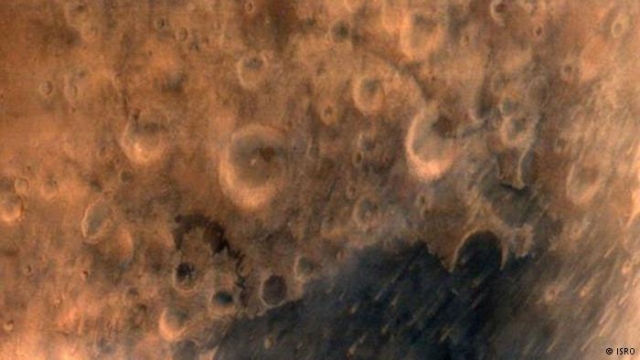
Mangalyaan's first image of Mars

Indian engineers have posted Mangalyaan’s first image on the spacecraft’s Facebook and Twitter accounts, as well as presented the photo to their nation’s leader.

My first reaction when I looked at the image above was an immediate flashback to 1969, when the American probes Mariner 6 and Mariner 7 flew past Mars, taking images of its cratered southern hemisphere and thus making scientists think for several years that Mars was not much different than the Moon. The Indian image is of about the same quality, and shows lots of moon-like craters.

Image if this was the first close-up image of Mars anyone had ever seen. It would be very easy to assume that Mars is pockmarked with craters everywhere, just like the Moon.

1 comment
1 33 34 35 36 37 42