Not only have the models failed to predict temperature, they also have failed to predict the amount of methane in the atmosphere.

Another IPCC failure, revealed in the leaked report: Not only have the models failed to predict global temperature, they also have failed to predict the amount of methane in the atmosphere.

The graph at the link is just like the temperature graph I posted on Monday. It compares actual observations with the predictions of the computer models, which all called for a hefty rise in atmospheric methane. All the models got it wrong.

0 comments

A preliminary copy of the next IPCC report has been leaked.

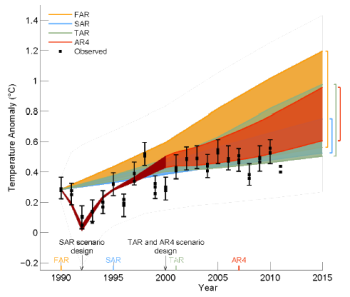
IPCC figure

A preliminary copy of the next IPCC report has been leaked.

In the coming days there will be much discussion of this document — such as how it appears the IPCC has finally acknowledged the importance of the Sun’s variability to climate change — but for now, I post on the right what is probably its most important admission. This graph from the leaked report shows the rise in global temperatures as predicted by all the different climate models used by the IPCC, compared to actual observed temperatures. As you can see, since the late 1990s there has been no significant increase in global temperature. Moreover, the observed data now sits outside the predicted margin of error for all the models, making every single one of these models completely wrong.

But don’t worry, these facts aren’t important. In fact, any facts that contradict the religion of global warming must be ignored. It is far more important to shut down all industry and live like cavemen, just because we have faith in our belief in global warming.

29 comments

Scientists have found that the method used by the IPCC to measure droughts has significantly overestimated their number during the the past 60 years.

The uncertainty of science: Scientists have found that the method used by the IPCC to measure droughts has significantly overestimated their number during the the past 60 years.

Although previous studies have suggested that droughts have increased over that 60-year period, the team’s new analysis hints that the increase in drought has been substantially overestimated. For instance, the new assessment technique found that between 1980 and 2008, the global area stricken by drought grew by approximately 0.08% per year—less than one-seventh the increase estimated by the temperature-only [IPCC method].

The IPCC and the global warming activists that run it had claimed that the warming climate was causing more droughts. It turns out that claim was essentially false. The number of droughts has apparently not gone up. Note that this fact is actually not a surprise to those who have read the IPCC reports carefully. Deep down past their simplistic summaries, the reports have consistently pointed out that these conclusions were very uncertain and could be found to be wrong.

Not surprisingly, the article above spends a lot of time trying to rationalize this new data, quoting one scientist who insists there is nothing to see here, move on! The trouble is that there is plenty to see here. Our knowledge of the climate remains very incomplete.

0 comments

A review by the IPCC of its earlier reports has admitted to serious problems and fundamental biases.

A review by the IPCC of its earlier reports has admitted that the manner in which the reports were produced had serious problems and fundamental biases.

The IAC reported that IPCC lead authors fail to give “due consideration … to properly documented alternative views” (p. 20), fail to “provide detailed written responses to the most significant review issues identified by the Review Editors” (p. 21), and are not “consider[ing] review comments carefully and document[ing] their responses” (p. 22). In plain English: the IPCC reports are not peer-reviewed.

The IAC found that “the IPCC has no formal process or criteria for selecting authors” and “the selection criteria seemed arbitrary to many respondents” (p. 18). Government officials appoint scientists from their countries and “do not always nominate the best scientists from among those who volunteer, either because they do not know who these scientists are or because political considerations are given more weight than scientific qualifications” (p. 18). In other words: authors are selected from a “club” of scientists and nonscientists who agree with the alarmist perspective favored by politicians.

The rewriting of the Summary for Policy Makers by politicians and environmental activists — a problem called out by global warming realists for many years, but with little apparent notice by the media or policymakers — was plainly admitted, perhaps for the first time by an organization in the “mainstream” of alarmist climate change thinking. “[M]any were concerned that reinterpretations of the assessment’s findings, suggested in the final Plenary, might be politically motivated,” the IAC auditors wrote. The scientists they interviewed commonly found the Synthesis Report “too political” (p. 25). [emphasis mine]

The sad part is that almost none of these problems have been addressed by the IPCC in producing its next report, due out sometime in 2013 or 2014.

3 comments

The IPCC has decided that it is too difficult to purge non-peer-reviewed envionmental activist press releases from its next report.

The IPCC has decided that it is too difficult to purge non-peer-reviewed envionmental activist press releases from its next report. Instead,

[A]ny information they choose to use will be considered peer reviewed just by being posted on the Internet by the IPCC.

In addition, the IPCC has decided “to impose gender and geographical quotas on IPCC membership,” rather than simple pick the best scientists.

And climate scientists wonder why the public no longer believes anything they say.

1 comment

“I feel duped.”

The man duped is Fritz Vahrenholt, a former global warming advocate and leftwing environmentalist in Germany. The words were spoken in a long and detailed interview in Der Spiegel. Read it all, as it demonstrates without question that Vahrenholt has done his research about the complexities of climate research as well as the flaws and dishonesty contained within the IPCC reports. However, he gets to the nub of the matter when he is asked why he has taken on the role of a climate skeptic with such passion.
» Read more

1 comment

Two more global warming scientists turn skeptics

Two more global warming scientists, this time in Germany, have become global warming skeptics.

One of the fathers of Germany’s modern green movement, Professor Dr. Fritz Vahrenholt, a social democrat and green activist, decided to author a climate science skeptical book together with geologist/paleontologist Dr. Sebastian Lüning. Vahrenholt’s skepticism started when he was asked to review an IPCC report on renewable energy. He found hundreds of errors. When he pointed them out, IPCC officials simply brushed them aside. Stunned, he asked himself, “Is this the way they approached the climate assessment reports?”

Vahrenholt decided to do some digging. His colleague Dr. Lüning also gave him a copy of Andrew Montford’s The Hockey Stick Illusion. He was horrified by the sloppiness and deception he found. Persuaded by Hoffmann & Campe, he and Lüning decided to write the book. Die kalte Sonne [The Cold Sun] cites 800 sources and has over 80 charts and figures. It examines and summarizes the latest science.

[The c]onclusion: climate catastrophe is called off. The science was hyped.

7 comments

The IPCC scientist working group has decided that Freedom of Information Act laws do not apply to its work

The law is such an inconvenient thing: The IPCC scientist working group, meeting in San Francisco, has decided that Freedom of Information Act laws do not apply to its work.

Putting aside the absurdity of a bunch of individuals simply declaring they don’t have to obey the law, it is interesting to me that the lead scientists of the IPCC happen to be meeting in San Francisco the same time the UN climate conference was going on in Durban. This seems to me to be further evidence of how irrelevant science was to that Durban conference.

0 comments

Climate theatre of the absurd

Climate theater of the absurd.

The key thing to understand about the climate talks is that they’re not really about the climate. They’re about power and money. They are about the desire of fast-growing emitters such as Brazil, South Africa, India and China to extract billions in so-called climate reparations from rich countries, especially the United States. These and other so-called developing countries now account for more than half of greenhouse gas emissions. They want the rich countries to start cutting large amounts of carbon right away, while they do nothing. The rich countries are understandably reluctant. Hence the impasse.

1 comment

The draft treaty being proposed in Durban

Some of the madness contained in the draft treaty being proposed in Durban, as reported by Lord Christopher Monckton:

  • A new International Climate Court will have the power to compel Western nations to pay ever-larger sums to third-world countries in the name of making reparation for supposed “climate debt”. The Court will have no power over third-world countries. Here and throughout the draft, the West is the sole target. “The process” is now irredeemably anti-Western.
  • “Rights of Mother Earth”: The draft, which seems to have been written by feeble-minded green activists and environmental extremists, talks of “The recognition and defence of the rights of Mother Earth to ensure harmony between humanity and nature”. Also, “there will be no commodification [whatever that may be: it is not in the dictionary and does not deserve to be] of the functions of nature, therefore no carbon market will be developed with that purpose”.
  • War and the maintenance of defence forces and equipment are to cease – just like that – because they contribute to climate change. There are other reasons why war ought to cease, but the draft does not mention them.

There’s more stupidity detailed by Monckton at the link.

All in all, this treaty draft once again reveals these activists for what they are: power-hungry socialists whose real goal isn’t to save the Earth but to take from some to enrich themselves and others. I pray the Obama administration and Congress refuse to go along.

0 comments

A collection of pertinent emails from Climategate 2

A collection of pertinent quotes from Climategate 2.

I come to two conclusions as I read these and earlier emails.

  • The IPCC process has nothing to do with science and should not be considered a valid reference source.
  • The scientists involved are as unsure of the science as the skeptics, but don’t want anyone to know.

Both of these facts are important to recognize in order to decide what sources of information are reliable in studying this issue. And obviously, this means that almost any reports or press announcements coming out of Durbin this week are untrustworthy.

2 comments

One scientist’s perspective on the new Climategate emails

One scientist’s perspective on the new Climategate emails.

Long time readers will recall that in 2004 and 2005 (before Katrina), I led an interdisciplinary effort to review the literature on hurricanes and global warming. The effort resulted in a peer-reviewed article in the Bulletin of the American Meteorological Society. That paper, despite being peer-reviewed and standing the test of time (as we now know), was ignored by the relevant part of the IPCC 2007 that dealt with extreme events. Thanks to the newly released emails from UEA [University of East Anglia] (hacked, stolen, donated, or whatever) we can say with certainty why that paper was excluded from the IPCC 2007 report Chapter 3 which discussed hurricanes and climate change. Those various reviews associated with the release of the UEA emails that concluded that no papers were purposely kept out of the IPCC may want to revisit that particular conclusion.

Read the whole thing. It is worth it to get a real sense about how petty and political the IPCC process is. It has little to do with science, and everything to do with forcing a conclusion down everyone’s throat.

0 comments

India pushes for a sharing of intellectual property rights at Durban climate talks

India pushes for a sharing of intellectual property rights at Durban climate talks.

If you ever had any doubts about the political goals behind the global warming movement, this headline and story should put those forever to rest. The advocates of climate change really don’t care about climate change. What they really want is to get their hands on other people’s success. Failing to get a deal that would limit the activities of the developed countries so that the developing countries would have an advantage in the free market, the effort is now aimed at attacking and even eliminating the property rights of private technology companies. What this has to do with climate change is beyond me.

That India is leading the way here is puzzling, however, as that country’s economic success in the past decade is solely due to its abandonment of communist ideals in favor of capitalism and the free market. You would think, with that experience, that India’s government would thus understand the importance of protecting property rights, not violating them.

0 comments

Uncertainty rules the day

The press reports have been unanimous:

Unfortunately, if you read the actual IPCC panel summary report, you find that, though the majority of the press stories accurately describe the report’s worst scenarios and predictions, all of them downplay the most important point of the report, that the uncertainties are gigantic and that the influence of human activity on the increase or decrease of extreme weather for the next few decades will be inconsequential. To quote the report:
» Read more

3 comments
1 2 3