
Scientists have found evidence of a great lake below the surface of Europa
Scientists have found evidence for the existence of great shallow lakes below the surface of Europa.
Scientists have found evidence for the existence of great shallow lakes below the surface of Europa.
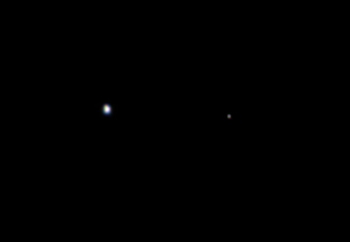
Juno, on its way to Jupiter, took a look back and snapped this picture of the Earth/Moon double planet.
The image was taken by the spacecraft’s camera, JunoCam, on Aug. 26 when the spacecraft was about 6 million miles (9.66 million kilometers) away.
Gives us a glimpse at what our home planet will really look like to future spacefarers, either on they way out or on their way home.
Things are so good on Juno ten days after launch that mission controllers have canceled a rocket burn to adjust the spacecraft’s course.
Juno, the U.S.’s next Jupiter probe, headed to the launchpad on Friday for a planned August 5 launch.
The ripples in the rings of Saturn and Jupiter were caused by comet impacts decades ago.
Jupiter’s south equatorial stripe appears to be reappearing.
Steve Squyres of Cornell University and the project scientist of the Mars rovers Spirit and Opportunity spoke today at an astrobiology symposium in Arlington, Virginia. He described several spectacular planetary missions that might be flown in the coming decade. All are being considered. None have yet been chosen or funded.
Squyres is the co-chair of a committee of the National Science Foundation that is right now putting together a decadal survey for outlining unmanned planetary research for the next decade. This survey is expected to be released in March, which is when we will find out which of the above missions the planetary science community prefers.
The detection in June by two different amateur astronomers of an impact on Jupiter bodes well for asteroid/comet research. You can read the actual paper here. [pdf] Key quote from the abstract:
A systematic study of the impact rate and size of these bolides can enable an empirical determination of the flux of meteoroids in Jupiter with implications for the populations of small bodies in the outer Solar System and may allow a better quantification of the threat of impacting bodies to Earth. The serendipitous recording of this optical flash opens a new window in the observation of Jupiter with small telescopes.
More information on the recently discovered fireball that impacted Jupiter on August 20, including images.