Juno turns on

The Juno engineering team has begun turning the spacecraft’s instruments back on following its Jupiter orbital insertion.

Everything looks fine. The next important engine burn on October 19 will shrink the orbit from 53 days to 14 days. In the meantime the present orbit will dip down close to Jupiter on August 27. Expect some news on September 1.

0 comments

Juno has entered Jupiter’s magnetic field

After five years of travel, Juno last Friday entered Jupiter’s gigantic and very powerful magnetic field in its approach for its July 4 orbital insertion.

Meanwhile, they have uploaded to the spacecraft its final software commands for that orbital insertion.

At about 12:15 pm PDT today (3:15 p.m. EDT), mission controllers will transmit command product “ji4040” into deep space, to transition the solar-powered Juno spacecraft into autopilot. It will take nearly 48 minutes for the signal to cover the 534-million-mile (860-million-kilometer) distance between the Deep Space Network Antenna in Goldstone, California, to the Juno spacecraft. While sequence ji4040 is only one of four command products sent up to the spacecraft that day, it holds a special place in the hearts of the Juno mission team. “Ji4040 contains the command that starts the Jupiter Orbit insertion sequence,” said Ed Hirst, mission manager of Juno from NASA’s Jet Propulsion Laboratory in Pasadena, California. “As soon as it initiates — which should be in less than a second — Juno will send us data that the command sequence has started.”

1 comment

Hubble images Jupiter and its aurora

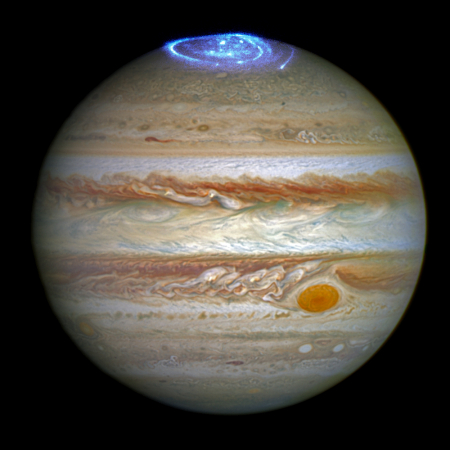
Jupiter and its aurora

Cool image time! In anticipation of the arrival of Juno in orbit around Jupiter on July 4, scientists have released a spectacular image of Jupiter and its aurora, taken by the Hubble Space Telescope. The image on the right has been reduced slightly to fit on the webpage.

The main focus of the imaging is the aurora.

To highlight changes in the auroras, Hubble is observing Jupiter almost daily for several months. Using this series of far-ultraviolet images from Hubble’s Space Telescope Imaging Spectrograph, it is possible for scientists to create videos that demonstrate the movement of the vivid auroras, which cover areas bigger than the Earth.

Not only are the auroras huge in size, they are also hundreds of times more energetic than auroras on Earth. And, unlike those on Earth, they never cease. While on Earth the most intense auroras are caused by solar storms — when charged particles rain down on the upper atmosphere, excite gases, and cause them to glow red, green, and purple — Jupiter has an additional source for its auroras.

The strong magnetic field of the gas giant grabs charged particles from its surroundings. This includes not only the charged particles within the solar wind, but also the particles thrown into space by its orbiting moon Io, known for its numerous and large volcanos.

I have embedded below the fold one of the videos of the aurora, taken over time by Hubble. Quite amazing.
» Read more

3 comments

Juno closing in on Jupiter

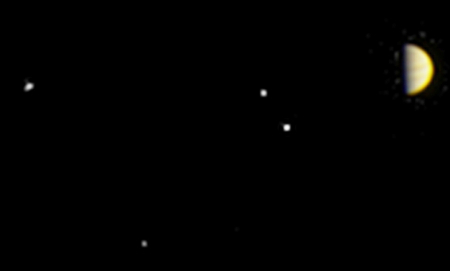
Jupiter from Juno

On Friday the Juno science team released a new image of Jupiter taken by the spacecraft from about 6.8 million miles away.

The reduced resolution image on the right is cropped but with the colors enhanced to bring out the four Galilean moons, Ganymede, Callisto, Europa, and Io. The website notes that “Juno is approaching over Jupiter’s north pole, affording the spacecraft a unique perspective on the Jovian system. Previous missions that imaged Jupiter on approach saw the system from much lower latitudes, closer to the planet’s equator.”

Rendezvous and orbital insertion happens on July 4.

0 comments

A possible impact on Jupiter?

On March 17 two different amateur astronomers have taken videos of a bright flash on Jupiter which suggests something had crashed into the gas giant.

March 17th’s impact, if the evidence for it holds up, becomes the fourth such event in the past decade. The largest of these occurred July 19, 2009, and it left a distinctly dark “powder burn” in Jupiter’s upper atmosphere first spotted by Australian astro-imager Anthony Wesley. That was followed by three lesser strikes on June 3, 2010 (recorded independently by Wesley and Christopher Go); on August 10, 2010 (independently seen by Masayuki Tachikawa and Kazuo Aoki); and on September 10, 2012 (seen visually by Dan Petersen and independently recorded by George Hall).

Counting the historic multiple-hit crash of Comet Shoemaker-Levy 9 in July 1994, that’s a grand total of six impacts on Jupiter in the past 22 years.

0 comments

Cosmic rays cause the red in Jupiter’s Great Red Spot

New ground-based chemistry research suggests that the bombardment of cosmic rays in Jupiter’s upper atmosphere could be the cause of the red color of the gas giant’s Great Red Spot.

They found that one of the spot’s major components, ammonium hydrosulfide, breaks down when exposed to that radiation in such a way that it turns red. They also think that ultraviolet radiation, also prevalent in space, will do the same.

2 comments

Juno becomes most distant solar-powered mission

Scheduled to enter orbit around Jupiter in July 2016, the American space probe Juno has now broken the record as the most distant solar-powered interplanetary spacecraft ever to operate.

The previous record had been held by Rosetta. In the past most missions beyond Mars used nuclear-generated power plants, since the amount of sunlight is insufficient. However, improvements to the efficiency of solar power, combined with a lack of nuclear fuel in the U.S., has made it possible to fly missions using solar power farther from the sun.

0 comments

New weather maps of Jupiter

Using the Hubble Space Telescope astronomers have compiled a new set of maps of Jupiter, showing changes in the gas giant’s bands and spots, including the Giant Red Spot.

The scientists behind the new images took pictures of Jupiter using Hubble’s Wide Field Camera 3 over a ten-hour period and have produced two maps of the entire planet from the observations. These maps make it possible to determine the speeds of Jupiter’s winds, to identify different phenomena in its atmosphere and to track changes in its most famous features.

The new images confirm that the huge storm, which has raged on Jupiter’s surface for at least three hundred years, continues to shrink, but that it may not go out without a fight. The storm, known as the Great Red Spot, is seen here swirling at the centre of the image of the planet. It has been decreasing in size at a noticeably faster rate from year to year for some time. But now, the rate of shrinkage seems to be slowing again, even though the spot is still about 240 kilometres smaller than it was in 2014.

1 comment

Juno flight plan at Jupiter revised

In preparation for its arrival in orbit around Jupiter in about a year, engineers for the unmanned probe Juno have revised their planned orbital maneuvers.

Following a detailed analysis by the Juno team, NASA recently approved changes to the mission’s flight plan at Jupiter. Instead of taking 11 days to orbit the planet, Juno will now complete one revolution every 14 days. The difference in orbit period will be accomplished by having Juno execute a slightly shorter engine burn than originally planned.

The revised cadence will allow Juno to build maps of the planet’s magnetic and gravity fields in a way that will provide a global look at the planet earlier in the mission than the original plan. Over successive orbits, Juno will build a virtual web around Jupiter, making its gravity and magnetic field maps as it passes over different longitudes from north to south. The original plan would have required 15 orbits to map these forces globally, with 15 more orbits filling in gaps to make the map complete. In the revised plan, Juno will get very basic mapping coverage in just eight orbits. A new level of detail will be added with each successive doubling of the number, at 16 and 32 orbits.

The change will extend the official mission from 15 to 20 months, though I expect that even this will be extended if the spacecraft’s fuel holds out.

0 comments

Is the dark material along Europa’s long surface fissures sea salt?

The uncertainty of science: By creating what they call “Europa in a can” here on Earth, scientists have determined that the dark material that appears to have seeped out of Europa’s long linear fractures might be sea salt from the underground ocean, turned brown by the harsh radiation hitting the moon’s surface.

This result is quite intriguing, but the only thing certain about it is its uncertainty. The only way we will know what this brown material really is will be to go there again with much better equipment and study the material itself

1 comment

Ganymede’s underground salt water ocean

By measuring the interaction of Jupiter and Ganymede’s magnetic fields, scientists have been able to estimate the size of the salt water ocean in Ganymede’s interior.

A team of scientists led by Joachim Saur of the University of Cologne in Germany came up with the idea of using Hubble to learn more about the inside of the moon. “I was always brainstorming how we could use a telescope in other ways,” said Saur. “Is there a way you could use a telescope to look inside a planetary body? Then I thought, the aurorae! Because aurorae are controlled by the magnetic field, if you observe the aurorae in an appropriate way, you learn something about the magnetic field. If you know the magnetic field, then you know something about the moon’s interior.”

If a saltwater ocean were present, Jupiter’s magnetic field would create a secondary magnetic field in the ocean that would counter Jupiter’s field. This “magnetic friction” would suppress the rocking of the aurorae. This ocean fights Jupiter’s magnetic field so strongly that it reduces the rocking of the aurorae to 2 degrees, instead of 6 degrees if the ocean were not present. Scientists estimate the ocean is 60 miles (100 kilometers) thick — 10 times deeper than Earth’s oceans — and is buried under a 95-mile (150-kilometer) crust of mostly ice.

That’s more water than contained in all of Earth’s oceans.

1 comment
1 9 10 11 12 13