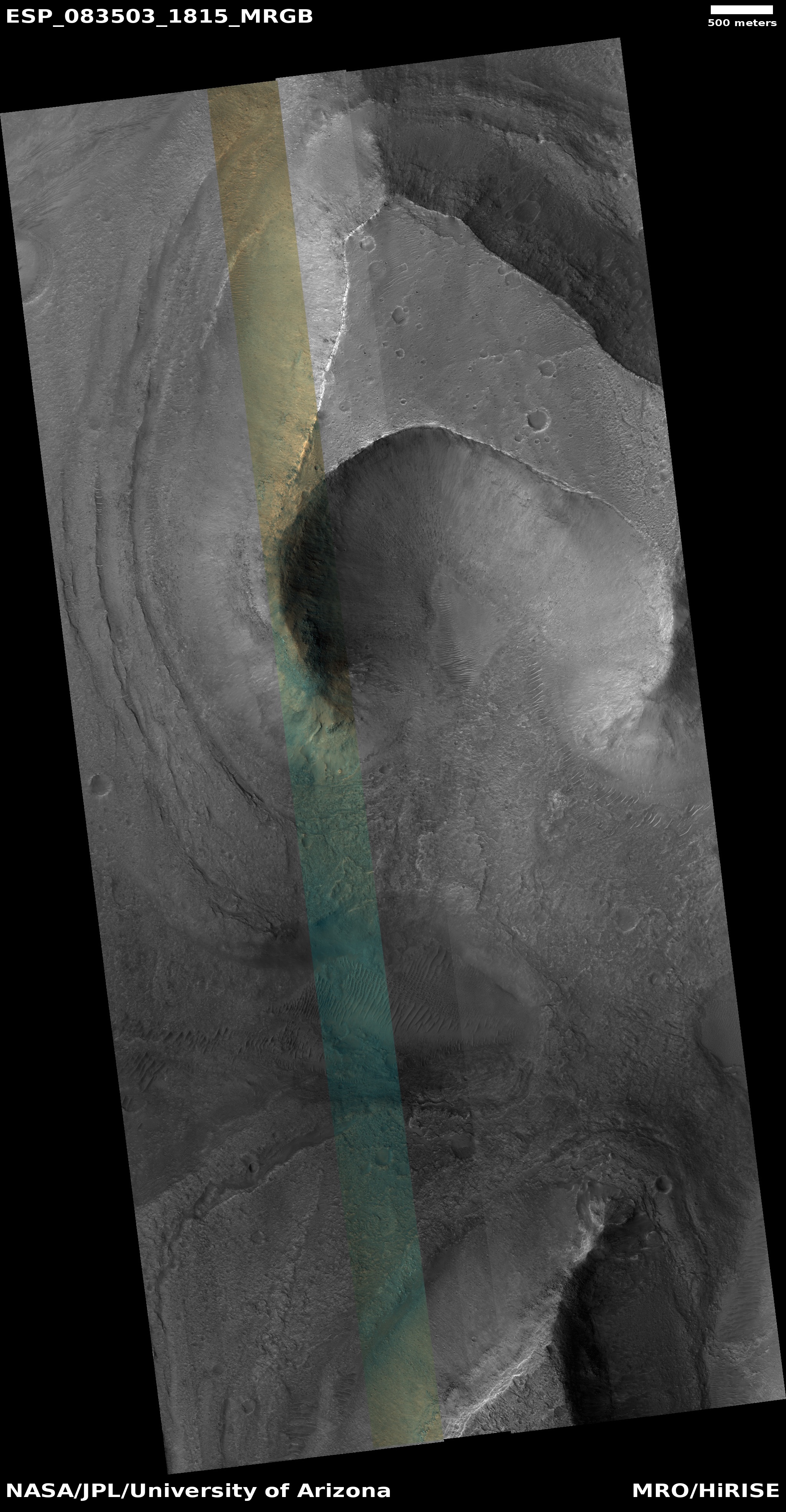
Terraced Martian butte

Terraced Martian butte
Click for original image.

Cool image time! The picture to the right, cropped, reduced, and sharpened to post here, was taken on April 1, 2025, by the high resolution camera on Mars Reconnaissance Orbiter (MRO).

The scientists label this as a “Layered Butte.” Seems like a good description. From top to bottom there appear to at a minimum about a dozen terraces, each of which represents a specific geological era on Mars.

I post this mostly because I think it shows us another example of the alien beauty of the Martian landscape. The scientific question of course is what do these layers represent. In a general sense, they indicate that over a long time period one by one these layers were laid down, and then over a likely equally long time period the top layers were worn away, one by one. The mesa is just a random spot where that erosion process was not complete, leaving behind this terraced 400-foot-high tower.
» Read more

1 comment

New research suggests the two types of streaks on Mars are caused by dry events

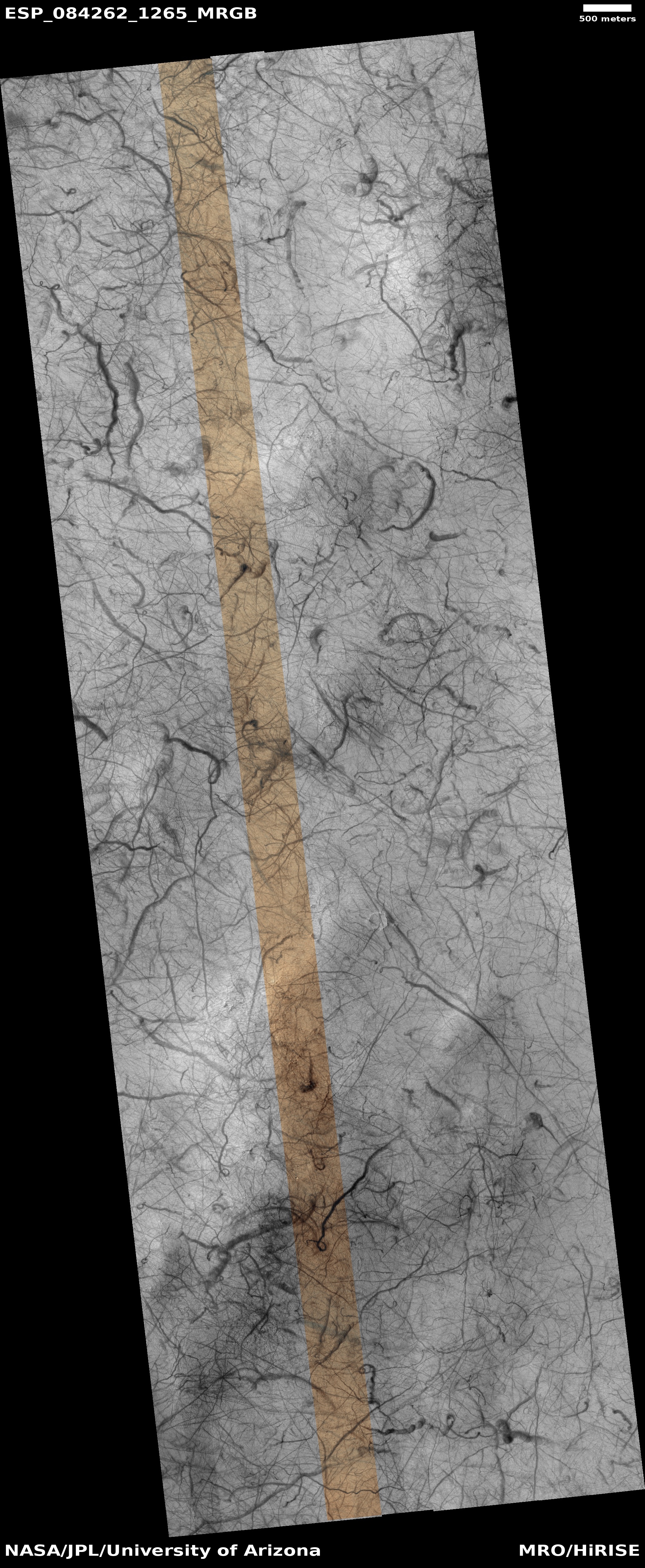
A Martian slope streak caused by a dust devil?
A Martian slope streak caused by a dust devil? From
data taken in 2023. Click for original image.

Scientists using a computer machine learning algorithm to assembly and analyze global maps of all known slope streaks and recurring slope lineae (RSL) — the two different types of streaks found on Mars whose cause as yet remain unexplained — have concluded that these streaks are likely caused by dry processes, not wet brine seeping from underground.

Slope streaks can occur randomly throughout the year, can be bright or dark, can occur anywhere, and fade with time. Recurring slope lineae instead appear seasonally in the same locations and are always dark.

You can read the published paper here. It essentially provides further details on research that was first announced at a conference in March. From its conclusion:

[O]ur observations suggest that slope streak and RSL formation may be predominantly controlled by two independent, dry drivers, 1) the seasonal delivery of dust onto topographic inclines, and 2) the spontaneous activation of accumulated dust by energetic triggers โ€“ wind and impacts for slope streaks, as well as dust devils and rockfalls for RSL.

…Our results underline the fundamental differences between slope streaks and RSL, despite their visual resemblance. Streak and RSL populations occur on opposite hemispheres (north vs south), at different topographic elevations (mostly lowlands vs mostly highlands), in opposite thermal inertia terrain (low vs high), in different wind speed regimes (above-average vs below-average), in dissimilar diurnal thermal amplitude and heat flux terrain (above-average vs average), in different WEH, H2O, H, and water vapor column terrain (average vs below-average), and in terrain that provides suitable (theoretical) conditions for liquid water at different seasons (Ls ~90ยฐ vs Lsโ€‰~โ€‰270ยฐ).

This data suggests both types of streaks form in connection with very fine Martian dust, but the researchers also admit that the actual method in which these avalanche-type streaks form remains unclear. In both cases the streaks cause no change in the topography (sometimes even traveling uphill for short distances), produce no debris piles at their base, as avalanches typically do, and do not appear to have an obvious cause or source at the top of the streak.

0 comments

The global distribution of dust devils on Mars

Global map of dust devils on Mars
Click for original image.

Scientists reviewing the dust devil tracks in orbital images produced by Mars Reconnaissance Orbiter (MRO) have now created a global map that also provides insight into the ground conditions that cause the dust devils to form. From the abstract:

In the first global study of these tracks using high-resolution satellite images from 2014 to 2018, we find tracks in 4% of the images, mostly near 60ยฐ north and south latitudes. These tracks are more common during local summers, especially in the southern hemisphere, coinciding with the peak of Mars’ dust storm season, when active dust devils are also more common. Surprisingly, dust devil track (DDT) formation does not depend on elevation, indicating it is not related to the ambient atmospheric pressure. Instead, they occur in darker areas where surface dust covers coarser material, which is revealed as the dust devil moves past.

The white dots on the map above, figure 5 of the paper, shows those MRO images where dust devil tracks were seen. The redish-orange regions are where the data suggests more dust devils should occur, while the blue areas of regions of few dust devils.

The map also notes the locations where Spirit, Opportunity, and InSight landed. Opportunity clearly landed in a region that had more dust devil activity, which explains why its solar panels were cleaned off so regularly by wind. Spirit did not land in such a region, but somehow it was lucky in getting wind events that cleared its panels of dust. InSight had no such luck, and having landed in a region with little dust devil activity, its panels steadily became covered with dust, eventually forcing the end of the mission.

As the paper notes, “To maximize mission lifetimes, future solar powered assets should favor regions where we have identified numerous [dust devil tracks] and where many active [dust devils] are present.” This proposal makes sense, for many reasons. For one, it shifts missions to higher latitudes where many glacial and near-surface ice features are found. Up until now the science community has sent all the landers and rovers to the Martian dry tropics, which has no such near surface ice. For future colonies it is imperative we begin studying Mars’ wetter regions.

This study provides another practical reason for doing so.

3 comments

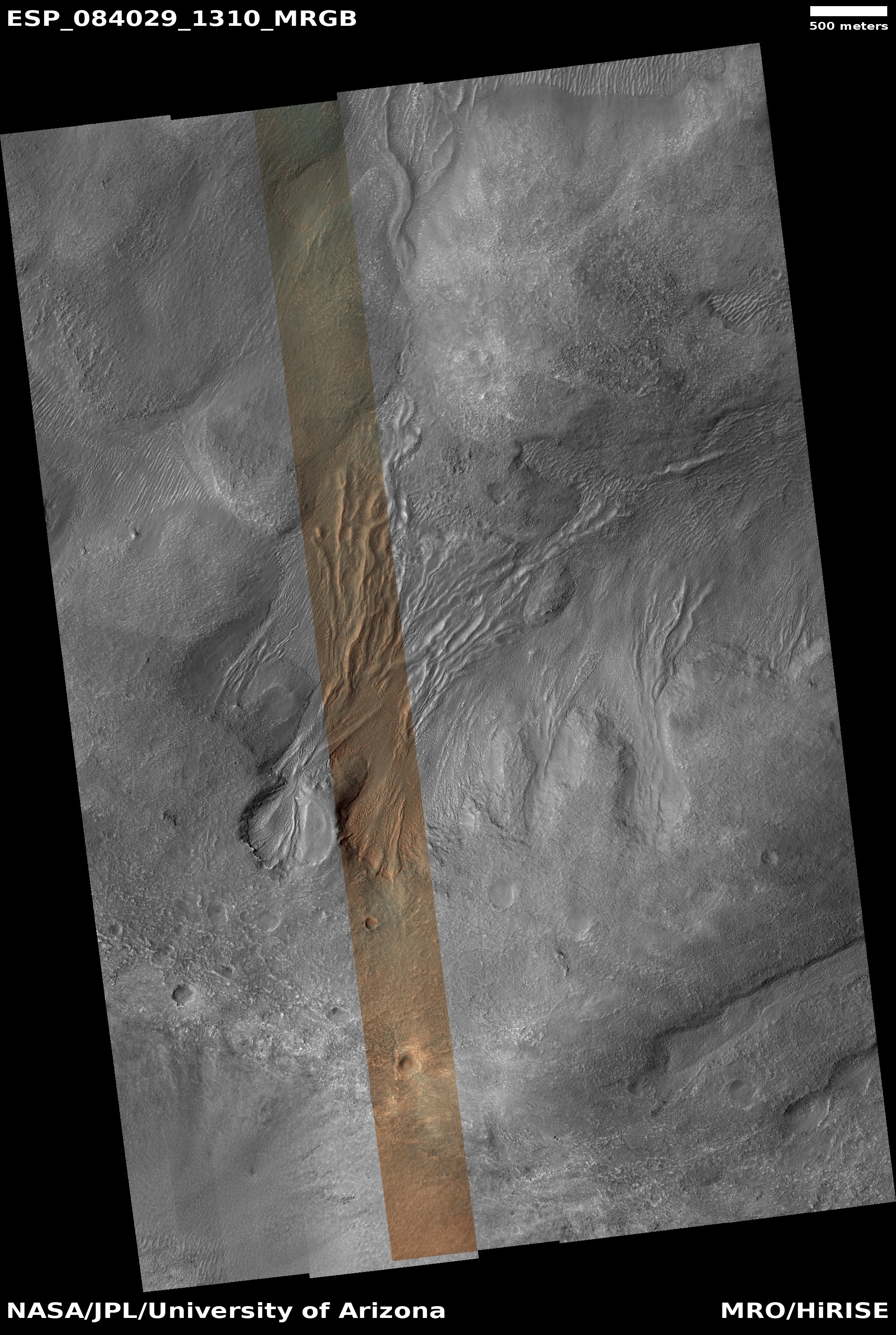
Scientists: Martian gullies formed by CO2 frost, not water flows

Frost on Martian hillside
Dry ice frost on Martian cliffs. From a 2020 post.
Click for full image.

A new analysis of the gullies found on cliffs on Mars, usually on the interior rims of craters, has concluded that carbon dioxide frost is the cause of the erosion, not ancient flows of water.

This conclusion eliminates the need for liquid flowing water in the Martian past, at least in conjunction with gullies. From the paper’s conclusion:

These results show that CO2 frost is capable of producing Martian gully morphologies. Since flows powered by this process are known to be ongoing and capable of transporting the necessary volume of material, it is the simplest explanation for their formation. Variations in the frequency and fluidity of flows could have occurred over time due to variations in the CO2 cycle. CO2-driven gully formation would indicate that there was not necessarily regular, recurring meltwater during high-obliquity periods. This removes a constraint on recent climate, and also addresses a paradox: if obliquity regularly exceeds the current value as generally thought, and if gullies formed via snow melting at high obliquity, the Late Amazonian Epoch should have included regular snowmelt and widespread aqueous processes. Gully formation by CO2 frost processes is consistent with a cold-desert Late Amazonian with rare or small amounts of liquid water and little aqueous weathering, consistent with the observed mineralogy.

…Gullies, one of the most-discussed lines of evidence for liquid water on Mars, may in fact have no direct connection to H2O. CO2 frost-fluidized gully formation also has broader implications for geomorphology, widening an emerging field of new landform types and processes without Earth analogs. Similar processes could occur on other worlds with erodible substrates on steep slopes and volatile ices at their frost point, although we currently lack the high-resolution images needed to test this hypothesis. Such ices include N2 on Pluto and Triton, and SO2 on Io. [emphasis mine]

In other words, though the gullies appear at first glance to our Earth eyes to have been caused by water flowing downhill, in fact the data now suggests the annual CO2 frost cycle of Mars is the prime cause, even in the distant past. No surface water was required. And since no one has yet come up with a good model for liquid surface water even existing in the Martian past (the atmosphere being too cold and thin), this conclusion helps eliminate this conflict.

The paper also notes the lack of water likely eliminates the need for any planetary protection efforts at these gullies, as the lack of water makes the likelihood of any microbiology nil.

As these conclusions are based on lab work and analysis of images, there remains great uncertainty. Nonetheless, the results help reinforce the arguments that the geological features we see on Mars were formed not by flowing liquid water but by other processes, such as glaciers of ice.

4 comments

Bright material on the high points of a Martian mountain

Bright material on top of a Martian mountain
Click for original image.

Today’s cool image is mostly an example of the present unknowns of Mars. The picture to the right, cropped, reduced, and sharpened to post here, was taken on April 2, 2025 by the high resolution camera on Mars Reconnaissance Orbiter (MRO).

The science team quite rightly labels this vaguely as “bright materials,” referring to the bright rim of that crater as well as the scattered bright patches on the surrounding plain. This vagueness tells us that the scientists don’t have enough data yet to definitively identify this stuff, though they know it is distinctly unique because of its inexplicable bright albedo compared to everything around it.

That the crater rim (as well as all the crater rims in the full picture) exhibit this same brightness suggests this material was excavated from below when the impacts hit. The surrounding patches suggest that erosion has exposed this buried material at these points.
» Read more

0 comments

Seepage coming from under an ancient Martian flood lava flow?

Seepage at edge of lava flow?
Click for original image.

Cool image time! The picture to the right, cropped, reduced, and enhanced to post here, was taken on April 3, 2025 by the high resolution camera on Mars Reconnaissance Orbiter (MRO).

I have enhanced the image to make it easier to see the details. It appears we are looking at three layers. At the base (on the left side of the picture) is a relatively smooth bottom layer with the highest number of scattered craters. On the top (on the right side of the picture) is a somewhat rough layer with fewer craters.

In between is a middle layer that appears to be seeping out from under the top layer.

The science team seems to agree with my last guess, as they label this image “Possible basal seepage at flow boundary.” The flow boundary is the edge of a lava flood that scientists believe covered a distance of about 1,400 miles at speeds ranging from 10 to 45 miles per hour.
» Read more

0 comments

A Martian river of ice

A Martian river of ice
Click for original image.

Cool image time! The picture to the right, cropped, reduced, and sharpened to post here, was taken on January 26, 2025 by the high resolution camera on Mars Reconnaissance Orbiter (MRO). The science team labeled it “Looking for Gullies” because the researchers were likely searching for such geological features on the cliff wall that runs down the right side of the picture.

What is more significant however about this picture is the glacier features in the canyon below that cliff. The downhill grade is to the southwest, and it is very evident that the canyon is filled with glacial-type debris, flowing down that grade. Along the base of the cliff the flow seems focused but squeezed, the larger blocks to the west moving slower and thus acting like a wall themselves. In between the flow moves like rapids in a narrow part of a river, albeit in slow motion.
» Read more

0 comments

Curiosity’s recent travels as seen from orbit

The view of Curiosity from orbit
Click for original image.

Oveview map
Click for interactive map.

Cool image time! Using Mars Reconnaissance Orbiter (MRO), scientists have captured a very cool image of Curiosity in its recent travels on Mars. That picture is above, reduced and sharpened to post here.

Taken by the HiRISE (High-Resolution Imaging Science Experiment) camera aboard NASAโ€™s Mars Reconnaissance Orbiter, the image shows Curiosity as a dark speck at the front of a long trail of rover tracks. Likely to last for months before being erased by wind, the tracks span about 1,050 feet (320 meters). They represent roughly 11 drives starting on Feb. 2 as Curiosity trucked along at a top speed of 0.1 mph (0.16 kph) from Gediz Vallis channel on the journey to its next science stop: a region with potential boxwork formations, possibly made by groundwater billions of years ago.

The overview map to the right provides some context. Curiosity’s present position is indicated by the blue dot. The yellow lines indicate the approximate section of its past travels photographed by the picture above.

According to the press release at the link, the science team is now estimating the rover will arrive at the boxwork geology in about a month.

0 comments

Eroding lava layers in Mars’ volcano country

Eroding lava in Mars' volcano country
Click for original image.

Cool image time! The picture to the right, cropped, reduced, and sharpened to post here, was taken on February 28, 2025 by the high resolution camera on Mars Reconnaissance Orbiter (MRO).

The scientists label this picture “enigmatic terrain.” And there are certainly mysteries here. For example, why are there scattered tiny knobs across the surface in the low areas, but not on the higher areas? Also, what caused that top layer to get stripped in places? Was it erosion from wind? Or did some other process cause that layer to vanish in these spots?

Note too that this landscape has few craters. Whatever happened here occurred recently enough that it was able to cover over the impact history from the early solar system that peppered the planets with craters as the planets formed. Though impacts continue even to this day, the impact rate is far less, which allows younger terrain like this to remain largely crater free.

The location provides us some answers, but it still leaves much of this geology a puzzlement.
» Read more

0 comments

Martian ridges that imitate rivers

Martian ridges that imitate rivers
Click for original image.

Cool image time! The picture to the right, cropped, reduced, and sharpened to post here, was taken on February 26, 2025 by the high resolution camera on Mars Reconnaissance Orbiter (MRO).

The scientists describe these features as “dendritic relief features,” an apt description of the thousands of miles of river-like meandering ridges that orbital images have discovered in the past decade scattered across Mars, as noted in 2016:

The inverted channels are similar to those found elsewhere on Mars and Earth. They are made of sand and gravel deposited by a river and when the river becomes dry, the channels are left upstanding as the surrounding material erodes. On Earth, inverted channels often occur in dry, desert environments like Oman, Egypt, or Utah, where erosion rates are low โ€“ in most other environments, the channels are worn away before they can become inverted.

The most dramatic example of these Martian ridge rivers are the fernlike ridges in Antoniadi Crater. The ridges to the right however are almost as striking.
» Read more

2 comments

Myriad flows on mountainous inner crater wall on Mars

Myriad flows in a crater rim
Click for original image.

Cool image time! The picture to the right, rotated, cropped, reduced, and sharpened to post here, was taken on February 27, 2025 by the high resolution camera on Mars Reconnaissance Orbiter (MRO).

That the science team labels this “Monitoring Slopes for Changes on Eastern Terraces of Mojave Crater” is quite understandable. The number of apparent dentritic channels suggests strongly the possibility of change over time, which is why MRO has been used repeatedly to monitor this location, beginning in 2006, when the science team noted this in a caption:

Aptly-named Mojave Crater in the Xanthe Terra region has alluvial fans that look remarkably similar to landforms in the Mojave Desert of southeastern California and portions of Nevada and Arizona.

Alluvial fans are fan-shaped deposits of water-transported material (alluvium). They typically form at the base of hills or mountains where there is a marked break, or flattening of slope. They typically deposit big rocks near their mouths (close to the mountains) and smaller rocks at greater distances. Alluvial fans form as a result of heavy desert downpours, typically thundershowers. Because deserts are poorly vegetated, heavy and short-lived downpours create a great deal of erosion and nearby deposition.

There are fans inside and around the outsides of Mojave crater on Mars that perfectly match the morphology of alluvial fans on Earth, with the exception of a few small impact craters dotting this Martian landscape.

» Read more

1 comment

The mighty scale of Mars’ geology

The mighty scale of Mars
Click for original image.

Today’s cool image is just one more example out of hundreds I have posted in the past decade of the difficult-to-imagine gigantic scale of the Martian landscape.

The picture to the right, rotated, cropped, reduced, and sharpened to post here, was taken on March 1, 2025 by the high resolution camera on Mars Reconnaissance Orbiter (MRO). The image title is simple, “Steep Slopes of Olympus Mons Caldera,” and tells us that this cliff face, about 1,300 feet high, is part of the caldera that resides on top of Mars’ largest volcano, Olympus Mons.

The parallel cracks on the plateau above the cliff tell us that the cliff face is slowly separating outward from that plateau, and that at some point in the future the entire wall will collapse downward.

Sounds impressive and big, eh? What the picture doesn’t make clear however is how truly tiny this cliff is in the context of the entire mountain.
» Read more

3 comments
1 7 8 9 10 11 90