Ice-filled fissure on Mars?

Ice-filled fissure on Mars?
Click for original image.

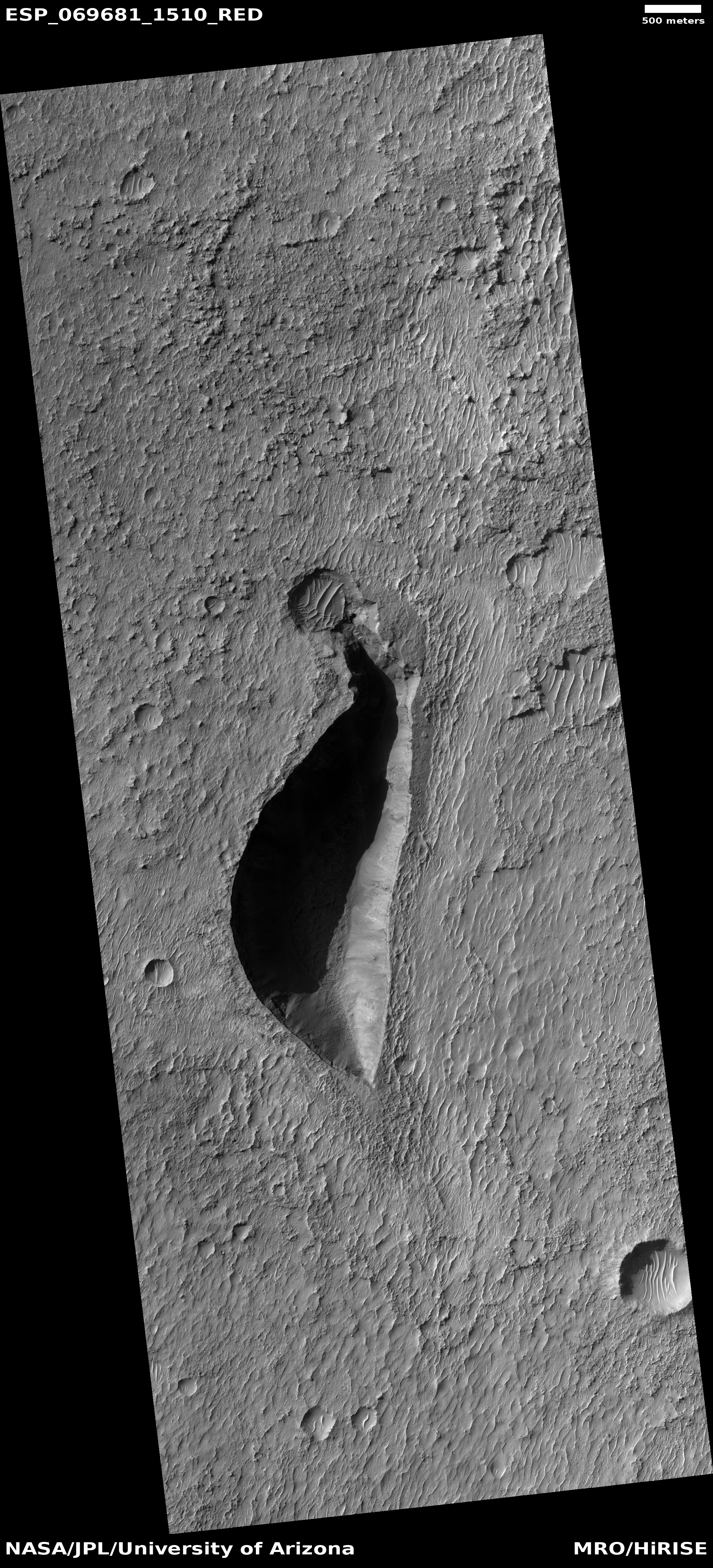
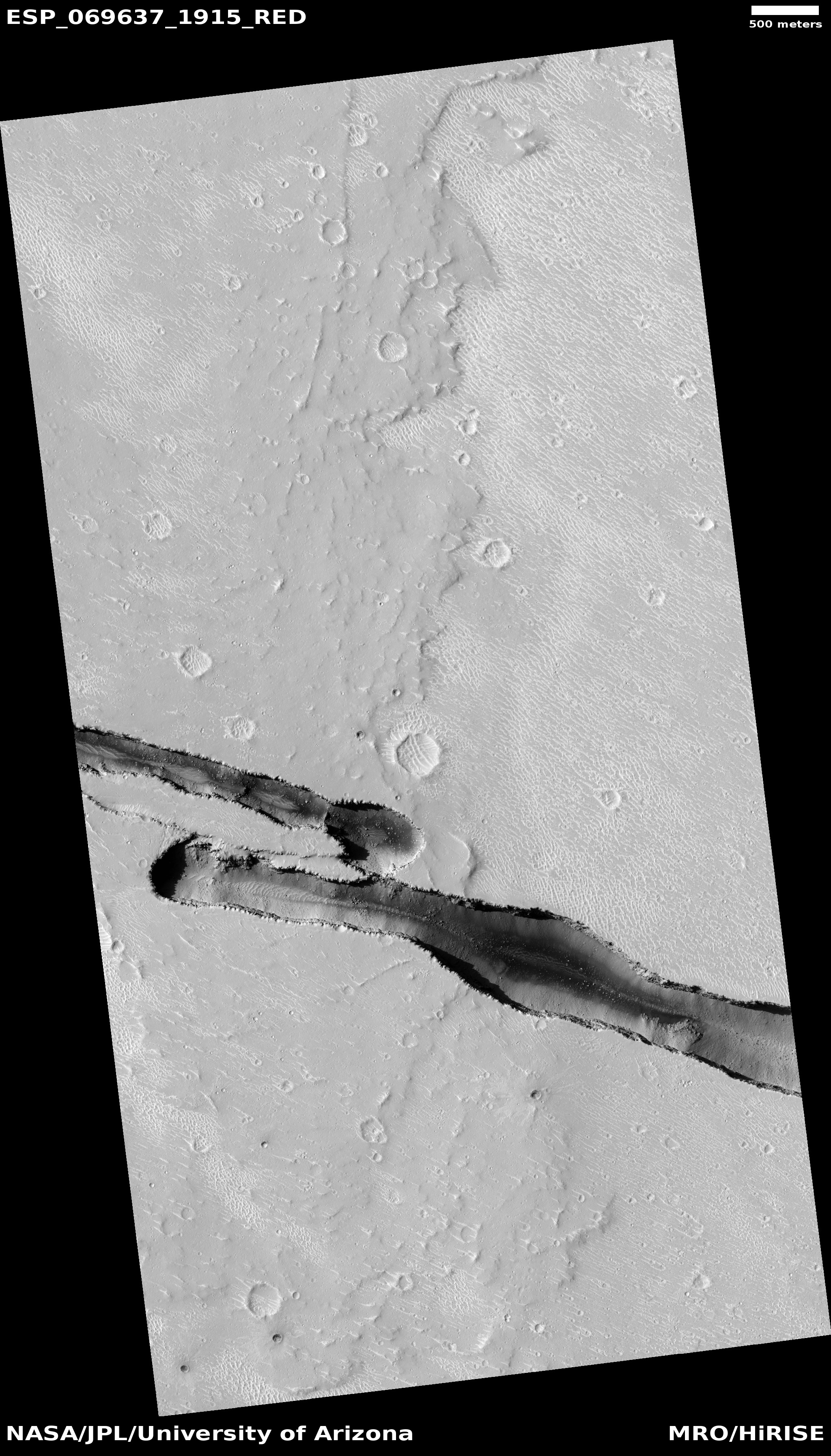
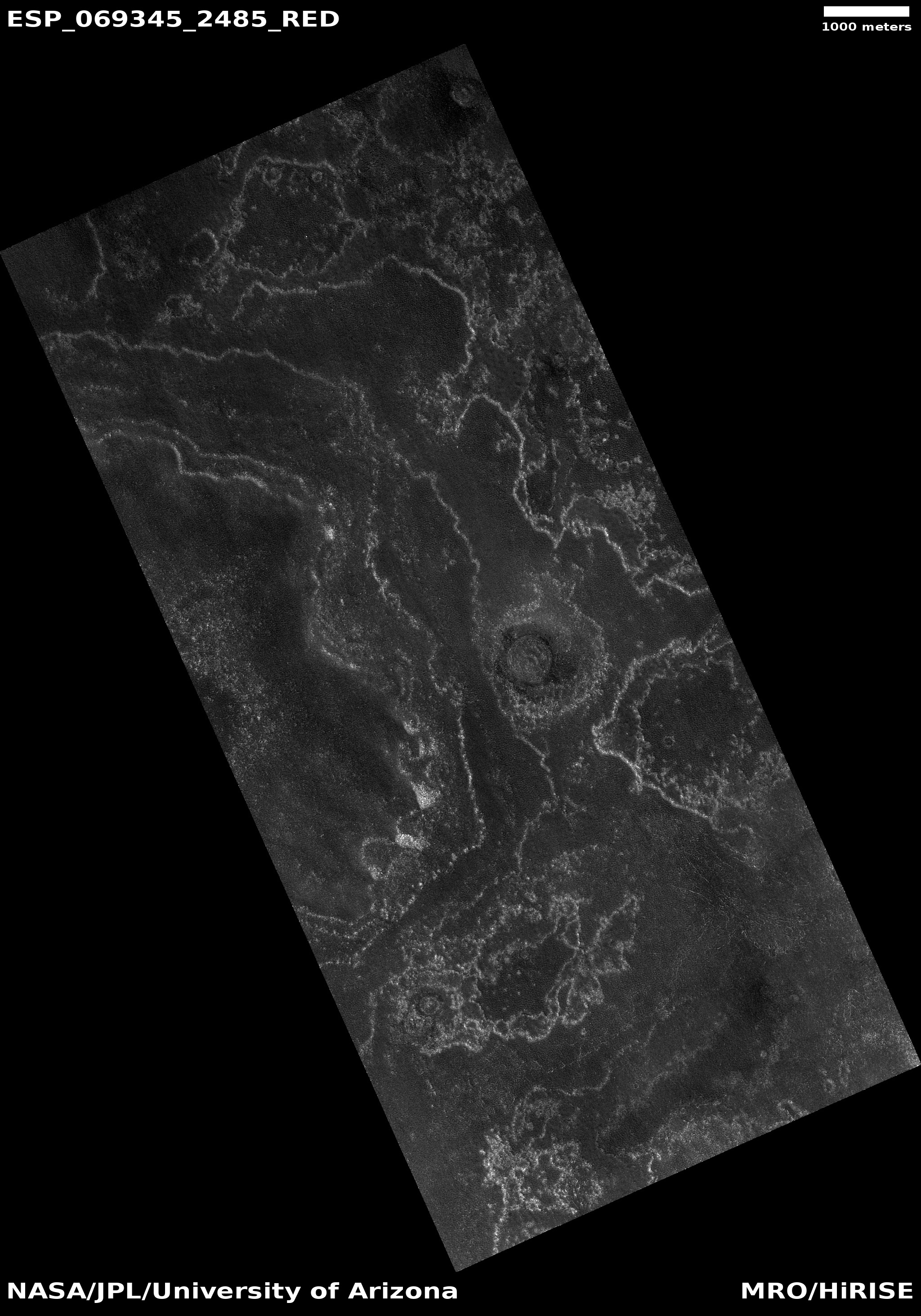
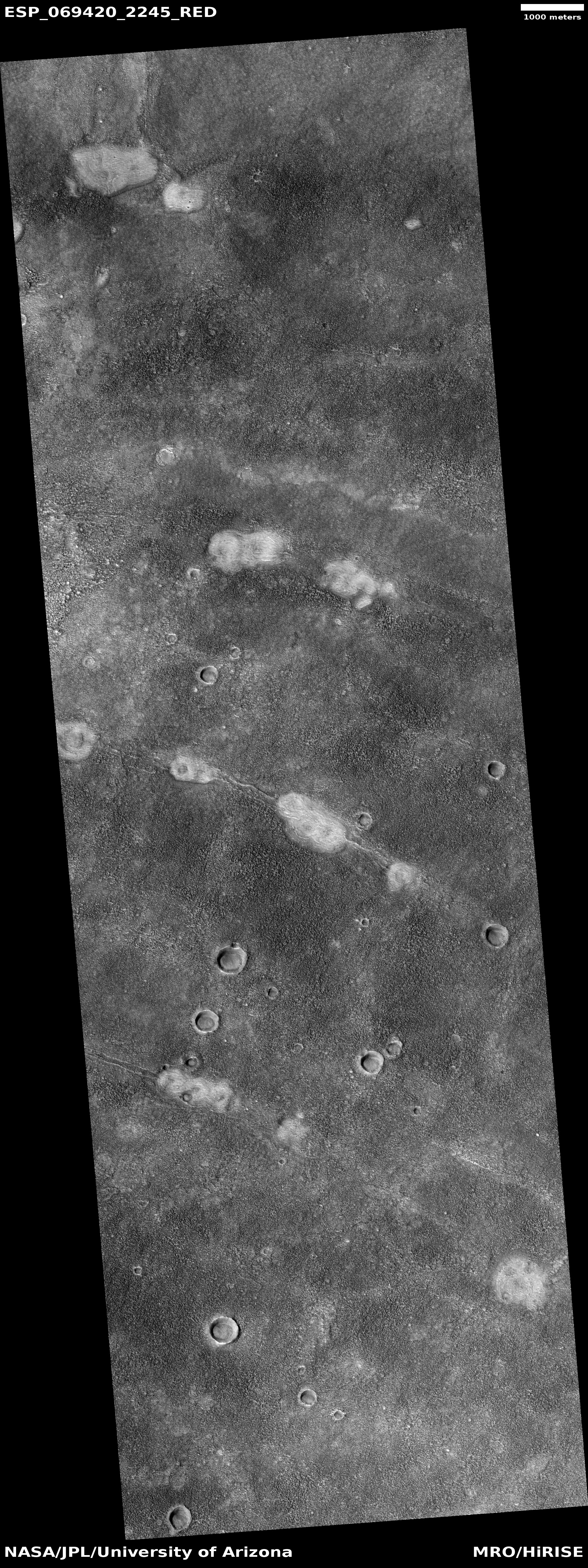
Cool image time! The picture to the right, cropped, reduced, and sharpened to post here, was taken on February 15, 2023 by the high resolution camera on Mars Reconnaissance Orbiter (MRO). The science team labeled this a “Terrain Sample”, which suggests but doesn’t guarantee that it was to fill a gap in the camera’s schedule in order to maintain that camera’s proper temperature, and therefore was targeted at a relatively random but potentially interesting location.

What we see is a fissure canyon, about 250 to 300 feet deep with cliffs about 125 high, that appears surrounded and even filled with icelike features. Even the craters on the plateau above the canyon appear like they either impacted in ice, or have since been filled and eroded by that ice.

But is it ice?
» Read more

0 comments

Distorted floor of a Martian crater

Overview map

Distorted floor of a Martian crater
Click for original image.

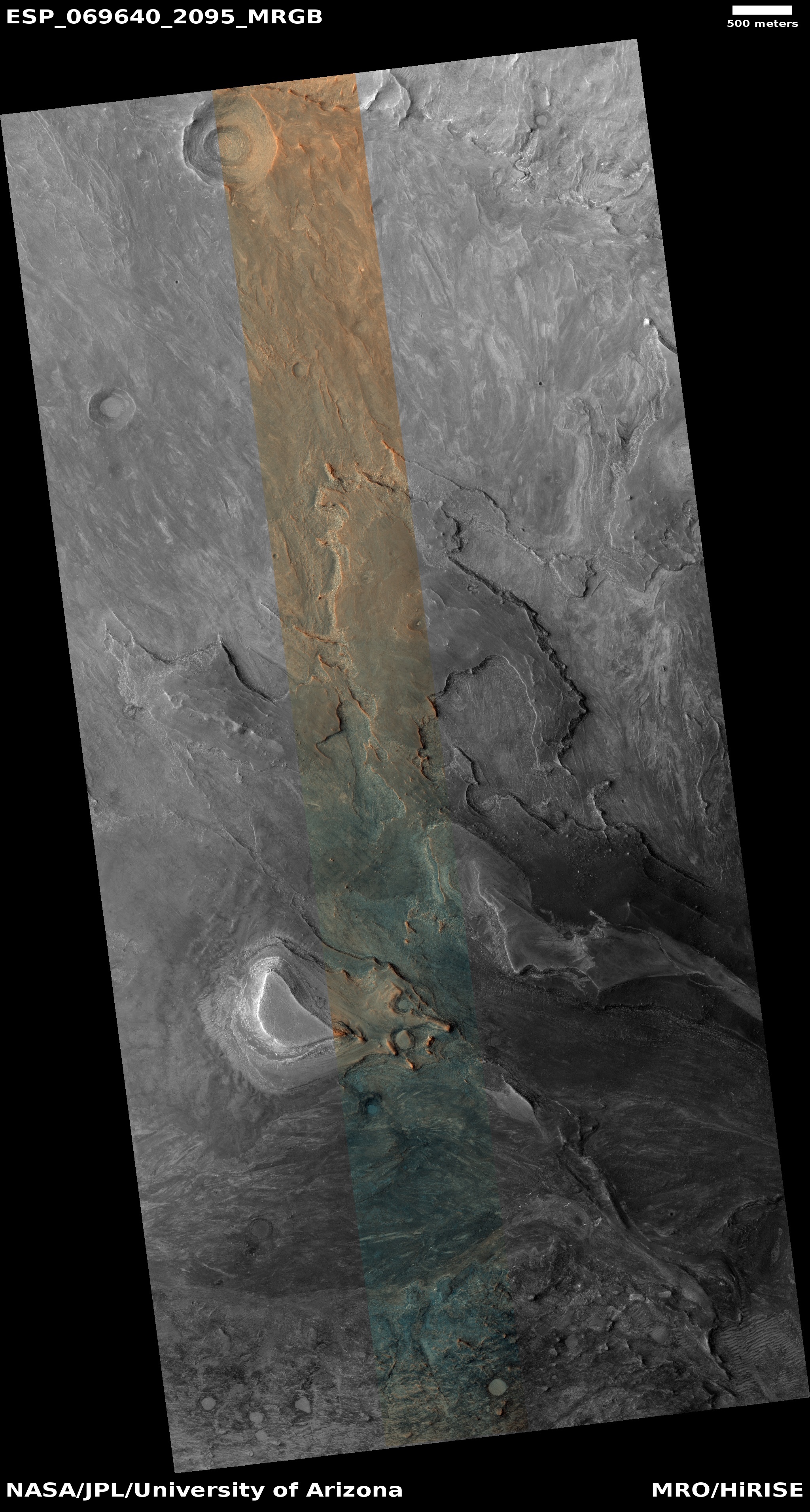
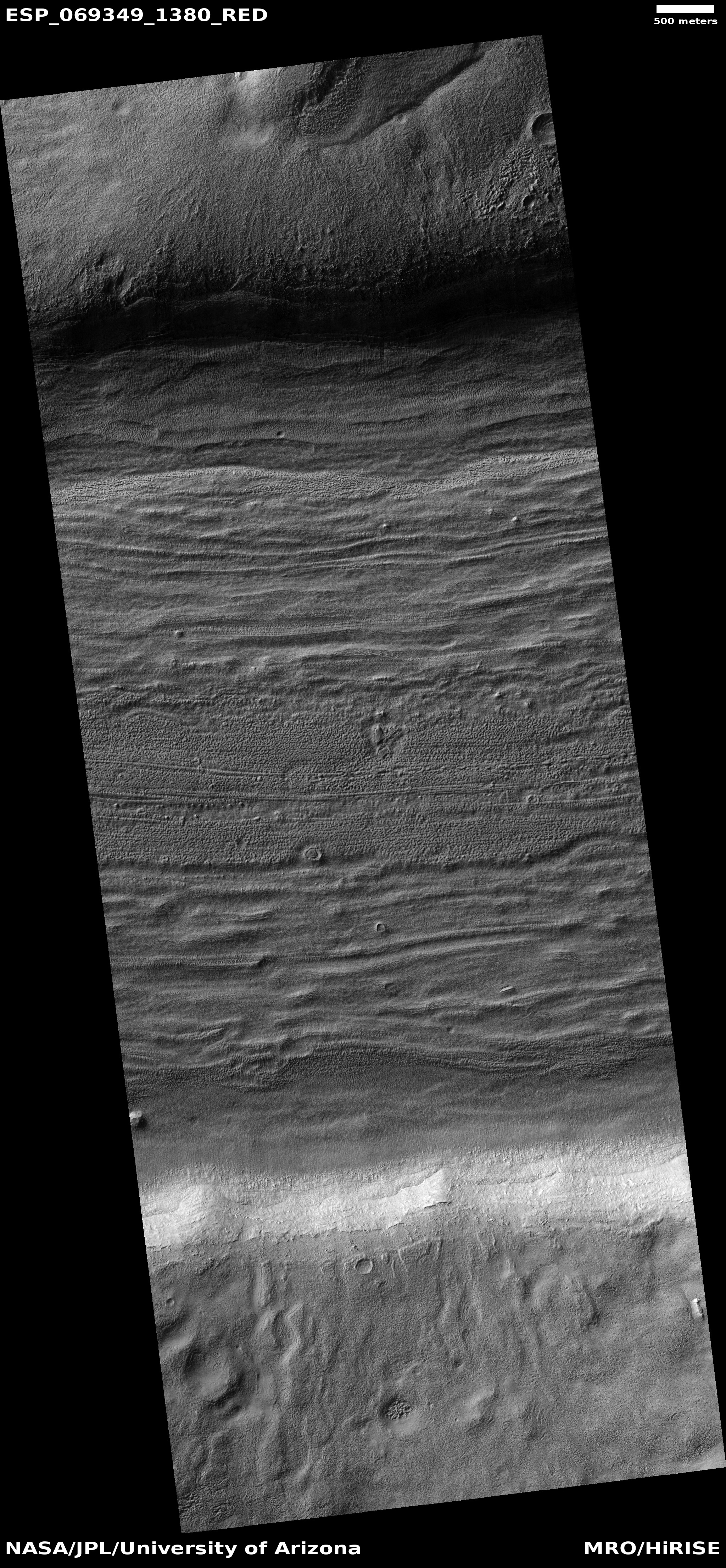
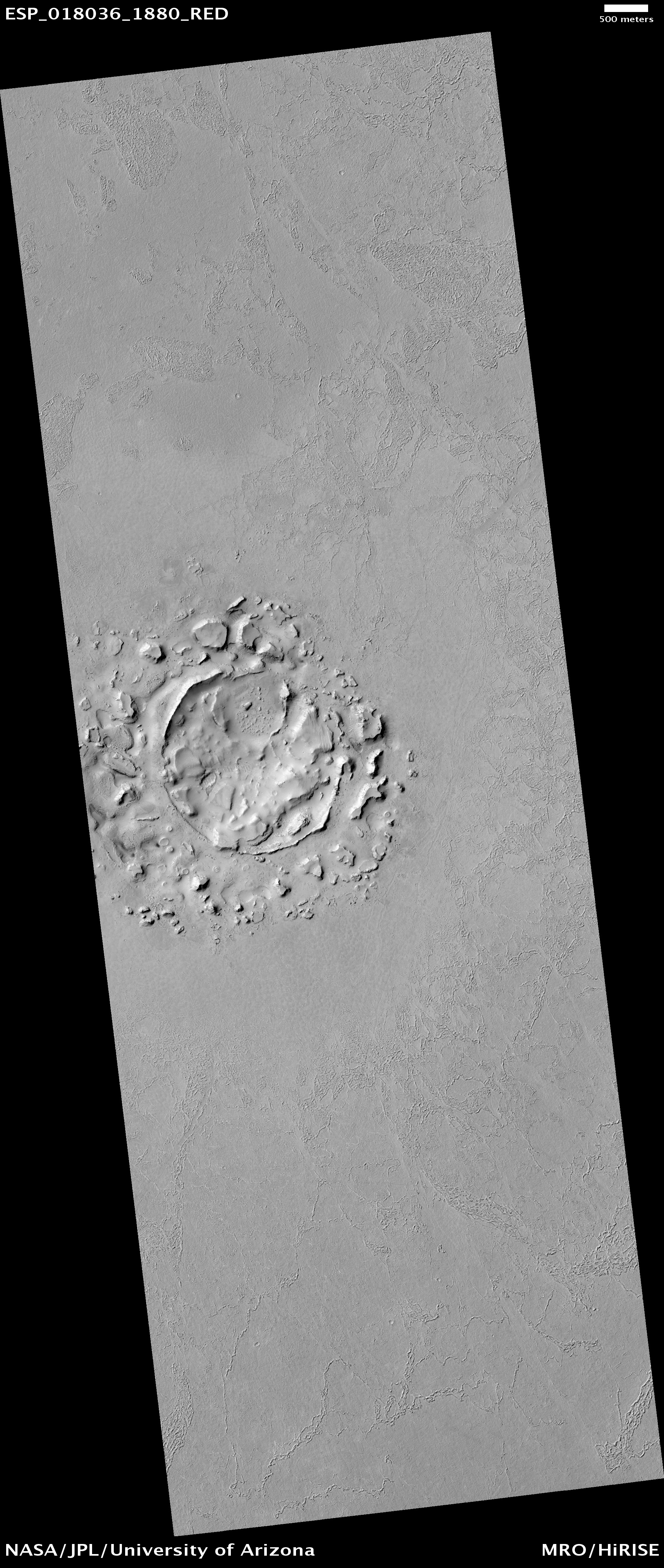
Cool image time! The picture to the right, rotated, cropped, reduced, and sharpened to post here, was taken on February 18, 2023 by the high resolution camera on Mars Reconnaissance Orbiter (MRO). It shows what the science team labels “Mantle Layers in Southern Mid-Latitudes.”

I would be less vague. These strangely shaped features invoke the typical glacial features seen throughout the mid-latitudes of Mars. The knobs and outcrops suggest some underlying breakdown that the top layers of glacial material has covered. They also suggest some form of sublimation or erosion process to the glacier itself.

The white rectangle inside the inset on the overview map above marks this location, covering the floor of an unnamed 10-mile-wide crater in the cratered southern highlands at 41 degrees south. In this region all the craters show some evidence of this sublimation, all suggesting that there is a near-surface underlying ice layer that when exposed vanishes to leave depressions or hollows. Here however it appears that ice layer is mostly intact, the knobs and ridges indicating the shape of the bedrock and large breakdown below.

0 comments

Martian dust devil where none had been before

Dust devil on Mars
Click for original image.

Today’s cool Mars image is especially cool because it is of the exact same place on Mars I had featured in a picture only a little more than one month ago. I return to this spot only a month later because the location was yesterday’s featured captioned image from the high resolution camera team of Mars Reconnaissance Orbiter (MRO). The difference is that this time the camera captured a dust devil there that wasn’t there previously. From the caption:

The dust devil is casting a shadow, which can be used to estimate its height. This image is part of ongoing monitoring activities by HiRISE of seasonal activities on Mars.

Over the years, HiRISE has observed many dust devils. Just like on Earth, dust devils develop when the Sun heats up the ground such that it warms the air directly above it. When air heats up its density decreases causing it to rise up while colder air sinks down driving local convection.

If the region is windy, the wind my end up rotating the โ€œconvection cellsโ€ caused by the vertical motion of air leading to development of a dust devil. Since the main requirements for development of such features are the presence of dust and a warm ground, we focus our monitoring of dust devils in regions on Mars that are known to be dusty (like Syria Planum), and during the late spring and summer time, when we expect the ground to be warm.

» Read more

2 comments

Barren land on Mars

Barren land on Mars
Click for original image.

It might seem strange to call any particular place on Mars “barren” when the entire planet has no visible signs of life anywhere. However, much of the surface of Mars involves wind and ice features that show evidence of change and evolution over time. The presence of apparent near-surface ice and glacial features in almost every image located above 30 degrees latitude emphasizes this sense of potential life, even if that life will only be transported from Earth and established there someday by humans.

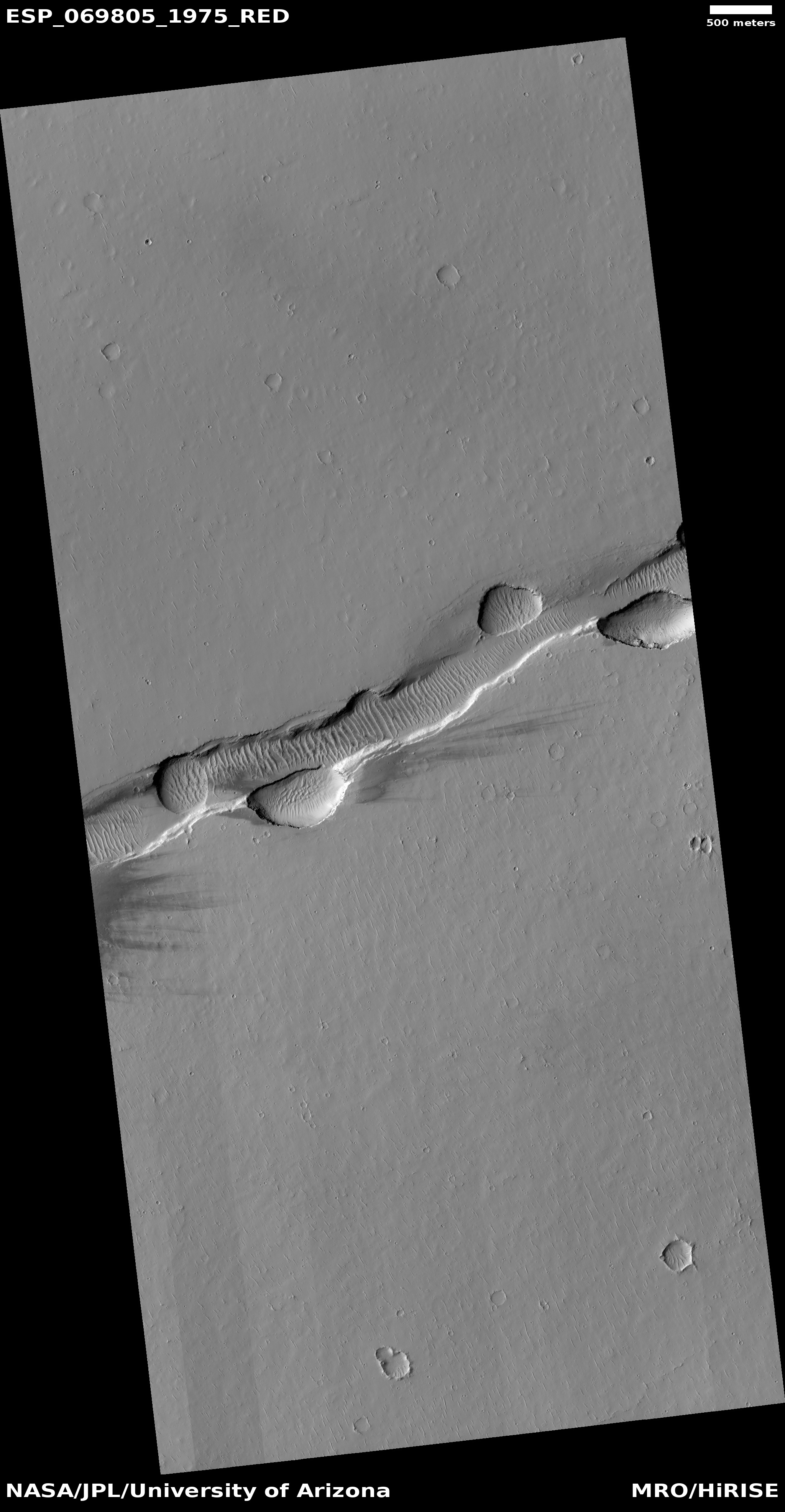
Today’s cool image to the right, cropped and reduced to post here, has none of these features. It is dry barren bedrock, with only a faint scattering of Martian dust indicated by many faint dust devil tracks.

The picture was taken on March 13, 2023 by the high resolution camera on Mars Reconnaissance Orbiter (MRO). The largest and most distinct flat-topped mesa in the image is only about 100 feet high, with the north-south ridgeline to the south about 20 feet high.
» Read more

0 comments

Avalanche to the east of Gale Crater on Mars

Landslide on Mars
Click for original picture.

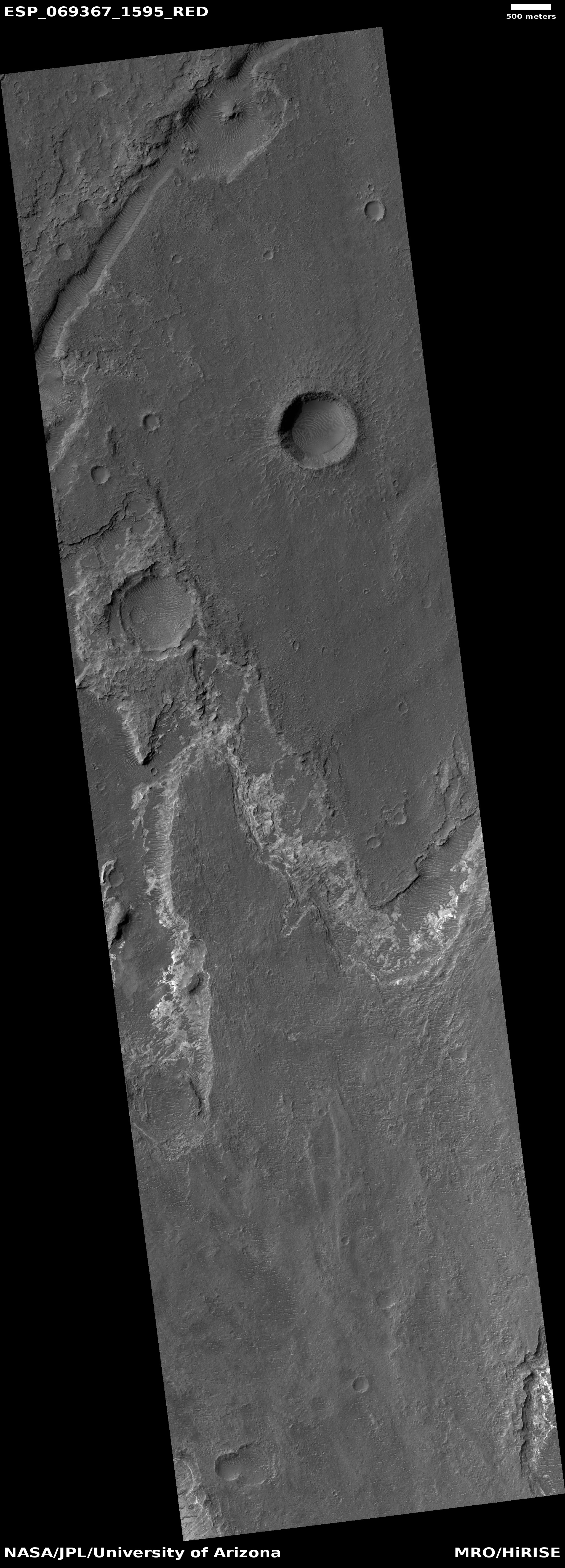
Cool image time! The picture to the right, cropped, reduced, and sharpened to post here, was taken on February 19, 2023 by the high resolution camera on Mars Reconnaissance Orbiter (MRO). It shows an avalanche that slumped downward out of the material that forms the interior western wall of an unnamed 25-mile-wide crater about 100 miles east of Gale Crater, where Curiosity has been roving for more than a decade.

The scientists call these types of Martian avalanches “mass-wasting events”, since the entire mass of the cliff moves downhill in a chunk, rather than as a pile of rocks that grows in size and strength as it picks up material on its way down.

It is not clear how old this slide is. A lot of the material on this slope appears to be Martian dust, some of which has flowed into the avalanche material after it had slide downhill.
» Read more

1 comment

Martian rootless cones

Rootless cones
Click for original image.

Cool image time! The picture to the right, cropped, reduced, and sharpened to post here, was taken on March 8, 2023 by the high resolution camera on Mars Reconnaissance Orbiter (MRO).

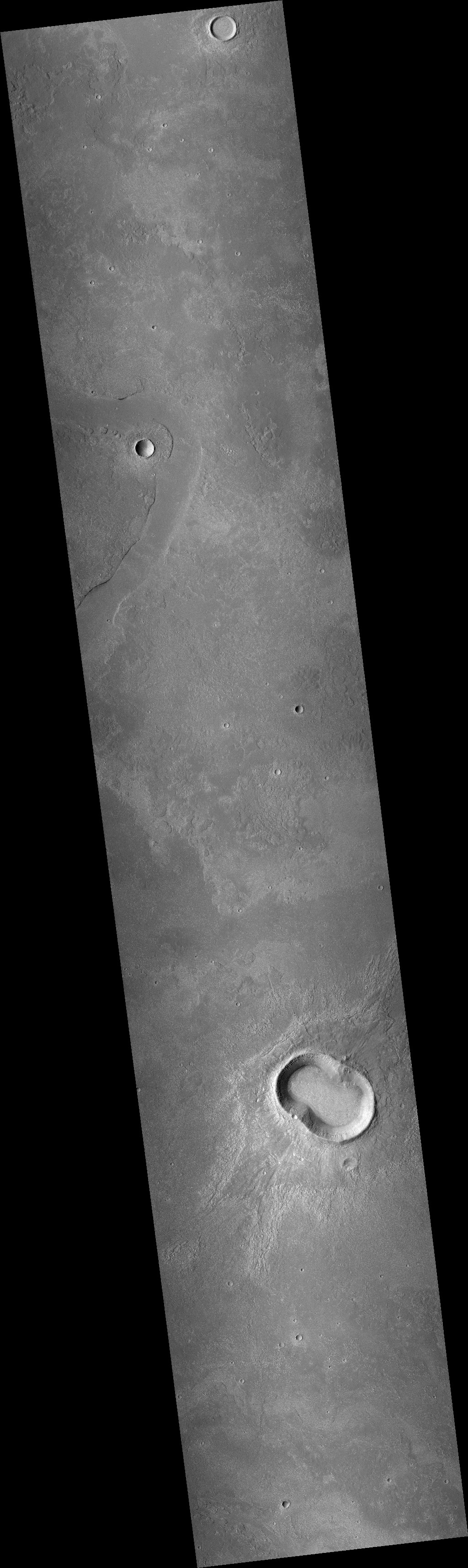
The camera team labeled this picture simply “Rootless Cones,” which is a feature that is created when the lava that covers the surface is thin, allowing the heated material below (which is not lava) to burst upward, producing the cone and caldera. If you look at the full image you will see other similar clusters of cones scattered about on this very flat and featureless plain. Apparently, the material that this lava plain covered had several similar bursts in a number of areas.

Such cones in this particular lava field are not rare, and in fact are evidence that this particular field is young.
» Read more

0 comments

A typical glacier, on Mars

Overview map

A typical glacier, on Mars
Click for original image.

The cool image from Mars to the right, rotated, cropped, reduced, and sharpened to post here, provides us a good illustration of the lineated grooves that are typically seen on the surface of valley-confined glaciers, both on Earth and on Mars, and are also seen on the patched, grooved surface of Ganymede.

The picture was taken on March 13, 2023 by the high resolution camera on Mars Reconnaissance Orbiter (MRO), and shows what appears to be a glacier flowing through a constriction. The arrow indicates the direction of the downhill grade.

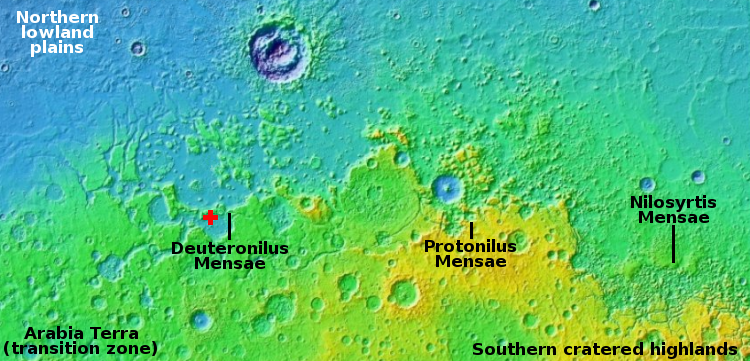
The location, indicated by the white dot inside the inset on the overview map above, marks the location, in the western end of the 2,000 long northern mid-latitude strip on Mars I dub glacier country. In these three mensae regions (Deuteronilus, Protonilus, and Nilosyrtis) of chaos terrain practically every high resolution image shows features that resemble glaciers.

In this case, the glacial flow appears to be draining from a 10-mile-wide ponded circular valley though a narrow gap.

0 comments

Cracking pedestal crater near Mars’ north pole

Cracking pedestal crater near Mars' north pole
Click for original image.

Cool image time! The picture to the right, cropped, reduced, and sharpened to post here, was taken on March 18, 2023 by the high resolution camera on Mars Reconnaissance Orbiter (MRO). I have also rotated it so that north is to the top.

Labeled a “terrain sample” by the camera team, this picture was likely taken not as part of any specific research project, but to fill a gap in the camera’s schedule so as to maintain its proper temperature. As usual, when the camera team needs to do this, they try to pick a target of interest. Sometimes they succeed, sometimes not.

In this case, the picture is of a location only about 800 miles from the Martian north pole, on the northern lowland plains. While the section shown to the right focuses on the largest crater, the full picture includes a few others, all of which appear to have their interior floors cracking in the same way, and all appear to be pedestal craters, sitting above the surrounding terrain, though by not as much.
» Read more

0 comments

A fractured spot in Mars’ northern lowland plains

A fractured spot in Mars' northern lowland plains
Click for original image.

Cool image time! The picture to the right, cropped, reduced, and sharpened to post here, was taken on February 16, 2023 by the high resolution camera on Mars Reconnaissance Orbiter (MRO). It shows a pockmarked flat plain with a scattering of meandering hollows, each filled with ripple sand dunes that make these depressions resemble at first glance the tracks of tires.

Obviously, we are not looking at evidence of a past giant vehicle moving across the ground on Mars. The MRO science team labels these “fractures,” suggesting some past geological process caused the surface to crack in this manner, with those cracks widening with time due to erosion or sublimation.

The location of course tells us something about that process.
» Read more

2 comments

The eroding north wall of glacial-filled Harmakhis Valles

The north wall of Harmakhis Valles
Click for original image.

Cool image time! The picture to the right, cropped and reduced to post here, was taken on February 8, 2023 by the high resolution camera on Mars Reconnaissance Orbiter (MRO).

We are looking at the 2,400-foot-high cliff, its lower walls clearly cracking horizontally as they sag downward, with other large sections higher up appearing to have been eroded away in larger pieces.

Yet, the ground below this cliff wall appears to have no debris piles, the kind you would expect below a landslide. Instead, that ground appears to be very glacial in nature, with many linear parallel lines suggesting layers.

The overview map below provides us the context, and an explanation as to where that debris has gone.
» Read more

0 comments

Knobs on the floor of a Martian caldera

Knobs on the floor of a Martian caldera
Click for original image.

Cool image time! The picture to the right, rotated, cropped, reduced, and sharpened to post here, was taken on February 14, 2023 by the high resolution camera on Mars Reconnaissance Orbiter (MRO) and shows what the scientists have dubbed as “enigmatic knobs” located on the caldera floor of a Martian shield volcano.

The knobs themselves, while puzzling, aren’t that interesting on their own. They are no more than 100 to 200 feet high, and are relatively featureless. Since most lack a pit at their peaks, they are probably not some form of small volcanic vent, though this conclusion is uncertain. The location, at about 30 degrees south latitude, suggests the faint possibility of near surface ice, which could make these mud volcanoes, or a very specific Arctic-type permafrost mound dubbed pingos, but once again the lack of any central pit at their peaks makes these origins also doubtful.

What the knobs however revealed to me was a giant Martian shield volcano I had never noticed before, even though it was hiding in plain sight.
» Read more

0 comments

Frozen waves of Martian lava?

Frozen waves of Martian lava?
Click for original image.

Cool image time! The picture to the right, rotated, cropped, reduced, and sharpened to post here, was taken on March 17, 2023 by the high resolution camera on Mars Reconnaissance Orbiter (MRO). The science team labeled this a terrain sample image, which implies it was taken not as part of any specific request, but to fill a gap in the camera’s schedule in order to maintain its proper temperature.

What are we looking at? This stippled terrain with curved ridges actually extends quite a distance beyond this image. A MRO context camera picture taken on July 22, 2020 shows its full extent, about 10 miles wide but extending to the north and south about 30 miles total, butting up against a north-south mountain chain to its east that is about seventy miles long with its highest peak about 8,000 feet above this plain.
» Read more

0 comments
1 31 32 33 34 35 90