More problems for Dark Matter

Vast Polar Structure

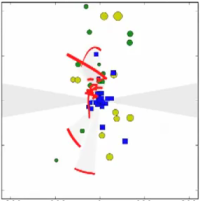
A new study by astronomers has found a vast structure of satellite galaxies and star clusters aligned perpendicular to the Milky Way and extending outward above and below the galaxy’s nucleus by as much as a million light years.

In their effort to understand exactly what surrounds our Galaxy, the scientists used a range of sources from twentieth century photographic plates to images from the robotic telescope of the Sloan Deep Sky Survey. Using all these data they assembled a picture that includes bright ‘classical’ satellite galaxies, more recently detected fainter satellites and the younger globular clusters.

“Once we had completed our analysis, a new picture of our cosmic neighbourhood emerged”, says Pawlowski. The astronomers found that all the different objects are distributed in a plane at right angles to the galactic disk. The newly-discovered structure is huge, extending from as close as 33,000 light years to as far away as one million light years from the centre of the Galaxy.

An animation illustrating this galactic distribution is posted below the fold. You can read the actual preprint paper here.

The problem with this polar alignment with the Milky Way’s core is that the theories for explaining the distribution of dark matter do not predict it.
» Read more

0 comments

Astronomers have concluded that the stars in the Milky Way must average at least one planet per star.

Billions and billions! Astronomers have concluded that the stars in the Milky Way must average at least one planet per star. More importantly, the data says the galaxy should have billions of habitable planets.

[According to astronomer Uffe Gråe Jørgensen], a statistical analysis … shows that out of the Milky Way’s 100 billion stars, there are about 10 billion stars with planets in the habitable zone. This means that there may be billions of habitable planets in the Milky Way.

3 comments

Where to find life in the Milky Way galaxy

A paper published today on the Los Alamos astro-ph preprint website has attempted to model the habitable zones within the Milky Way galaxy. From the abstract:

We predict that ~1.2% of all stars host a planet that may have been capable of supporting complex life at some point in the history of the Galaxy. Of those stars with a habitable planet, ~75% of planets are predicted to be in a tidally locked configuration with their host star. The majority of these planets that may support complex life are found towards the inner Galaxy, distributed within, and significantly above and below, the Galactic midplane.[emphasis mine]

They took into consideration the hazard of supernovae for killing off planetary life, as well as other factors such as the where the necessary heavier elements would be available for producing planets.

You can download the paper here [pdf].

0 comments
1 2 3 4