
Are the Russians no longer going to dock to its leaking Zvezda module on ISS?
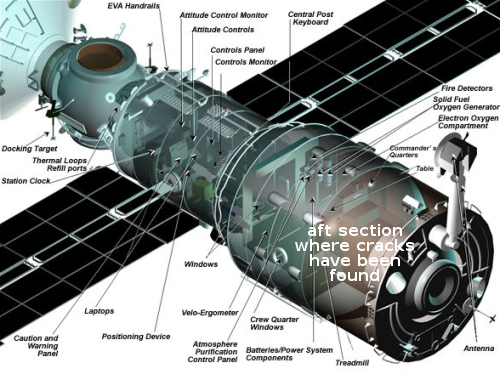
The Zvezda module, with aft PrK section indicated
where the cracks have been found.
In a report today at Ars Technica, Eric Berger cites two anonymous NASA officials as saying that the Russians have decided to decommission the aft PrK section of its Zvezda module where it has found numerous cracks and air leaks in the hull, apparently caused by the stress of the many dockings to Zvezda since it was launched almost thirty years ago.
Berger’s report was aimed at providing more information about the kerfuffle between NASA and Roscosmos on June 5, 2026,, when NASA had the astronauts on its half of the station shelter inside their Dragon capsule because Roscosmos was going to have its Russian astronauts cut off a structural bracket in Zvezda as part of the first phase of a new leak patch effort. NASA objected strongly to this action, fearing justifiably that the work could cause a catastrophic failure in Zvezda.
The Russians eventually backed off, merely doing measurements of the module’s new crack, which appearantly appeared after a Progress docking in April
Berger doesn’t really add any significant new details to this June 5 story, but he ends his report with this tidbit:
In the days since, there has been some additional back-and-forth, but Russia has now told NASA it will decommission the PrK module. Effectively, this means cosmonauts will no longer enter the PrK module or attempt to pressurize it. Progress vehicles will still be able to use the docking port to transfer fluids or perform other functions, but Russia will need to use other ports to move supplies on board the space station. [emphasis mine]
This quote however doesn’t tell us anything, and actually raises more questions. The Russians have already been keeping the hatch to Zvezda closed as much as possible, opening it only to unload Progress cargo. And if Progress freighters are still going to dock to Zvezda to “transfer fluids or perform other functions”, the module isn’t decommissioned. Nor is the risk reduced. One of the reasons Zvezda has been stressed over the years is that this port is along the station’s main axis, which makes it ideal for engine burns to raise the station’s orbit. Progresses have been doing this repeatedly from Zvezda for three decades. If they intend to dock with Zvezda to “transfer” fluids”, that also suggests they also plan to continue to use that port for those burns.
It also makes no sense to say other ports will be used to “move supplies” from freighters. Russia isn’t going to dock to Zvezda to transfer fluids, do engine burns, and then move Progress to a different port to transfer cargo.
Thus, we really at this moment do not know what the Russians intend. Nor do we know if they plan to continue to dock with Zvezda. And it appears that each time they do, the chances of a catastrophic failure of Zvezda increases.

On Christmas Eve 1968 three Americans became the first humans to visit another world. What they did to celebrate was unexpected and profound, and will be remembered throughout all human history. Genesis: the Story of Apollo 8, Robert Zimmerman's classic history of humanity's first journey to another world, tells that story, and it is now available as both an ebook and an audiobook, both with a foreword by Valerie Anders and a new introduction by Robert Zimmerman.
The print edition can be purchased at Amazon or from any other book seller. If you want an autographed copy the price is $60 for the hardback and $45 for the paperback, plus $8 shipping for each. Go here for purchasing details. The ebook is available everywhere for $5.99 (before discount) at amazon, or direct from my ebook publisher, ebookit. If you buy it from ebookit you don't support the big tech companies and the author gets a bigger cut much sooner.
The audiobook is also available at all these vendors, and is also free with a 30-day trial membership to Audible.
"Not simply about one mission, [Genesis] is also the history of America's quest for the moon... Zimmerman has done a masterful job of tying disparate events together into a solid account of one of America's greatest human triumphs."--San Antonio Express-News
I agree. But I think the biggest takeaway is just how much NASA and Roscosmos were at odds over this, and just how little the Russians were telling them. I know that the working relationship has never been free of bumps, but the picture painted by Eric’s sources, if he is accurately representing them (and they are accurately representing what really happened) looks like an almost total breakdown in cooperation.
In a way, that’s more dangerous to the ISS future than a leaky transfer module.
It would be a pain, but I don’t see the practical obstacles to doing so. Roscosmos has moved Soyuz and Progress vehicles between ports before, just as we have done with Dragons (I believe this last occurred with Progress 78 in October 2021). I expect what this could look like is that a new Progress would dock at Pirs/Nauka, transfer all supplies and take on trash, then undock and move over to PrK, dock for just purposes of doing a burn or simply transferring propellant for Zvezda to do the burn, then depart for a disposal reentry. Maybe I’m missing something here, but they have done this sort of thing before.
Now, it could be that the Russians have not made up their minds, or worse, made up their minds to do something risky and misled NASA about that intent. But that wouldn’t make Berger or his sources liars. It would just make them dupes.
The biggest question I have is this: if indeed the PrK module catastrophically failed and “unzipped,” what do NASA and Roscosmos models suggest this would do to the station’s spin and orbit, and what capability does the station and potential docked vehicles have to correct that? Because you know both agencies have to have studied such a possibility at some length.
The second biggest question I have is: What is NASA’s “breaking point” on Russian actions? But it could be that this hasn’t really been decided yet — that there’s active disagreement at top levels of the agency on what would constitute a scenario or scenarios where it’s time to give it up.
Thanks for doing a writeup on this.
Docking elsewhere for cargo and at Zvezda just the burns is absurd. It fixes nothing. It is the dockings and burns that are stressing the module and causing stress fractures.
As for a breaking point, there really isn’t any. When Clinton signed us up for this partnership, it was a deal with the devil. Until we replace ISS we are stuck with the Russians.
Also, this recent friction with the Russians is nothing new. It has been this way on and off for the past decade or so.
It has certainly turned out that way.
I hate to put myself at risk for any defense of the Clinton Administration, but I think at the time, given the state of things they inherited . . . from everything I have heard, including at least a couple chaps who were there, they really had decided that they needed the Russian involvement to get the space station through Congress. That’s easy to second guess now, but it really was very iffy at the time. There was a bipartisan amendment to kill the entire thing in June 1993 that got scotched by a single vote, and that put the fear of God into ’em. Yeltsin, likewise, was hanging onto power by his fingernails. It looked like a way to kill both birds with one stone.
That said, when Shuttle-Mir got underway, that should have been a clear warning of just what they’d gotten themselves into. The book to read here is Dragonfly: NASA and the Crisis Aboard Mir by Bryan Burrough. It’s a bit of a horror story.
Ideally, you really wished they had just gone back to square one and taken the thing away from JSC, which had made such a hash of it, and wasted billions on paper studies for station design revisions that Congress was never gonna pay for. But that is the sort of thing that requires an administration that cares enough to diagnose what ailed the agency, and spend the capital on addressing it. And we have not had that with *any* administration since LBJ — until now, arguably. Once Clinton decided to keep on Dan Goldin, it was obvious that they weren’t going down that road, and the only question then became, “How do we get the space station across the finish line?”
So here we are. But, fortunately, not for much longer.
Richard M: I was reporting on those initial ISS negotiations in the 1990s for several mainstream outlets at the time.
1. Clinton used the Russians and the idea of international cooperation to get the hostile Democrats to agree to ISS.
2. He also used national security issues to win the Republicans, arguing that if we didn’t partner with the
Russians (giving it lots of money first to save Mir and then to partner on ISS), its talent and government would use its skills for far worse things, such has funding terrorism and supplying some rogue countries (South Korea, Iran, etc) nuclear weapons and missile technology.
Much of this was a lie, but there were kernels of truth embedded, which is why Clinton succeeded.
At the time I publicly opposed the partnership, mostly because I remain an American who wanted an American station. (See for example my 1997 essay for The Sciences, Just Say Nyet!. I still do, and thank God before I die we will likely get more than one, and they’ll all be private and operated for profit.
As for Dragonfly, it is an excellent book, one which I used as source material for Leaving Earth.
So does this mean they are going to depress the module to vacuum? If so, in the case of a progress burn, is there sufficient structural strength to support such a burn without pressure? Not an engineer, honest question.
If they designed it right, it should work pressurized or not. If they keep it depressurized, then the chance of a zipper effect are significantly reduced. They are not completely gone. There are dependencies on the structure, where the cracks are, how deep are they, and is the metal fatigue expanding them in an unpredictable way. This of the metal cracks like what happens to your car windshield. It gets hit by a rock and the crack spreads (propagates) in a fairly predictable pattern.
While we shouldn’t be afraid of bold moves in space, they should be fully understood based on the information available. Removing support beams is not ideal but if the system load can handle it for a short time, it might help the investigation. Drilling holes with a stop has a lot of issues with it. That is a (drill) bit too far in this case and could lead to a very big leak. It is however a technique used to stop crack propagation but more information about the structure needs to be learned.
I agree with Joe. Patrick may be worried about the “balloon tank” design, which is made so lightweight that it cannot hold itself up if it loses pressure. There is a video of a collapse of an upper stage on top of an Atlas rocket, six decades ago, when the pressure failed. This balloon tank design is not often used, because the reward of using it is usually not worth the risk and consequences of a failure.
Cracks are a serious issue and must not be taken lightly. They are a sign that bad things are happening, that the module is not strong enough to handle the tasks that are assigned to it. Because we have so much tied up in this very important space resource (astronauts onboard, money spent, research underway and more expected in the future, etc.), we positively must be careful about how we handle the problem.
One downside to an international space station is that all the international partners have to accept the changes that one partner wants to make, because a failure over there affects everyone else. The Russians seem willing to try modifying structural elements without all the other partners being reassured that it will work well and not end in disaster or catastrophe.
All of Robert Z’s questions are valid and don’t appear to have especially encouraging answers. About the only seemingly unalloyed positive to this “decommissioning” is that the rest of the station volume will be permanently closed off from the leaking module. That doesn’t make a sudden major structural failure of said module any walk-in-the-park to deal with, but at least the crew won’t have to be scrambling to get into IVA suits if the thing finally blows out. If it was me, I’d probably be sleeping with my arms wrapped around mine and towing it around on a tether the rest of the time.
More broadly, it seems this new procedure of routine dock-move-dock of Progress could have been initiated at any time over the past several years. That it has not suggests simple bloody-minded stubbornness on the part of the Russians.
Jared needs to have a Tiger Team working on what needs to be done to operate the station without any Russian personnel or vehicles if it becomes necessary to evict them prior to ISS decommissioning. Then all preparations should be made and the Russians quietly informed of this fact. Perhaps if they knew they no longer had any leverage, the Russians would straighten up and fly right. Failing that, we could just toss them out and be done with them.
Given the growing amount of damage Ukraine is inflicting on Russia, I think there’s a real possibility the Russians may be forced to abandon ISS on their own for loss of ability to any longer participate well before decommissioning in any case.
I bet they are actually physically unable to undock the module?
What fluids do they need to transfer? Lox, LN, or water.
Doesn’t America ship that stuff up also?
As for the module popping open and moving the station. It just does not have enough gas mass to make this happen.
Hi Bob,
(I’m not nesting my replies because for some reason my phone’s browser refuses to include the authenticator on nested replies.)
I would say that I don’t know what the stresses are from just docking and undocking, or doing altitude raising burns, versus opening and closing the PrK airlock hatches. I don’t think any of that has been published. The *implication* of the article seems to be that the latter creates more stress than the former, and presumably also that the former are somehow small enough to be considered (by Roscosmos, and perhaps NASA, too?) safe enough. That being the case, that’s what informed what I wrote.
If that is not the case — if using the PrK port at all really is that high of a stressing event — then that strikes me as a grave problem, because the alternatives available for altitude raising burns are all considerably inferior to Zvezda/Progress, as things stand even now. Correction: Quick research reveals that the new Crew Dragon “boost kit” provides a total reboost impulse of 9 m/s, that is, about as much as provided by one-and-a-half Russian Progress cargo vehicles. So it actually can replace the Russian reboost’s delta-v; its disadvantages (as I understand it, I stand happy to be corrected) are that a) it is not steerable, b) can only be used when a Dragon is docked (whereas Zvezda can do a burn all by itself), and c) the Dragon would actually have to have a boost kit installed, and so far, NASA is only willing to have SpaceX install them on cargo Dragons (for safety reasons, I assume).
That said, if the risk is that high from just docking or doing burns at Zvezda’s aft end, then this may still be a safer, if more awkward, way to reboost the station. Unless the Russians refuse to agree, in which case the ISS may well become untenable.
Pzatchok,
The PrK is actually not a separate module; it is integral to Zvezda.
And Zvezda is pretty thoroughly connected to Zarya, and after 25 years in space there’s a question of how easy it would be to disconnect, due to material degradation. Anyway, it is the central node of the Russian side.
“”part of the first phase of a new leak patch””
This entire phrase above just unnerves me. Space is very unforgiving.
Richard M wrote:
“”I’m not nesting my replies because for some reason my phone’s browser refuses to include the authenticator on nested replies.””
Same here. I tried different phones, same thing. I will try my laptop and see what happens. This belongs in the category of First World Problems. Not too worried, just wanted to let you know.
Hello Ronaldus,
It works fine on Chrome on both my laptop and my Chromebook; it’s just for some reason that Chrome on my Android never picks it up. I’m not bothered, and I don’t expect Bob to go chasing it down; it’s just as easy for me to respond with a new post. If it bothers Bob, well, that’s a different story. I’m just glad there’s a nesting option I can *sometimes* use!
My web guy says he has fixed the authentication issue with nested comments. I can’t see the problem, but I am letting my readers know. Try it again.
Same issue as Richard M.
Only on my phone, using Brave (chrome based browser) if I hit reply to nest the result, it lacks the applet the verifies my status as a human.
Standalone posts are fine.
I’m on an ipad. The “verify you are human” button doesn’t appear for a nested reply. I hit post, the “you failed”message comes up with a back link, and when I use that link, the verify button shows up. So I am able to post with a couple extra steps.
While I’m at it, a “remember me” option sure would be nice. I have to type in my name and email for every post.
Did anyone else notice a minor weirdness about Eric’s article? Since day 1 I think we’ve always called it Zvezda, but early on in the article, Eric refers to it as “the PrK module” and then uses that through the rest of the article. He didn’t even write “PrK”, but “PrK module.”
And the commenters seem to have caught on and all started calling it that, too. It’s almost like someone’s running a search and replace. Just thought that was weird, and maybe a little creepy.
Rick C,
This may have confused pzatchok, too.
Wikipedia clarifies the PrK as:
Berger usually does a better job than this, but this is the second time recently that he has flubbed it. He recently relied upon a source that turned out to be wrong — apparently without verifying through any second source — so I am wondering whether he is distracted or getting lazy or something like your search and replace idea. Even then, he should have paid close enough attention to have replaced it right, not wrong.
“PrK module” probably should have been “PrK tunnel.”
Because Wikipedia may not be the best of references, I am doing some due diligence, listing another reference from a month ago. It may also be worth reading, on this topic. The New Space Economy: ISS is a disaster waiting to happen. This article also calls it “PrK transfer tunnel” or “PrK tunnel.”
Why would NASA and Russia disagree about severities, operations, and solutions with this crack/leak problem? For one, NASA has become very conservative, where astronaut safety is concerned (not conservative enough, in some cases), and the Russians tend to be bold with risks. This is why the Russians got Chernobyl, the Progress collision with Mir, and the demolished Sayano-Shushenskaya hydroelectric station.
Both NASA and Russia seem to be more certain about their operations than they should be, but the Russians also seem much more willing to take risks than NASA does.
Thanks for the clarification! That makes sense.
With no intention to offend anyone, I can’t wait until the ISS is de-orbited. I suspect that it is providing only a minimal contribution to the overall space exploration effort, and that the proverbial “juice” isn’t worth the “squeeze”.
I understand that not every study or research program conducted there is going to make headlines, but the lack of ANY such headlines over the years is telling.
They should consider the station as a whole experimental platform.
Lets see just how long we can keep it going with repairs and maintenance.
Better yet, separate the component modules, attach experimental heat shields of varying types/configurations, and send them crashing to Earth one at a time. That might provide some information that is actually useful.