Perseverance moves west, into the barren hinterlands beyond Jezero Crater

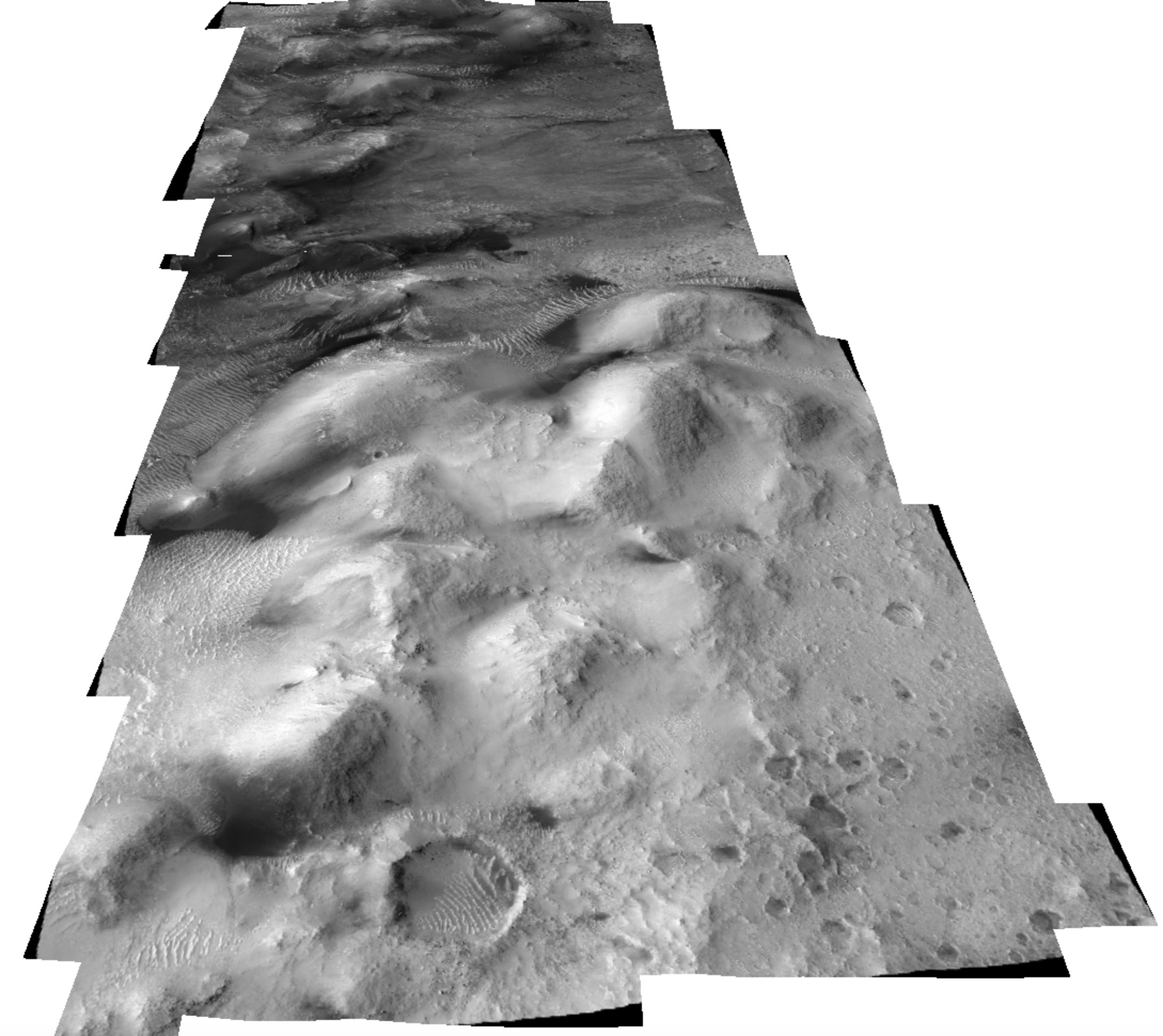
Perseverance looking west
Click for full resolution. Original images can be found here and here.

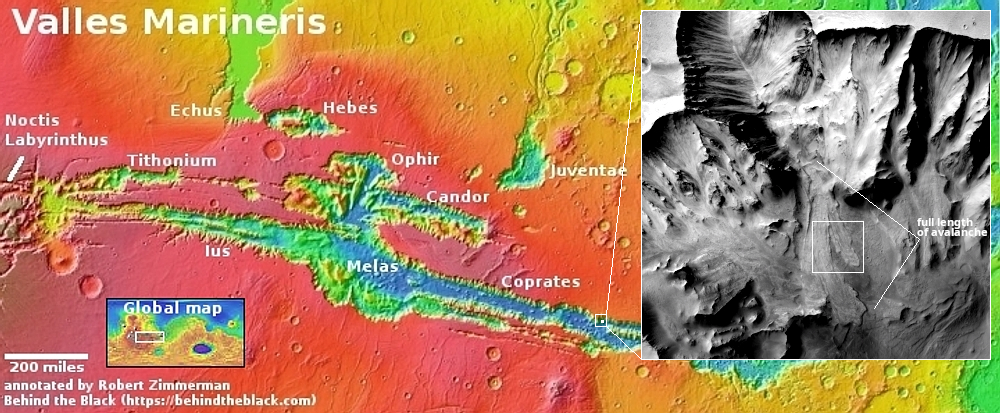
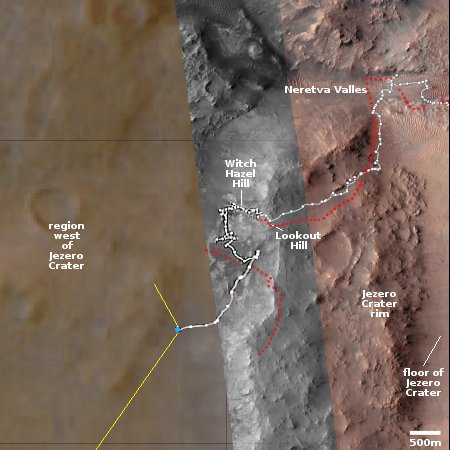
Overview map
Click for interactive map.

Cool image time! The panorama above was created using two pictures taken on December 4, 2025 (here and here) by the navigation camera on the Mars rover Perseverance. The view I think is looking west, away from the rim of Jezero Crater, which now lies behind the rover to the east.

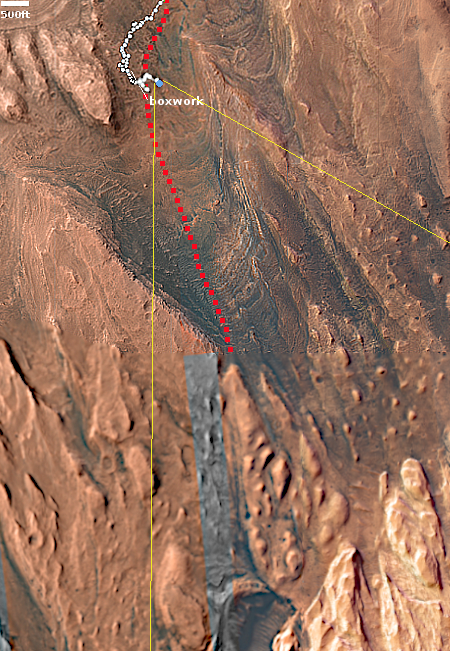
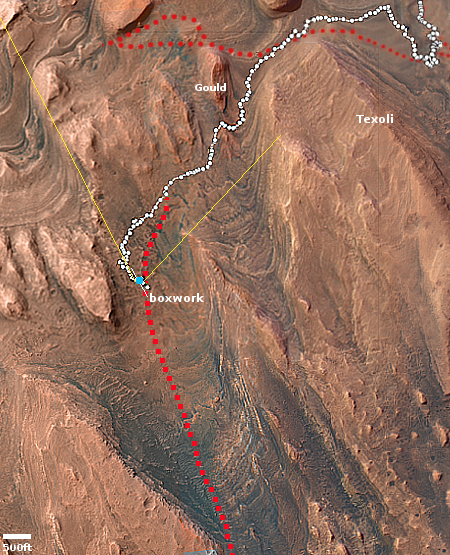
The blue dot on the overview map to the right marks Perseverance’s position when it took this picture. The yellow lines indicate my rough guess as to the area covered by the panorama. The white dotted line marks the actual route the rover has taken, while the red dotted line the original planned route.

As I noted in my previous Perseverance update in mid-November, the science team has apparently decided to revise the route, abandoning initial plan of going back uphill towards the rim and instead travel downhill into the hills beyond. This is a region that orbital data has suggested might be rich in minerals, making it a prime mining location for future colonists. My guess is that the science team decided they needed to get there, that they had enough data from the rim and that it was now more important to get to the western mineralogy.

Though I am sure they are using the highest resolution orbital images from Mars Reconnaissance Orbiter (MRO) to guide them, the Perseverance team has not yet upgraded its interactive location map to show those details in this western region. Thus, the map in this area is fuzzy and not as detailed.

The team has also not published its revised planned route, so there is no way to guess where the rover will go next. It does appear however that it is finally leaving Jezero Crater for good.

And as all recent pictures from Perseverance, these images show this Martian landscape to be utterly barren, its hills and valleys softened by dust and eons of erosion from the very thin Martian wind. This is an alien place, though it has the potential with human ingenuity to bloom if we have the courage to try.

The insane terrain inside Mars’ Death Valley

taffy terrain
Click for original image.

Cool image time! The picture to the right, cropped, reduced, and sharpened to post here, was taken on October 27, 2025 by the high resolution camera on Mars Reconnaissance Orbiter (MRO).

The science team labels this a “twisted surface,” to which I think we all can agree. What we are looking at is a geological feature found only on Mars in only one region that has been labeled “taffy terrain” by scientists. According to a 2014 paper, the scientists posit that this material must be some sort of “a viscous fluid,” naturally flowing downward into “localized depressions.” Because of its weird nature I have posted many cool images of it in the past (see here, here, here, here, here, and here).

In the case of the image to the right, the red dot marks the peak of a small knob, with the green dot on the upper left the low point about 900 feet below. As you can see, the taffy has migrated into the depressions, as some flowing material would.
» Read more

Weird mottled terrain in the dry tropics of Mars

Mottled ridges
Click for full image.

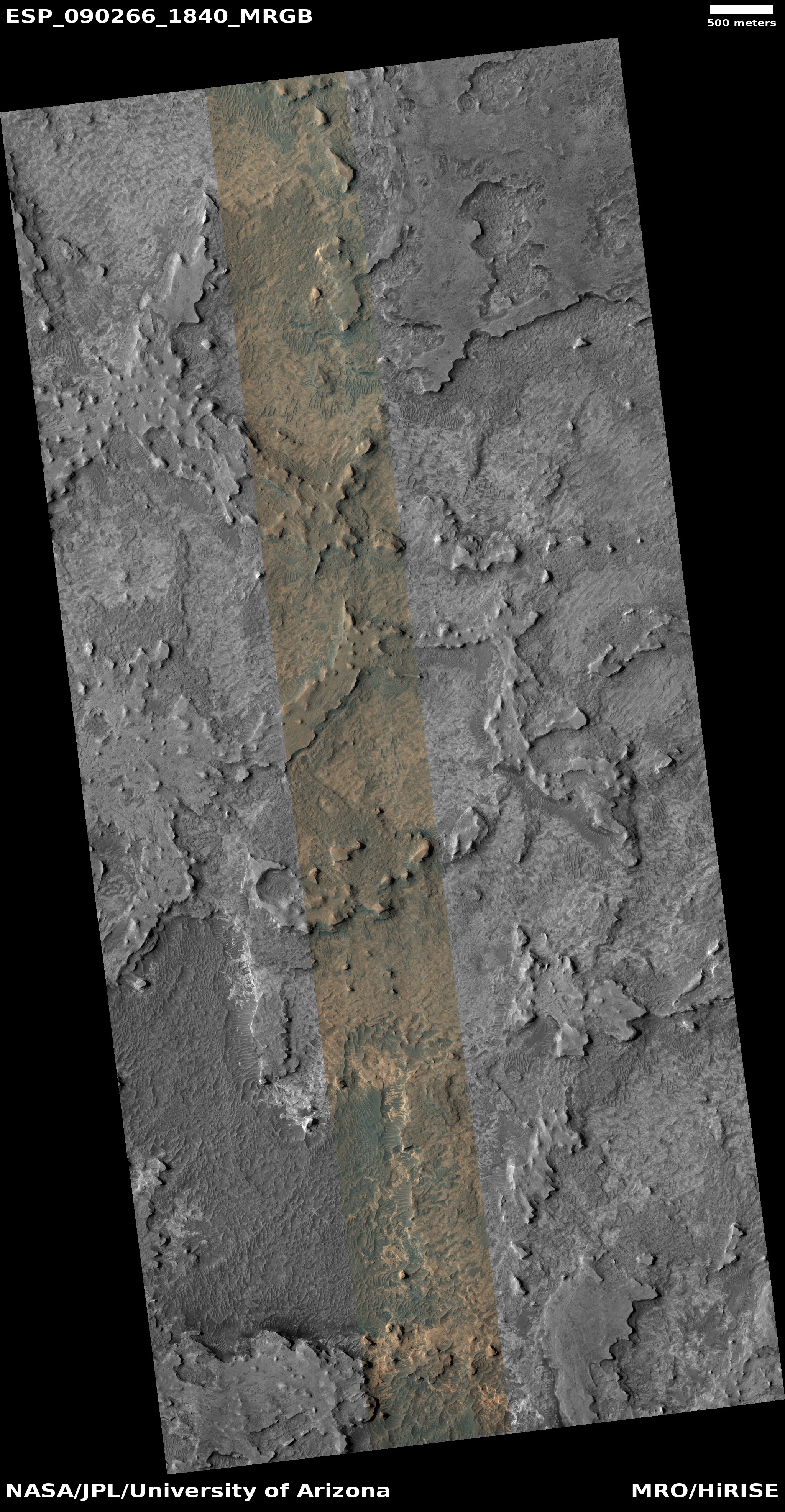
Cool image time! The picture to the right, cropped, reduced, and enhanced to post here, was taken on October 28, 2025 by the high resolution camera on Mars Reconnaissance Orbiter (MRO). Labeled by the science team as “mottled ridged terrain,” it shows a relatively flat area of scattered broken-up flat-topped ridges and knobs, following no clear pattern of formation.

In trying to research this, I could only find one paper [pdf] discussing this kind of mottled ridges that did a survey of similar features across a large region to the northwest. That paper could not determine what caused such features, but came up with hypothesis. From the abstract:

While it is not possible to determine the precise formation mechanism of these polygonal ridge networks from our new data, their formation can be assessed in terms of three possibly separate processes: (1) polygonal fracture formation, (2) fracture filling and (3) exhumation. We find that polygonal
fracture formation by impact cratering and/or desiccation of sedimentary host deposits is consistent with our results and previous spectral studies. Once the polygonal fractures have formed, fracture filling by clastic dikes and/or mineral precipitation from aqueous circulation is most consistent with our results. Exhumation, probably by aeolian processes that eroded much of these ancient Noachian terrains where the ridges are present caused the filled fractures to lie in relief as ridges today.

To put this in plain terms, the initial polygon-patterned cracks were formed by either an impact or the drying out of the surface (similar to the cracks seen on dried mud here on Earth). Both could have contributed. Then material welled up from below, either lava or mud, that hardened to fill the cracks. Later erosion by wind stripped away the surface, leaving behind these broken ridges.

As always, the location adds some very interesting context.
» Read more

More glaciers on Mars

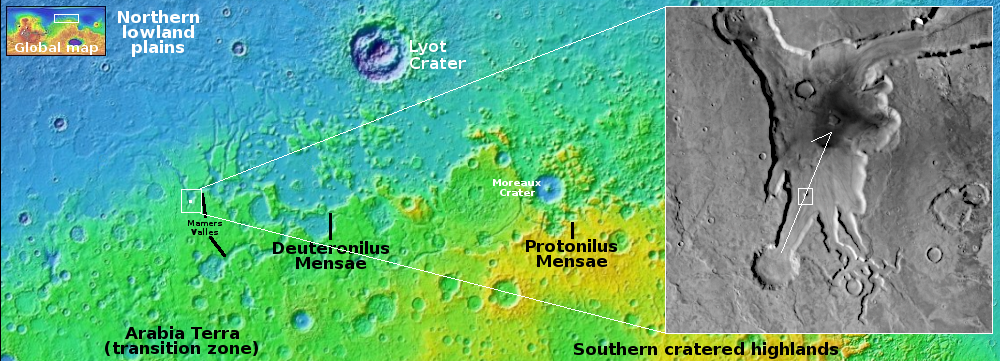
Overview map

More glaciers on Mars
Click for original image.

Cool image time! The picture to the right, rotated, cropped, reduced, and sharpened to post here, was taken on September 26, 2025 by the high resolution camera on Mars Reconnaissance Orbiter (MRO).

The scientists label this image “Moraine-like assemblage exposed by ice retreat.” I say: If anyone still doubts the extensive presence of near-surface ice on Mars, this picture should put that doubt to rest.

The white dot on the overview map above marks the location, deep within the 2,000-mile-long strip in the Martian northern mid-latitudes that I label “glacier country,” because practically every picture taken there shows glacial features. This picture is just one more example. As the inset in the overview above shows, this flow is coming down from the exterior rim of an unnamed, partly obscured ancient 17-mile-wide crater, dropping about 7,000 feet from the rim’s peak. This particular section shows the last 3,000 feet of that descent, as the glacier worked its way through a gap in a ridge paralleling that rim.

The image label refers to the flow features that appear to be corroding away. It appears the full data set suggests that corrosion is exposing the material pushed downward by that glacier, what on Earth we call a moraine.

New radar data shows no evidence of liquid water under Mars’ south pole ice cap

New data using the Sharad radar instrument on Mars Reconnaissance Orbiter (MRO) appears to disprove the 2018 observations that suggested a lake of liquid water might exist under the Martian south pole ice cap.

From the abstract:

Due to a novel spacecraft maneuver, SHARAD has now obtained a basal return associated with the putative body of water. Modeling of the radar response is not consistent with the liquid water explanation, instead suggesting a localized, low roughness region of dry rock/dust beneath the ice could explain the SHARAD response. Reconciling the divergent responses of SHARAD and MARSIS remains essential to determine the nature of this anomalous south polar region.

In other words, this reflectively bright area is caused not by liquid water, but by a very smooth patch in the south pole’s many underlying layers. What remains unknown is the cause of that smoothness. The scientists posit that “a crater floor with sediment or impact melt fill” could be the cause. Another study in 2022 suggested it could be volcanic rock, while a 2021 study claimed clay could be the cause.

At the moment no one has the ability to find out. The only certain way would be to drill deep cores, but that won’t happen until there is a thriving colony on Mars.

What might be the weirdest crater on Mars

What might be Mars' weirdest crater
Click for original.

Cool image time! The picture to the right is taken from a global mosaic created from images taken by the wide-view context camera on Mars Reconnaissance Orbiter (MRO). The original source image was probably a photograph taken on February 15, 2020.

I normally begin with an image from MRO’s high resolution camera, but the only images that camera took of this crater did not show it entirely. This context camera shows it in all its glory, what to my eye appears to be one of the weirdest craters I’ve seen on Mars.

First, note its oblong shape — 5.5 miles long and 3.7 miles wide — which appears to narrow to the southeast. It certainly appears that if this crater was caused by an impact, the bolide came in at a very low angle from the northwest, plowing this 700-foot-deep divot as it drove itself into the ground. Research has shown that an impact has to come in almost sideways to do this. Even at slightly higher angles the resulting craters will still appear round.

But wait, there’s more!
» Read more

Cracks on Mars

A cracking Martian surface

Cool image time! The picture to the right, cropped, reduced, and sharpened to post here, was taken on September 20, 2025 by the high resolution camera on Mars Reconnaissance Orbiter (MRO).

The camera team describes these features as “ridges,” which in one sense is entirely true. The features are ridges that rise above the surrounding plain. The problem is that they are also cracks, with most showing a distinct central fissure in their middle.

Such double ridged cracks are reminiscent of the surface of dried mud or paint, when it begins to crack and shrink. The surface on each side of a crack pulls away, rising upward slightly as it does so. Is that what we are seeing here, the drying of this surface?

As always, location is critical to understanding the Martian geology.
» Read more

Looking for avalanches on Mars

Avalanche scarp on Mars

Cool image time! The picture to the right, rotated, cropped, reduced, and enhanced to post here, was taken on September 24, 2025 by the high resolution camera on Mars Reconnaissance Orbiter (MRO).

The science team labels this as an “avalanche scarp”. At first glance it appears we are looking at a major mass wasting event flowing downward to cover the lighter banded terrain near the bottom of the picture.

The problem is that the overlying material didn’t move as an avalanche down onto that lighter material. Note that it has within it its own layers. To have flowed over that lower terrain it would have had to do that coherently, its many layers moving in unison. This doesn’t seem probable, though who knows considering the alien nature of Mars.

So what is going on? And why was this picture taken?
» Read more

Cracking scallops in the Mars

Cracking scallops on Mars
Click for original image.

Cool image time! The picture to the right, cropped to post here, was taken on September 27, 2025 by the high resolution camera on Mars Reconnaissance Orbiter (MRO).

The science team labels this “scallop-hosting mantle”. In other words, the surface here has a mantle of material that is for a variety of reason cracking and producing these north-facing scallops. That mantle also appears layered, since it descends downward in terraced steps as you travel north. This particular terrace drops about 40 feet.

Scientists believe [pdf] these scallops are formed in connection with the sublimation of underground ice.

According to [one hypothesis] scallop formation should be ongoing at the present time. Sublimation of interstitial ice could induce a collapse of material, initially as a small pit, then growing southward because of greater solar heating on the southern side. Nearby scallops would coalesce together as can be seen to have occurred.

In the case of the image to the right, this sublimation is also accompanied by a drying process similar to cracks one sees in dried mud. As the ice sublimates away the remain material shrinks and cracks.
» Read more

The edge of Mars’ north polar ice cap

The fringe of Mars' perennial ice cap
Click for original image.

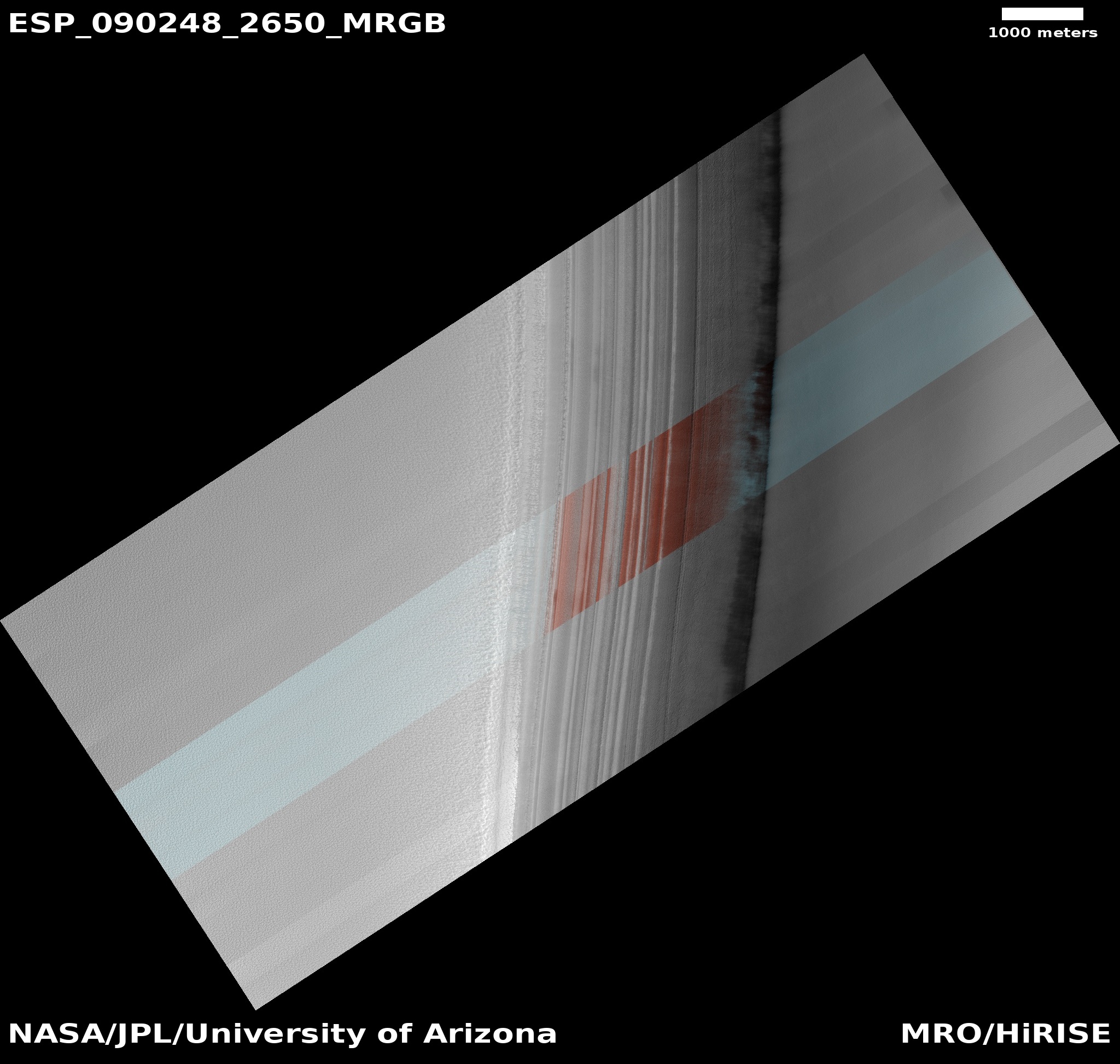
Cool image time! The picture to the right, cropped, reduced, and sharpened to post here, was taken on September 29, 2025 by the high resolution camera on Mars Reconnaissance Orbiter (MRO).

The picture shows what the science team labels as a “fringe of perennial ice.” For this picture, north is down. The white stuff on the top half of the image is that perennial ice, while the dark material at the bottom is likely a mixture of dust and debris that is still impregnated with ice.

Mars is a very icy world. Orbital data now suggests that above 30 degrees latitude there is a lot of near surface ice, though it is often mixed in with the red planet’s ample dust, blown there for eons. This location however shows us a place where that ice is on the surface, and is generally pure.

That does not mean however this will be a good location to establish a colony.
» Read more

Crazy layers inside a Martian crater

Crazy layers in a Martian Crater
Click for original image.

Cool image time! The picture to the right, cropped, reduced, and sharpened to post here, was taken on September 30, 2025 by the high resolution camera on Mars Reconnaissance Orbiter (MRO).

The scientists label this image with the term “layers”, but to my eye this is kind of an understatement. The geology in the top half of this picture is more than simply layers, it is an example of that unique Martian geological feature dubbed “brain terrain”, but on steroids.

No one yet knows what causes brain terrain, though scientists think it is related to the sublimation of near surface ice. Normally the tubelike formations are much smaller, only ten to thirty feet long, not hundreds of feet as we see here.

In this case the location of these features makes their formation even more puzzling, as there is no near surface ice found here.
» Read more

This typical cliff on Mars just happens to match the walls of the Grand Canyon

A typical Martian cliff, comparable to the Grand Canyon
Click for original image.

Cool image time! The picture to the right, cropped, reduced, and sharpened to post here, was taken on August 23, 2025 by the high resolution camera on Mars Reconnaissance Orbiter (MRO).

The label the science team gave this image, “remnant fan”, suggests the focus of research here is the fingerlike ridges on the floor of the canyon, emanating out from the cliff. These appear to be the remains of an ancient mass-wasting event, similar to an avalanche but different in that instead of it being a pile of surface material falling down the cliff, the cliff itself breaks free and slumps downward. In this case the event was so long ago that most of the slumped material has eroded away, leaving only those ridges, likely resistant to erosion because of the impact of the material from above.

If you look at the top of cliff, you can see evidence that another mass wasting event is pending. Note how the plateau floor near the cliff has dropped about 100 feet. This drop suggests that this part of the cliff has started to slump and break away from the plateau.
» Read more

Someone is apparently considering putting a helicopter on Starship when it goes to Mars

Potential Starship helicopter location

In my regular trolling through the images sent down from Mars Reconnaissance Orbiter (MRO), I sometimes come across things that imply truly exciting future missions. That happened when in 2019 I found a bunch of photos each labeled as a “candidate landing site for SpaceX Starship”. Without fanfare SpaceX had begun researching locations for where it intended to land Starship on Mars, in the northern lowland plains, research that it later solidified considerably.

Similarly, I have found MRO images in 2022 suggesting scientists were thinking of running a helicopter mission inside Valles Marineris, the largest canyon in the solar system. Another image in 2024 suggested that a helicopter mission might go to another region in Mars’s southern cratered highlands.

The image to the right, cropped, reduced, and sharpened to post here, is another new example of a potential Martian helicopter mission. It was taken on August 19, 2025 and is labeled provocatively “Characterize Possible Rotorcraft Landing Site.” Unlike the previous two proposed helicopter locations, however — which appeared to be aimed at uncertain NASA funding — this image’s location suggests it is far more certain, and might launch far sooner than you can imagine.
» Read more

New orbital radar data confirms large ice deposits in Phelgra Mountains near Starship landing zone

Overview map

A new paper published this week used the SHARAD radar instrument on Mars Reconnaissance Orbiter (MRO) to confirm that the glacial features found everywhere within the Phlegra Mountains where one of Starship’s four prime landing sites is located contains significant quantities of very accessible pure water ice.

The red dots on the map to the right mark two of those prime landing sites, with one inside the Phelgra Mountains in a region directly studied by this paper. The numbered black dots were other images taken by MRO for SpaceX, reported here in 2020. From the paper’s abstract:

We examined mid-latitude landforms on Mars that resemble Earth’s debris-covered glaciers in a region called Phlegra Montes. Our study site is a 1,400-km-long mountain range in the northern hemisphere of Mars that houses numerous debris-covered glaciers also called Viscous Flow Features (VFFs). Using data from the SHallow Radar (SHARAD) instrument, we detected eight new glaciers and estimated the thickness and volume of ice within them as well as the thickness of the debris on top insulating the ice. Our findings suggest that the region holds around 1.2 trillion cubic meters of ice below the surface. We detected two notable types of glaciers for the first time on Mars using SHARAD: (a) a glacier system with terrace-like steps and (b) a perched “hanging” glacier on the eastern side of the mountains

The study also found that the layer of dust and debris that covers these glaciers and protects them from sublimating away ranges from 6 to 25 feet in thickness, well within reach of any future colonists.

This study only confirms what all the orbital data for the past two decades has suggested, that Mars is an icy world like Antarctica, not a dry desert like the Sahara. As the researchers themselves note in the very first line of their paper, “Mars is a frozen world where water ice is abundant above, at, and under the surface.”

Their research also confirms that SpaceX has made a good choice for its Starship prime landing sites. Though it will likely not make its first landing at site #3, because it is inside the mountains and thus more risky, expect a landing there not long thereafter.

The alien landscape of Mars’ north polar ice cap

The strange terrain of Mars' north polar ice cap
Click for original image.

Cool image time! The picture to the right, cropped to post here, was taken on August 24, 2025 by the high resolution camera on Mars Reconnaissance Orbiter (MRO).

The camera team labels this simply as a “terrain sample,” which usually means it was not taken as part of any specific research request, but to fill a gap in the camera’s schedule in order to maintain its proper temperature. When they need to do this, they try to find interesting things to photograph, and mostly succeed.

At first glance the picture to the right does not appear that interesting. If anything it shows an endless expanse of mottled terrain, with no features of any interest at all. This sameness however is what makes this picture and landscape intriguing. What caused it to look this way?
» Read more

Weird “What the heck?!” pedestal crater on Mars

A
Click for full image.

Cool image time! The picture to the right, cropped and reduced to post here, was taken on August 26, 2025 by the high resolution camera on Mars Reconnaissance Orbiter (MRO). While the full image shows what the camera team labels as the “ridges” that cover this area, the most prominent feature in the whole landscape is this half-mile-wide pedestal crater, sitting about 50 to 100 feet above the surrounding terrain.

What makes this strange butte so weird is the plateau on top, criss-crossed with ridges and hollows in a manner that defies any obvious geological explanation.

Pedestal craters are not uncommon on Mars, and in fact a bunch of others are found throughout this region. The theory for their formation is that they formed when the surface here was much higher. The impact made the crater floor more dense and resistant to erosion, so as the surrounding terrain wore aware the crater ended up being a butte.

However, pedestal craters usually have relatively smooth tops, making this crater another example of a “What the heck?” image.
» Read more

A somewhat typical volcanic vent on Mars

Overview map

With today’s cool image we begin with the overview map to the right. The white dot marks the location, within the region on Mars dubbed the Tharsis Bulge, where four of its biggest volcanoes are located on a surface that has been pushed significantly above the red planet’s mean “sea level.”

The small rectangle in the inset shows the area covered by the cool image below. The focus is on a two-mile-long and half-mile-wide depression that sits on a relatively flat landscape of few craters.

If you look at the inset closely, you will notice this depression is surrounded by a dark borderline on all four sides, ranging in distance from three to thirteen miles. The grade to that borderline is downhill in all directions, with the drop ranging roughly from 800 to 1,000 feet.

So what are we looking at? » Read more

Small fresh impact on Mars’ youngest major lava flow

Monitoring a fresh impact on Martian lava
Click for original image.

Cool image time! The picture to the right, cropped, reduced, and sharpened to post here, was taken on August 26, 2025 by the high resolution camera on Mars Reconnaissance Orbiter (MRO).

The camera team labels this “Monitoring New Impact Site.” The fresh impact, indicated by the three dark patches just left and up from center, is actually not that fresh. It was first photographed by MRO on September 27, 2008. This newer picture is to see if anything significant had changed in the subsequent seventeen years.

In comparing the two pictures, the only change that is obvious is that the patches have faded and become less distinct. Nothing else appears different.

The surrounding terrain however is interesting in its own right. The landscape is remarkably flat, though it has that meandering ridge coming out from that lighter patch in the lower right. What are we looking at?
» Read more

Meandering channel in Mars’ southern cratered highlands

Meandering channel on Mars
Click for original image.

Cool image time! The picture to the right, cropped, reduced, and sharpened to post here, was taken on August 30, 2025 by the high resolution camera on Mars Reconnaissance Orbiter (MRO).

Dubbed a “channel” by the MRO science team, it shows us a meandering canyon with a floor that seems filled with corroded linear features seen frequently on Earth glaciers. Here, the linear ridges appear broken, in many places missing, and in other places so broken their linear nature disappears.

If this was on Earth and I was a global warming activitist, I would immediately claim that the glacier has been evaporating away due to a warming climate caused by SUVs and Republican intransigence. This however is on Mars, where there are no SUVs or Republicans. So what is going on?
» Read more

Layers of Martian ash

Layering on Mars
Click for original image.

Cool image time! The picture to the right, cropped, reduced, and sharpened to post here, was taken on August 31, 2025 by the high resolution camera on Mars Reconnaissance Orbiter (MRO).

The science team labels this as “layering”, which surely is an apt description. As the latitude is 9 degrees south, this location is within the dry tropics of Mars, where no near surface ice has yet been found. Thus, the terraced layers of this low 20-foot-high mesa are not indicative of the many glacial climate cycles found in the mid-latitudes.

Instead, we are looking at sedimentary layers of rock or dust, laid down over time and later exposed by erosion.

So what caused the layers? And what is causing them to be exposed, one by one? As always the overview map helps provide a possible explanation.
» Read more

Peeling brain terrain in Martian crater

Overview map

Peeling brain terrain on Mars
Click for original image.

Today’s cool image takes us once again back to Mars’ glacier country, the 2,000 mile-long mid-latitude strip in the northern hemisphere where almost every image shows glacier features. The picture to the right, cropped, reduced, and sharpened to post here, was taken on September 4, 2025 by the high resolution camera on Mars Reconnaissance Orbiter. It shows a small section of the floor of an unnamed 13-mile-wide crater, highlighting what the science team labels vaguely as “features.”

Those features appear to be glacial debris whose surface alternates between peeling gaps and the unique Martian geology dubbed “brain terrain”, whose formation is not yet understood but is believed to be associated with near surface ice.

The location is indicated by the white rectangle on the overview map above. At 36 degrees north latitude, this crater is deep within that mid-latitude strip where a lot of glacial features are routinely found. If you look at the inset, you can see that all the nearby craters appear to have formed in what appears to be slushy ground, their rims not very pronounced or distorted and their floors shallow, as if the ground melted like ice upon impact but very quickly solidified.

Mars is not a dry place. Future colonists will likely build their first cities around 30 degrees latitude, close enough to the equator to get warmer temperatures, but close enough to the near-surface ice found just a few degrees poleward, in a place such as this.

New research confirms the steady decline of Martian ice with each glacial cycle

The obliquity cycles of Mars

Using orbital data from Mars Reconnaissance Orbiter (MRO) of glaciers inside mid-latitude craters, scientists have concluded that there was a steady decline in the growth of those glaciers with each new glacial cycle.

They focused on craters with indicative signs of glaciation, such as ridges, moraines (piles of debris left behind by glaciers), and brain terrain (a pitted, maze-like surface formed by ice-rich landforms). By comparing the shapes and orientations of these features with climate models, they found that ice consistently clustered in the colder, shadowed southwestern walls of craters. This trend was consistent across various glacial periods, ranging from approximately 640 million to 98 million years ago.

The results show that Mars didn’t just freeze once—it went through a series of ice ages driven by shifts in its axial tilt, also known as obliquity. Unlike Earth, Mars’ tilt can swing dramatically over millions of years, redistributing sunlight and triggering cycles of ice build-up and melting. These changes shaped where water ice could survive on the planet’s surface. Over time, however, each cycle stored less ice, pointing to a gradual planetary drying. [emphasis mine]

You can read the paper here [pdf]. This result is not new. Based on the orbital data scientists have theorized now for almost a decade that as Mars’ rotational tilt (its obliquity) swings from 11 to 60 degrees, it produces extreme climate cycles on the planet. Those swings are shown on the graph to the right, taken from this 1993 paper [pdf]. When the obliquity is low, the mid-latitudes are warm and the glaciers there shrink, with the snow falling at the poles. When obliquity is high, the poles are warmer and its ice sublimates away to fall as snow in the mid-latitudes, thus causing those glaciers to grow instead.

The orbital data has consistently shown that with each new cycle, the glaciers grew less, suggesting that less global water was available on the planet. This new study further confirms these conclusions.

One last point: Though the amount of water ice on Mars has declined, we mustn’t think the red planet now has none. The orbital data shows that there is a lot of near surface ice on Mars, covering the planet from 30 degrees latitude poleward. As I’ve noted numerous times, Mars is a desert like Antarctica.

Martian winds are faster than expected

According to an analysis of pairs of 300 hundred orbital images taken seconds apart, scientist have found that Martian winds can reach speeds of 100 miles per hour (160 kilometers per hours), much faster than previously expected.

The results show that the dust devils and the winds surrounding them on Mars can reach speeds of up to 44 m/s, i.e. around 160 km/h, across the entire planet, which is much faster than previously assumed (previous measurements on the surface had shown that winds mostly remain below 50 km/h and – in rare cases – can reach a maximum of 100 km/h). The high wind speed in turn influences the dust cycle on the Red Planet: “These strong, straight-line winds are very likely to bring a considerable amount of dust into the Martian atmosphere – much more than previously assumed,” says Bickel. He continues: “Our data show where and when the winds on Mars seem to be strong enough to lift dust from the surface. This is the first time that such findings are available on a global scale for a period of around two decades.”

You can read the paper here. The study also found dust devils favor the spring and summer in both the north and south hemispheres, and tended to be concentrated in the mid-latitudes.

What is most interesting about this data, which because it is somewhat sparse has a lot of uncertainties, is that it suggests the candidate landing zone for SpaceX’s Starship is a region with one of the most intense dust devil seasons every spring and summer. This is not really a threat to settlement, because the atmosphere is so thin even these high winds would hardly be felt, but it does indicate an environmental condition that must be considered for any future settlement there.

Fresh slope streak on Mars

Fresh slope streak on Mars
For original images go here and here.

Cool image time! One of the geological mysteries on Mars seen no where on Earth is something scientists have dubbed “slope streaks.” Though they at first glance appear to be avalanches, they do nothing to change the topography, have no debris pile at their base, and sometimes even travel up and over rises on their way downhill. They can also appear randomly throughout the year, can be bright or dark, and fade with time.

No theory as to their cause has yet been accepted, though recent research suggests they are dry events, dust avalanches triggered by dust devils, wind, or the accumulation of dust.

To better understand this geology, scientists repeatedly monitor known slope streak locations looking for changes. The two images to the right are an example, downloaded from the high resolution camera on Mars Reconnaissance Orbiter (MRO) on July 2, 2024 and September 1, 2025. In the fourteen months that passed between the first and second images, two distinct and large slope streaks occurred next to each other, near the bottom of the picture. All the other streaks merely faded.
» Read more

Martian boxwork on the flanks of Mount Sharp

The boxwork on Mars
Click for original image.

Cool image time! The picture to the right, cropped, reduced, and sharpened to post here, was taken on October 5, 2025 by the left navigation camera on the Mars rover Curiosity.

The picture looks north and downhill from the lower flanks of Mount Sharp, inside Gale Crater. In the far distance on the horizon can be seen the crater’s northern rim, about 20 to 30 miles away. As it is now moving into the dusty season on Mars, the haze has increased from only a month ago, making it hard to see many distant details.

In the foreground can be seen clearly the light-colored ridges of the boxwork that the rover has been traversing for the past three months, with one rover track visible on the nearest ridge. Unlike the very rocky and boulder-strewn terrain the rover has seen in most of its travels on Mount Sharp, this boxwork seems smoother.
» Read more

A Martian landscape of volcanic pimples

A Martian landscape of volcanic pimples
Click for original image.

Cool image time! The picture to the right, cropped, reduced, and sharpened to post here, was taken by the high resolution camera on Mars Reconnaissance Orbiter (MRO) and downloaded on August 3, 2025. Labeled as a “terrain sample,” such images are usually taken not as part of any specific research request but because the camera team needs to fill a gap in the camera’s schedule so as to maintain its proper temperature. When they do this, they always try to pick interesting targets within the time window, and usually succeed.

In this case, the camera team picked a location in the middle of Isidis Planitia, one of Mars’ four biggest basins thought to have been formed from a major impact several billion years ago, focusing on an area covered with these strange knobs that have craterlike depressions at their peaks.

According research published in 2010 [pdf], it is believed these cones — all of which are only a few feet high — are the result of volcanic activity following the impact that formed Isidis four billion years ago. In a sense, they are leftover pimples from that impact and the subsequent volcanic activity within that melted basin.
» Read more

Blobby Martian crater filled with ice

Overview map

A blobby Martian crater filled with ice
Click for original image.

Cool image time! The picture to the right, rotated, cropped, reduced, and sharpened to post here, was taken on August 4, 2025 by the high resolution camera on Mars Reconnaissance Orbiter (MRO).

The science team labels this a “concentric fill crater,” a term used by planetary scientists for Martian craters that appear to be filled with glacial material. That certainly appears to be the case, but this 3.5-mile-wide unnamed crater also appears to have been warped by the ice that impregnates the ground all around it.

The overview map above explains why. The white dot marks the location, on the eastern end of the 2,000-mile-long northern mid-latitude strip that I label glacier country, because almost every image in this region shows similar glacial features. Though it is hard to tell from the inset, all the craters here have similar glacial material within them, and the ground surrounding them also appears glacial in nature.

This particular location is at 40 degrees north latitude. While it might be difficult to establish a colony here, on ground that appears so unstable, going 700 to 800 miles to the southeast would put you in what is considered one of Mars’ prime mining regions. Thus, with the right equipment mining operations would have accessible water not that far away.

Monitoring the largest recent impact detected by InSight’s seismometer

Overview

Cool image time! On December 24, 2021 the seismometer of the Mars lander InSight detected a four magnitude earthquake, the largest detected up until then. Because its nature suggested that it had been caused by an impact, not an internal shifting, the science team for Mars Reconnaissance Orbiter (MRO) immediately started searching for new impact craters in the area of Mars where the data suggested the quake came from.

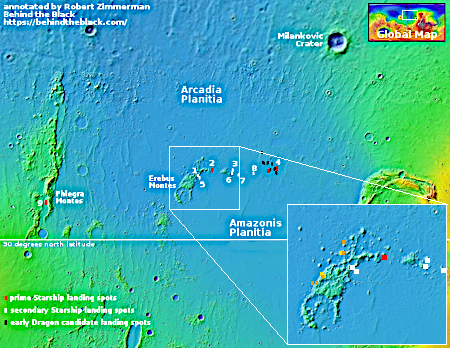
Two months later they found it, in the northern lowland plains just south of the prime landing zone chosen by SpaceX for its Starship spacecraft. The black cross on the overview map to the right indicates the position. The four red spots are the prime Starship landing sites. The white dots indicate other locations considered. The black dots were images taken for a proposed Dragon landing. This impact is thus only about 100 miles away from the nearest possible Starship landing spot.
» Read more

Bubbling lava frozen in a Martian crater

Bubbling lava frozen in a Martian crater
Click for original image.

Cool image time! The picture to the right, cropped, reduced, and sharpened to post here, was taken on June 23, 2025 by the high resolution camera on Mars Reconnaissance Orbiter (MRO). This one-mile-wide unnamed crater was a featured image last week by the science team. As noted in the caption, written by Chris Okubo of the U.S. Geological Survey:

This area was covered by a large flood of lava, which we see as the generally flat areas surrounding the crater. As the lava flowed across, some of it flowed into this crater through a low spot along the crater rim.

Once in the crater, the lava heated ground water or ground ice in the floor, causing the water to boil and turn into steam. This steam then exploded through the overlying lava and created small, ring-shaped formations. These are called ”rootless cones,” and they record the presence of ground water or ground ice in the crater floor at the time of the lava eruptions.

In other words, when this crater was flooded with hot lava, it was filled with ice or water. That fact is significant because of the crater’s location, as shown in the overview map below.
» Read more

Has Curiosity stumbled upon a small slope streak?

Is that a slope streak in the lower right?
Click for original.

Overview map
Click for interactive map

In reviewing the pictures downloaded today by the Mars rover Curiosity, I noticed something very intriguing in the pictures taken by rover’s two navigation cameras. One such picture is above, taken by the right navigation camera and looking west across the boxwork ridges that Curiosity has been traversing for the past two months. You can see two such ridges in the right foreground, cutting diagonally from left to right.

The overview map to the right gives the context, with the blue dot marking Curiosity’s position. The white and red dotted lines indicate its actual and planned routes respectively, with the top inset zooming in to show the recent travels more clearly. The yellow lines show the approximate area covered by the picture above.

Note the dark streak in the lower right of the picture. The bottom inset on the overview map shows this streak more closely. To my eye, it strongly resembles a slope streak, a strange geological feature unique to Mars.

If I am right, expect the rover team to focus in on this streak. The cause of slope streaks remains unknown. From orbit, the streaks look like avalanches at first glance, but they don’t change the topography, have no debris pile at their base, and sometimes even travel up and over rises as they head downhill. They can occur randomly throughout the year, can be bright or dark, can occur anywhere, and fade with time.

There are a number of theories (see here, here, and here) attempting to explain their cause, but none has been confirmed. If this is a streak, it will be the first that any scientist can see up close.

It is also very likely my guess is wrong, and this is not a streak. Stay tuned for updates.

1 2 3 35