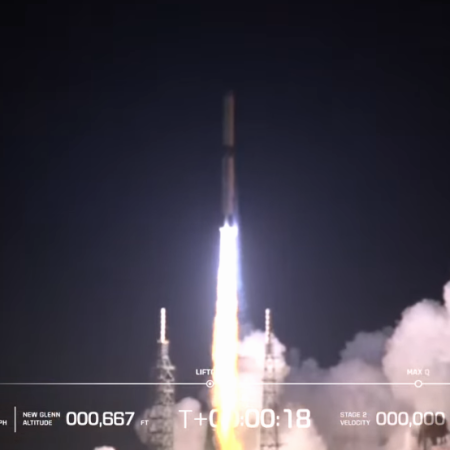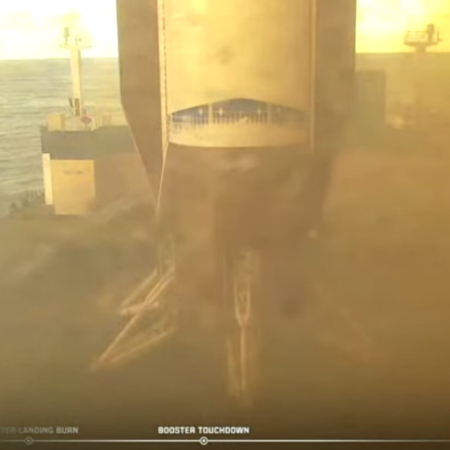
Bezos releases new video of the New Glenn first stage landing yesterday

Jeff Bezos, founder of Blue Origin, today released on X new footage showing from a distance the full landing sequence of New Glenn’s first stage on a barge in the Atlantic.

I have embedded it below. It is quite spectacular, and suggests the Blue Origin team can match SpaceX’s team in controlling a landing spacecraft. The stage comes down several hundred feet to the side of the barge, hovers, and then slides sideways to touch down exactly on target. As Bezos notes:

We nominally target a few hundred feet away from Jacklyn to avoid a severe impact if engines fail to start or start slowly. We’ll incrementally reduce that conservatism over time.

This is not unlike the landing maneuver performed by Starship prior to capture by the tower chopsticks. If Blue Origin can do it also, it means it has capabilities it has been hiding for the past decade due to its slow and timid testing/launching pace.
» Read more

11 comments

New Glenn successfully launches Escapade orbiters AND lands 1st stage

New Glenn first stage after landing

Blue Origin today successfully placed two the NASA Escapade Mars orbiters into space, its New Glenn rocket launching for the second time from Cape Canaveral in Florida.

More significantly, the company successfully landed the rocket’s first stage on a barge in the Atlantic. New Glenn is now the second rocket company capable of vertically landing and recovering an orbital first stage, after SpaceX.

Several take-aways: First, this first stage recovery took place almost exactly a decade after Blue Origin successfully landed vertically its suborbital New Shepard rocket, and almost a decade after SpaceX successfully did it with its Falcon 9 orbital rocket. It is a shame that it took Blue Origin so long to get to this point. It is also magnificent that it has finally made it happen. The United States now has two reusable rockets, with two more (by Rocket Lab and Stoke Space) expected to launch by next year.

Blue Origin is not likely to reuse this particular first stage, but its recovery will make future reuses likely and soon.

Second, Blue Origin made one interesting broadcast choice that I like. It listed the rocket’s altitude and speed in feet/miles and miles per hour, not kilometers. The engineers might have been using metric, but the audience is American, so using the traditional Imperial numbers is smart. Good for Blue Origin.

Third, Blue Origin’s announcers were once again annoying, distracting, ignorant, and childishly emotional. And they simply would not shut up, preventing the audience from hearing critical reports from mission control. They also seemed oblivious to reality, bragging repeatedly about the ten year gap between the first New Shepard landing and this landing, as if this was somehow a good thing. It was embarrassing to listen to.

The company would do a far better job selling itself by hiring announcers who are more serious and professional. Sadly, I have noted this problem from Blue Origin’s announcers now for almost a decade, with little change.

Finally, this success is a very big deal, both for Blue Origin and the United States. The company is now primed to begin regular launches next year, including the 27 launches Amazon has purchased for its Kuiper constellation.

For the U.S., this finally gives us a solid competitor to SpaceX. And that competition is finally going to force launch prices to drop significantly. SpaceX dropped prices, but not as far as it could because there was no pressure to do so from anyone else. Now there is that pressure.

As this was only the second launch by Blue Origin in 2025, the leader board for the 2025 launch race remains unchanged:

147 SpaceX
70 China
14 Rocket Lab
13 Russia

SpaceX still leads the rest of the world in successful launches, 147 to 116. Note that ULA hopes to launch its Atlas-5 rocket tonight.

40 comments

Lawsuit against Amazon for favoring Blue Origin over SpaceX to launch Kuiper satellites gets new hearing

The lawsuit originally filed in 2023 against Amazon because it favored other less reliable rockets, including Blue Origin’s forever-delayed New Glenn, instead of using SpaceX to launch its Kuiper constellation of satellites, got a new hearing yesterday after the suit was dismissed in February.

The suit is now being pursued a pension fund that apparently invested in the Kuiper constellation, and claims Jeff Bezos used his influence to convince Amazon to avoid using SpaceX when it signed launch contracts with ULA, Arianespace, and Blue Origin in 2022, even though none of those rockets were even operational at the time. Even now they appear unable to meet Amazon’s launch requirements.

Amazon has until 2026 to send up the first 1,600 satellites and three more years to launch the next batch. That broader backdrop barely came up during the appeal proceedings, which zoomed in on allegations that the board made no effort to oversee self-dealing by Bezos as he directed billions from Amazon to his own rocket company, Blue Origin, despite SpaceX’s superior capabilities.

Vivek Upadhya, counsel for the pension fund, stressed the “billions of dollars flowing directly from Amazon to a company owned and controlled by Amazon’s CEO and chairman.” The sheer scale of the conflict of interest made the Blue Origin contract “a truly exceptional transaction” requiring attentive board supervision, regardless of the actual role Bezos played in negotiations, according to Upadhya. “Delaware law doesn’t require that directors harbor some innate suspicion” before taking steps to manage conflicts, but the board “failed to lift a finger,” he said.

Following the filing of the 2023 lawsuit, Amazon signed SpaceX to a three-launch contract, which SpaceX has now completed. Meanwhile, only ULA has managed any of the other launches, three also. As for Arianespace and Blue Origin, it is not clear when either will begin doing any Kuiper launches.

It does appear Amazon’s board played favorites here, and did so in a way that was harmful to the company’s bottom line. Whether this can be proved to the satisfaction of the court however is very uncertain.

0 comments

Blue Origin officials provide update on their lunar lander program

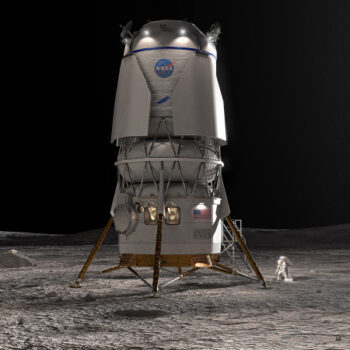
2023 artist rendering of the manned Blue Moon lander

Link here. According to the article, the company is presently stacking its first unmanned version of its Blue Moon lander, dubbed Blue Moon Mark 1, scheduled for launch now next year.

The 8.1-meter-tall cargo lander will help with ongoing development of their crewed lander, named Blue Moon Mk. 2, which is 15.3 meters tall. Both are powered by Blue Origin’s BE-7 engines, which are being tested on stands in Alabama, Texas and Washington.

…“A big milestone for you to look out for online is that Mk. 1 is three modules that are being stacked as we speak: aft, forward and mid. And once it is stacked in its finished configuration, we will be barging it over to NASA Johnson Space Center Chamber A to do a full up thermal vac campaign,” said [Jacqueline Cortese, Blue Origin’s Senior Director of Civil Space]. “So when you see that on its boat, you will know that big things are happening.”

Both versions of the lander are powered by a combination of liquid hydrogen and liquid oxygen. A key difference though is that Mk.1 can be launched to the Moon with a single launch of Blue Origin’s New Glenn rocket while Mk. 2 requires orbital refueling. [emphasis mine]

The highlighted sentence above is important because it illustrates the absurdity of the comments last week by interim NASA administrator Sean Duffy, claiming SpaceX’s program to make Starship a manned lunar lander is “behind”, forcing him to open up the competition to Blue Origin, who might get it done sooner.

One of the big issues used against SpaceX is that Starship will need to be refueled once in orbit to work as a lunar lander, and that technology needs to be developed and tested. The problem with this criticism is that, as noted above, Blue Origin’s manned lunar lander also needs to be refueled.
» Read more

11 comments

Space Force awards SpaceX and ULA seven launches worth more than a billion dollars

The U.S. Space Force (USSF) yesterday awarded multi-launch contracts to both SpaceX and ULA for seven launches beginning in 2027 worth more than a billion dollars.

SpaceX received $714 million for five launches and ULA was awarded $428 million for two launches, USSF said in an Oct. 3 news release.

The awards are part of the Space Force’s National Security Space Launch Program, which it uses to launch services for military space missions. In April, it chose SpaceX, ULA, and Blue Origin to launch a total of 54 missions scheduled between fiscal 2027 and 2032, with SpaceX responsible for just over half, with 28 launches. Individual missions will be awarded in batches through fiscal 2029.

Though Blue Origin was included in this program and its New Glenn rocket has finally launched once successfully, its not yet been certified to launch military satellites, and to get certified the company is going to have to launch at least one more time. That launch is expected before this month is out. Moreover, it will soon have to compete against more companies, and the Pentagon will be adding Rocket Lab and Stoke Space to its approved list as soon as both successfully launch their respective Neutron and Nova rockets by next year.

7 comments

Speculation on future New Glenn launch schedule

According to anonymous sources at Blue Origin, the company has now delayed the second launch of its New Glenn rocket to September, ten months after its first launch in January 2025, and hopes to quickly follow with three more launches by the middle of 2026.

The September launch will launch NASA’s two smallsat Escapade Mars orbiters.

After Escapade, Blue Origin has several missions tentatively plotted out. However, sources cautioned that the manifest could be moved around due to the readiness of subsequent New Glenn vehicles and their payloads. Based upon information received by Ars, the launch manifest could look something like this:

  • New Glenn 2: ESCAPADE (fall 2025)
  • New Glenn 3: Firefly’s Elytra orbital transfer vehicle (end of 2025, early 2026)
  • New Glenn 4: Blue Moon MK1 lander (first half of 2026)
  • New Glenn 5: First batch of 49 Amazon Project Kuiper satellites (mid-2026)

Whether this schedule will occur as speculated is unknown. Blue Origin’s long term track record — slow and timid — suggests it is very unlikely. And even if it does fly as planned, it suggests strongly that Amazon is not going to meet its FCC license requirement to have 1,600 Kuiper satellites in orbit by July 2026. So far Amazon has only placed 54 operational Kuiper satellites into orbit, on two Atlas-5 launches. It has contracts to launch these satellites 46 times on ULA rockets (8 on Atlas-5 and 36 on Vulcan), 27 times on Blue Origin’s New Glenn, 18 times on ArianeGroup’s Ariane-6, and 3 times on SpaceX’s Falcon-9.

Except for the Falcon 9, none of the other rockets have begun flying with any frequency. Vulcan has only launched twice, New Glenn once, and Ariane-6 twice. All three have been extremely slow to ramp up operations, with months passing between each launch. To meet Amazon’s FCC license requirements, they will have to achieve between 35 to 60 launches in the next twelve months, a pace of three to six launches per month. At this point none of these companies appear capable of even coming close to doing this.

Nor does Amazon have the option to switch these launches to the Falcon 9. SpaceX would certainly accept the business, but the manifest for the Falcon 9 is presently very full. It is doubtful it could do more than double or triple its commitment to Amazon.

5 comments

Blue Origin again delays 2nd launch of New Glenn

According to a statement from David Limp, the CEO of Blue Origin, on June 9, 2025, the company has once again delayed the second launch of its new New Glenn rocket, pushing back from May to August.

New Glenn’s second mission will take place NET August 15th. Following in the footsteps of our first booster, we’ve chosen the name “Never Tell Me The Odds” for Tail 2. One of our key mission objectives will be to land and recover the booster.

The rocket’s first launch had occurred in January, and successfully placed its test payload in orbit as intended, though it was unable to land the first stage on its barge in the Atlantic. Blue Origin later said it was targeting May for the second launch, carrying NASA’s two Escapade smallsat Mars orbiters. With this new delay it is unclear what the payload would be.

According to this report, anonymous sources claim an August launch is unlikely and will likely slip to September. The company has a large backlog of launch contracts, including 27 for Amazon’s Kuiper constellation as well as a number for the military. The hope had been that it could ramp up its launch cadence in 2025 to meet those contracts.

Instead, Amazon has begun shifting some of its launch work to SpaceX’s Falcon 9. Its FCC license requires it to get 1,600 satellites in orbit by July 2026, and at present it only has sixteen in space. It can no longer wait for Blue Origin to dilly-dally along.

Considering the actual success of the first launch, it seems very puzzling for there to be a nine-month delay until the second launch, even with the failure to land the first stage. Was there some technical problems with the rocket that have not been revealed? It seems foolish to delay further launches in order to fix the landing of the first stage, since that has no impact on getting the customer’s payload into orbit. Wouldn’t it be better to fly again, test the landing again during flight, than sit on the ground looking at computer simulations?

It is also possible the company is still having production problems producing enough BE-4 engines for both ULA’s Vulcan rocket and its own New Glenn. Vulcan uses two per launch, and according to ULA Blue Origin has delivered enough to begin launching Vulcan as many as fifteen times before the end of this year. New Glenn uses seven BE-4s on its first stage. Could it be that Blue Origin wasn’t able to produce enough of these engines for this year’s New Glenn launches?

All this is speculation. What we do know for certain is that both of these companies continue to disappoint. The result is that for larger payloads the United States remains reliant entirely on SpaceX, a situation that is not healthy for the commercial and government satellite industry.

9 comments

Space Force awards SpaceX, ULA, and Blue Origin $13.7 billion in launch contracts

The Space Force yesterday awarded a combined $13.7 billion in launch contracts to SpaceX, ULA, and Blue Origin, covering military launches through 2032.

The contracts, announced April 4 by the U.S. Space Force’s Space Systems Command, are part of the National Security Space Launch (NSSL) Phase 3 Lane 2 procurement, a cornerstone initiative designed to bolster the Pentagon’s access to space for its most sensitive and risk-averse missions.

SpaceX emerged as the leading contractor, securing $5.9 billion in anticipated awards, followed by ULA at nearly $5.4 billion and Blue Origin at nearly $2.4 billion. The three companies are expected to collectively perform 54 launches under the agreement between fiscal years 2025 and 2029.

Based on the contracts, SpaceX will do 28 launches, ULA 19, and Blue Origin 7. Since these launches include many military payloads that must go on “risk-adverse” rockets, the distribution of launches makes sense. While SpaceX’s rockets (Falcon 9 and Falcon Heavy) are well proven to be reliable, both ULA and Blue Origin launch with new rockets, Vulcan and New Glenn respectively, that have barely yet left the factory. Vulcan has done only two launches, with the second having technical issues (supposedly resolved). Blue Origin has done only one successful launch, though it failed to land the first stage as planned.

The distribution however serves the needs of both the military and the American rocket industry. It gives the Pentagon redundancy, multiple launch providers. And it gives America the same, three competing rocket companies striving for business and profit.

The result is going to be a very vibrant American space effort, doing a lot of things having nothing to do with the Pentagon.

13 comments

Blue Origin completes investigation of the failed landing of New Glenn’s 1st stage

Blue Origin today announced that it has completed its investigation into the failure of New Glenn’s first stage when it attempted to land on a barge in Atlantic during the rocket’s first launch on January 16, 2025.

Our ambitious attempt to land the booster, “So You’re Telling Me There’s a Chance,” was unsuccessful due to our three BE-4 engines not re-igniting properly. Our review confirmed that all debris landed in our designated hazard area with no threat to public safety. The report identified seven corrective actions, focusing on propellant management and engine bleed control improvements, which we’re already addressing. We expect to return to flight in late spring and will attempt to land the booster again.

It is very concerning that the three BE-4 engines that were supposed to relight were unable to do so, especially because this engine was supposedly designed from the start of re-usability.

The next scheduled New Glenn launch in for June, launching NASA’s Escapade Mars orbiters.

6 comments

Blue Origin successfully launches New Glenn

New Glenn 18 seconds after liftoff

Better late than never! After almost a decade of development and five years behind schedule, Blue Origin tonight successfully launched its massive New Glenn orbital rocket, placing its second stage into orbit carrying a demo version of the company’s Blue Ring orbital tug.

It appears the first stage had a problem during what Blue Origin calls its “booster reentry burn”, which appears somewhat equivalent to SpaceX’s entry burn. Unfortunately no camera views were made available. From that point no further telemetry came down from the first stage, suggesting something had gone wrong enough to require initiation of the flight termination system so the stage would not crash on the landing barge.

The second stage will operate in orbit for six hours, testing Blue Ring.

For Blue Origin this success, though late, is a grand achievement. The company has a full launch manifest, with a 27-launch contract with Amazon for its Kuiper internet constellation. It also has a deal with the Space Force to get the rocket certified for military launches, once it completes two successful launches. Once certified the Space Force very much wants to use it, a lot.

America now has three major rocket companies, SpaceX, ULA, and Blue Origin. It also has Rocket Lab, which has a smaller rocket but intends to introduce its own larger version in 2025.

The 2025 launch race:

8 SpaceX
2 China
1 Blue Origin

Nor is the launch action over. Tomorrow SpaceX will attempt the seventh orbital test launch of its Starship/Superheavy rocket, the one-hour launch window opening at 4 pm Central.

9 comments

Live stream of first New Glenn launch

I have once again embedded below Blue Origin’s live stream of its attempt tonight to complete the maiden launch of its orbital New Glenn rocket.

The launch window of three hours opens at 1 am (Eastern). It would be nice if Blue Origin’s announcers showed some improvement in their delivery tonight but I have doubts. Expect as always lots of “This is so exciting!” and “Aren’t you excited?” and “Isn’t this the most exciting evening yet!” Blah.

As I’ve said, their audience doesn’t want emotion, it wants detailed information provided coolly. If they do that, they will do more to sell their rocket than anything.

UPDATE: It appears Blue Origin management might have seen the blistering criticisms of its launch coverage yesterday. Instead of starting the live stream an hour before, they are now going to start it at T-20 minutes, but have also placed the count on hold at T-20:50. This avoids blather, especially if mission control is not going to provide the announcers any concrete information, as they did yesterday.

The change from simply recycling the count to an actual hold is also a positive change. Simply recycling the count (by adding 20-30 minutes periodically while they work out issues) puts pressure on the launch team unnecessarily. Better to work under a hold.

The count now has been recycled to 30 minutes and is rolling. We shall see if the podcast goes live at 20 minutes.
» Read more

6 comments

Live stream of first launch of Blue Origin’s New Glenn rocket-Launch scrubbed!

UPDATE: The company has scrubbed the launch for tonight.

Scheduled for launch at 1 am (Eastern) on January 13, 2025 (with a three hour window), I have embedded the live stream below. On the west coast the launch will occur at 10 pm (Pacific), January 12, 2025. According to Blue Origin, the live stream will go live one hour prior to launch. Based on the company’s past broadcasts, we will have to suffer through a lot of “Gosh! Gee whiz!” Isn’t this great?!” stuff that really ain’t necessary. Maybe Blue Origin will surprise me. If not, come back five minutes before launch to spare yourself this blather.

You see, there is no need for Blue Origin to blather like that. The rocket is spectacular, and it speaks for itself.

38 comments
1 2 3 4 11