New Glenn launched delayed one more day because of rough seas

Blue Origin announced today that it is delaying its first launch of its orbital New Glenn rocket by one day to 1 am (Eastern) Monday morning.

The company’s tweet explained that “sea state conditions are still unfavorable for booster landing.”

Without question this will be a truly heart-stopping launch. Blue Origin needs to get New Glenn operational, and it trying to also achieve its first vertical landing of the first stage on the first launch.

Right now all you need to do is stay up a little late Sunday night to watch.

8 comments

Blue Origin fined by the Florida Department of Environmental Protection for using its launch deluge system

Because it conducted a static fire test using its launchpad deluge system in September 2024, before the Florida Department of Environmental Protection (FDEP) had issued it a permit, the department has now fined Blue Origin $3,250.

The actual permit was subsequently approved in November 2024.

The story is very reminiscent of the red tape treatment SpaceX has been getting at Boca Chica. I am certain Blue Origin’s deluge system uses potable water (confirmed in the comments below), which will do no harm to the environment — proven by decades of government launches at both Cape Canaveral and the Kennedy Space Center. Yet, FDEP accuses the company of dumping “untreated industrial wastewater [in]to the environment.”

This story kind of proves that leftist politicians and activists can never stay bribed. Bezos for years has cozied up to the left with major donations to leftist organizations, including many many environmental groups. But when he finally gets ready to launch they are still ready and willing to make his life difficult.

It seems to me that Governor Ron DeSantis of Florida should have a conversation with the officials at FDEP that issued this fine, explaining to them that the real problem was likely that permitting was taking longer than it should, especially when everyone knows such deluge systems cause no harm. The permit should have been approved instantly.

6 comments

Blue Origin completes first full dress rehearsal countdown and static fire test of New Glenn

Blue Origin today successfully completed the first full dress rehearsal countdown and static fire test of its New Glenn orbital rocket at its launchpad at Cape Canaveral.

The tanking test included a full run-through of the terminal count sequence, testing the hand-off authority to and from the flight computer, and collecting fluid validation data. The first stage (GS1) tanks were filled and pressed with liquefied natural gas (LNG) and liquid oxygen (LOX), and the second stage (GS2) with liquid hydrogen and liquid oxygen–both to representative NG-1 set points.

The formal NG-1 Wet Dress Rehearsal demonstrated the final launch procedures leading into the hotfire engine run. All seven engines performed nominally, firing for 24 seconds, including at 100% thrust for 13 seconds. The test also demonstrated New Glenn’s autogenous pressurization system, which self-generates gases to pressurize GS1’s propellant tanks.

According to the company, the test achieved all its engineering goals, apparently making it ready for its targeted January 6, 2025 launch date. Beforehand however it will be rolled back into the assembly building so that its payload, Blue Origin’s Blue Ring orbital tug, can be stacked inside the fairings to fly a demo mission for the military.

7 comments

Blue Origin finally gets FAA license to launch New Glenn, now targeting January 6, 2025

The first completely assembled New Glenn, on the launchpad
The first completely assembled New Glenn,
on the launchpad

The FAA, after months of apparent delays, today finally issued Blue Origin a license to launch its New Glenn rocket for a period covering the next five years.

As has now become the FAA’s custom, in issuing this license it also brags about its success in issuing the license “well in advance of the statutory deadline” for doing so.

What a crock. Blue Origin and NASA were originally targeting an October launch of New Glenn carrying two Mars orbiters, but had to cancel when the rocket couldn’t lift off during the six-day launch window. Though delays at Blue Origin certainly contributed to this cancellation, I suspect the FAA’s red tape played a major factor as well.

According to another source, Blue Origin is now targeting a launch date of January 6, 2025. The company is presently doing a static fire test on the launchpad.

Hat tip to BtB’s stringer Jay.

7 comments

ULA’s CEO outlines a bright 2025 for its Vulcan rocket

In an interview for the website Breaking Defense, ULA’s CEO Tory Bruno outlined his optimistic outlook in 2025 for its Vulcan rocket, despite the loss of a nozzle from a strap-on booster during its second test launch.

The important take-aways:

  • He expects the military to certify the rocket “momentarily”, though this could mean one to several months.
  • The company plans 20 launches in 2025, with 16 Vulcans already in storage.
  • Eventually Bruno expects to be launching 20 to 30 times per year.
  • Blue Origin has so far delivered 12 BE-4 engines, of which four have flown.
  • Blue Origin’s production rate is presently one per week.

The last two items are significant. If this production rate is the fastest Blue Origin can do, it will limit the number of Vulcan and New Glenn launches significantly per year. For example, Vulcan uses two engines per launch. To do 20 launches in 2025 will require 40 engines. Blue Origin however wants to also launch its New Glenn a number of times in 2025, and it uses seven BE-4 engines per launch. A production rate of one per week means that Blue Origin will not be producing enough engines for the number of launches planned for both rockets. Either ULA will have to delay its Vulcan launches awaiting engines, or Blue Origin will have to do the same for its New Glenn.

Of course, it is also possible that Blue Origin will be able to up this production rate with time. It has certainly made progress in this area in the past year, since a year ago it was having trouble producing one engine per month.

5 comments

New Glenn on the launchpad and vertical for the first time

The first completely assembled New Glenn, on the launchpad
The first completely assembled New Glenn,
on the launchpad

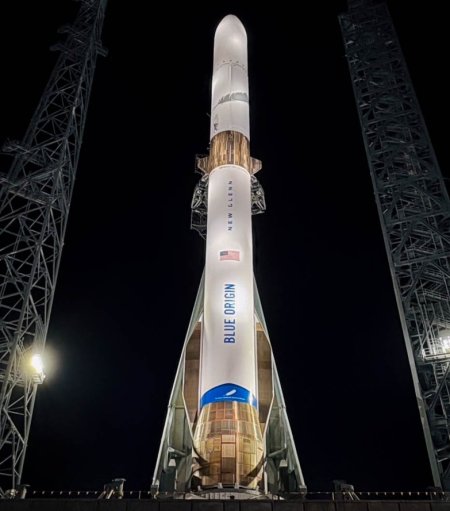
Blue Origin’s first New Glenn rocket to be fully stacked and ready for launch was finally placed vertical on its Cape Canaveral launchpad late November 21, 2024.

For the first time, the company placed a fully integrated, flight-capable rocket on the launch pad Thursday evening. The company rolled the rocket out of the hangar at Launch Complex 36 (LC-36) earlier. A static fire test with the full 98-meter-tall (320 ft) rocket is forthcoming, though a specific date hasn’t been announced.

…The upcoming integrated static fire test would be the first time that Blue Origin fuels a full-assembled. flight-ready New Glenn rocket. It previously conducted a static fire test of its upper stage, which saw a 15-second burn of the two BE-3U engines.

The picture to the right was released by the company that night.

No launch date has been announced. The present payload for this launch is the company’s own Blue Ring orbital tug on a Pentagon-supported test flight. The original payload, two smallsat NASA Mars orbiters built by Rocket Lab, had to be pulled when Blue Origin’s generally leisurely approach meant that it was unable to get the rocket ready in time to meet the October launch window.

That leisurely approach to business will have to end if Blue Origin really wants to compete in today’s modern aerospace industry.

4 comments

Blue Origin links the first and second stages of New Glenn for the first time

New Glenn finally stacked
Click for original image.

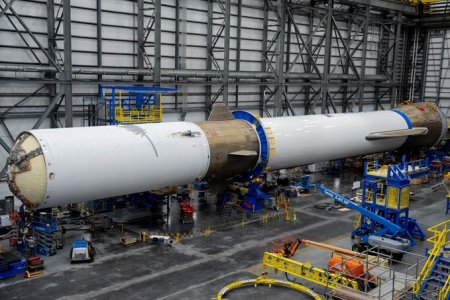
After more than a decade of development and five years overdue, Blue Origin earlier this week finally intergrated the two stages of its New Glenn rocket in preparation for its first launch.

The picture to the right shows the rocket stacked horizontally in Blue Origin’s rocket facility in Florida.

The company still has to roll the rocket out to the launchpad, raise it to a vertical position, and conduct at least one dress rehearsal countdown ending in a short static fire test of the first stage’s seven BE-4 engines. At the moment the company is targeting a November launch.

New Glenn is expected to make its maiden flight sometime in November, taking off from Launch Complex 36 at Cape Canaveral Space Force Station, which is next door to KSC. The flight will carry one of the company’s new Blue Ring spacecraft on a National Security Space Launch certification flight known as DarkSky-1 and sponsored by the Defense Innovation Unit.

The original payload for this launch, two small NASA Mars orbiters, had been pulled because Blue Origin couldn’t get the rocket ready in time for its October launch window. Blue Ring is Blue Origin’s own orbital tug and satellite platform, and this flight is probably intended to get it certified for national security payloads.

The fast development of Blue Ring might give us a hint as to the changes to Blue Origin’s culture since Bezos replaced its previous CEO, Bob Smith, with Dave Limp in September 2023. Blue Ring was announced only one month later, and in just over a year it is now ready for its first launch. Such speedy development has not been the way at Blue Origin for years, if ever. If Limp has been able to instill that urgency across the entire company, then we shall some very exciting achievements from Blue Origin indeed in the next few years.

2 comments

AST Spacemobile signs multi-launch agreement with Blue Origin

The direct-to-cell satellite company AST Spacemobile announced yesterday that it has signed a multi-launch agreement with Blue Origin to use its New Glenn orbital rocket to place approximately sixty of its second generation BlueBird satellites into orbit in the 2025-2026 time frame.

The next-generation Block 2 BlueBirds are designed to deliver up to 10 times the bandwidth capacity of the BlueBird satellites in orbit today, accelerating the goal to achieve 24/7 continuous cellular broadband service coverage. The service will target approximately 100% U.S. nationwide coverage from space with over 5,600 coverage cells, with beams designed to support a capacity of up to 40 MHz, enabling peak data transmission speeds up to 120 Mbps, supporting voice, full data and video applications. The Block 2 BlueBirds, featuring up to 2,400 square foot communications arrays, will be the largest ever commercially deployed in low Earth orbit once launched, surpassing the current record held by AST SpaceMobile’s BlueBird 1-5 and BlueWalker 3, each ~700 square feet in size.

The Block 2 BlueBirds are designed to be compatible with all major launch vehicles. Blue Origin’s launch vehicle, the New Glenn, offers a seven-meter fairing enabling twice the payload volume of five-meter class commercial launch systems, and is well-suited to launching up to 8 of the largest-ever Block 2 BlueBirds.

According to this, the contract is for approximately 7 to 8 New Glenn launches. It also notes the large capacity of New Glenn apparently gives it an advantage over the rockets available from both SpaceX and ULA. If (the operative word) Blue Origin can finally get this rocket off the ground soon, it will then finally provide some real competition to SpaceX.

We shall see. New Glenn is five years behind schedule, and all signs suggest the company continues to move at a relatively slow pace compared to its competitors. It has said it wants to do the first New Glenn launch before the end of the year, but that remains uncertain.

0 comments

Space Force awards SpaceX big launch contract

Space Force yesterday awarded SpaceX a $733 million contract for what appears to be a total of eight future launches of military and national security payloads.

Few details were released about the payloads, including the launch timeline. The deal was issued as part of the military launch contracting system, which in June named SpaceX, ULA, and Blue Origin as its launch providers for the next five years.

However, one official’s comment appeared to suggest this contract award was the military’s expression of disgust at the delays at ULA and Blue Origin in getting their rockets launchworthy.

“In this era of Great Power Competition, it is imperative to not leave capability on the ground,” Brig. Gen. Kristin Panzenhagen, program executive officer for Assured Access to Space, said in an emailed statement on Friday. “The Phase 3 Lane 1 construct allows us to execute launch services more quickly for the more risk-tolerant payloads, putting more capabilities on orbit faster in order to support national security,” Panzenhagen added. [emphasis mine]

In other words, the Space Force wanted to split this contract between the three companies, but it decided to give it all to SpaceX because it expected any launches given to ULA and Blue Origin would not launch on time, and it didn’t want “to leave [that] capability on the ground.”

In the case of ULA, its Vulcan rocket finally made its first two launches this year, four years late, but on the second launch had a failure on one of its solid-fueled strap-on boosters (the nozzle fell off). Though the rocket successfully placed its dummy payload into the correct orbit, the military has either decided that it can’t yet certify Vulcan for military launches, or sees further delays while the investigation and fixes are installed.

As for Blue Origin, its New Glenn rocket is also four years behind schedule, and likely won’t launch until next year. To get it certified will also probably require two launches, and since that company never seems to be in a hurry to do anything (NASA removed its payload from New Glenn’s first launch because the company had failed to meet the required interplanetary launch window), the Pentagon probably decided it can’t give it any contracts at this time.

And so, more launches and profits for SpaceX. While it is great for that company, with revenue that will likely aid in developing Starship/Superheavy, this is not a healthy situation for the American space industry. As a nation we need more than one launch provider. We need these other companies to stop dithering around and get the job done. That’s the true American way. Have they forgotten how to do it?

14 comments

Blue Origin completes first static fire test of New Glenn upper stage

Blue Origin yesterday successfully conducted a 15 second static fire test of the upper stage of its orbital New Glenn rocket.

The hotfire lasted 15 seconds and marked the first time we operated the vehicle as an integrated system. The purpose of the hotfire test was to validate interactions between the subsystems on the second stage, its two BE-3U engines, and the ground control systems.

Additionally, we demonstrated its three key systems, including: the tank pressurization control system, which uses helium to pressurize the liquid hydrogen and liquid oxygen tanks during flight; the thrust vector control system, which gimbals the engines and steers the rocket during flight; and validated the start-up and shut-down sequences for the BE-3U systems, which can be restarted up to three times during a mission.

In addition to testing our flight hardware, this hotfire test was also an opportunity for the launch operations team to practice launch day procedures on console and verify timing for a number of critical operations.

An actual launch date has not been announced. Previously New Glenn was to carry two Mars orbiters for NASA and launch by October 21, 2024 at the latest. Because of doubts the company could meet that data, NASA pulled the satellites from the rocket.

Prior to launch the company still has to do a full static fire test of the rocket’s first stage. Though company officials have said this would happen “very soon,” no date has been announced for the test.

0 comments

NASA cancels launch of its two Escapade Mars Orbiters due to Blue Origin delays

After reviewing the status of launch preparations by Blue Origin of its New Glenn rocket, NASA today decided to cancel the launch because it appeared that Blue Origin would not be able to meet the October 13-21 launch window for sending the agency’s two Escapade orbiters to Mars.

NASA announced Friday it will not fuel the two ESCAPADE (Escape and Plasma Acceleration and Dynamics Explorers) spacecraft at this time, foregoing the mission’s upcoming October launch window. While future launch opportunities are under review, the next possible earliest launch date is spring 2025.

The agency’s decision to stand down was based on a review of launch preparations and discussions with Blue Origin, the Federal Aviation Administration, and Space Launch Delta 45 Range Safety Organization, as well as NASA’s Launch Services Program and Science Mission Directorate. The decision was made to avoid significant cost, schedule, and technical challenges associated with potentially removing fuel from the spacecraft in the event of a launch delay, which could be caused by a number of factors.

The press release of course is vague about why the launch has been canceled, but the reasons are obvious if you have been paying attention. Though Blue Origin has clearly been making progress towards the first launch of New Glenn, recent reports suggested strongly that it would be impossible for it to assemble the rocket, integrate the two orbiters, and get everything on the launchpad on time.

Rocket Lab, which built the orbiters, of course fully supported the decision, though that company very much wanted it to fly now to demonstrate its ability to make low cost smallsat planetary probes.

This failure of Blue Origin to meet this deadline speaks poorly of the company. To serve the satellite and especially the planetary research community rocket companies must be able to launch on schedule and on time. Blue Origin has failed to do so in this case. It appears Jeff Bezos needs to ramp up the pressure on his moribund company to finally get it to perform in the manner he desires, as described by Bezos himself recently.

3 comments

New Glenn’s 1st stage ocean-landing platform arrives in Florida

Jacklyn docked in Florida
Blue Origin image of Jacklyn platform
docked in Florida. Click for original image.

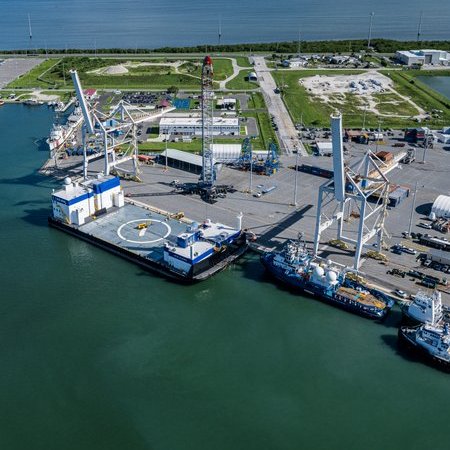
Blue Origin yesterday released images of the arrival at Port Canaveral in Florida of the landing platform, dubbed Jacklyn, to be used by the first stage of its New Glenn rocket when it returns to Earth.

Jacklyn is 380 feet long and 150 feet wide (116 by 46 meters), according to Space Offshore. It’s named after the mother of Jeff Bezos, the billionaire founder of Blue Origin. (“Jacklyn” is a nickname, however; the ship’s legal moniker is “Landing Platform Vessel #1.)

Jacklyn is a new ship that was specially designed to be a New Glenn landing platform, Space Offshore reports. Construction on the ship began in Romania last year and wrapped up in Brest, France in the last month or so. Jacklyn departed Brest for Florida on Aug. 8.

The first launch of New Glenn is presently scheduled for October 13, 2024, and will carry two Rocket Lab-built Mars Orbiters for NASA. The launch window for these orbiters is only eight days, so there is not much margin in getting ready for that launch. The arrival of the platform in Florida in time for that launch suggests Blue Origin will attempt to land the first stage right from the start.

3 comments
1 2 3 4 5 11