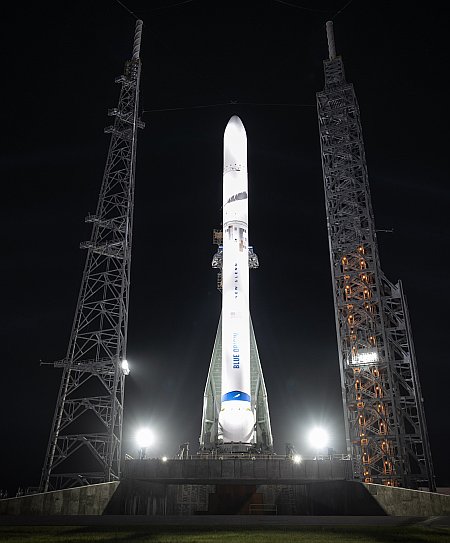
First New Glenn launch, set for October 13, 2024, only has an 8-day launch window

According to an article from Aviation Week today, in order for Blue Origin’s New Glenn rocket to get its payload of two Mars orbiters on their way to Mars it must launch within a very short window lasting only eight days, beginning on the present launch date of October 13, 2024.

The Oct. 13-21 launch window is an ambitious goal. The aft and mid modules of New Glenn’s reusable first stage were recently attached, clearing the path for installation of the vehicle’s seven methane-fueled BE-4 engines, CEO Dave Limp noted in an Aug. 23 update on the X social media site.

A static hot-fire at New Glenn’s Florida launch complex is planned prior to launch. The company did not release the status of the New Glenn upper stage, which is to be powered by a pair of BE-3U engines fueled by liquid oxygen and liquid hydrogen. A hot-fire of the second stage is also pending.

This launch will be the first ever for New Glenn. To get ready for that tight launch window it appears a great deal of work must be done in the next six weeks, some of which Blue Origin engineers will be doing for the very first time.

If there are any issues and that launch window is missed, the two NASA Escapade orbiters, built by Rocket Lab, will face a two-year delay until the next window to get to Mars re-opens. At that point New Glenn will likely do this launch with a dummy payload, since it needs to get off the ground in order to fulfill other launch contracts, including a 27-launch contract with Amazon for its Kuiper satellite constellation.

2 comments

A tour of Blue Origin’s New Glenn factory

Tim Dodd of Everyday Astronaut on May 30, 2024 was given a detailed tour by founder/owner Jeff Bezos of Blue Origin’s New Glenn factory at Cape Canaveral.

It is incredible to watch, because for the very first time, Bezos shows us what the company is finally doing to prepare for the first New Glenn launch, targeting no earlier than the end of September. Unlike every other visual shown of this facility in the past, this tour actually shows a factory floor where work is going on.

Much of the backgrounds inside the stages have apparently been put out of focus to protect Blue Origin’s proprietary rights. No matter.

As for the state of the manufacture of the BE-4 engines, Bezos stated that he expects next year to be building one engine every three days. Cross your fingers that he is right.

I have embedded the video of the tour below. Enjoy, and get excited by the competition and capability this rocket will create when it finally starts flying.
» Read more

14 comments

Update on status of Blue Origin’s New Glenn rocket

Link here. The report provides a lot of detail about the ramped up operations of Blue Origin in Florida in preparation for the first launch of New Glenn, previously announced as September 29, 2024. It appears the company is finally getting something done, and is getting closer to that launch.

Nonetheless, this detailed report makes no mention of that launch date. Furthermore, based on the work presently being done, it appears that launching by that date is impossible. With less than two months to go, the rocket has not yet been stacked and brought to the launchpad for even one dress rehearsal countdown. In March the company did tanking tests using an engineering test prototype, but so far such tests have not been done on the actual flightworthy rocket. It seems there will not be enough time to do them and meet that September 29th date.

The report also claims that Blue Origin “continues to ramp up testing its BE-4 and BE-3U engines” and “should have no problem supporting engine demand for both New Glenn and Vulcan,” but provides no hint as to the actual number of engines produced. Recent numbers suggest that ULA will have sufficient engines to launch its rockets, but will New Glenn, which needs seven BE-4 engines compared to the two needed for ULA’s Vulcan? We presently have no idea.

All in all, however, things at Blue Origin in 2024 appear to finally be happening, after a five year lull of nothing under the previous CEO, Bob Smith. Even if that launch doesn’t happen in September, it appears that it will happen sometime within the six months that follow.

4 comments

Update on Cape Canaveral work by multiple launch companies

Link here. The article provides a nice summary of the construction work by Blue Origin, Stoke Space, and SpaceX at the cape, all leading to future launches and greater capabilities.

Blue Origin is still pushing for a September 29, 2024 first launch of its New Glenn orbital rocket. SpaceX is continuing work on its new Starship/Superheavy facilities as well as installing upgrades to its Falcon launchpads. The most interesting tidbit however is was about Stoke Space and its proposed Nova rocket:

The first two flights of Nova are planned for 2025, while 10 flights are planned for both 2026 and 2027. Initial flights of Nova will be expendable, with full reusability of the first and second stages coming later.

Stoke’s primary goal has been to make this rocket entirely reusable. It apparently plans to begin launching and do recovery tests as it goes until it achieves that reusability later.

0 comments

Air Force sends letter of concern about Vulcan to ULA

According to a report yesterday [behind a paywall], the Air Force has sent a letter of concern to ULA and its joint owners, Boeing and Lockheed Martin, about the long delays getting its new Vulcan rocket operational.

When the military chose in 2021 ULA and SpaceX to be its two launch providers for the first half of the 2020s, it expected ULA to complete 60% of the launches and SpaceX 40%. It also expected Vulcan to being launching within a year or two, at the latest.

Instead, the first launch of Vulcan did not occur until 2024, and its second launch — required by the military before it will allow Vulcan to launch its payloads — won’t occur until late this year. Worse, the military has a large backlog of launches it has assigned to Vulcan that need to launch quickly.

“I am growing concerned with ULA’s ability to scale manufacturing of its Vulcan rocket and scale its launch cadence to meet our needs,” [Air Force Assistant Secretary Frank] Calvelli wrote. “Currently there is military satellite capability sitting on the ground due to Vulcan delays. ULA has a backlog of 25 National Security Space Launch (NSSL) Phase 2 Vulcan launches on contract.”

These 25 launches, Calvelli notes, are due to be completed by the end of 2027. He asked Boeing and Lockheed to complete an “independent review” of United Launch Alliance’s ability to scale manufacturing of its Vulcan rockets and meet its commitments to the military. Calvelli also noted that Vulcan has made commitments to launch dozens of satellites for others over that period, a reference to a contract between United Launch Alliance and Amazon for Project Kuiper satellites.

ULA says that once operations ramp up, it plans to launch Vulcan twice a month. The Air Force doubts about whether that will be possible however are well founded. To meet that schedule ULA will need delivery per month of at least four BE-4 engines from Blue Origin, and so far there is no indication the Bezos company can meet that demand. Delays at Blue Origin in developing that engine are the main reason Vulcan is so far behind schedule in the first place.

In order to get Vulcan operational, ULA needs to fly a second time successfully. The second launch of Sierra Space’s Tenacity mini-shuttle is booked for that flight, and was originally supposed to launch this spring. Tenacity however was not ready, as it is still undergoing final ground testing. The launch is now set for the fall, but both ULA and the Pentagon are discussing replacing it with a dummy payload should Tenacity experience any more delays.

The source of all of these problems points to Blue Origin. Not only has it been unable to deliver its BE-4 rocket engine on schedule — thus blocking Vulcan — the long delays in developing its own New Glenn orbital rocket (which uses seven BE-4 engines) has given the military fewer launch options. As a result the military has been left with only one rocket company, SpaceX, capable of launching its large payloads.

To put Blue Origin’s problems in perspective, for Blue Origin to finally achieve its many promises and get both Vulcan and New Glenn flying regularly, it will need to begin producing a minimum of 50 to 150 BE-4 engines per year, with two-thirds for its own New Glenn rocket. Right now all evidence suggests the company is having problems building two per year.

In other words, the Pentagon might send a letter of concern to ULA, but it should instead be focusing its ire on Blue Origin.

8 comments

NASA: first launch of New Glenn is targeting a September 29, 2024 launch date

According to a presentation given by a NASA official at a conference in London yesterday, the first launch of Blue Origin’s New Glenn rocket is now targeting a September 29, 2024 launch.

In a presentation at a meeting of a planetary protection committee of the Committee on Space Research (COSPAR) in London April 24, Nick Benardini, NASA’s planetary protection officer, listed a Sept. 29 date for the launch of Escape and Plasma Acceleration and Dynamics Explorers (ESCAPADE) mission, a pair of smallsats that will go into orbit around Mars to measure the interaction of the planet’s magnetosphere with the solar wind.

NASA selected Blue Origin’s New Glenn rocket to launch ESCAPADE, awarding the company a $20 million task order through the agency’s Venture-Class Acquisition of Dedicated and Rideshare contract in February 2023 for the mission. The award at the time mentioned only a late 2024 launch, with the expectation that ESCAPADE would be on one of the first, if not the first, flight of the rocket.

Benardini mentioned ESCAPADE in his COSPAR presentation to discuss how the mission was complying with planetary protection requirements, intended to prevent any contamination of Mars, during the assembly of the spacecraft and launch preparations at Cape Canaveral. “They’re slated to be launching Sept. 29 with Blue Origin,” he said.

This is the first time any source at NASA or Blue Origin has revealed a specific launch date. The rocket was originally supposed to fly its first orbital test flight four years ago, but numerous delays, mostly related to the BE-4 engine used by the rocket’s first stage as well as decisions by the company’s former CEO, Bob Smith, to slow all development, pushed that launch back repeatedly. With Smith leaving late last year, the company has suddenly come back to life, with many indications that it was pushing for a launch this year.

3 comments

Blue Origin completes delivery of the two BE-4 engines for ULA’s second Vulcan launch

Blue Origin this week completed delivery of the two BE-4 engines needed for the second launch of ULA’s Vulcan rocket, presently scheduled for sometime this fall.

That launch was originally targeting an April launch, but according to official announcements has been delayed until the fall because final ground testing of its payload, Sierra Space’s Tenacity mini-shuttle, is not complete. It appears that Blue Origin also contributed to that delay, as it is now obvious that its engines were not available as planned in time for that April launch.

This delay also raises questions about Blue Origin’s ability to ramp up BE-4 engine production to meet the needs of ULA’s Vulcan rocket and Blue Origin’s New Glenn rocket. Both have large launch contracts with Amazon to launch its Kuiper constellation, while ULA also has almost as many contracts with the U.S. military. To meet those contracts, Blue Origin will have to produce several hundred BE-4 engines yearly in the very near future. Right now it appears it can only produce about one per year.

7 comments

Blue Origin completes first round of launchpad/New Glenn tanking tests

Link here. In the past week or so Blue Origin has done three tanking tests of its assembled engineering test rocket, simulating fueling of a New Glenn rocket on the launchpad, and now intends to roll that test vehicle back to its rocket assembly building.

From here, it is most likely that the rocket will be prepared for the next round of testing, which will include a static fire of the seven first-stage BE-4 engines. This test will mark the first time that Blue Origin’s BE-4 engines will ignite while integrated with a New Glenn first stage. It will also be the first time that the new launch pad supports an engine firing.

The company continues to aim for a first test launch of New Glenn before the end of the year, and these tests strengthen the likelihood that this schedule is realistic.

3 comments

Complete New Glenn test prototype now vertical on launchpad

New Glenn test vehicle on launchpad

For the first time, after more than a decade of development, a complete two-stage New Glenn test vehicle is now vertical on the launchpad at Cape Canaveral, ready for launchpad tests in preparation for what Blue Origin hopes will be a first launch later this year.

The journey to the pad began in December when New Glenn’s first-stage modules were transported from our factory to the Integration Facility nine miles away. The tests will conclude in the coming weeks following several demonstrations of cryogenic fluid loading, pressure control, and the vehicle’s venting systems. Our launch pad and ground systems are complete and will be activated for the first time during the test campaign.

If successful, New Glenn would be somewhat competitive with Falcon Heavy, and would give the U.S. a third company, after ULA, capable of competing directly with SpaceX. This of course assumes Blue Origin doesn’t buy ULA, which has been rumored.

10 comments

Space Force issues contract to assess New Glenn rocket for military launches

The Space Force has awarded Blue Origin an $18 million contract to assess that company’s new New Glenn rocket in order to certify it eventually for military launches.

The Space Force awarded Blue Origin nearly $18 million for “National Security Space Launch Phase 3 Lane 2 early integration studies to assess launch vehicle trajectory and mission design, coupled launch loads, and integrated thermal environments to inform compatibility between launch vehicles and space vehicles for missions planned in fiscal years 2025 and 2026.”

The NSSL Phase 3 procurement is divided into two lanes: Lane 1 caters to lower-risk missions to lower orbits, while Lane 2 focuses on demanding missions to higher orbits, requiring certified launch vehicles and full mission assurance. The latter is where Blue Origin, with its New Glenn heavy-lift rocket, could aim to challenge incumbents SpaceX and United Launch Alliance.

Bids for NSSL Phase 3 were submitted in December. Launch services contracts are expected to be awarded later this year for missions to be flown starting in late 2025 through 2029 or beyond.

The Pentagon wants to certify a third launch company for these higher-mass, higher-orbit missions, and New Glenn is powerful enough to provide that service, once it begins operational. This study puts Blue Origin on a path to get that certification.

After years of delays at both ULA and Blue Origin that left almost the entire launch market in the hands of SpaceX, it now looks like SpaceX is finally going to get some competition.

0 comments

First two stages of New Glenn assembled for the first time

After years of delays, Blue Origin announced yesterday that it has finally joined the first and second stages of its orbital New Glenn rocket, in preparation for its planned first launch later this year.

The stages remain horizontal inside Blue Origin’s assembly facility at Cape Canaveral, where engineers continue to check them out.

New Glenn’s launch was originally supposed to be in 2020. Problems with its first stage BE-4 engine put it (as well as ULA’s Vulcan rocket) four years behind schedule. The evidence now suggests that those problems were badly acerbated by the poor leadership of Bob Smith, Blue Origin’s CEO from 2017 to 2023, who apparently refused to spend money on test engines and the additional hardware necessary to test the engine to figure out what was wrong. Smith also appeared to slow all other work down in numerous ways as well as antagonize many at the company, causing a lot of high level engineers over time to flee.

Almost to the day Smith left last year Blue Origin has appeared to come to life. If so, this bodes well for both its future as well as that of the entire American rocket industry. New Glenn is a very powerful rocket, capable of lifting 50 tons to low Earth orbit, making it comparable to SpaceX’s Falcon Heavy. Its first stage is also designed to be reuseable, landing on a drone ship like the Falcon 9. If successful it will thus be a very capable competitor to SpaceX.

The company is aiming for an August launch. Keep your fingers crossed.

4 comments

Blue Origin moves first stage of its New Glenn rocket from factory to launchpad hanger

In what might be the first step in assemblying Blue Origin’s New Glenn rocket for the first time (followed by a launch), the company yesterday transported the rocket’s first stage from its factory to its launchpad hanger.

Transported by a series of multiwheeled carriages and an arching structure, the 189-foot-tall first stage for what will be a 320-foot-tall rocket when fully assembled traveled horizontally on a 22-mile trip from the New Glenn factory in Merritt Island through Kennedy Space Center over to Cape Canaveral Space Force Station where Blue Origin has a hangar and launch pad at Launch Complex 36.

Jeff Bezos has said the company plans that first launch before the end of this year, though the company has been making this same promise now for the last three years, and is years behind schedule. What makes this promise different however is that this time we are seeing actual hardware moving towards the launchpad.

The article also gives a rough update on the company’s effort to manufacture the many BE-4 rocket engines needed for New Glenn (7) and ULA’s Vulcan rocket (2). The two engines for the next Vulcan launch in April are presently undergoing final testing at Blue Origin’s test facility in Texas, and the company says it is about to ramp up production. It thus appears that getting enough engines built is still the main obstacle to launch. We shall finally know later this year if Blue Origin has solved this problem.

1 comment
1 2 3 4 5 6 11