
Researchers identify the oldest cheese so far found, from 3,600 years ago

One of the ancient cheese samples
Click for full image, figure 1 from the paper.

Researchers have confirmed that three clumps of organic matter taken from a gravesite in northwestern China are the oldest samples of cheese yet identified — more than 3,600 years old — and are in fact a specific kind of cheese, called kefir cheese.

And it’s not just any cheese: Cow and goat DNA, as well as the bacterium Lactobacillus kefiranofaciens, has indicated that these clumps were in fact kefir cheese, providing insight into the history and evolution of probiotics and human health. L. kefiranofaciens is still a key microorganism in kefir soft cheeses. The researchers also identified the microscopic fungal species Pichia kudriavzevii, which is a type of yeast found in kefir grains today.

These kefir grains contain a host of probiotic bacteria and yeast, which is key in fermenting milk to produce kefir products that have been studied for their health impacts, particularly in the areas of the immune and gastrointestinal systems, as well as metabolic regulation.

“Our observation suggests kefir culture has been maintained in Northwestern China’s Xinjiang region since the Bronze Age,” Fu said.

You can read the published paper here. The researchers suggest the cheese indicates not only the evolutionary history by which humans began creating such diary products, it also suggests the historical routes this process followed across the European and Asian continents.
7 comments

Scientists discover in Alaska the largest dinosaur track site in U.S.

New dinosaur track site in Alaska
Click for original image.

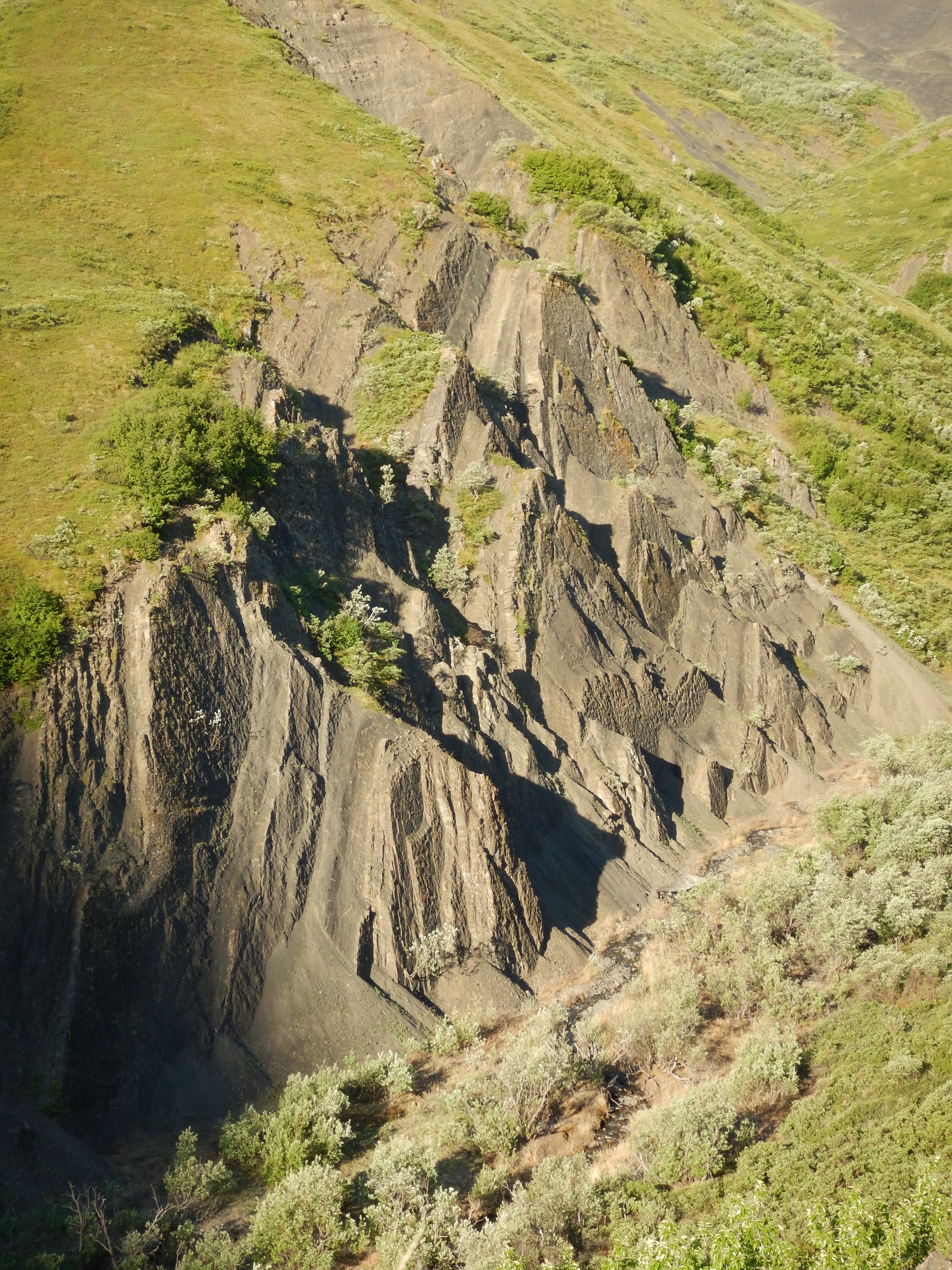
Paleontologists have discovered in Alaska a new dinosaur track site that appears to contain numerous exposed tracks on what is now a series of vertical walls covering an area larger than a football field.

The picture to the right shows the entire site. The darker flat walls that appear to be dimpled are the track sites, with the dimples the actual tracks.

Researchers at the University of Alaska Fairbanks made the discovery following a seven-hour hike into the Denali National Park and Preserve, and it is now the home of the largest known single dinosaur track site in the US state.

Like a geological triple-decker (or more) sandwich, the 20-story-high structure, pushed vertical due to tectonic plate convergence, reveals a cliff face of layer upon layer of preserved prints throughout time. “It’s not just one level of rock with tracks on it,” said Dustin Stewart, the paper’s lead author and a former UAF graduate student. “It is a sequence through time. Up until now, Denali had other track sites that are known, but nothing of this magnitude.”

The scientists think these now vertical walls, when horizontal in the past, marked a major water-hole location visited by numerous dinosaurs and other species.

4 comments

Bones of the biggest ever whale species possibly found?

A big whale?

The uncertainty of science: Paleontologists have discovered a portion of the skeleton of what they claim might be the biggest and heaviest animal ever found, a whale that potentially grew to be as much as twice as big as a blue whale, the largest living species previously known.

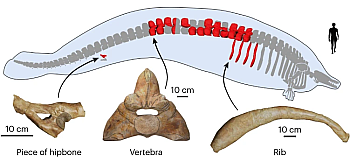
A newly described fossilized whale named Perucetus colossus, dating to roughly 38 million years ago, might have been heavier than a blue whale, even if it was not as long. Blue whales, which are endangered, weigh about 100 to 150 tonnes, although some might be as heavy as 200 tonnes. Perucetus colossus was between 85 and 340 tonnes, according to the scientists who found and described the remains: 13 vertebrae, 4 ribs and a bit of pelvis. Their best-guess estimate is that the whale was around 180 tonnes. This mind-boggling mass is the result of its bones, which were big and dense — an evolutionary adaptation that helped it to dive.

The graphic to the right shows the discovered bones in red, with the rest of the theorized skeleton indicated in grey. Only in the article’s next-to-last paragraph does Nature recognize this very very very large uncertainty:

The team chose to create a visual reconstruction of what the whale might have looked like, basing the head on skulls of related basilosaurid species, but they caution that some of the details are speculative. It could have been skinnier. But it also could have been quite a bit longer or fatter, [co-author Eli] Amson says.

In other words, they presently have no idea what the species actually looked like, or how big it actually was. It very well could have been much shorter and thinner than proposed. It appears therefore they chose to highlight the largest possible size to garner the biggest press coverage — which of course they are getting.

0 comments

A mile-long trail of human footprints about 12,000 years old

Scientists have found in New Mexico a mile-long trail of human footprints from about 12,000 years ago that was probably left by a woman and toddler.

Even more interesting, the tracks show that the woman (or male adolescent) retraced her route, without the child.

Unlike many other known footprint trackways, this one is remarkable for its length – over at least 1.5km [almost a mile] – and straightness. This individual did not deviate from their course. But what is even more remarkable is that they followed their own trackway home again a few hours later.

Each track tells a story: a slip here, a stretch there to avoid a puddle. The ground was wet and slick with mud and they were walking at speed, which would have been exhausting. We estimate that they were walking at over 1.7 metres per second – a comfortable walking speed is about 1.2 to 1.5 metres per second on a flat dry surface. The tracks are quite small and were most likely made by a woman, or possibly an adolescent male.

At several places on the outward journey there are a series of small child tracks, made as the carrier set a child down perhaps to adjust them from hip to hip, or for a moment of rest. Judging by the size of the child tracks, they were made by a toddler maybe around two years old or slightly younger. The child was carried outward, but not on the return.

There is also evidence of a mammoth and sloth crossed the tracks in-between the outward and return journey, with the sloth apparently sensing the human tracks or presence.

2 comments

Court rules fossils belong to landowners

The Montana Supreme Court has ruled that any fossils found on private land belong to exclusively to the landowners, and that no rights accrue to any owners of the land’s mineral rights.

The Montana Supreme Court this week ruled that fossils are not legally the same as minerals such as gold or copper. Therefore, Montana fossils, including a dramatic specimen of two dinosaurs buried together, belong to people who own the land where they are found, rather than to the owners of the minerals underneath that land.

The 4-3 decision upholds the way U.S. scientists have long approached questions of fossil ownership. It appears to defuse a potentially explosive 2018 ruling by the federal 9th Circuit U.S. Court of Appeals that fossils went to the owners of mineral rights.

The outcome is a win for scientists who had warned that tying fossils to mineral rights could make it harder to get permission to excavate and could throw into doubt who owns fossils already on display, says David Polly, an Indiana University paleontologist and past president of the Society of Vertebrate Paleontology.

Because the earlier 2018 federal court decision was later appealed and the court then referred the case to Montana’s Supreme Court, this decision settles the dispute nationally as well.

That absurd 2018 9th Court of Appeals decision illustrates how insane that specific federal court had become, packed with many radical leftist and partisan Democratic judges. In the past three years however the balance of that court has been significantly changed, so expect fewer such crazy rulings.

4 comments

Earth’s day was half hour shorter 70 million years ago

Using data from an ancient fossil shell, scientists have determined that 70 million years ago the Earth’s day was about 30 minutes shorter, and that a year comprised 372 days.

This result is not a surprise, as scientists have known for a long time that the day has been growing longer as the Moon’s gravity, producing tides, wears away at the Earth’s rotation. This data however is the most precise yet, and will allow scientists to better constrain not only the Earth’s changing rotation over time but the Moon’s orbit. As it slows the Earth’s rotation its own orbit around the Earth gets longer, pushing it farther away.

3 comments

Battle over ownership of dinosaur fossils could upend paleontology research

A dispute over the land rights on a property where several significant and valuable dinosaur fossils have been discovered could completely change how future fossil digs are run.

The fight is between the ranchers who own the surface rights to the property in question, and the owners who possess the mineral rights. The latter are claiming, and have won in federal court, that fossils are minerals and thus belong to them.

That court decision however upturned more than a century of practice, where fossils were always considered part of the surface rights only.

The ruling sent shock waves through the paleontology world, threatening to upend the way fossil hunters have operated for decades.

It would make searching for fossils extremely complicated, said David Polly, a former president of the Society of Vertebrate Paleontology, based in Bethesda, Maryland, because paleontologists would need to navigate both surface ownership—to get to the dig location—and mineral ownership of a parcel. Often, mineral rights are hard to find and frequently change hands between large corporations.

The article says this decision could threaten previous finds, but I think that is hyperbole. On issues like this the statue of limitations would apply, and would make almost all challenges on earlier fossil finds moot.

Nonetheless, the issue is still before the courts. The federal court has decided to vacate its decision and has instead let the case shift to the state supreme court in Montana, which is expected to take up the case later this year.

13 comments

The oldest fossils ever?

Scientists think they have found the oldest fossils ever in Canada.

Scientists say they have found the world’s oldest fossils, thought to have formed between 3.77bn and 4.28bn years ago. Comprised of tiny tubes and filaments made of an iron oxide known as haematite, the microfossils are believed to be the remains of bacteria that once thrived underwater around hydrothermal vents, relying on chemical reactions involving iron for their energy.

If correct, these fossils offer the oldest direct evidence for life on the planet. And that, the study’s authors say, offers insights into the origins of life on Earth. “If these rocks do indeed turn out to be 4.28 [bn years old] then we are talking about the origins of life developing very soon after the oceans formed 4.4bn years ago,” said Matthew Dodd, the first author of the research from University College, London.

This discovery reminds me of the Mars fossils discovered in the late 1990s. There were enormous uncertainties with that discovery, all of which eventually caused most scientists in the field to reject the result. The same thing could be the case here.

Still in Dallas. I hope to get caught up tomorrow.

14 comments

First dinosaur tail found, preserved in amber

Paleontologists have discovered the first completely preserved dinosaur tail, feathers and all, preserved in amber.

Inside the lump of resin is a 1.4-inch appendage covered in delicate feathers, described as chestnut brown with a pale or white underside. CT scans and microscopic analysis of the sample revealed eight vertebrae from the middle or end of a long, thin tail that may have been originally made up of more than 25 vertebrae. Based on the structure of the tail, researchers believe it belongs to a juvenile coelurosaur, part of a group of theropod dinosaurs that includes everything from tyrannosaurs to modern birds.

2 comments

The Earth’s oldest fossil?

The uncertainty of science: Geologists this week announced the discovery of what they think is the Earth’s oldest fossil, approximately 3.7 billion years old.

While the press as usual is going gaga over this announcement, it should be noted that many others in the field have expressed significant doubts.

But the discovery involves some of the most physically tortured rocks on Earth, which have been squeezed and heated over billions of years as crustal plates shifted. The pressure and heat recrystallizes the rocks, erasing much of the fine-scale detail that researchers normally use to identify fossilized stromatolites — so the work is already triggering heated debate. “I’ve got 14 queries and problems that need addressing before I’ll believe it,” says Roger Buick, a geobiologist at the University of Washington in Seattle.

5 comments

It wasn’t just an asteroid that killed the dinosaurs

Scientists have now obtained enough solid data to confirm that the large extinction of the dinosaurs 65 million years ago was caused not just by the Yucatan asteroid impact but also by the gigantic volcanic event in India called the Deccan Traps.

The researchers said the asteroid strike occurred 66.04 million years ago, plus or minus about 30,000 years. They said eruptions in a region called the Deccan Traps were already underway at a lower intensity but dramatically accelerated after the asteroid strike as if the powerful impact triggered it. The dating method they used found this acceleration began within 50,000 years of the impact, but it could have been in the mere days, months or years afterward. “Within measurement error, they’re simultaneous,” said volcanologist Loÿc Vanderkluysen of Philadelphia’s Drexel University. “The two processes in tandem caused the extinctions,” added Paul Renne, director of the Berkeley Geochronology Center and a University of California, Berkeley geologist, who led the study in the journal Science.

Though many planetary scientists have discounted the Deccan Traps for decades, paleontologists have tended to favor it as a major factor in the extinction. This new study suggests that both were involved, which was the theory held by most of the more reasonable scientists in both fields. While many liked to push one or the other theory in the press, the better scientists considered both a possible factor and have been working to determine this possibility.

0 comments

New human species found?

The uncertainty of science: Scientists in South Africa think they have found fossils of a new human species.

In the end, the work of more than 60 researchers yielded a picture of “a relatively tall, skinny hominid with long legs, humanlike feet, with a core and shoulder that is primitive,” Berger says. Some body parts have come into sharper focus than others. In an analysis of the remarkably complete hands, paleoanthropologist Tracy Kivell of the University of Kent in the United Kingdom found that bones in the wrist were shaped like those in modern humans, suggesting that the palm at the base of the thumb was quite stiff. That would allow forces to dissipate over a larger area of the hand than in more primitive humans—a trait associated with tool use. At the same time, H. naledi had a weird thumb and long, curving fingers, as if it still spent a lot of time climbing.

The story of the discovery is interesting in that the fossils were found in a cave in a room that is very difficult to access, so difficult that the scientists themselves have never seen the site. Instead, they have sent very small cavers inside to do the fossil gathering.

There are many caveats to this story. The 15 skeletons appear different than humans, but to then create a whole human species from this single location is a bit risky.

I think the biggest mystery about this find involves its location. How the heck did these 15 individuals get trapped in this room at the back of a cave that requires you to squeeze down a vertical 100-foot chute only about 8 inches wide to enter?

5 comments

Did some dinosaur soft tissues survive fossilization?

The uncertainty of science: New research strongly suggests that within dinosaur fossils are found many preserved soft tissues from when the creature was still living.

As early as the 1970s, researchers captured images of what looked like cellular structures inside dinosaur fossils. But did the structures contain actual tissue? Proteins commonly decay hundreds to thousands of years after an organism dies, but in rare cases they have been known to survive up to 3 million years. In a series of studies beginning a decade ago, a team led by North Carolina State University paleontologist Mary Schweitzer reported that they had extracted what appeared to be collagen, the most abundant protein in bone, from a 68-million-year-old T. rex fossil. They sequenced fragments of the protein and concluded that it closely matched that of birds, dinosaurs’ living descendants (see here and here). But other teams haven’t been able to replicate the work, and others suggested that the collagen could be contamination.

The new study, led by materials scientist Sergio Bertazzo and paleontologist Susannah Maidment, both of Imperial College London, has a different strategy for hunting down ancient proteins. Bertazzo, an expert on how living bones incorporate minerals, uses a tool called a focused ion beam to slice through samples, leaving pristine surfaces that are ideal for high-resolution imaging studies. He teamed up with Maidment to apply the technique to eight chunks of dinosaur toe, rib, hip, leg, and claw.

What they found shocked them. Imaging the fresh-cut surfaces with scanning and transmission electron microscopes, “we didn’t see bone crystallites” as expected, Maidment says. “What we saw instead was soft tissue. It was completely unexpected. My initial response was these results are not real.” [emphasis mine]

It must be noted that the new research depends on many uncertainties that still need to be replicated or confirmed.

0 comments

Russian hunters find frozen carcass of extinct whoolly rhino

In September Russian hunters accidentally discovered the frozen remains of an adolescent whoolly rhinoceros.

Larger than modern-day rhinos and more suited to extreme cold and harsh environments, the woolly rhino first appeared about 3.6 million years ago. Weighing up to an estimated 4,000 pounds and equipped with 24-inch-long horns, these intimidating creatures co-existed with early humans and were often hunted. Yet for all their strength, the woolly rhino became extinct over 10,000 years ago. Unlike the woolly mammoth, little is known about this species since few specimens have ever been retrieved. Those that have were often mummified to a point where study was impossible, and up until now, no calf has ever been found.

RT reported that experts at the Yakutsk academy will attempt to extract DNA from the calf’s remains and try to come up with a more accurate date on when the creature died. Nicknamed “Sasha,” researchers say the calf died at least 10,000 years ago and may have been 18 months old when it perished.

0 comments

Brontosaurus returns!

The uncertainty of science: The popular but unofficial and rejected dinosaur name “Brontosaurus” has been resurrected by paleontologists.

A new study has found that the bones that had been assigned to Apatosaurus, the term that paleontologists in the 1970s chose over the more popular term Brontosaurus, actually appear to come from two distinct but different species, and they have chosen the more popular term for one of these species.

Brontosaurus was always easy to pronounce, which has probably contributed to its popularity as a general term for dinosaurs. When it was officially rejected in the 1970s there were a lot of unhappy fans of paleontology. I suspect the modern generation of scientists, children in the 1970s, had a warm spot in their heart for the term and have thus found a way to bring it back.

1 comment

New data says volcanoes, not asteroids, killed dinosaurs

The uncertainty of science: A careful updating of the geological timeline has strengthened the link between the dinosaur extinction 66 million years ago and a major volcanic event at that time.

A primeval volcanic range in western India known as the Deccan Traps, which were once three times larger than France, began its main phase of eruptions roughly 250,000 years before the Cretaceous-Paleogene, or K-Pg, extinction event, the researchers report in the journal Science. For the next 750,000 years, the volcanoes unleashed more than 1.1 million cubic kilometers (264,000 cubic miles) of lava. The main phase of eruptions comprised about 80-90 percent of the total volume of the Deccan Traps’ lava flow and followed a substantially weaker first phase that began about 1 million years earlier.

The results support the idea that the Deccan Traps played a role in the K-Pg extinction, and challenge the dominant theory that a meteorite impact near present-day Chicxulub, Mexico, was the sole cause of the extinction. The researchers suggest that the Deccan Traps eruptions and the Chicxulub impact need to be considered together when studying and modeling the K-Pg extinction event.

The general public might not know it, but the only ones in the field of dinosaur research that have said the asteroid was the sole cause of the extinction have been planetary scientists.

5 comments

Newly discovered dinosaur tracks

A cluster of dinosaur tracks discovered recently in Alaska has revealed to paleontologists a wealth of new information about their behavior.

The thousands of impressions, created on a 180-meter-long portion of near-coastal flood plain, today pepper a steep mountainside. Most of the tracks, made somewhere between 69 million and 72 million years ago, were left by hadrosaurs, commonly known as duck-billed dinosaurs (the crested creatures in this artist’s representation).

The consistent and excellent preservation of tracks suggests all the footprints were created within a short time period. Varying in width from 8 to 64 centimeters, the footprints cluster within four distinct size ranges, which researchers suggest represent specific age groups within a multigenerational herd. About 84% of the tracks were made by adult and near-adult hadrosaurs and 13% by young presumed to be less than 1 year old. A mere 3% of the tracks represent juvenile hadrosaurs, a rarity that strongly suggests the young of this species experienced a rapid growth spurt and therefore spent only a short time at this vulnerable size, the researchers report online this week in Geology.

0 comments
1 2 3