Pluto’s cratered glacial terrain

Panorama of Pluto's eastern limb
Click for full resolution. For original images go here, here, here, and here.
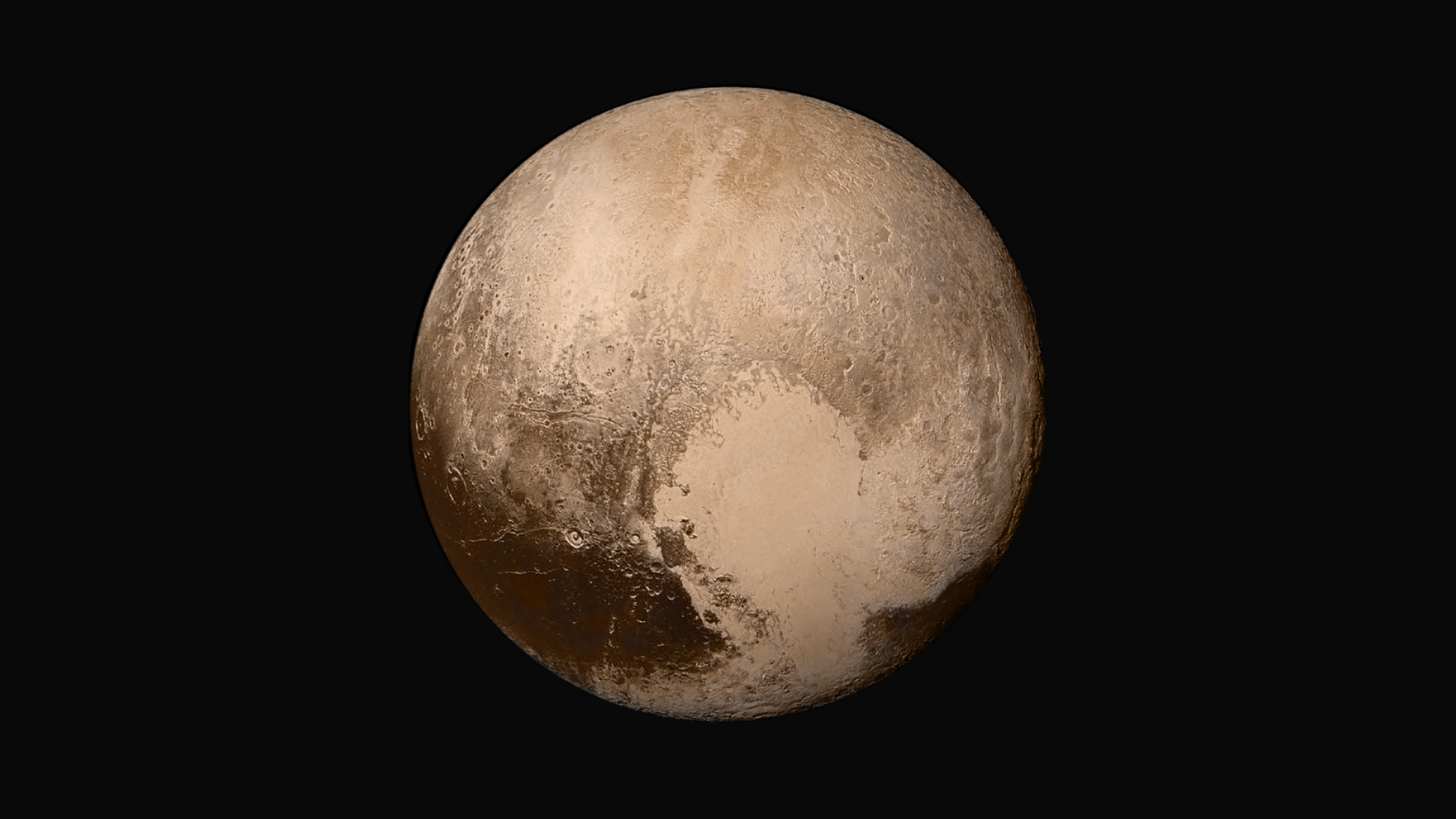
Pluto in true color
Click for original image.

Cool image time! The panorama above, created from four New Horizons’ images that were cropped and enhanced to post here, was taken by New Horizons on July 14, 2015 (here, here, here, and here), about 30 minutes before its closest approach of 7,800 miles above Pluto.

I have searched the New Horizons’ press release archive, and as far as I can tell, this sequence of images and the terrain it shows was never highlighted publicly by the science team. For that reason, I am not sure exactly where to place it on the global true-color image of Pluto to the right, released by the science team shortly after that fly-by. I suspect the panorama covers a strip on the eastern limb of the globe, in the darker crater region to the east of Pluto’s giant frozen nitrogen sea. It is also possible this is actually covering the north pole regions, with the raw images as released oriented with north to the right.

Other than these guesses I cannot tell. If anyone has better information please provide it in the comments.

What the panorama does show us is cracked and pitted terrain, thought to be mostly made up of frozen ice mixed with dust and debris with some nitrogen and other materials thrown in. Though in many ways it resembles the Moon, that similarity is only very superficial. For example, the polygon shapes near the picture’s center suggest ice floes or glaciers, though there is no underground liquid ocean on which they could float.

This is a very alien world. And it is likely even more alien than the few pictures obtained during that New Horizons’ fly-by have suggested. After all, we only saw in high resolution one hemisphere. Who knows what’s really on the planet’s other side?

2 comments

Charon’s surface, completely unlike Pluto

Panorama of part of Charon's surface
Click for full resolution. For original images go here, here, and here.

Charon

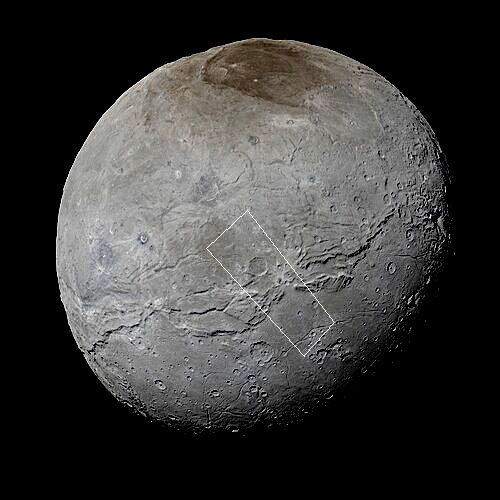
Cool image time! The panorama above, created from three images taken by New Horizons as it began its July 14, 2015 fly-by of the Pluto-Charon double planet system (found here, here, and here), show in close-up one specific swath of Charon cutting across its equatorial regions.

The true color global image of Charon to the right shows the approximate area covered by the panorama above. For scale, Charon has a diameter of about 750 miles, about half that of Pluto. For clarity I have rotated the panorama so that it more closely aligns with the rectangle of global image.

One of the most remarkable discoveries made during New Horizons’ fly-by was how completely different Pluto and Charon appeared, despite their likely formation together at the same time and in the same location of the early solar system. While Pluto had frozen nitrogen seas and water ice mountains floating at the shores, Charon more resembled Mercury, cratered with many large ridges and canyons criss-crossing its service. Both planets appear to be icy, but somehow Charon appears to lack the large differentiated variety of materials seen on Pluto.

0 comments

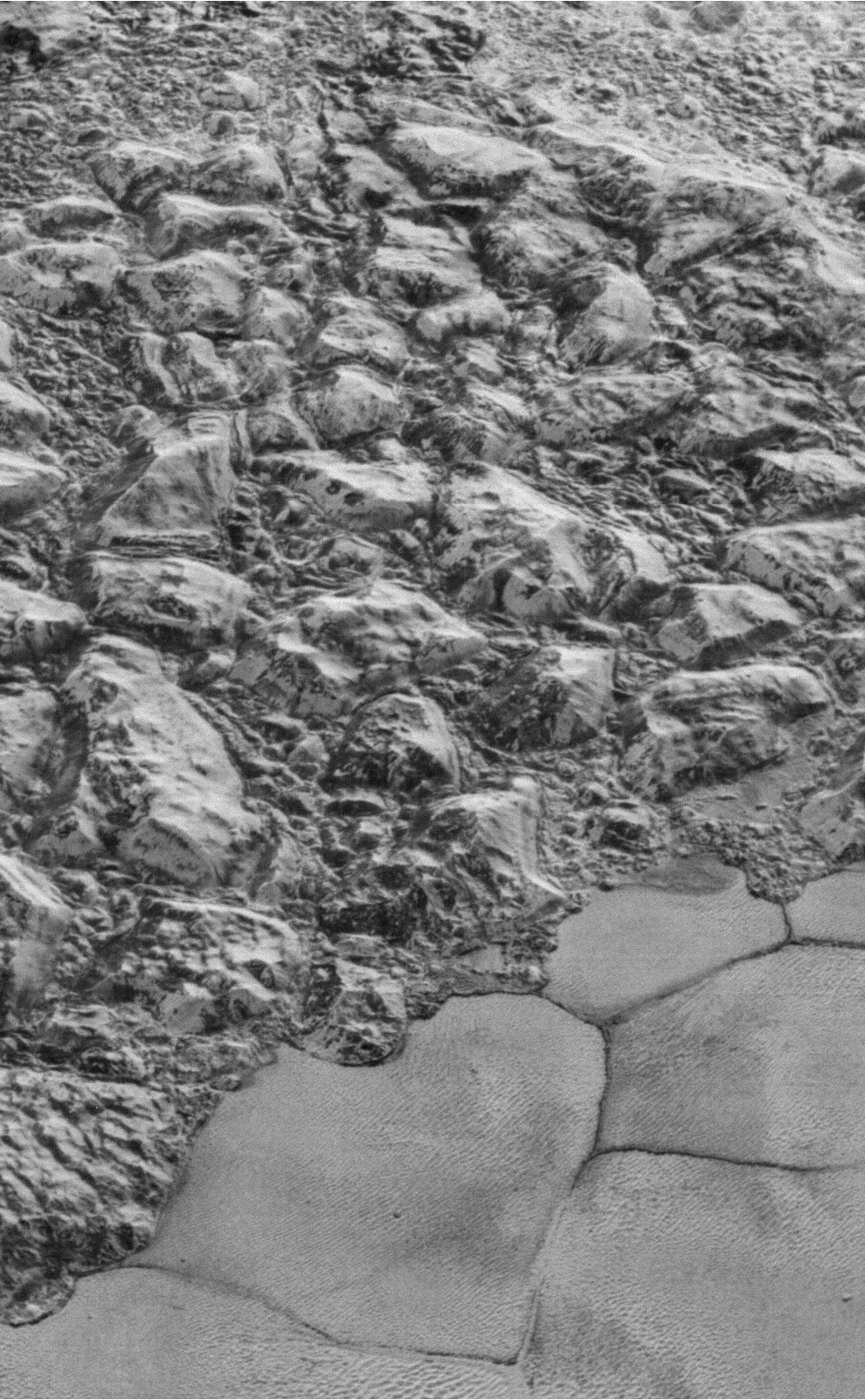
The shoreline of Pluto’s frozen nitrogen sea

The shoreline of Pluto's frozen nitrogen sea
Click for full resolution. For original
images go here and here.

Cool image time! In my continuing exploration of the New Horizons’ image archive, I keep finding things that I do not remember ever seeing before. The two New Horizon pictures used to create the panorama to the right (here and here) were taken by the spacecraft only thirteen minutes before its closest approach to Pluto at 7,800 miles on July 14, 2015. It shows the Al-Idrisi mountains — thought to be made up of frozen ice as hard as granite — and the frozen nitrogen sea that pushes against those mountains and squeezes them into their jumbled shape. For scale, the image is estimated to be fifty miles wide.

In December 2015 the science team released a small section of one of two images, focused specifically at that nitrogen sea shoreline, noting:

Great blocks of Pluto’s water-ice crust appear jammed together in the informally named al-Idrisi mountains. Some mountain sides appear coated in dark material, while other sides are bright.

The team however did not release this wider panorama produced by both images, which I think gives a better perspective of what we are looking at.

I posted an even wider shot of this shoreline on January 29, 2026. If you look closely at that picture, you can spot the features to the right, but much smaller seen from a greater distance.

For the larger context, below is a wide shot of Pluto indicating the part of the planet where this image is located.
» Read more

4 comments

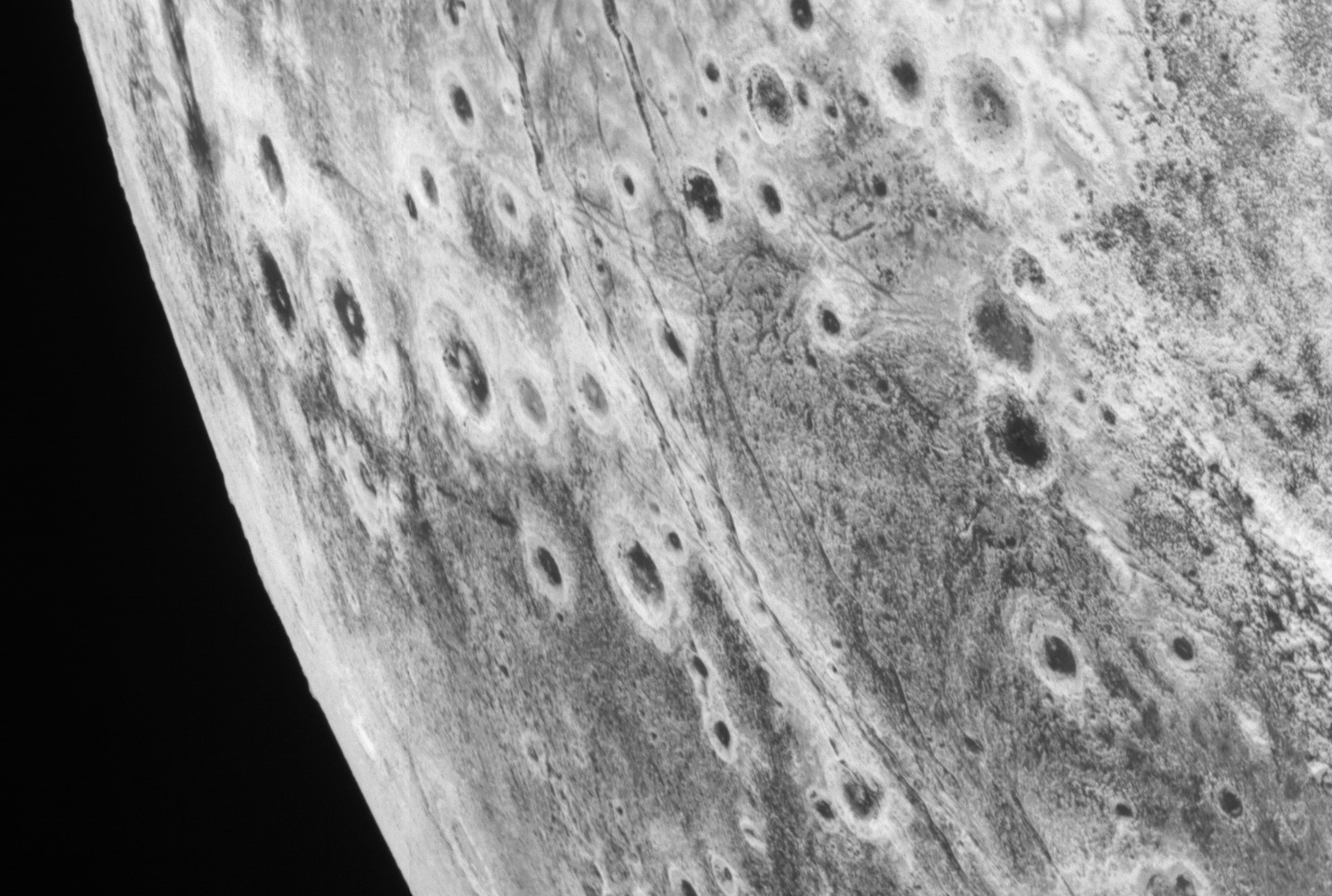
Pluto’s splotched surface

Pluto's splotched surface
For original images go here and here.

Cool image time! The panorama above was created using two photographs (found here and here) taken by New Horizons during its close fly-by of Pluto on July 14, 2015. It looks at Pluto’s western limb, well lit by the Sun, from a distance of approximately 60,000 miles.

I pulled these images from the New Horizons’ archive specifically because I don’t remember ever seeing them publicly released by the science team. More important, they show a surface far more alien than other more well-known New Horizon pictures. Are those round splotches impact craters or some alien type of volcanic caldera? Note also the vertical cracks that appear to divide this terrain near the center.

It would be a serious mistake to make any conclusions. In the emptiness of the outer solar system, the impact rates are going to be far less than in the inner solar system, so assuming impacts is dangerous. Pluto meanwhile has an alien surface of frozen nitrogen seas often filled with floating mountains of frozen water ice. For it to also produce weird volcanic eruptions of nitrogen, sublimating away like bubbling tomato sauce when it is simmering, is quite possible.

2 comments

Pluto’s floating mountains of frozen ice

Pluto's floating mountains
Click for original image.

Cool image time! The picture to the right, rotated, cropped, and sharpened to post here, was taken by New Horizons on July 14, 2015 when it made its close fly-by of Pluto.

The picture looks at the part of Pluto that was close to sunset. Hence the mountain’s long dramatic shadow. The raw image webpage provides little information, including a scale of 0.0 meters, which means nothing. My guess is that these mountains could be several hundred to several thousand feet high based on data from other New Horizon mountain images, but that is a pure guess.

What we think we know is that these mountains are likely made of ice, which at Pluto’s eternally cold environment is as hard as granite. We also think we know that they float on a layer of frozen nitrogen, but because that nitrogen can sublimate into gas when Pluto’s climate warms as its orbit brings it closer to the Sun, the foundation of these mountains is quite unstable. They can roll and drift about, even if they are the size of the Appalachian mountains in the eastern U.S.

I continue to delve into the New Horizons’ archive, and have discovered a trove of quite amazing pictures that hadn’t been featured by the science team during the fly-by. Pluto really is an alien place. Stay tuned, there is more to come!

2 comments

Pluto’s implausible atmosphere, as seen in 2015 by New Horizons

Pluto's implausible atmosphere
Click for original image.

Cool image time! The picture to the right, cropped to post here, was taken on July 14, 2015 by the camera on the New Horizons probe as it flew past Pluto, the only time a human craft has gotten close to this distant planet. From the link:

These high phase angle images show many artifacts associated with scattered sunlight; the Sun was less then 15 degrees from the center of the LORRI frame for these observations. But the outline of Pluto and its hazy atmosphere are also visible.

To see the atmosphere the light from the planet itself has been blocked out.

What is implausible about Pluto’s atmosphere is the location of the planet, about 3.7 billion miles from the Sun, out in the nether reaches of the solar system. At that distance sunlight is very weak, and produces very little energy. And yet, there is enough energy here to produce an atmosphere of mostly nitrogen gas, with trace amounts of metane and carbon monoxide. Scientists think this atmosphere only exists when Pluto is closer to the Sun in its somewhat oblong orbit, and freezes out the rest of the time. As Pluto was just retreating in 2015 from that closest approach in the last two decades of the 20th century, New Horizons could detect its presence.

But then, we really can’t be sure if this atmosphere truly vanishes when the planet is farthest from the Sun, as we have only so far observed 96 years in Pluto’s 248-year orbit.

1 comment

Pluto and Charon come out of the dark

Pluto and Charon come out of the dark
Click for original image.

Cool image time! I have decided to start delving into the archives of some of the older planetary missions, because there is value there that is often forgotten now years later, that should not be forgotten.

In looking through the archive of images from the main camera on New Horizons as it sped past Pluto in July 2015, I found the picture to the right, taken on July 10, 2015 when New Horizons was still about three million miles away.

This is the raw image from that camera, cropped, reduced, and sharpened to post here. It is also the first time in human history we had a sharp look at these two planets that sit at the outer fringes of the solar system. The science team that day released a version that they enhanced to bring out the details, which I immediately posted. They then noted the following:

A high-contrast array of bright and dark features covers Pluto’s surface, while on Charon, only a dark polar region interrupts a generally more uniform light gray terrain. The reddish materials that color Pluto are absent on Charon. Pluto has a significant atmosphere; Charon does not. On Pluto, exotic ices like frozen nitrogen, methane, and carbon monoxide have been found, while Charon’s surface is made of frozen water and ammonia compounds. The interior of Pluto is mostly rock, while Charon contains equal measures of rock and water ice. “These two objects have been together for billions of years, in the same orbit, but they are totally different,” said Principal Investigator Alan Stern of the Southwest Research Institute (SwRI), Boulder, Colorado.

This difference is quite clear in the raw image, with Charon markedly dimmer than Pluto even though they are getting the same amount of light from the Sun.

More than any other objects in the solar system, the double planet system of Pluto-Charon demonstrates how uniquely different every object in the solar system is from every other object. Even when formed together, as these two planets were, they formed in a manner that made them drastically different.

8 comments

Pluto’s mountains of ice surrounded by a sea of frozen nitrogen

Ice mountains floating in nitrogen sea on Pluto
Click for original image.

Cool image time! Though we only have a limited archive of high resolution pictures of Pluto that were taken when New Horizons did its close fly-by of the planet in July 2015, it is worthwhile sometimes to take a second look at some of those images. The picture to the right, cropped and annotated to post here, was taken during that July 14, 2015 fly-by, and shows a mountainous region dubbed Al-Idrisi Montes on the shore of a white frozen ocean. The red dotted line indicates a large trench that separates the Al-Idrisi mountains from the mountainous region to the west.

Sounds similar to an arctic shoreline here on Earth, doesn’t it? Not in the least. Those mountains, ranging from 600 to 9,000 feet high, are made of frozen ice, which on Pluto are as hard as granite due to the endless cold. And the white frozen ocean is frozen nitrogen, broken into polygon shaped blocks. Even stranger: those ice mountains might even be floating in that nitrogen sea! A paper from 2019 [pdf] looked at the New Horizons data and concluded as follows:

Evidence suggests that the Al-Idrisi mountains may have been uplifted by the formation of
the western trench feature. Solid state convection appears to be our best supposition as to how the Al-Idrisi Montes reached their heights.

In other words, as that large trench/depression formed, convection (the bubbles you see when you simmer tomato sauce) pushed these mountains of ice upward to float above the “sea level” of that nitrogen sea.

At least, that’s one hypothesis. The scientists who wrote this paper admit their “our hypothesis still remains in need of study and this trench-mountain system warrants serious further research.” In other words, we simply don’t know enough to have a definitive understanding of the geology of this extremely alien planet.

3 comments

Carbon dioxide and hydrogen peroxide found on the surface of Pluto’s moon Charon

Using spectroscopic data from the Webb Space Telescope, scientists have detected both carbon dioxide and hydrogen peroxide on the surface of Pluto’s moon Charon, adding these chemicals to the previously detected water ice and ammonia-bearing chemicals that give the planet its gray and red colors.

The team compared the spectroscopic observations with laboratory measurements and detailed spectral models of the surface, concluding that carbon dioxide is present primarily as a surface veneer on a water ice-rich subsurface. “Our preferred interpretation is that the upper layer of carbon dioxide originates from the interior and has been exposed to the surface through cratering events. Carbon dioxide is known to be present in regions of the protoplanetary disk from which the Pluto system formed,” Protopapa said.

The presence of hydrogen peroxide on the surface of Charon clearly indicates that the water ice-rich surface is altered by solar ultraviolet light and energetic particles from the solar wind and galactic cosmic rays. Hydrogen peroxide forms from oxygen and hydrogen atoms originating from the breakup of water ice due to incoming ions, electrons or photons.

The theory proposing the dry ice comes from the interior is interesting, but there simply is not enough data to take it very seriously at this point.

1 comment

Active volcanoes on Pluto?

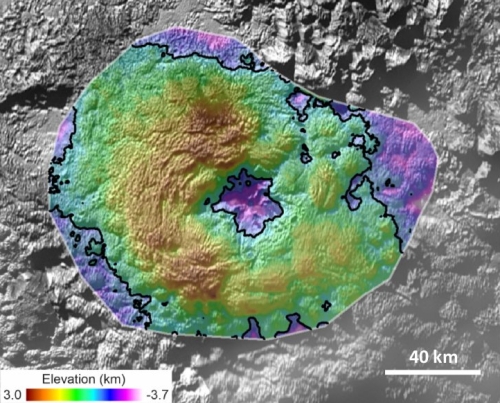
Elevation map of Wright Mons on Pluto

The uncertainty of science: According to new research published yesterday, scientists now posit that there might be recent volcanic activity on Pluto, based on data and images sent back by New Horizons during its fly-by of the planet in 2015.

You can read the paper here. From its abstract:

The New Horizons spacecraft returned images and compositional data showing that terrains on Pluto span a variety of ages, ranging from relatively ancient, heavily cratered areas to very young surfaces with few-to-no impact craters. One of the regions with very few impact craters is dominated by enormous rises with hummocky flanks. Similar features do not exist anywhere else in the imaged solar system. Here we analyze the geomorphology and composition of the features and conclude this region was resurfaced by cryovolcanic processes, of a type and scale so far unique to Pluto. Creation of this terrain requires multiple eruption sites and a large volume of material (>104 km3) to form what we propose are multiple, several-km-high domes, some of which merge to form more complex planforms. The existence of these massive features suggests Pluto’s interior structure and evolution allows for either enhanced retention of heat or more heat overall than was anticipated before New Horizons, which permitted mobilization of water-ice-rich materials late in Pluto’s history. [emphasis mine]

The image to above is Figure 10 in the paper’s supplementary material [pdf]. It shows the volcano-like appearance of Wright Mons on Pluto, a mound approximately 3,000 feet high with a central depression equally deep, with a volume “similar in magnitude to that of the Hawaiian volcano Mauna Loa.”

These conclusions are quite tantalizing, but the amount of data is sparse, and thus it is wise not to take them too seriously. For example, the scientists have no idea how Pluto could presently have any form of liquid or active volcanism. Another mission to Pluto — studying it over a long time from orbit — will be required to determine how active the planet really is, or if it is active at all.

2 comments

Planetary scientists fight back: “Pluto is a planet!”

A group of eminent and active planetary scientists have just published a new peer-reviewed paper documenting how moons and asteroids were routinely referred to as planets from Galileo until 2006 when a very small number of scientists at an International Astronomical Union (IAU) meeting decided arbitrarily that the definition must be changed.

That IAU definition, which required an object to have a solar orbit and the vague ability of the object to clear that orbit, somehow made Pluto a non-planet. It has also never been accepted by planetary scientists, who consider it inconsistent, vague, and useless in their research as well as in teaching students about planetary science. I know this attitude is real because of what planetary scientists have told me consistently in many interviews since 2006.

The new paper appears to be part of a new aggressive campaign by planetary scientists to get that IAU definition dumped, and replace it with the definition planetary scientists have been using forever, which is that if the object is large enough for gravity to shape it into a spherical shape, it is a planet. This is still the definition they routinely use when discussing large moons like the Moon or the large Galilean moons of Jupiter or the larger moons of Saturn or Pluto itself.

It also appears, based on information at the link, that this campaign is beginning to make headway. To that I say, Hallelajuh!

20 comments

As expected, Pluto’s atmosphere is freezing as its orbit takes it from the Sun

Data from ground-based telescopes has now confirmed that Pluto’s nitrogen atmosphere has begun it annual winter freeze out as the planet’s somewhat elliptical 248-year-long orbit takes it away from the Sun.

For about 25 years, Pluto has been moving farther and farther away from the sun, so its surface temperature has been going down. And with these recent observations, the researchers found evidence showing that Pluto’s atmosphere is actually refreezing back onto its surface as the dwarf planet gets colder and colder. Pluto is so far from the sun that, as time goes on, it will get distinctly farther away (and colder) before getting closer to the sun in other regions of its immense orbit.

The astronomers were able to detect this refreezing by observing the planet as it eclipsed a star in 2018.

7 comments

New Horizons discovers two binary asteroids in Kuiper Belt

Overview map
Click for full map.

As New Horizons traveled from Pluto to the asteroid Arrokoth in 2018, scientists used it to take images of the relatively nearby asteroids that it was passing, and found that two of those asteroids appeared elongated.

[T]he team fit the shapes with a two-body model: two asteroids in a tight orbit. Even though the individual rocks weren’t resolved, the modeling showed that two bodies were better able to explain the elongation, as well as the brightness seen. The model for 2011 JY31 had two 50-km-wide objects nearly 200 km apart, while for 2014 OS393, the model had slightly smaller bodies (30 km across) that orbited each other 150 km apart.

The map, cropped and further annotated by me, shows New Horizons’ path during this time period, with the two binary asteroids indicated in blue.

This data, combined with the double lobe shape of Arrokoth (formerly named Ultima Thule), strongly suggests that it was not unusual for these primitives asteroids in the early solar system to coalesce from comparably sized partners.

1 comment

Pluto’s mountains are white-capped but with methane not ice

Pluto's white-capped mountains
Pluto’s mountains, capped with methane snow.
Click for full figure.

Scientists now theorize that the white-capped mountains first photographed by New Horizons during its 2015 fly-by of Pluto are capped not with ice but with methane snow, as part of that planet’s methane gas-ice cycle.

The image to the right, from their paper, shows these white-capped mountains on Pluto.

The exact composition of this frost on Pluto was unclear. While researchers identified methane, it was unknown whether it is pure frozen methane, frozen methane diluted with frozen nitrogen or a mix of both. The uncertainty about the frost’s composition made it unclear how it might have formed.

To help solve these mysteries, scientists in this new study examined high-resolution data from New Horizons, focusing on the composition of the frost at high altitudes. This new analysis revealed that the snowcap frost “is almost pure methane ice, with traces of nitrogen ice,” Bertrand said.

The researchers also developed high-resolution computer simulations of Pluto’s climate. They focused on how methane circulates around the dwarf planet. [emphasis mine]

Though their simulations of the methane cycle that produces the caps are reasonable, I purposely highlight the fact that this is what they are, and as such must be treated with great skepticism. We might now know the composition of these snowcaps, but our overall knowledge of Pluto remains to limited to trust blindly any computer model.

2 comments

New simulations of Pluto’s atmosphere

New simulations of Pluto’s atmosphere, created using data obtained during the 2015 fly-by by New Horizons of Pluto, suggest that the planet’s thin atmosphere, mostly made up of nitrogen, generally blows in a retrograde direction when compared with the planet’s rotation.

Bertrand and his colleagues set out to determine how circulating air – which is 100,000 times thinner than that of Earth’s – might shape features on the surface. The team pulled data from New Horizons’ 2015 flyby to depict Pluto’s topography and its blankets of nitrogen ice. They then simulated the nitrogen cycle with a weather forecast model and assessed how winds blew across the surface.

The group discovered Pluto’s winds above 4 kilometers (2.5 miles) blow to the west — the opposite direction from the dwarf planet’s eastern spin — in a retro-rotation during most of its year. As nitrogen within Tombaugh Regio vaporizes in the north and becomes ice in the south, its movement triggers westward winds, according to the new study.

The press release is very badly written. It tries to make it sound as this work discovered the atmosphere of Pluto, and that this process is more unique in the solar system than it is. It also neglects to mention that we only have good information about one hemisphere of Pluto. The fly-by did not see the planet’s other half, and so any computer model based on New Horizons’ data is by definition guaranteed to be half incomplete, with gigantic uncertainties.

Still, it gives us another example of the unexpected complexity of the geological processes on Pluto, something no one expected for a place so far from the Sun where there is so little energy to drive such processes.

0 comments

New Horizons data suggests the Kuiper Belt is emptier that previously believed

The uncertainty of science: An analysis of data from New Horizons now suggests a paucity of small objects in the Kuiper Belt.

Using New Horizons data from the Pluto-Charon flyby in 2015, a Southwest Research Institute-led team of scientists have indirectly discovered a distinct and surprising lack of very small objects in the Kuiper Belt. The evidence for the paucity of small Kuiper Belt objects (KBOs) comes from New Horizons imaging that revealed a dearth of small craters on Pluto’s largest satellite, Charon, indicating that impactors from 300 feet to 1 mile (91 meters to 1.6 km) in diameter must also be rare.

I therefore wonder how the objects we do find there formed. The volume of space in the Kuiper Belt is gigantic, and if the larger bodies found so far are the bulk of the objects there, what did they coalesce from? Moreover, it seems unlikely that the few large objects we have found there would have been able to clear the region out of small objects.

Overall, this is a fundamental mystery tied directly to how the solar system formed, and illustrates how little we know about that process.

0 comments

IAU approves China’s proposed names for Chang’e-4 landing site

That was fast! The International Astronomical Union (IAU) has approved all of the proposed names that China submitted for the features at or near Chang’e-4 landing site.

The IAU Working Group for Planetary System Nomenclature has approved the name Statio Tianhe for the landing site where the Chinese spacecraft Chang’e-4 touched down on 3 January this year, in the first-ever landing on the far side of the Moon. The name Tianhe originates from the ancient Chinese name for the Milky Way, which was the sky river that separated Niulang and Zhinyu in the folk tale “The Cowherd and the Weaver Girl”.

Four other names for features near the landing site have also been approved. In keeping with the theme of the above-mentioned folk tale, three small craters that form a triangle around the landing site have been named Zhinyu, Hegu, and Tianjin, which correspond to characters in the tale. They are also names of ancient Chinese constellations from the time of the Han dynasty. The fifth approved name is Mons Tai, assigned to the central peak of the crater Von Kármán, in which the landing occurred. Mons Tai is named for Mount Tai, a mountain in Shandong, China, and is about 46 km to the northwest of the Chang’e-4 landing site.

Compare this fast action with the IAU’s approval process for the names the New Horizons team picked for both Pluto and Ultima Thule. It took the IAU more than two years to approve the Pluto names, and almost three years to approve the Charon names. It is now almost two months after New Horizons’ fly-by of Ultima Thule, and the IAU has not yet approved the team’s picks for that body.

Yet it is able to get China’s picks approved in less than a month? Though it is obviously possible that there is a simple and innocent explanation for the differences here, I think this illustrates well the biases of the IAU. Its membership does not like the United States, and works to stymie our achievements if it can. This factor played a part in the Pluto/planet fiasco. It played a part in its decision to rename Hubble’s Law. And according to my sources, it was part of the background negotiations in the naming of some lunar craters last year to honor the Apollo 8 astronauts.

The bottom line remains: The IAU has continually tried to expand its naming authority, when all it was originally asked to do was to coordinate the naming of distant astronomical objects. Now it claims it has the right to approve the naming of every boulder and rock anywhere in the universe. At some point the actual explorers are going to have to tell this organization to go jump in a lake.

1 comment

New Horizons sees no hazards, will do closest fly-by of Ultima Thule

After three weeks of intense observations and seeing no significant objects orbiting close to the Kuiper Belt object Ultima Thule, the New Horizons team has decided to go for the closest fly-by on January 1, 2019.

After almost three weeks of sensitive searches for rings, small moons and other potential hazards around the object, New Horizons Principal Investigator Alan Stern gave the “all clear” for the spacecraft to remain on a path that takes it about 2,200 miles (3,500 kilometers) from Ultima, instead of a hazard-avoiding detour that would have pushed it three times farther out. With New Horizons blazing though space at some 31,500 miles (50,700 kilometers) per hour, a particle as small as a grain of rice could be lethal to the piano-sized probe.

We should begin to see more detailed images soon. Because of the speed in which New Horizons is traveling, it will not get very close until it is almost on top of Ultima Thule, so the best images will all occur over a very short span of time.

0 comments

Evidence of nitrogen ice glaciers on Pluto

Using data sent back by New Horizons during its fly-by of Pluto scientists now think they have identified land forms created by past nitrogen ice glaciers.

The washboard and fluted terrain … occur at the location on Sputnik Planitia’s perimeter where elevations and slopes leading into the surrounding uplands are lowest, and also where a major tectonic system coincides with the edge of Sputnik Planitia. The low elevation of the area makes it a natural setting for past coverage by nitrogen ice glaciers, as indicated by modeling of volatile behavior on Pluto performed by Dr. Bertrand at Ames.

Through comparison of the washboard and fluted texture with parallel chains of elongated sublimation pits (depressions in the surface formed where ice turns directly into a gas) seen in southern Sputnik Planitia, the ridges are interpreted to represent water ice debris liberated by tectonism of underlying crust. This water ice debris was buoyant in the denser, pitted glacial nitrogen ice that is interpreted to have formerly covered this area, and collected on the floors of the elongated pits. After the nitrogen ice receded via sublimation, the debris was left as the aligned ridges, mimicking the sublimation texture – washboard ridges where deposited on flat terrain, and fluted ridges where deposited on steeper slopes.

This is strange stuff. The solid bedrock here, water ice, will float on the nitrogen ice sitting on top of it. Thus, the material that wants to sublimate away, nitrogen, sometimes has to fight its way past the water ice that has risen to the top of the pile.

To put it mildly, we hardly understand these alien processes. This research is merely a first stab, the first hand-waving.

3 comments

Pluto orbiter mission could also explore Kuiper belt

An analysis by scientists of the orbital mechanics surrounding Pluto and Charon, combined with the use of an ion engine similar to that used by the asteroid probe Dawn, suggests that an orbiter sent to Pluto could also break from from that planet to travel out into the Kuiper Belt and explore additional objects there.

The team first discovered how numerous key scientific objectives can be met using gravity assists from Pluto’s giant satellite, Charon, rather than propellant, allowing the orbiter to change its orbit repeatedly to investigate various aspects of Pluto, its atmosphere, its five moons, and its solar wind interactions for up to several years. The second achievement demonstrates that, upon completing its science objectives at Pluto, the orbiter can then use Charon’s gravity to escape the system without using fuel, slinging the spacecraft into the Kuiper Belt to use the same electric propulsion system it used to enter Pluto orbit to then explore other dwarf planets and smaller Kuiper Belt bodies.

“This is groundbreaking,” said Stern. “Previously, NASA and the planetary science community thought the next step in Kuiper Belt exploration would be to choose between ‘going deep’ in the study of Pluto and its moons or ‘going broad’ by examining smaller Kuiper Belt objects and another dwarf planet for comparison to Pluto. The planetary science community debated which was the right next step. Our studies show you can do both in a single mission: it’s a game changer.”

The key here is a willingness to make increased use of the ion-type engine used by Dawn in its journey from the asteroids Vesta and Ceres. Such a probe could spend decades traveling from one Kuiper Belt object to the next.

3 comments
1 2 3 8