TSA to make pat-downs more “intimate”

Does this make you feel safer? TSA has decided to make the pat-downs they give to travelers more thorough and invasive.

Bloomberg reported that airport employees have already been notified at some locations that they need to employ a “more rigorous” and “thorough” screening. The screenings will reportedly include “more intimate contact” than before. The new measure also applies to airline pilots and flight attendants. [emphasis mine]

In other words, they are ordering their thugs at the airports to commit sexual assault each time they do a pat-down. Not only is this unconstitutional, it is downright criminal. Be prepared to hear about a a sex scandal when TSA employees abuse this power.

9 comments

Cuts to NOAA, EPA, and the environmental bureaucracy

Two articles today outline some of the proposed cuts the Trump administration is considering for the EPA and NOAA and their generally bloated and politicized administrative bureaucracies.

The first article focuses on the proposed cuts to the EPA, which would reduce the overall budget to that agency by about 25%.

The Trump administration wants to cut spending by EPA’s Office of Research and Development (ORD) by more than 40% from roughly $510 million to $290 million, according to sources that have seen preliminary directives from the White House’s Office of Management and Budget (OMB). The cuts target scientific work in fields including climate change, air and water quality, and chemical safety. EPA’s $50 million external grant program for environmental scientists at universities would disappear altogether. Such erasures represent just part of a larger plan to shrink EPA’s budget by 25% to $6.1 billion, and cut its workforce by 20% to 12,400 employees, in the 2018 fiscal year that begins 1 October.

The second article focuses on proposed cuts aimed at NOAA and within the Commerce Department, with cuts in specific departments ranging from 5% to 26%, with an overall cut to NOAA of 17%.
» Read more

6 comments

Blue Origin proposes unmanned lunar mission

The competition heats up: Blue Origin has proposed building for NASA an unmanned lunar mission to visit Shackleton Crater at the Moon’s south pole by 2020.

The Post says the company’s seven-page proposal, dated Jan. 4, has been circulating among NASA’s leadership and President Donald Trump’s transition team. It’s only one of several proposals aimed at turning the focus of exploration beyond Earth orbit to the moon and its environs during Trump’s term.

As described by the Post, the proposal seeks NASA’s support for sending a “Blue Moon” lander to Shackleton Crater near the moon’s south pole. The lander would be designed to carry up to 10,000 pounds of payload. It could be launched by Blue Origin’s New Glenn rocket, which is currently under development, or by other vehicles including NASA’s Space Launch System or United Launch Alliance’s Atlas 5. [emphasis mine]

The important take-away from this story is not the proposal to go to the Moon, but the proposal, as highlighted, that other rockets could do it instead of SLS. Though the proposal includes SLS as a possible launch vehicle, NASA’s giant rocket simply won’t be ready by 2020. That New Glenn might be illustrates again how much better private space does things, as this rocket is only now beginning development. If it is ready by 2020, which is what Blue Origin has been promising, it will have taken the company only about four years to build it, one fourth the time it is taking NASA to build SLS.

0 comments

China launches smallsat on new rocket

The competition heats up: China yesterday launched a small experimental satellite on new rocket, Kaituozhe-2 (KT-2).

The Xinhua news agency is identifying the new launch vehicle simply as ‘KT-2’. Other sources identify the new launcher as the Kaituo-2. Previously rumors expected that the new launch vehicle was the Kaituozhe-2A. The Kaituozhe-2/Kaituo-2 launch vehicle is a three-stage solid propellant launch vehicle developed by the “CASIC Forth Bureau”. The new launcher is capable of orbiting a 350 kg cargo to LEO or a 250 kg cargo to a 700 km high SSO.

KT-2 has similar capabilities to the Kuaizhou-1A launch vehicle, that was used for the first time on January 9, 2017. The KZ-1A is capable of orbiting a 300 kg satellite to LEO or a 200 kg payload to a 700km SSO. The other Chinese solid fuel launcher, the Long March 11 (Chang Zheng-11) rocket, is capable of orbiting a 750 kg to LEO or 350kg to a 700 km SSO.

With this fleet of small rockets, Chinese is now well positioned to grab market share in the emerging smallsat launch market. Their biggest problem remains the legal restrictions that prevent any American space technology from launching on Chinese rockets.

0 comments

China completes construction of space station core module

The competition heats up: China has completed the construction of the core module of its full size space station, now set to launch in 2018.

Tianhe-1, the first of three 20-tonne space station modules, was completed by the end of 2016 and has entered a testing phase, according to Bao Weimin of the China Aerospace Science and Technology Corporation (CASC). Tianhe-1 will launch from Wenchang on a new Long March 5 heavy-lift rocket sometime in 2018, which was developed specifically to allow China to put large space station modules into low Earth orbit.

The image of the module at the link is remarkable in its resemblance to the core module of Russia’s Mir station, launched in 1986.

0 comments

The tampering of climate data at NOAA and NASA

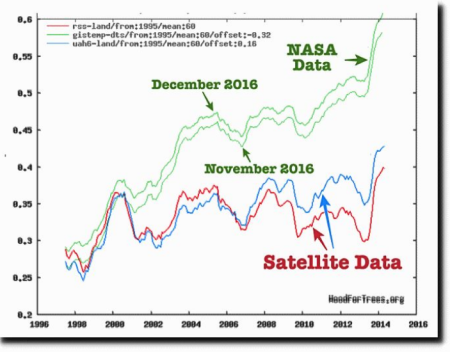
data tampering at NASA

Last week there was the another Conservative Political Action Conference (CPAC) in Washington. One presentation there by several important climate skeptics outlined in detail the data tampering that has been going on at an increasingly outrageous manner at both NOAA and NASA in recent years. The slides presented by Tony Heller (available here [pdf]), many of which I have highlighted previously here at Behind the Black, are especially educational and damning.

To the right is just one of Heller’s slides, the one that I find the most damning of all. It shows how the surface data issued by NASA’s Goddard Institute of Space Studies (GISS), the two green lines, does not match the satellite data at all. While the satellite data shows no warming this entire century, the GISS data shows steady rising in the surface data. Other slides by Heller show that this rise comes solely from data adjustments and the extrapolation of imagined temperature data in places where no data exists, neither of which has been explained in any manner by the scientists at GISS.

What is most damning however is the change Heller documents between GISS’s November 2016 and December 2016 data sets. For reasons that are simply unjustified by any scientific measure, GISS somehow found it necessary to adjust its entire data set upward in one month about 0.03 of a degree. The only reason I can find for such a change in such a short period of time is a desire by the scientists at GISS to create the illusion that the climate is warming, and warming fast. They don’t have any real data to show this, so they make it up.

Make sure you look at all of Heller’s slides [pdf]. It is also definitely worthwhile to spend the time to watch the entire CPAC presentation, available at the first link above.

42 comments

NASA buys Soyuz seats from Boeing

NASA has purchased two additional seats from Boeing on a Russian Soyuz capsule and rocket to get astronauts to ISS beyond 2019.

The reason Boeing was able to sell Russian Soyuz seats is because they have obtained them from the Russians in a deal to settle Boeing’s $320 million lawsuit over ending the Russian/Boeing Sea Launch partnership.

4 comments

Heading Home

Today we completed our last caving trip in Belize. I and many of the expedition’s participants head home tomorrow.

Because our cave trips take so much time, I have not had time to post anything these last few days. I will try to post tomorrow during my return home, but expect full posting to resume on Thursday.

Also, though I will comment then in greater length about SpaceX’s announcement on Monday that they plan on sending two tourists around the Moon by 2018, I want to note here that this announcement is clearly Elon Musk’s response to the effort by NASA to delay the launch of commercial crew because of so-called safety issues so that SLS/Orion might fly first. Musk is telling the world that NASA’s safety concerns are crap (to which I generally agree) and he intends to prove this with his own lunar manned mission.

11 comments

India’s government a barrier to private space

Even as India and its space agency show themselves to increasingly be a major player in the worldwide aerospace market, it appears that India’s governmental policy on private satellite communications is acting as a barrier that blocks the growth of a commercial space industry.

India’s current satcom policy, first rolled out in 1997 and then updated in 2000, is clearly outdated. A senior ISRO official who attended the ORF event (but declined to be identified) pointed out that all the existing satcom policy says is Indian satellite companies will be given preference over foreign multinational companies. “How does this preference play out? If the department of space is worried about national security concerns, they should lay down clear guidelines for security compliance by foreign satellites. The existing policy doesn’t talk about this, which inevitably leaves it to ISRO, DoS and Antrix’s discretion,” the official told The Wire.

And this discretion has held up multiple applications for satellite manufacturing and foreign direct investment over the last decade. Hughes’ Krishna is particularly frustrated over this. “If a company submits an application for satellite broadband services in India, irrespective of where the satellites will be made, it needs a specific timeline on when it will hear back from ISRO or the DoS. Will it be two years, three years or five years? It is difficult to line up future investments if speedy clearance is not given,” Krishna said.

Essentially, India’s Department of Space (DoS) and its space agency ISRO control all licensing, and have been using that power to delay or deny the issuing of any private satellite licenses, since such efforts are in competition with these government agencies.

The situation here is very similar to what existed in the U.S. with NASA for most of the last half of the 20th century. The agency did not want private launch companies competing with its own manned programs, and diligently worked to block their efforts. If you wanted to be part of manned space, you did what NASA told you to do and you built what they told you to build. It wasn’t until the rise of the commercial space programs to launch cargo to ISS that NASA’s grip on manned space was finally broken.

India now faces the same problem. ISRO has done an excellent job, as NASA did in its early years, in getting India’s space industry started. It now needs to back off, stop running things and simply be a customer of these competing private companies, letting freedom do the job instead of government dictate. The question now is whether the Indian government will allow this to happen. There are many vested interests there that will resist.

1 comment

NASA signs technology development contracts with eight companies

The competition heats up: NASA today announced the award of contracts to eight small companies to develop new technologies for the advancement of smallsat launch capabilities.

The contracts cover a wide range of launch concepts, from testing new imaging technology for spotting asteroids to new rocket engine development to new rocket designs. The key component however of all these contracts is this:

These fixed-priced contracts include milestone payments tied to technical progress and require a minimum 25 percent industry contribution, though all awards are contingent on the availability of appropriated funding. The contracts are worth a combined total of approximately $17 million, and each have an approximate two-year performance period culminating in a small spacecraft orbital demonstration mission or the maturation of small launch vehicle technologies.

In other words, the companies have to provide some of the funding, since the technology being developed will benefit them. They also will only be paid once they meet certain milestones, and any cost overages will be their responsibility. The result? The U.S. has the chance of giving birth to eight new space companies, all with cutting edge technology that can compete in the new launch market. And the country gets this for a measly $17 million.

1 comment

Aerojet Rocketdyne sets record testing new rocket engine

The competition heats up: In recent static fire tests of its new AR-1 rocket engine Aerojet Rocketdyne set a record for the highest chamber pressure for any American engine using oxygen and kerosene.

They hope to convince ULA to use this engine in its Atlas 5 rocket to replace the Russian engine they presently use. At the moment, though ULA has made no commitment, it appears however that the company is favoring Blue Origin’s engine instead. That Congress favors Aerojet Rocketdyne is their one ace in the hole, since Congress controls the purse strings.

0 comments

Sea Launch deal finalized?

The competition heats up? Two articles today in the Russia press suggest that either their settlement deal with Boeing over bankrupt Sea Launch is either on the verge of signing or the Russians are trying to pressure Boeing to an agreement by use of the press.

The first article says that a final agreement is about to be signed, but provides no date or indication from Boeing that they have agreed to terms. The second announces that the private Russian company that is acquiring Sea Launch from the Russian government to compete in the commercial launch market has been given a launch license by the Russian government, and will launch its first rocket from Baikonur later this year, using the Ukrainian Zenit-M rocket that was designed to fly from the Sea Launch floating platform. .This launch is intended as a test flight prior to restarting launches from the Sea Launch platform itself.

The complexity of this Sea Launch situation boggles my mind. Russia has sold Sea Launch to a private Russian airline company, S7, which will use a Ukrainian rocket to launch satellites from the Sea Launch platform. Before that can happen however Russia has to settle its dispute with Boeing, which won a $300+ million settlement in court over the breakup of their Sea Launch partnership. That settlement reportedly includes free passenger seats on Soyuz flights to ISS, which Boeing is reportedly offering to sell to NASA, which might need them. Meanwhile, Russia does not seem to have a problem with a Russian company using a Ukrainian rocket, even though Russia itself has completely banned the use of Ukrainian equipment on any of its own space rockets or capsules.

The business of commercial space sometimes amazes me.

Posted in the airport terminal in Belize City. We are waiting for everyone to arrive to take a van together to our resort, Maya Mountain Lodge.

0 comments
1 586 587 588 589 590 838