
Herman Cain speaks out about NASA and space

Herman Cain speaks out about NASA and space:

When President Obama decided to cut, it put the United States in a position that we don’t like. We don’t like to have to thumb-ride with the Russians when we were the first ones and the leaders in space technology. It’s not just about getting to the moon and outer space. The space program inspires other technological advances to business and the economy. In the Cain presidency, it will be reversed back to where it should be.

As much as I might like Cain for some things, I could not help cringing when I read these words. They suggest a great deal of ignorance about what the Obama administration has done, a willingness on Cain’s part to pander to his audience (speaking as he was at the U.S. Space & Rocket Center in Huntsville), and a desire by this self-declared fiscal conservative to spend lots more money for a big government space program at a time when the federal government is broke.

I’d rather have Cain take a more thoughtful approach. Alas, this is a campaign. Moreover, whoever ends up as president after this election will probably be less important than the make-up of the next Congress. It is that part of the 2012 election that really counts.
10 comments

Obama Administration Pushing for Solar Projects on Public Lands

Coming to a state near you (until the project goes bankrupt and leaves behind a financial and environmental ruin): The Obama administration this week identified seventeen sites in six Western states, all on public land, as prime locations for solar energy projects.

To me, the best indication that something is not quite right with this proposal is that the solar industry itself has doubts.

Environmental groups hailed the announcement, but the solar industry was guarded in its response. Rhone Resch, president and CEO of the Solar Energy Industries Association, said he had “some significant areas of concern” about the solar energy zones@ Flexibility in project siting and access to transmission were crucial to financing and development of utility-scale solar power plants, Resch said, adding that he was optimistic a balanced approach could be found.

You would think the solar industry would be thrilled to get this support from the government. That they have reservations is a serious red flag.

0 comments

According to Zubrin, Obama about to terminate all NASA science

According to Robert Zubrin, the Obama administration is planning to terminate all funding to NASA’s planetary program, while cutting back significantly on its astronomy program.

Word has leaked out that in its new budget, the Obama administration intends to terminate NASA’s planetary exploration program. The Mars Science Lab Curiosity, being readied on the pad, will be launched, as will the nearly completed small MAVEN orbiter scheduled for 2013, but that will be it. No further missions to anywhere are planned. After 2013, America’s amazing career of planetary exploration, which ran from the Mariner probes in the 1960s through the great Pioneer, Viking, Voyager, Pathfinder, Mars Global Surveyor, Mars Odyssey, Spirit, Opportunity, Mars Reconnaissance Orbiter, Galileo and Cassini missions, will simply end.

Furthermore, the plan from the Office of Management and Budget (OMB) also leaves the space astronomy program adrift and headed for destruction. The now-orbiting Kepler Telescope will be turned off in midmission, stopping it before it can complete its goal of finding other Earths. Even worse, the magnificent Webb Telescope, the agency’s flagship, which promises fundamental breakthroughs in our understanding of the laws of the universe, is not sufficiently funded to allow successful completion. This guarantees further costly delays, with the ensuing budgetary overruns leading inevitably to eventual cancellation.

I suspect these cuts have been leaked now, months before the budget is publicly released, in order to whip up support for funding these programs. I also find it distressing that these programs, which cost practically nothing, are targets, while others that cost many many more billions (in NASA and elsewhere) remain fully funded.

10 comments

Doubts on Display from Congress during hearing on Private Space

Several Congressmen expressed doubts about and resistance to the new private space manned effort by companies like SpaceX during hearings today in the House.

Let’s be honest: it’s all about pork and only pork. Unfortunately, the new companies don’t deliver the same kind of pork to the right congressional districts, even if they might deliver a real product faster and for less money. To quote the article:

Dana Rohrabacher, R-Calif., rallied to the industry’s defense, citing a “hostility” to the private space industry. “Much to my dismay, I see some of the worst elements of decision making,” he said. “I see an anti-commercial-space attitude that could have very negative consequences.” Rohrabacher (who represents a district near SpaceX’s headquarters) seemed to chide Hall and Johnson, the two Texans who chair the panel, for parochial views. “Focusing on one’s own district and directing federal funds seems to be having a major impact on this decision,” he said.

As we anticipated yesterday, there were other regional pleas connected to the word of choice heard in the halls of Congress: jobs. Rep. Hansen Clarke, D-Mich., for instance, asked how the space contract could be used to create jobs in his district of metropolitan Detroit. The witnesses made the most diplomatic kowtows they could. “I’ve been pushing SpaceX to use more automotive suppliers,” Musk responded. Other space industry execs went on to claim Michigan subcontractors, to praise the auto industry, and to speak of spin-offs from space science programs.

4 comments

Elon Musk and the forgotten word

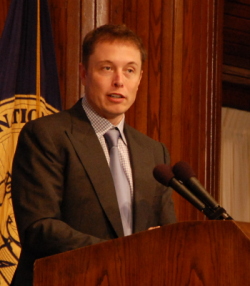
Elon Musk at National Press Club

When Elon Musk gave his speech at the National Press Club on September 29, he was asked one question to which he really did not know the answer. He faked it, but his response illustrated how completely forgotten is one fundamental fact about American society — even though this fact is the very reason the United States became the world’s most wealthy and powerful nation less than two centuries after its founding.

To explain this fundamental fact I think I need to take a step back and talk about the ongoing war taking place right now over how the United States should get its astronauts into space. On one side we have NASA and Congress, who want NASA to build a new heavy-lift rocket to carry its Orion capsule beyond Earth orbit. On the other side we have a host of independent new space companies, all vying for the chance to launch humans and cargo into space for fun and profit.

Which is right? What system should the United State choose?
» Read more

10 comments

Space News suggests Congress use the billions for NASA’s heavy-lift rocket to fund JWST

In an editorial yesterday Space News suggested that Congress use the billions it is allocating for NASA’s heavy-lift rocket to fund the James Webb Space Telescope instead.

This is not surprising. Webb already has a strong constiuency (astronomers, the public) while the Space Launch System has little support outside of Congress and the specific aerospace contractors who want the work. With tight budgets as far as the eye can see into the future, and the likelihood that Congress is going to become more fiscal conservative after the next election, it would not shock me in the slightest if SLS gets eliminated and the money is given to Webb. And if the SpaceX and Orbital Sciences cargo missions to ISS go well then cutting SLS would almost be a certainty, as this success would demonstrate that these private companies should be able to replace SLS for a tenth of the cost.

And I also think this would be a much wiser use of the taxpayers money.

2 comments

A UN report says that nearly one billion people are hungry because of biofuels such as ethanol from corn

A UN report this week says that nearly one billion people are hungry, partly because of biofuels such as ethanol from corn.

The findings are echoed in a report published today by the International Food Policy Research Institute (IFPRI), based in Washington DC. Maximo Torero, one of the report’s authors, says policymakers must “curtail biofuels subsidies” and “discourage the use of food crops in biofuel production” to limit food price volatility.

4 comments
1 794 795 796 797 798 838