Today’s blacklisted American: Fire chief fired for attending a Christian-affiliated leadership conference

Christians banned from Stockton's government

They’re coming for you next: Ron Hittle, who had served as a firefighter in Stockton, California, for more than two decades and was for five years its fire chief, was fired in 2010 because he had had the nerve to attend a leadership conference that happened to be affiliated with the Christian religion.

More than a decade ago, the Deputy City Manager asked Chief Hittle to attend leadership training. Chief Hittle learned about the Willow Creek Global Leadership Summit from a business magazine, and he decided to attend because it was a renowned leadership seminar that featured a โ€œpop up business schoolโ€ with stellar speakers from various backgrounds including his own Christian worldview. Chief Hittle invited three of his staff members who shared his Christian faith to join him, and he put his attendance on the public city calendar so his supervisors would be aware. The firefighters paid for the two-day seminar with their own funds.

But the same supervisor who asked Chief Hittle to attend leadership training told him it was unacceptable that he attended a Christian-affiliated seminar.
» Read more

22 comments

September 5, 2022 Space quick links

All courtesy of BtB’s stringer Jay.

1 comment

India’s space agency successfully tests prototype for controlling descent of spent 1st stages

IAD by ISRO

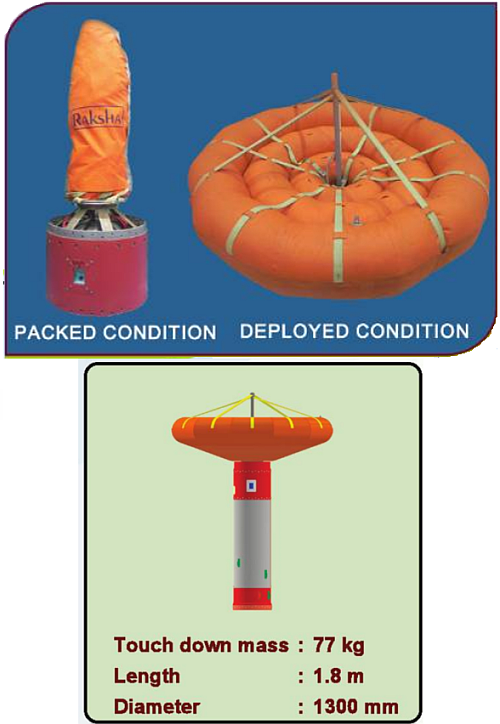
India’s space agency ISRO on September 3, 2022 successfully used a suborbital sounding rocket to test a prototype of an inflatable airbag, which it dubs an Inflatable Aerodynamic Decelerator (IAD), that can inflate at the top of a 1st stage and slow and control its descent back to Earth after launch.

The graphic to the right was adapted from the mission brochure [pdf]. According to ISRO:

The IAD was initially folded and kept inside the payload bay of the rocket. At around 84 km altitude, the IAD was inflated and it descended through atmosphere with the payload part of sounding rocket. The pneumatic system for inflation was developed by LPSC. The IAD has systematically reduced the velocity of the payload through aerodynamic drag and followed the predicted trajectory. This is first time that an IAD is designed specifically for spent stage recovery. All the objectives of the mission were successfully demonstrated

ISRO claims this design can not only facilitate the reuse of first stages, it can also be used for science payloads to Mars and Venus.

I look at this and wonder, wouldn’t parachutes or parasails, already developed and used numerous times in similar applications, do the same job? In fact, Rocket Lab has already successfully used parachutes to control the re-entry of its Electron first stages. Meanwhile, SpaceX uses simple and lightweight grid fins to control the descent of its Falcon 9 first stages, and simply fires that stage’s engines twice to slow it down for landing.

While there may be engineer advantages to this airbag design, the whole thing smacks of many of NASA’S complex test programs that never made it past prototype tests. The ideas always looked good, but they never were practical or cost effective.

7 comments

Indian rocket startup raises $51 million in private investment capital

Capitalism in space: The Indian rocket startup Skyroot has just raised $51 million in private investment capital for the development of its smallsat rocket, Vikram-1.

Operating as a private aerospace manufacturer and commercial launch service provider in the country, the Hyderabad-headquartered startup has been working on its flagship Vikram series of small-life launch vehicles. The first among them, the Vikram 1, is slated to take to the skies by the end of the year and launch small satellites to space.

The $51 million is the most any private aerospace commercial company from India has ever raised in a single funding round.

Though the Modi government has publicly encouraged the development of a private, independent, commercial aerospace industry, India’s bureaucracy has generally acted to block this effort. In 2019 it convinced the government to create New Space India Limited (NSIL), a wholly government-owned entity which is designed to retain as much control over commercial market share as possible. As recently as one month ago, the NSIL webpage described itself as aiming to “capture” that commercial market. That revealed its purpose too obviously, so the website was rewritten to now say its goal is to “spur” the Indian aerospace sector.

Because NSIL gets government money and has full control over all of India’s already developed government rockets and space facilities, it has an enormous advantage, which acts to discourage investment in new private companies such as Skyroot. This is a similar situation that existed in the U.S. for more than a half century following Apollo. NASA had the resources, controlled all launches, and thus made private investment for independent companies hard to obtain.

This only changed when NASA began awarding contracts to private companies in 2008, whereby the rockets and spacecraft produced were not owned or designed by NASA. And NASA was only forced to do so because Elon Musk happened to have enough of his own money to finance SpaceX himself.

When ISRO (India’s agency) or NSIL begin awarding contracts like this, then company’s like Skyroot will begin to blossom.

4 comments

NASA to roll SLS back to assembly building, delaying launch by weeks at minimum

NASA managers today decided they will not attempt another launch of SLS during the present launch window that closes on September 6, 2022, and will bring the rocket back to assembly building for more detailed trouble-shooting.

Engineers not only need to solve the hydrogen fuel leak in a fuel line connection that caused today’s launch scrub, they will also have to replace the flight termination batteries needed in case the rocket has to be destroyed during liftoff because it is flying out of control. These batteries only have a few weeks life, and the launch delays this week caused them to reach their limit.

The next launch windows are either from September 19 to October 4, excluding September 29-30, or October 17 to October 31, excluding October 24, 25, 26, and 28.

At that point SLS’s two solid rocket strap-on boosters will have been stacked for about two years, one full year past what NASA once considered their safe lifespan. The agency has waived that rule for SLS, but waiving it for more than a full year might simply be too risky. If the boosters need to be replaced, that will delay the launch by at least another three months, at the minimum.

Right now the odds remain high this launch will not occur in 2022.

32 comments

China’s Long March 4C rocket launches military satellite

China today successfully used its Long March 4C rocket to place a military Earth observation satellite into orbit.

Launched from an interior spaceport, the rocket’s lower stages thus crashed uncontrolled in China.

The leaders in the 2022 launch race:

39 SpaceX
34 China
11 Russia
6 Rocket Lab
5 ULA

American private enterprise still leads China 54 to 34 in the national rankings, and the entire globe 54 to 52.

3 comments

OneWeb lost $229 million when Russia canceled its launches and confiscated its satellites

On September 1, 2022, OneWeb revealed that Russia’s cancellation of the last six or so OneWeb launches as well as Russia’s confiscation of 36 satellites cost the company $229 million.

Russia’s actions were the response by then head of Roscosmos, Dmitry Rogozin, to sanctions imposed on Russia by the west because of its invasion of the Ukraine. Rogozin’s petty response ended up shooting his space agency in the foot, because it ended up losing billions of dollars in foreign launch business, business that is not likely to return for decades.

OneWeb has since signed contracts with SpaceX, ISRO (India’s space agency), and Relativity for future launches. None of these have been firmly scheduled, though the first by SpaceX is tentatively planned for sometime before the end of the year.

11 comments

SLS test launch scrubbed again

NASA engineers once again were forced to scrub the launch of the SLS rocket today due to another hydrogen leak during fueling.

The launch director waived off todayโ€™s Artemis I launch attempt at approximately 11:17 a.m. EDT. Teams encountered a liquid hydrogen leak while loading the propellant into the core stage of the Space Launch System rocket. Multiple troubleshooting efforts to address the area of the leak by reseating a seal in the quick disconnect where liquid hydrogen is fed into the rocket did not fix the issue.

NASA has one more chance, on September 5th, to launch this rocket before it must return it to the assembly building to replace the flight termination batteries, used to abort the launch after liftoff should something go seriously wrong during flight. As I understand it, their use-by date is September 6th, and it would require a major safety waiver by the military range officer, who is entirely independent from NASA and under no obligation to it, to allow for a launch after that date with those batteries.

8 comments

Sunspot update: Solar activity continues to exceed sunspot predictions

It is the beginning of September and time to post another update on the Sun’s ongoing solar cycle. Below is NOAA’s monthly graph tracking the number of sunspots on the Sun’s Earth-facing hemisphere, with the activity in August now added. I have also added some additional details to the graph to give the numbers a larger context.

Though sunspot activity dropped in August it remained significantly above the predictions of the panel of government solar scientists put together by NOAA. The predicted sunspot number for August, as indicated by the red curve, was supposed to be about 48. The actual number was 75.

» Read more

4 comments

Chinese astronauts complete first spacewalk using new Wentian module

The new colonial movement: Chinese astronauts yesterday completed their first spacewalk using the airlock on the new Wentian module that was recently launched to that nation’s Tiangong-3 space station.

The spacewalk lasted six hours, and was mostly designed to test the airlock itself as well as do the first tests of Wentian’s own robot arm. It appears they also installed an “extended pump set”, whatever that is, and did other work near the hatch. More here.

4 comments

NASA is paying Boeing twice as much as SpaceX for its manned flights

Capitalism in space: in an excellent analysis of the total amount NASA will pay both SpaceX and Boeing for all their manned flights to ISS before the station retires, Eric Berger at Ars Technica has determined that the agency will essentially pay Boeing twice as much per flight.

In 2014, NASA narrowed the crew competition to just two companies, Boeing and SpaceX. At that time, the space agency awarded Boeing $4.2 billion in funding for development of the Starliner spacecraft and six operational crew flights. Later, in an award that NASA’s own inspector general described as “unnecessary,” NASA paid Boeing an additional $287.2 million. This brings Boeing’s total to $4.49 billion, although Finch told Ars that Boeing’s contract value as of August 1, 2022, is $4.39 billion.

For the same services, development of Crew Dragon and six operational missions, NASA paid SpaceX $2.6 billion. After its initial award, NASA has agreed to buy an additional eight flights from SpaceXโ€”Crew-7, -8, -9, -10, -11, -12, -13, and -14โ€”through the year 2030. This brings the total contract awarded to SpaceX to $4.93 billion.

Since we now know how many flights each company will be providing NASA through the lifetime of the International Space Station, and the full cost of those contracts, we can break down the price NASA is paying each company per seat by amortizing the development costs.

Boeing, in flying 24 astronauts, has a per-seat price of $183 million. SpaceX, in flying 56 astronauts during the same time frame, has a seat price of $88 million. Thus, NASA is paying Boeing 2.1 times the price per seat that it is paying SpaceX, inclusive of development costs incurred by NASA.

Despite the larger payments to Boeing, the company could very well lose money on Starliner. The higher cost to NASA from Boeing is due almost entirely because the agency was absorbing more of its initial development cost. SpaceX’s Dragon capsule had already been flying cargo missions to ISS when these manned contracts were awarded. SpaceX merely had to upgrade its manned capsule. Boeing had to design and build it from scratch. Moreover, the contracts were fixed price, which means Boeing had to absorb more than a half billion in additional costs when it had to refly the unmanned demo flight of Starliner.

Finally, because of the delays, Boeing won less NASA business. It also has gotten none of the private commercial manned flights that are going on right now. Those contracts went to SpaceX, including all the profits. Whether Boeing can eventually win some private contracts down the road is unknown. It will certainly have to lower its price to compete with SpaceX.


13 comments
1 247 248 249 250 251 988