A drone for Mars

Engineers at JPL have begun testing prototypes of a drone that would be used on Mars to aid future rovers.

The newest solution proposed by JPL is the Mars Helicopter, an autonomous drone that could “triple the distances that Mars rovers can drive in a Martian day,” according to NASA. The helicopter would fly ahead of a rover when its view is blocked and send Earth-bound engineers the right data to plan the rover’s route.

2 comments

Ocean science deals with limited budgets

A National Research Council report has outlined a range of budget cuts in the field of ocean science, including significant cuts to infrastructure expenses, in order to focus the available funds more wisely.

Faced with rising costs of going to sea, the ocean-sciences division of the US National Science Foundation (NSF) should immediately slash what it spends on marine hardware, says a new report. It suggests making the biggest cut to the flagship US$386-million Ocean Observatories Initiative (OOI), which after years of construction is just months away from being finished.

The report, released on 23 January by the US National Research Council, is likely to guide US oceanography for years to come. It is the first formal attempt to address what many researchers have grumbled about for years — that basic ocean science at the NSF is losing out to the rising costs of infrastructure.

This report and the response of the ocean science community illustrates a pattern going on throughout the sciences. For years, their budgets had been rising so fast that they really didn’t know what to do with the money. (I know they would disagree with me.) This resulted in some laziness in how they spent it, including a great deal of feather-bedding and pork.

Now that budgets have frozen and are no longer growing, and in many cases shrinking back to more affordable levels, they need to figure out what is essential and what is not. This report is part of that effort.

I am seeing this same process happening in other fields as well. Santa, in the form of unlimited federal spending, has gone home, and is unexpected to return for quite some time.

1 comment

Ten astonishing images from Rosetta

Link here. These images are from Rosetta’s high resolution camera OSIRIS, the results from which have been kept very closely secret by the Rosetta science team. Today however they published a bunch of papers in the journal Science, so we are finally beginning to see some of their amazing images.

Take a look. Each one illustrates how alien a place Comet 67/C-G is.

More info on these papers can be found here and here.

Even more here, from the Rosetta team.

2 comments

Comet 67P/C-G’s coma fluctuates widely

Climate change: Data from Rosetta has shown that the coma surrounding Comet 67P/C-G’s nucleus varies far more than had been expected by Earth-based observations.

“From a telescope, images of a comet’s atmosphere suggest that the coma is uniform and does not vary over short periods of hours or days. That’s what we were expecting as we approached the comet,” said Dr. Stephen Fuselier, a director in the SwRI Space Science and Engineering Division and the lead U.S. co-investigator for the Rosetta Orbiter Spectrometer for Ion and Neutral Analysis Double Focusing Mass Spectrometer (ROSINA DFMS) instrument. “It was certainly a surprise when we saw time variations from 200 km away. More surprising was that the composition of the coma was also varying by very large amounts. We’re taught that comets are made mostly of water ice. For this comet, the coma sometimes contains much more carbon dioxide than water vapor.”

The variations might be seasonal, or even reflect a variation from day to night.

Expect more news stories about Comet 67P/C-G from Rosetta. The journal Science is today publishing a special section on results from Rosetta.

0 comments

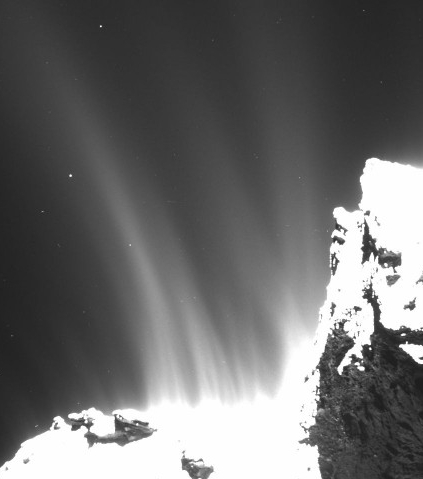
Comet 67P/C-G’s plumes

plumes from Comet 67P/C-G

The science team running Rosetta has released an image (cropped by me on the right) from the probe’s high resolution camera showing the fine structure of Comet 67P/C-G’s plumes.

I call them plumes rather than jets, which is the word the scientists use as well as everyone else, because it appears to me that they really aren’t jets, tightly confined flows of material coming from a nozzle-like opening. Instead, the image makes me think of very fast-rising plumes of smoke rising from an extinguished fire.

This image was taken in November, and is one of only a very tiny handful of images released from the high resolution camera. Rosetta’s science team has been very possessive of images from this camera, holding them back for their own research papers to follow in the future. Even here, the image is not very detailed. I wonder what cool stuff this camera has snapped close in that they have not yet shown us.

0 comments

New Horizons to begin observations of Pluto

In preparing for its July 14 fly-by of Pluto, New Horizons will take its first images of the planet on January 25.

Snapped by New Horizons’ telescopic Long-Range Reconnaissance Imager, known as LORRI, those pictures will give mission scientists a continually improving look at the dynamics of those moons. And they’ll play a critical role in navigating the spacecraft as it covers the remaining 135 million miles (220 million kilometers) to Pluto. “We’ve completed the longest journey any craft has flown from Earth to reach its primary target, and we are ready to begin exploring!” said Alan Stern, New Horizons principal investigator from Southwest Research Institute in Boulder, Colorado.

Over the next few months, LORRI will take hundreds of pictures of Pluto against star fields to refine the team’s estimates of New Horizons’ distance to Pluto. Though the Pluto system will resemble little more than bright dots in the camera’s view until May, mission navigators will use those data to design course-correction maneuvers that aim the spacecraft toward its flyby target point this summer. The first such maneuver could occur as early as March.

0 comments

Scientists demand more skepticism of doom-sayers

The uncertainty of science: Ocean scientists have published a review of the literature, criticizing the ocean science field and the journals and journalists who report on it for overstating the environmental damage to the oceans.

The state of the world’s seas is often painted as verging on catastrophe. But although some challenges are very real, others have been vastly overstated, researchers claim in a review paper. The team writes that scientists, journals and the media have fallen into a mode of groupthink that can damage the credibility of the ocean sciences. The controversial study exposes fault lines in the marine-science community.

Carlos Duarte, a marine biologist at the University of Western Australia in Perth, and his colleagues say that gloomy media reports about ocean issues such as invasive species and coral die-offs are not always based on actual observations. It is not just journalists who are to blame, they maintain: the marine research community “may not have remained sufficiently sceptical” on the topic. [emphasis mine]

Gee, what a concept! These guys actually want scientists to base their claims of environmental disaster on actual observations. Who wodda thunk it?

1 comment

A 132-year-old Winchester rifle found leaning on a tree in national park

Archeologists made the astonishing discovery of a 132 year old Winchester rifle leaning against a tree in Great Basin National Park in Nevada during a survey sweep.

“The 132 year-old rifle, exposed to sun, wind, snow, and rain was found leaning against a tree in the park. The cracked wood stock, weathered to grey, and the brown rusted barrel blended into the colors of the old juniper tree in a remote rocky outcrop, keeping the rifle hidden for many years,” Great Basin National Park said in a statement.

They hope with some historical research they might be able to identify who left the rifle there more than a century ago.

1 comment
1 483 484 485 486 487 729