
Scientists discover that bigger is not better

Why am I not surprised? An comparison of the size of research labs and the number of impact papers the lab published found that increasing the number of students to the staff above a certain point does little to increase research success.

To publish the most papers, labs should ideally have 10 to 15 members, according to a much-discussed study in PeerJ PrePrints. Adding more and more graduate students and postdocs beyond that number does not guarantee a continued rise in high-impact papers, the study found, partly because the extra workers tend to be much less productive than the principal investigator (PI). Mark Pallen, who heads a microbiology lab at the University of Warwick, UK, tweeted โ€œNice that PIs matter!โ€

Not surprisingly, there is much skepticism of this result in the scientific community, as having more workers in their lab tends to give them a justification for requiring more grant funds.
0 comments

OSIRIS-REx to get more fuel for its asteroid mission

In what might be a first for the planetary science/engineering community, an unmanned probe, being built to bring samples back from the asteroid Bennu, is turning out to be lighter than expected, thus allowing engineers to stuff its tanks with extra fuel to extend its mission.

The OSIRIS-REx spacecraft, being built at a Lockheed Martin facility in Denver, is coming in lighter than the lift capability of the Atlas 5 rocket, which will lift off in its โ€œ411โ€ configuration with a four-meter payload fairing, a single-engine Centaur upper stage, and one strap-on solid rocket booster.

The proposal โ€” described as a โ€œheavy launch optionโ€ โ€” would add an extra 341 pounds of fuel to the spacecraftโ€™s fuel tank.

Planetary probes never end up lighter than planned, at least until now. During construction scientists have always found it impossible to resist adding more instruments or capabilities, and thus engineers always struggle to get the spacecraft built within its weight budget. For OSIRIS-REx to have this wonderful problem is surely astonishing.

0 comments

Astronomers find an invisible dwarf galaxy

Using dark matter data that suggested the existence of a faint dwarf galaxy 300,000 light years away on the other side of the Milky Way, astronomers have pinpointed its location by finding a tiny cluster of bright Cepheid variable stars, also located at that distance.

โ€œThese young stars are likely the signature of this predicted galaxy,โ€ said Chakrabarti, assistant professor in RITโ€™s School of Physics and Astronomy. โ€œThey canโ€™t be part of our galaxy because the disk of the Milky Way terminates at 48,000 light years.โ€ Invisible particles known as dark matter make up 23 percent of the mass of the universe. The mysterious matter represents a fundamental problem in astronomy because it is not understood, Chakrabarti said.

This result is intriguing because it not only found a previously unknown dwarf galaxy orbiting the Milky Way, it also provides further evidence that dark matter, whatever it is, does exist. The dark matter of this unseen dwarf galaxy showed its gravitational effects on Milky Way stars, and when the astronomers looked at the right spot suggested by those effects, they found distant stars that had to belong to the invisible dwarf galaxy, proving it was there. This is comparable to finding Neptune and Pluto by analyzing their gravitational effects and then predicting their location in the sky.

0 comments

Five years later a second attempt to put a Japanese spacecraft into Venus orbit

If at first: After failing to place its Akatsuki spacecraft into orbit around Venus in 2010 because of a cracked engine nozzle, Japan has announced its plans for a new attempt later this year.

The attempt will be made on December 7. If successful, the spacecraft will begin studying Venus’s climate and atmosphere only a short time after the end of Europe’s very success Venus Express mission.

0 comments

New Pluto images from New Horizons

Pluto from 126 million miles

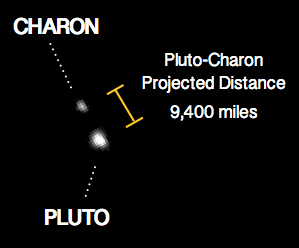
The New Horizons science team has finally released the navigation image of Pluto and Charon that the spacecraft took on January 25.

A cropped version is on the right. The image shows Pluto and its biggest moon Charon, with both appearing somewhat elongated in shape. Why this is so is not explained by the press release, but I suspect it is because the goal of the image was not sharpness but to locate the planet for navigation purposes.

1 comment

Life found that hasn’t changed in 2 billion years

Scientists have discovered a micro-organism that has not evolved in more than 2 billion years.

Schopf and his colleagues used a variety of spectroscopic imaging techniques to study sulfur bacteria fossils embedded in deep sea rocks of varying ages. Analysis of the microorganisms from 1.8 billion-year-old rocks from Western Australia and 2.3 billion-year-old rocks collect off the coast of Chile showed that ancient sulfur bacteria looks the exact same now as it has for more than two billion years.

1 comment

The Hubble Space Telescope lives on!

At a press conference at the January meeting of the American Astronomical Society scientists and engineers of the Space Telescope Science Institute that operates the Hubble Space Telescope reported that it is functioning far better than expected and is likely to continue to function until 2020 or beyond.

This is good news, since there is nothing being planned to replace Hubble. The article implies that the James Webb Space Telescope has that job, but Webb is an infrared telescope, not optical, and thus observes the universe in wavelengths not visible to the human eye.

1 comment

Gravitational wave/inflation discovery literally bites the dust

The uncertainty of science: The big discovery earlier this year of gravitational waves confirming the cosmological theory of inflation has now been found to be completely bogus. Instead of being caused by gravitational waves, the detection was caused by dust in the Milky Way.

Even while the mainstream press was going nuts touting the original announcement, I never even posted anything about it. To me, there were too many assumptions underlying the discovery, as well as too many data points with far too large margins of error, to trust the result. It was interesting, but hardly a certain discovery. Now we have found that the only thing certain about it was that it wasn’t the discovery the scientists thought.

Nor is this unusual for the field of cosmology. Because much of this sub-field of astronomy is dependent on large uncertainties and assumptions, its “facts” are often disproven or untrustworthy. And while the Big Bang theory itself unquestionably fits the known facts better than any other theory at this time, there remain too many uncertainties to believe in it without strong skepticism.

6 comments

Hayabusa-2 in “tip-top” shape

Launched in December for a 2018 rendezvous with an asteroid, Hayabusa-2 has successfully completed its initial check-out according to Japanese officials.

Checkups on early-phase functionality are being carried out over a three-month period. Although the first Hayabusa had suffered malfunctions of its ion engines, it is confirmed that the four ion engines of Hayabusa-2 are functioning properly, JAXA said. Kuninaka said: โ€œWith the engines functioning, the explorer can set out on its voyage with a lot of leeway. I feel like, โ€˜Way to go!โ€™โ€

0 comments
1 481 482 483 484 485 729