A place on Mars that was possibly habitable only 200 million years ago.

A place on Mars that was possibly habitable only 200 million years ago.

This article discusses the possibility of liquid water from the melting of the glaciers that scientists think once covered the western slopes of the giant volcano Arsia Mons. I have also written about this area in an article I wrote for Sky & Telescope last year on exploring caves in space. It is thought that there might be caves here in which some of that water from those glaciers might still be found.

As one scientist is quoted as saying in this article, “Arsia Mons would be the next place I would want to go.” Like the south pole of the Moon, it likely has all the ingredients for establishing a habitable colony.

1 comment

An summary of the past week’s private effort at Aceibo to reactivate ISEE-3.

A summary of the past week’s private effort at Aceibo to reactivate ISEE-3.

They have discovered that the spacecraft is approximately 150,000 miles away from its expected position. This complicates the rescue effort significantly, as all their course corrections have to be recalculated based on this new position and they don’t yet have it refined enough to do those recalculations.

This has become extremely important as there is a solid statistical chance that the spacecraft could impact the moon or even be off course enough to threaten other spacecraft in Earth orbit. We are working with Mike Loucks of Space Exploration Engineering (SEE) our trajectory guy on this issue. An east coast company, Applied Defense (ADS) has also offered their help and engineering support to derive a new ephemeris from our new position reports. ADS and SEE did the trajectories for NASA’s just completed LADEE mission.

Hopefully by the end of this weekend they will have more to report.

1 comment

The predicted new meteor shower last night was less than hoped but intriguing nonetheless.

The predicted new meteor shower last night was less than hoped but intriguing nonetheless.

Based on a few reports via e-mail and my own vigil of two and a half hours centered on the predicted maximum of 2 a.m. CDT (7 UT) Saturday morning the Camelopardalid meteor shower did not bring down the house. BUT it did produce some unusually slow meteors and (from my site) one exceptional fireball with a train that lasted more than 20 minutes.

1 comment

Short of money for astrophysics because of the overruns on the James Webb Space Telescope as well as federal budget woes, NASA has decided to shut down the Spitzer Space Telescope.

Short of money for astrophysics because of the overruns on the James Webb Space Telescope as well as federal budget woes, NASA has decided to shut down the Spitzer Space Telescope.

Other missions, such as Kepler, Chandra, Hubble, NuStar, and Swift got extensions, however.

0 comments

The Sun settling down?

Two weeks ago NOAA posted its monthly update of the solar cycle, showing the sunspot activity for the Sun in April. I have been remiss about doing my monthly post about this, so here it is now, posted below with annotations.
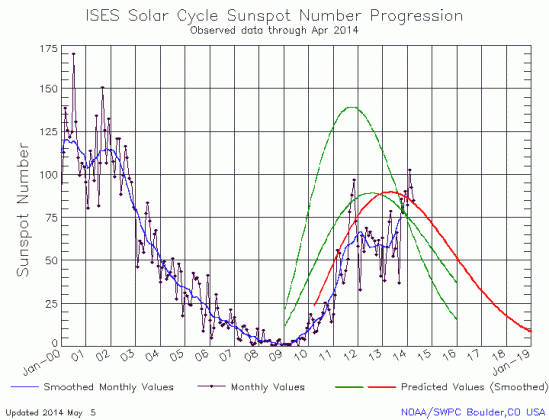
April Solar Cycle graph

The graph above has been modified to show the predictions of the solar science community. The green curves show the community’s two original predictions from April 2007, with half the scientists predicting a very strong maximum and half predicting a weak one. The red curve is their revised May 2009 prediction.

The Sun continued the drop in sunspots seen the previous month, though the total number remains above the 2009 prediction for this moment in the solar cycle. As already noted, that the second peak of this double peaked solar maximum has been much stronger than the first remains unprecedented.

Overall, the maximum continues to be the weakest seen in a hundred years. Whether this is an indicator of future events or an anomaly can only be discovered after the Sun completes this solar solar cycle and begins the ramp up to its next solar maximum, at least five years away.

The next update is only a few weeks away. Stay tuned.

5 comments

Designed and funded on the premise that it would fly past a Kuiper belt asteroid after it flew past Pluto, the New Horizons team has so far failed to find such an asteroid and is running out of time.

Designed and funded on the premise that it would fly past a Kuiper belt object (KBO) after it flew past Pluto, the New Horizons team has so far failed to find such an asteroid and is running out of time.

In theory, project scientists should have identified a suitable KBO long ago. But they postponed their main search until 2011, waiting for all the possible KBO targets to begin converging on a narrow cone of space that New Horizons should be able to reach after its Pluto encounter. Starting to look for them before 2011 would have been impossible, says Grundy, because they would have been spread over too much of the sky.

Now that the hunt for KBOs is on, the New Horizons researchers have mainly been using the 8.2-metre Subaru Telescope in Hawaii and the 6.5-metre Magellan Telescopes in Chile. They have found about 50 new KBOs; none is close enough for New Horizons to reach.

I always thought it unlikely that they would be able to, on the fly, find a suitable candidate that New Horizons could reach in the very empty vastness beyond Pluto. In fact, it seemed absurd and to me seemed instead a transparent public relations ploy to get the funding for the fly-by mission to Pluto. Sadly, my cynical perspective here appears to be turning out to be true.

6 comments
1 511 512 513 514 515 729