
Is the Sun’s strange double-peaked solar maximum finally ending?

Last week NOAA posted its monthly update of the solar cycle, showing the sunspot activity for the Sun in April. As I do every month, I am posting it here, with annotations to give it context.
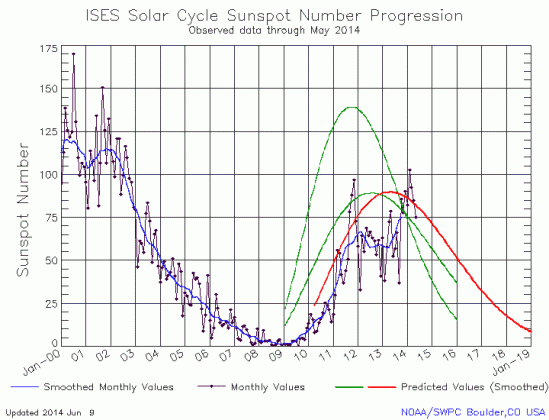
May Solar Cycle graph

The graph above has been modified to show the predictions of the solar science community. The green curves show the community’s two original predictions from April 2007, with half the scientists predicting a very strong maximum and half predicting a weak one. The red curve is their revised May 2009 prediction.

For the third month in a row the Sun continued its drop in sunspots, with the total finally slipping below the 2009 prediction for this moment in the solar cycle. If this decline continues through to solar minimum, the shape of the solar maximum will essentially have been established, double-peaked with the second peak stronger than the first, something that solar scientists have never seen before.

At the moment I await word from the scientists that the Sun has completed the flip of its magnetic field polarity in the southern hemisphere. This flip has already occurred in the northern hemisphere, and when the south follows, the maximum will be officially over and we will officiallybegin the ramp down to solar minimum.

0 comments

The astronomers who allocate time on the Hubble Space Telescope have decided to devote a large block for finding a Kuiper Belt object that the probe New Horizons might fly past.

The astronomers who allocate time on the Hubble Space Telescope have decided to devote a large block for finding a Kuiper Belt object that the probe New Horizons might fly past.

This allocation is still contingent upon a test observation to see if Hubble will be able to spot enough objects to make the long observations worthwhile.

0 comments

Engineers have returned to full operation the x-ray instrument on the Swift gamma-ray burst space telescope.

Engineers have returned to full operation the x-ray instrument on the Swift gamma-ray burst space telescope.

They are still investigating what went wrong this week, but have figured out how to get the instrument back in full automatic robotic mode so that it can gather x-ray data on gamma ray bursts within seconds of their occurence.

0 comments

For the past four years the glaciers in Glacier National Park have stopped shrinking.

The uncertainty of science: For the past four years the glaciers in Glacier National Park have stopped shrinking.

“We had this sort of pause,” Fagre said of shrinking at Sperry Glacier and, by extrapolation, other glaciers. “They pretty much got as much snow as they needed.” Sperry covered 0.86 square kilometers in 2005, 0.83 in 2009 and 0.82 in 2013, illustrating the “pause” in its retreat as there was a 0.03 square kilometer loss from 2005 to 2009, but only 0.01 in the last four years, from 2009 to 2013, Fagre said.

The article spends a lot of time talking about how the shrinkage is about to resume and the glaciers are certain to disappear, but this pause in glacier shrinkage corresponds nicely with the 17 plus year pause in warming that has been going on.

And then there’s this: Great moments in climate forecasting.

And this, also from Steve Goddard: In 1971 the world’s top climate scientists said fossil fuels would cause an ice age by 2020.

I especially like the quote from the last article, where these experts say that there is “no need to worry about the carbon dioxide fuel-burning puts in the atmosphere.” These are the same experts who have have spent the past three decades since 1988 telling us that CO2-caused global warming was going to kill us all.

4 comments

A new analysis of Apollo lunar rocks provides strong new evidence for the theory that the Moon was formed when the Earth was hit by a Mars’ sized planet.

A new analysis of Apollo lunar rocks provides strong new evidence for the theory that the Moon was formed when the Earth was hit by a Mars’ sized planet.

The abstract from this just released science paper summarizes the scientific problem.

Earth formed in a series of giant impacts, and the last one made the Moon. This idea, an edifice of post-Apollo science, can explain the Moon’s globally melted silicate composition, its lack of water and iron, and its anomalously large mass and angular momentum. But the theory is seriously called to question by increasingly detailed geochemical analysis of lunar rocks. Lunar samples should be easily distinguishable from Earth, because the Moon derives mostly from the impacting planet, in standard models of the theory. But lunar rocks are the same as Earth in O, Ti, Cr, W, K, and other species, to measurement precision. Some regard this as a repudiation of the theory; others say it wants a reformation. Ideas put forward to salvage or revise it are evaluated, alongside their relationships to past models and their implications for planet formation and Earth.

The new analysis has found that lunar rocks do differ from Earth in certain ways. Not surprisingly, however, the results have uncertainties.

0 comments

The rupture of a drum at a nuclear waste site in New Mexico has shut down a neutrino experiment.

The rupture of a drum at a nuclear waste site in New Mexico has shut down a neutrino experiment.

This article, from Nature, focuses on the harm done to the science experiment, which is considerable and very unfortunate. However, scroll to the end of the article to learn a little about the drum rupture, which has serious implications for the storage of nuclear waste anywhere.

0 comments
1 510 511 512 513 514 729