Ingenuity’s last flight: an accident investigation

Ingenuity accident investigation conclusions
Click for original image.

Using all the data available, engineers at JPL have done a more detailed accident investigation into Ingenuity’s last flight on Mars on January 18, 2024, and are about to publish their report. Their conclusions however were published today by NASA, with the graphic to the right the main conclusion.

One of the navigation system’s main requirements was to provide velocity estimates that would enable the helicopter to land within a small envelope of vertical and horizontal velocities. Data sent down during Flight 72 shows that, around 20 seconds after takeoff, the navigation system couldn’t find enough surface features to track.

Photographs taken after the flight indicate the navigation errors created high horizontal velocities at touchdown. In the most likely scenario, the hard impact on the sand ripple’s slope caused Ingenuity to pitch and roll. The rapid attitude change resulted in loads on the fast-rotating rotor blades beyond their design limits, snapping all four of them off at their weakest point — about a third of the way from the tip. The damaged blades caused excessive vibration in the rotor system, ripping the remainder of one blade from its root and generating an excessive power demand that resulted in loss of communications.

The reason Ingenuity’s system couldn’t find enough features to track was because it was flying over a dune field, the ground almost all smooth sand. The only features were the soft changes of topography caused by the dunes, which were not small.

Not surprisingly, these same engineers are working on a larger drone-type helicopter for a future mission, dubbed Mars Chopper, which based on an short animation released by NASA, is the mission targeting Valles Mariner that I first described in June 2022. The investigation into Ingenuity’s failure will inform the design of Chopper.

6 comments

Reanalysis of Webb data discovers more than a hundred very small main-belt asteroids

Portrait of all 138 new asteroids
Click for original image.

Using data from the Webb Space Telescope in an unexpected way, astronomers have discovered 138 asteroids in the main asteroid belt, most of which are the smallest so far detected.

The picture to the right shows all 138 asteroids. The researchers had originally used Webb to study the atmospheres of the exoplanets that orbit the star TRAPPIST-1. They then thought, why not see if their data also showed the existence of asteroids in our own solar system. By blinking between multiple images they might spot the movement of solar system objects moving across the field of view. From the press release:

The team applied this approach to more than 10 000 [Webb] images of the TRAPPIST-1 field, which were originally obtained to search for signs of atmospheres around the system’s inner planets. By chance TRAPPIST-1 is located right on the ecliptic, the plane of the solar system where all planets and most asteroids lie and orbit around the Sun. After processing the images, the researchers were able to spot eight known asteroids in the main belt. They then looked further and discovered 138 new asteroids, all within tens of meters in diameter — the smallest main belt asteroids detected to date. They suspect a few asteroids are on their way to becoming near-Earth objects, while one is likely a Trojan — an asteroid that trails Jupiter.

The data is insufficient for most of these objects to chart their orbits precisely. Based on this one single study, however, it suggests that pointing Webb along the ecliptic in almost any direction will detect more such objects. Do this enough and astronomers might actually be able to get a rough census of the asteroid belt’s population.

1 comment

NSF punts on its two big telescope projects

Because it presently does not have sufficient funds to build both the Giant Magellan Telescope (GMT) in Chile and the Thirty Meter Telescope (TMT) in Hawaii, the National Science Foundation (NSF) asked an independent panel to look at both projects and give recommendations on which project it should go with.

That report [pdf] has now been released, and its conclusions essentially take the advice of former Yankee catcher Yogi Berra, “When you come to a fork in the road, take it.” From the report’s executive summary:

Both GMT and TMT have strong leadership, partnership and financial commitments but require $1.6 billion in NSF funding to proceed. Without this support, significant delays or project cancellations may result. The panel emphasized the critical need for congressional support, noting that without additional appropriations, NSF may face challenges balancing these projects with other national priorities, risking U.S. competitiveness in fundamental research. [emphasis mine]

If you dig into the report however you find that TMT is a far more uncertain project. GMT is already being built, while TMT is stalled because it has been unable to get political approval to build in Hawaii on Mauna Kea, even though it initially wanted to start construction almost a decade ago.

Clearly, this report was created simply as a lobbying ploy by the NSF to Congress. NSF didn’t want the report to make a choice. It wanted it to endorse both telescopes so that — rather than bite the bullet and fund one telescope with the money it has already been given by Congress — NSF could use the report to demand more funding so that it can fund both.

Though Congress is now controlled by more fiscally-minded Republicans, don’t expect them to be anymore responsible on this issue than Democrats. These guys really don’t understand basic economics, and think they have a blank check for anything they wish to do. I anticipate Congress will give NSF the extra cash for both telescopes.

The problems for TMT remain, however, and even with that cash it remains very doubtful the telescope will be built. But gee, that won’t be a problem for NSF. Who wouldn’t like getting an extra billion or two to spend as one wishes?

1 comment

“Thar’s ice in them hills!”

Overview map

Thar's ice in them hills!
Click for original image.

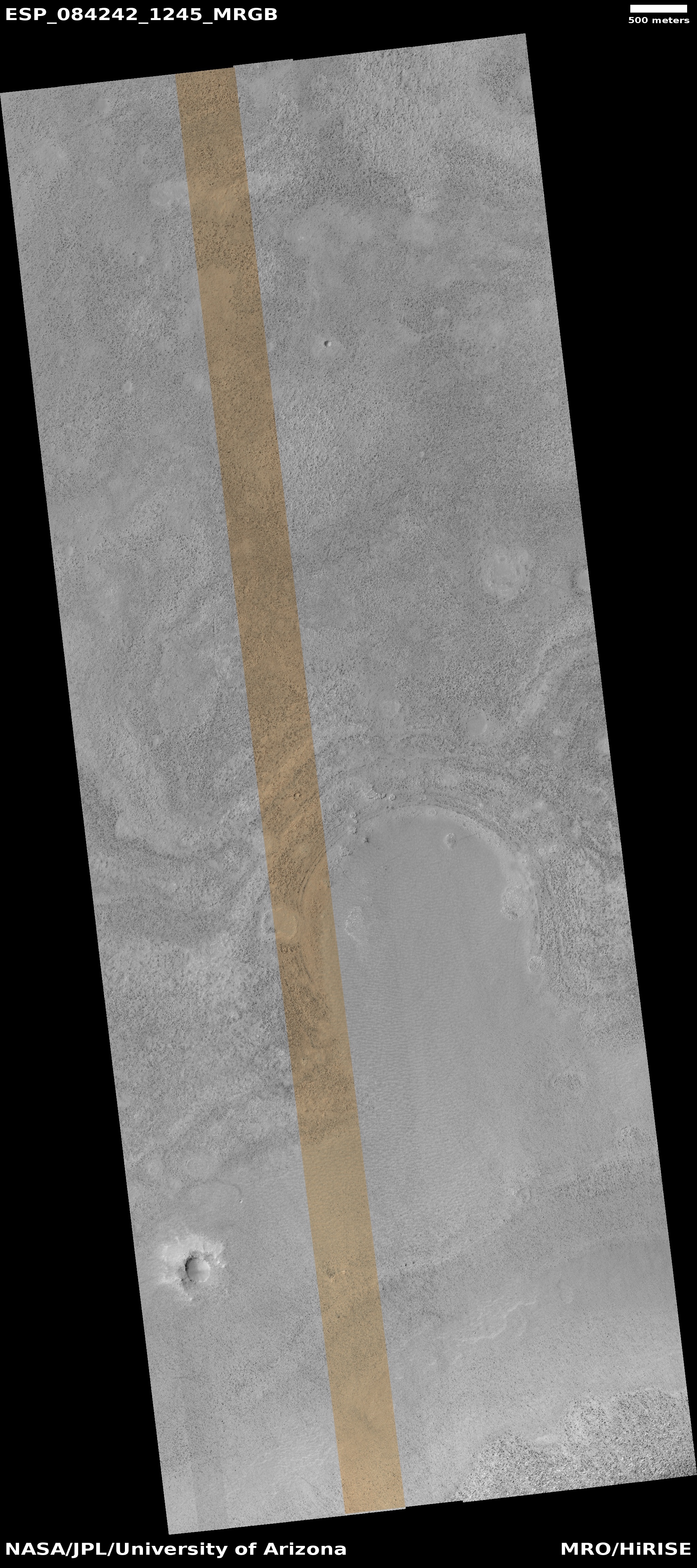
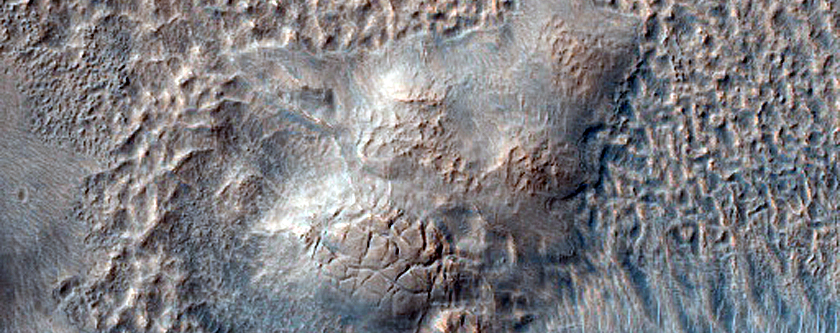
Cool image time! The picture to the right, cropped, reduced, and sharpened to post here, was taken on September 25, 2024 by the high resolution camera on Mars Reconnaissance Orbiter (MRO). It shows what the camera team labels as a “mound in the southern highlands.”

The mound in question sits in the center of the sunken depression, and at the highest resolution shows its top to be cracked and broken, as if something is attempting to break out by pushing up from below.

Everything about this picture screams near-surface ice. The cracked mound suggests ice sublimating into gas, which applies pressure to the surface and thus the cracks. The depression suggest that much of the near-surface ice at this location has already disappeared, causing the ground to sag. All the craters lack upraised rims. If caused by impacts, the ground here was soft enough that the impactor simply sank into the ground. Imagine dropping a rock you’ve heated into snow. It would simply leave a hole.

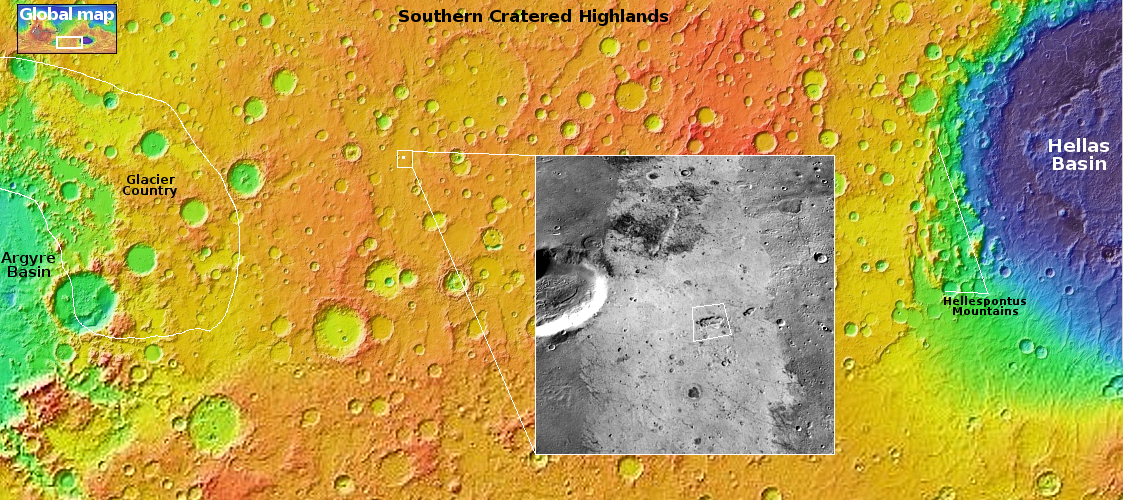
But there’s more. The white dot in the overview map above marks the location. In the inset, the lighter area surrounding this depression resembles an ice sheet that is slowly sublimating away. There are also other similar depressions in that lighter area. The lighter area also has fewer craters than the darker regions nearby, suggesting that this ice sheet covers the older impacts.

The location is in the southern cratered highlands in a mid-latitude region where many images indicate the existence of layers of ice deep below ground. This picture is more evidence of the same, but it also indicates the presence of ice very close to the surface as well.

The orbital data continues to tell us that Mars is not a dry desert like the Sahara, but an icy desert like Antarctica. There will be plenty of water for future colonists. All they will have to do is stick a shovel in the ground, dig it up, and process it.

0 comments

Ten stupid academic studies funded by the federal government

Campus Reform last week posted a list of ten academic studies funded by federal government that any sane person would not only consider stupid, but an utter waste of money.

Number 1 on the list was a grant of almost a half million dollars to researchers at Reed College in Oregon to study the gambling habits of pigeons. The researchers claimed the study would shed light on human gambling behaviors, but if you believe that then you would likely also fork over your life savings to buy the Brooklyn Bridge.

Of the ten studies listed, the National Institute of Health (NIH) and the National Science Foundation (NSF) funded four each, while the National Endowment for the Humanities and the National Cancer Institute funded one each.

National Cancer Institute’s study is surely going to help cure cancer, as it gave $7 million to the con artists faking as researchers at Stanford University to build an AI toilet equipped with cameras to scan the user’s waste and backside.

The studies were done at a range of other major universities, including Cornell, the University of California, the University of Illinois, and the University of Connecticut. Most are publicly funded institutions.

This list demonstrates clearly the bankruptcy of the government agencies involved and justifies any effort to slash their budgets by significant amounts. It does more however. It shows us the bankruptcy of the academic community as well. If scientists at major universities think this drivel is valid research, then we know they are teaching their students garbage as well. The public funding to these colleges should be slashed also.

7 comments

Strange flat layers on Mars

Strange layers on Mars

Cool image time! The picture to the right, rotated, cropped, reduced, and enhanced to post here, was taken on July 16, 2024 by the high resolution camera on Mars Reconnaissance Orbiter (MRO). It shows what MRO’s camera team labels as “layers near ridge in Argyre Planitia.”

The layers are strange because there is so little topographic difference between them. Though the ground slopes downward from the south to the north, dropping about 1,300 feet, it does so almost smoothly. The layers show relatively little topographic relief.

And what caused the circular shape? Is it evidence of a buried crater? And if so, why so little relief at its rim?

As always, the overview map provides some answers.
» Read more

0 comments

Hubble takes a different look at quasar 3C 273

Hubble's different views of 3C 273
Click for original image.

One of the most studied objects in the sky is the quasar 3C 273, located about 2.5 billion light years away and the first quasar ever to be identified, in 1963. What makes it especially interesting is the 300,000-light-year-long jet that shoots out from it.

Astronomers have now used the Hubble Space Telescope to take a different view of 3C 273, using the telescope’s coronograph to block the central bright light so that the surrounding dimmer features can be seen. The two images to the right, reduced and sharpened to post here, show what this new image (bottom) reveals when compared to an earlier Hubble image (top).

The new Hubble views of the environment around the quasar show a lot of “weird things,” according to Bin Ren of the Côte d’Azur Observatory and Université Côte d’Azur in Nice, France. “We’ve got a few blobs of different sizes, and a mysterious L-shaped filamentary structure. This is all within 16,000 light-years of the black hole.”

Some of the objects could be small satellite galaxies falling into the black hole, and so they could offer the materials that will accrete onto the central supermassive black hole, powering the bright lighthouse.

What makes this observation even more outstanding is that the image was produced by using Hubble’s Space Telescope Imaging Spectrograph (STIS) as the coronograph to block the bright center of 3C 273. This improvisation of STIS has been done many times before, but it remains a great example of clever thinking by the astronomers who use Hubble.

4 comments

The strange beginning of a 300-mile-long meandering canyon on Mars

Overview map

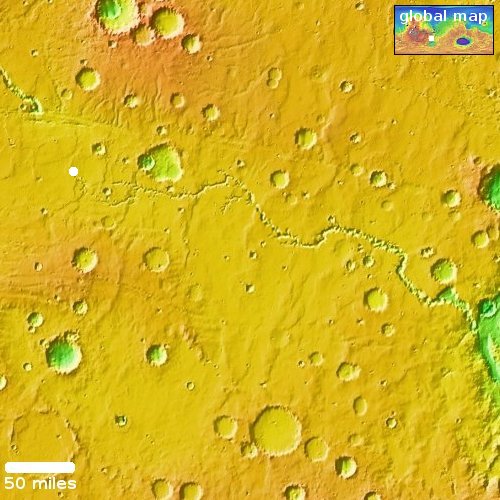
Today’s cool image will be unlike most cool images, in that we will begin not with the image but with the overview map to the right. The long meandering canyon at the center of this map is Nirgal Vallis, a 300-mile long canyon on Mars that eventually drains to the east into a much larger drainage system that runs south-to-north several thousand miles into the Martian northern lowland plains.

At first glance Nirgal Vallis invokes a river system. It starts in the west as several branches that combine to form a single major canyon meandering eastward until it enters that south-to-north system. To our Earth eyes, this canyon suggests it was carved by water flowing eastward, the many drainage routes combining as they flowed downhill.

Today’s the cool image, its location indicated by the white dot, tells us however that liquid water might not have been what created this canyon.
» Read more

1 comment

Analysis of Chang’e-6’s lunar samples suggest the giant impact that caused Aitken Basin occurred 2.83 billion years ago

Chang'e-6's landing site
Click for original image of Chang’e-6 on the Moon

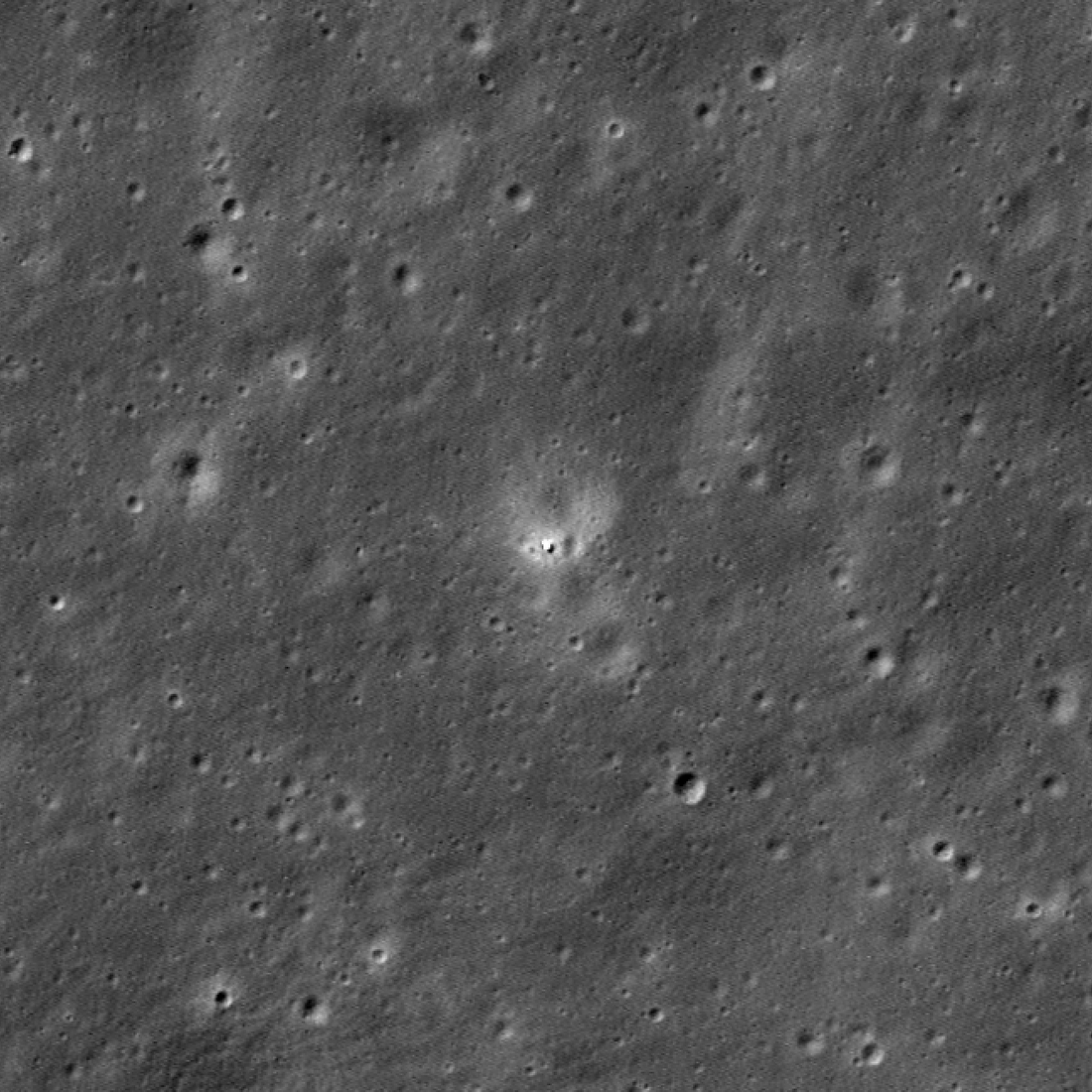
In a paper published in mid-November, Chinese scientists have concluded that — based on their analysis of the lunar samples returned by their Chang’e-6 spacecraft — the giant impact that created the 1,600-mile-wide South Pole-Aitken Basin on the Moon occurred about 2.83 billion years ago.

This conclusion is based both on the dating of the samples as well an analysis of the cratering rate on the Moon. It also suggests the landing site as well as Aitken basin were volcanically active for longer than previous predictions. Overall, scientists believe most volcanic activity on the Moon ceased around three billion years ago.

As noted in the paper, the near and far sides of the Moon are very different.

The Moon has a global dichotomy, with its near and far sides having different geomorphology, topography, chemical composition, crustal thickness, and evidence of volcanism. Volcanic eruptions flooded parts of the surface with lava, producing rocks known as mare basalts, which are more common on the nearside (4), where they cover ~30% of the surface compared to 2% of the farside.

The farside’s crust is also thicker, though under Aitken Basin the difference largely disappears.

This first precise dating for the far side is the first step for understanding why the Moon’s hemispheres are so different. Though many theories exist, none can be considered definitive because we so far have only one data point for the far side.

0 comments

The uncertainty of science: Star refuses to erupt when predicted

Based on records of two past eruptions approximately eighty years apart, astronomers had predicted that the binary star system T Coronae Borealis would erupt sometime in September 2024, brightening from magnitude 10 to as much as magnitude 2, making it one of the sky’s brighter stars for a short while.

That eruption however has so far not taken place.

“We know it has to happen,” astrophysicist Elizabeth Hays, who is watching T CrB every day using NASA’s Fermi gamma-ray space telescope, told Space.com in a recent interview. “We just can’t pin it down to the month.”

The unpredictability stems partly from limited historical records of T CrB’s outbursts. Only two such eruptions have been definitively observed in recent history: on May 12, 1866, when a star’s outburst briefly outshined all the stars in its constellation, reaching magnitude 2.0, and again on February 9, 1946, when it peaked at magnitude 3.0. These events appear to follow the star’s roughly 80-year cycle, suggesting that the next outburst may not occur until 2026. [emphasis mine]

The eruptions are thought to occur because the system’s denser white dwarf star pulls material from the lighter orbiting red giant. Over time that material accumulates on the surface of the white dwarf until it reaches critical mass, triggering a nuclear explosion that we see as the star’s brightening.

Astronomers have assumed this process is predictable, but in truth it really is not. For example, the star has brightened at other times, in 1938 and again in 2015, though not as much. These other brightenings suggest a great deal of uncertainty in the rate in which material accumulates, as well as how much is needed to trigger a nuclear burst.

Because of the possibility however of a burst at any time, astronomers have been poised eagerly now for months, observing the star regularly with the many orbiting telescopes that can observe it not only in optical wavelengths but in gamma, X-rays, and infrared. The latter capabilities didn’t exist in previous eruptions, and are now able to tell them things about the system that was impossible for earlier astronomers.

Assuming the eruption occurs at all. Despite the certainty of the astronomer’s quote highlighted above, there is no certainty here. This star system will do whatever it wants, despite the predictions of mere human beings.

10 comments

New stars shaped by old stars

New stars shaped by old stars
Click for original image.

Cool image time! The picture to the right, cropped, reduced, and sharpened to post here, was taken by the Hubble Space Telescope as part of a study focused on looking at star formation in nearby galaxies. From the caption:

Evidence of star formation is scattered all around NGC 1637, if you know where to look. The galaxy’s spiral arms are dotted with what appear to be pink clouds, many of which are accompanied by bright blue stars. The pinkish colour comes from hydrogen atoms that have been excited by ultraviolet light from young, massive stars. This contrasts with the warm yellow glow of the galaxy’s centre, which is home to a densely packed collection of older, redder stars.

The stars that set their birthplaces aglow are comparatively short-lived, and many of these stars will explode as supernovae just a few million years after they’re born. In 1999, NGC 1637 played host to a supernova, pithily named SN 1999EM, that was lauded as the brightest supernova seen that year. When a massive star expires as a supernova, the explosion outshines its entire home galaxy for a short time. While a supernova marks the end of a star’s life, it can also jump start the formation of new stars by compressing nearby clouds of gas, beginning the stellar lifecycle anew.

This galaxy is one worth keeping an eye on for supernovae, since every one of those blue stars has the potential of erupting.

1 comment

Strange mesas in the glacier country of Mars

Overview map

Strange mesas in the glacier country of Mars

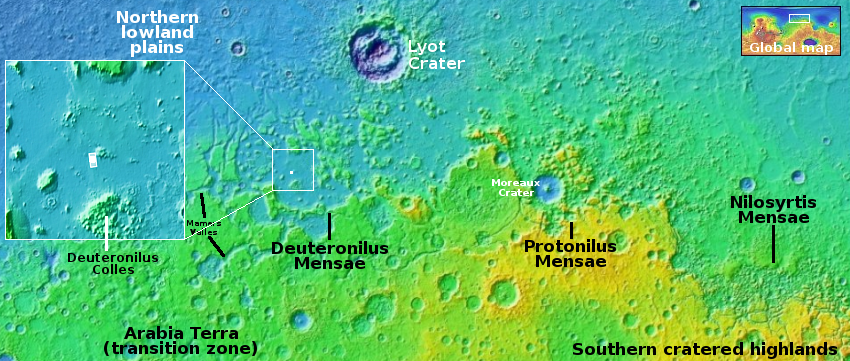
Cool image time! The picture to the right, cropped, reduced, and sharpened to post here, was taken on October 2, 2024 by the high resolution camera on Mars Reconnaissance Orbiter (MRO). The white dot in the overview map above marks the location, inside the chaos terrain of Deuternilus Mensae and part of the 2,000-mile-long mid-latitude Martian strip I label “glacier country,” because practically every image of every part of its landscape has glacial features. For example, the splash apron around the picture’s largest crater as well as the material within it all suggest some form of glacial activity and near-surface ice.

The scientists label what they see here as “Mesas in Small Craters.” These features are located in a low flat plain that geologists think was created when the ground eroded away, leaving behind scattered high plateaus that indicate the previous surface elevation. The geological map [pdf] of this plain describes it as follows:

Smooth, relatively featureless materials with regions of variable albedo north of continuous cratered highlands; exhibits scattered clusters of small circular to irregular knobs.

Based on the many accumulated photos from MRO, the general conclusion is that we are looking at a sheet of ice/dirt and covered by a thin dust layer that acts to protect that ice from sublimating away. When wind blows that dust off and the summer sun hits that near-surface ice, however, it does sublimate in bursts, which thus provides an explanation for the erosion that caused these low featureless plains.

As for these strange terraced mesas inside these distorted hollows, my guess is that the mesas predate the icesheet and are made of material with less ice impregnated within it. As that ice sublimates away it creates the craters within which the mesas remain. The terraces suggest a earlier series of geological sedimentary history.

0 comments
1 53 54 55 56 57 729