
The door to hell.
You’ve almost certainly seen pictures of this geological formation, but this article gives the background.
You’ve almost certainly seen pictures of this geological formation, but this article gives the background.
War of the Worlds! The Earth invading spacecraft on Mars has fired its laser for the first time!
Forgive me the hyperbole. I have this childhood vision from that moment when I first read H.G. Wells’ War of the Worlds, when the Martian tripod first rose up and fired its death ray at a crowd of curious humans. And here we are, a century after Wells penned that classic science fiction novel, and humans have put a spacecraft on Mars, Curiosity, capable of firing lasers! The laser isn’t a death ray but a scientific tool, but nonetheless the ironies remain delicious.
The failed predictions of the last half century of scientific doomsayers.
It is entertaining to read this long list of foolish predictions describing the certain and soon-to-arrive end of humanity. Maybe the best is the prediction of Rajendra Pachauri, head of the IPCC, who in 2007 predicted that “if there’s no action before 2012, that’s too late … This is the defining moment.”
However, it is Ridley’s concluding thoughts about climate change that are maybe the most worthwhile:
We hardly ever allow the moderate “lukewarmers” a voice: those who suspect that the net positive feedbacks from water vapor in the atmosphere are low, so that we face only 1 to 2 degrees Celsius of warming this century; that the Greenland ice sheet may melt but no faster than its current rate of less than 1 percent per century; that net increases in rainfall (and carbon dioxide concentration) may improve agricultural productivity; that ecosystems have survived sudden temperature lurches before; and that adaptation to gradual change may be both cheaper and less ecologically damaging than a rapid and brutal decision to give up fossil fuels cold turkey.
Read the whole thing. It is a truly educational experience.
Curiosity’s travel plans tentatively outlined.
A dinosaur footprint has been discovered on the Goddard Space Flight Center grounds in Maryland.
Facing tight budgets, a National Science Foundation panel has recommended the shuttering of five major ground-based telescopes.
Stay tuned for loud screams of outrage. However, some of these facilities have not been very useful for years. Consider the Robert C. Byrd Green Bank Radio Telescope. It was only rebuilt after it collapsed in 1988 because of the political clout of Senator Robert Byrd. By the time that reconstruction was finished, a process that took more than 20 years, the telescope was completely obsolete. Though it has done some good science, it is far outmatched by other radio telescope arrays.
Many of the facilities are funded merely due to bureaucratic and political inertia. For the astronomical community to be willing to recognize this is a good thing, for which they should be lauded.
The promised land: where Curiosity is headed.
This image (cut out from a mosaic) shows the view from the landing site of NASA’s Curiosity rover toward the lower reaches of Mount Sharp, where Curiosity is likely to begin its ascent through hundreds of feet (meters) of layered deposits. The lower several hundred feet (meters) show evidence of bearing hydrated minerals, based on orbiter observations. The terrain Curiosity will explore is marked by hills, buttes, mesas and canyons on the scale of one-to-three story buildings, very much like the Four Corners region of the western United States.
Click through to the image itself. Like all mountains, what appears to be a featureless mountainside from a distance instead becomes a complex and rough terrain in close-up.
An evening pause:
The uncertainty of science: Scientists using Solar Dynamics Observatory have found that the Sun is possibly the roundest object every measured, far rounder than predicted by theory.
Lunar Reconnaissance Orbiter has detected helium in the Moon’s tenuous atmosphere.
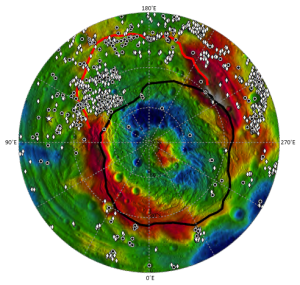
In a preprint paper published today at the Los Alamos astro-ph website, scientists have taken a detailed look at the mysterious dark streaks seen by Dawn on the surface of the asteroid Vesta and have concluded that the material comes from impacts, not from volcanic activity.
The scientists also concluded that
the majority of the spectra of [dark material] are similar to carbonaceous chondrite meteorites mixed with materials indigenous to Vesta.
Carbonaceous chondrite meteorites are considered to be the most primeval material in the solar system. This means that Vesta has the potential to give scientists a convenient laboratory for studying that primeval material and the early formation of the solar system. Ideally, the best way to do this would of course be to go there.
The scientists also theorize that much of this material was brought to Vesta by a single large impact.
» Read more