
Tag: science
The Giant Magellan Telescope project has decided it will not participate in a funding competition offered by the National Science Foundation.
The 24.5 meter Giant Magellan Telescope project (GMT) has decided it is not interested in competing for funds offered by the National Science Foundation (NSF).
With just US$1.25 million available to the winner, the NSF competition was less about money and more about prestige. The NSF has been adamant that it has no significant money to support either project until the early part of next decade. But the Thirty Meter Telescope, which will still respond to the NSF’s solicitation, believed that a competition would at least demonstrate the NSF’s intention to eventually support one project — and that the winner would have an easier time attracting international partners.
But the GMT says it can go it alone, at least for now. On 23 March, the group began blasting at its mountaintop site in Chile. And they say they are nearly halfway towards raising the $700 million they need to complete construction.
If the GMT has already raised almost $350 million without NSF support, it makes perfect sense for them to thumb their noses at this piddling funding from the NSF, especially since the bureaucratic cost of getting that money will probably be far more than $1.25 million.
Paleontologists in China have unearthed fossils of the largest feathered creature ever found, a 1.4 ton dinosaur that was an early cousin of Tyrannosaurus rex.
Paleontologists in China have unearthed fossils of the largest feathered creature ever found, a 1.4 ton dinosaur that was an early cousin of Tyrannosaurus rex.
Want to study the more than 2000 exoplanets so far discovered by Kepler? There’s now an app to do it!
Want to study the more than 2000 exoplanets so far discovered by Kepler? There’s now an app to do it!
The world’s largest solar power project, recipient of the second largest ever Department of Energy loan guarantee, has filed for bankruptcy.
Another wise investment of the Obama administration: The world’s largest solar power project, recipient of the second largest ever Department of Energy loan guarantee, has filed for bankruptcy.
Update and correction: It turns out that the company was offered the DOE loan guarantee, but turned it down. Read this second article. The facts it describe make the decisions of the Obama administration seem beyond foolish.
“I am a simple Muslim.”
Considering how easily this Muslim scientist apparently participated in conversations with terrorists where he casually discussed the idea of suicide bombings, his description of himself tells us quite a lot about Islam in general.
Ten amazing treetop walkways from around the world.
Ten amazing treetop walkways from around the world.
The science leaders on the team that announced faster-than-light neutrinos at CERN last year have stepped down.
The science leaders on the team that announced faster-than-light neutrinos at CERN last year have stepped down.
The report of an 80-year-old former U.S. Marine has provided the Chinese a clue to the whereabouts of the missing bones of Peking Man.
Life imitates pulp fiction: A report describing the memories of an 80-year-old former U.S. Marine has provided the Chinese a clue to the whereabouts of the missing bones of Peking Man.
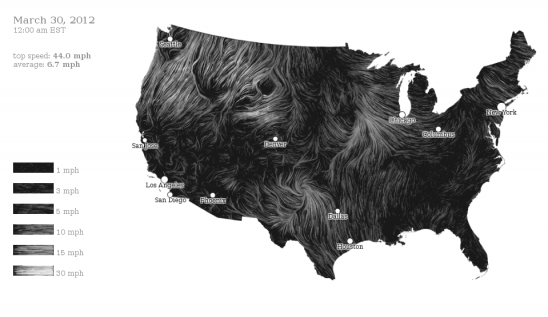
Blowing in the wind
Want to see where the wind is blowing? Check out this website, which shows an animated map of the wind patterns blowing across the continental United States, continually updated.
Geologists have uncovered a variable in the amount of uranium in rocks that will as increase the margin of error for dating events hundreds of millions of years ago.
The uncertainty of science: Geologists have uncovered a variable in the amount of uranium in rocks that will increase the margin of error for dating events hundreds of millions of years ago.
Is it snowing microbes on Enceladus?
Is it snowing microbes on Enceladus?
“More than 90 jets of all sizes near Enceladus’s south pole are spraying water vapor, icy particles, and organic compounds all over the place,” says Carolyn Porco, an award-winning planetary scientist and leader of the Imaging Science team for NASA’s Cassini spacecraft. “Cassini has flown several times now through this spray and has tasted it. And we have found that aside from water and organic material, there is salt in the icy particles. The salinity is the same as that of Earth’s oceans.”