
Scouring the Aegean Sea for the world’s oldest shipwrecks.

Scouring the Aegean Sea for the world’s oldest shipwrecks.

A Bronze Age wreck called Ulu Burun shows how the remains of a single ship can transform archaeologists’ understanding of an era. Discovered in 1982, it lies about 9 kilometres southeast of Kaş in southern Turkey, and dates from around 1300 BC, a century or two after the Minoans disappeared.

Christos Agourides, secretary-general of the Hellenic Institute of Marine Archaeology in Athens, describes it as “the dream of every marine archaeologist”. It took ten years to excavate, and researchers are still studying the nearly 17 tonnes of treasures recovered. The vast cargo includes ebony, ivory, ostrich eggs, resin, spices, weapons, jewellery and textiles as well as ingots of copper, tin and glass.

But what really stunned archaeologists was that the artefacts on this one vessel came from at least 11 different cultures1 — from a gold scarab bearing the name of the Egyptian queen Nefertiti to copper from Cyprus and tin from central Asia.

The wreck provided tangible evidence of an astonishing array of contacts and trade between the different cultures of the Mediterranean and Near East in the late Bronze Age. The Ulu Burun ship sailed at around the time that Tutankhamun ruled Egypt, and “it is far more important than Tutankhamun’s tomb as a contribution to our understanding of the period”, according to Wachsmann. “This goes to the nitty gritty of the world. It’s Wall Street in a ship.”
0 comments

A Japanese whistleblower is using the web and YouTube to document scientific fraud by a prominent Japanese researcher.

A Japanese whistleblower is using the web and YouTube to document scientific fraud by a prominent Japanese researcher.

Jigen has created separate Web sites for half a dozen cases in Japan in which he alleges scientific misconduct has occurred, and last week he posted details of what he believes is a case of image manipulation by researchers at a U.S. institution. The sites often include information about major grants and significant awards won by the scientist in question and any press releases from the institutions involved. The allegations against Kato are the first time Jigen has produced a video. He had previously used slide shows to make his point.

You can see his website here.

0 comments

A new superconducting detector might supersede CCDs for astronomy

Good news: A new superconducting detector might supersede CCDs for large astronomical telescopes.

Ben Mazin, an astronomer at the University of California, Santa Barbara, believes that he is on the cusp of a camera breakthrough: his lab is working on a superconducting detector that could eventually replace the charge-coupled devices (CCDs) that have become de rigueur in both consumer and astronomical digital cameras. Mazin’s detectors, known as microwave kinetic inductance detectors (MKIDs), can simultaneously count photons, measure their energy and record each one’s time of arrival — something that CCDs can do only after the light is split with a prism or a grating, an extra step that adds to the loss of photons.

And you know that inevitably some variation of this technology is going to find its way into ordinary commercial products.

0 comments

It doesn’t exist

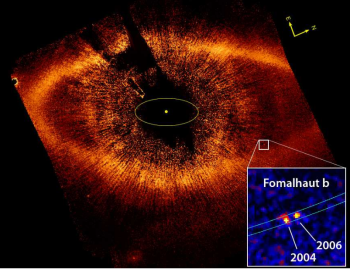
Fomalhaut b

In a preprint paper published today on the Los Alamos astro-ph website, astronomers have concluded that the exoplanet orbiting the star Formalhaut might not exist. This planet, the first exoplanet ever thought to be directly imaged in visible light, was first described in a paper published in 2008, and was actually tracked in its orbit over several years, as shown in the image on the right.

The new research used the Spitzer Space Telescope to see if the planet’s heat could be detected in infrared wavelengths. Unfortunately, the scientists found nothing.
» Read more

0 comments

A 33,000-year-old dog skull found in a Siberian cave, when compared with other ancient dog remains found in a Belgium cave, suggest to scientists that the domestication of dogs took place separately in many different places.

A 33,000-year-old dog skull found in a Siberian cave, when compared with other ancient dog remains found in a Belgium cave, suggest to scientists that the domestication of dogs took place separately in many different places.

0 comments

The biggest solar storm to be aimed at the Earth in seven years is expected to reach us by Tuesday.

The biggest coronal mass ejection to be aimed at the Earth in seven years is expected to reach us by Tuesday.

No need to panic. Not only is the storm still relatively mild compared to past eruptions, the airline and electrical industries are actually well prepared for this event. However, if you want to see the aurora, this will probably be a good opportunity.

0 comments

A group of researchers have failed to reproduce the earlier NASA result that suggested arsenic-based life was possible.

A group of researchers have failed to reproduce the earlier NASA result that suggested arsenic-based life was possible.

One interesting aspect of this story is that the research results were discussed openly, with regular updates as the work was on-going, on one of the scientists blogs.

Redfield and her collaborators hope to submit their work to Science by the end of the month. She says that if Science refuses to publish the work because it has been discussed on blogs, it will become an important test case for open science.

0 comments

Scientists have agreed to a sixty day voluntary pause in their research into the transmissibility of avian influenza, commonly called bird flu.

In a letter published jointly [pdf] in Science and Nature today, the researchers who have discovered how to easily transmit avian influenza — commonly called bird flu — have agreed to a sixty day voluntary pause in their research.

Despite the positive public health benefits these studies sought to provide, a perceived fear that the ferret-transmissible H5 HA viruses may escape from the laboratories has generated intense public debate in the media on the benefits and potential harm of this type of research. We would like to assure the public that these experiments have been conducted with appropriate regulatory oversight in secure containment facilities by highly trained and responsible personnel to minimize any risk of accidental release. Whether the ferret-adapted influenza viruses have the ability to transmit from human to human cannot be tested. We recognize that we and the rest of the scientific community need to clearly explain the benefits of this important research and the measures taken to minimize its possible risks. We propose to do so in an international forum in which the scientific community comes together to discuss and debate these issues. We realize that organizations and governments around the world need time to find the best solutions for opportunities and challenges that stem from the work. To provide time for these discussions, we have agreed on a voluntary pause of 60 days on any research involving highly pathogenic avian influenza H5N1 viruses leading to the generation of viruses that are more transmissible in mammals. In addition, no experiments with live H5N1 or H5 HA reassortant viruses already shown to be transmissible in ferrets will be conducted during this time.

The situation is difficult. This research is important as it helps scientists understand how flu is transmitted. At the same time, this research is very dangerous, as it could be used by evil people to kill millions.

1 comment
1 612 613 614 615 616 729