
Tag: science
A 70-million-year-old nest of fifteen baby dinosaurs has been found
A 70-million-year-old nest of fifteen baby dinosaurs has been found.
The hunt for the “God Particle” enters the final stretch
The hunt for the “God Particle” enters the final stretch. And scientists might find it doesn’t exist!
Uncertainty rules the day
The press reports have been unanimous:
- Nature: Climate panel says prepare for weird weather
- Associated Press: Get ready for extreme weather
- The Guardian: Extreme weather will strike as climate change takes hold, IPCC warns
- Reuters: Extreme weather to worsen with climate change: IPCC
Unfortunately, if you read the actual IPCC panel summary report, you find that, though the majority of the press stories accurately describe the report’s worst scenarios and predictions, all of them downplay the most important point of the report, that the uncertainties are gigantic and that the influence of human activity on the increase or decrease of extreme weather for the next few decades will be inconsequential. To quote the report:
» Read more
An engineering prize to rival the Nobel
An engineering prize to rival the Nobel.
The CERN experiment that appeared to see faster-than-light neutrinos has repeated its results, except that not everyone on the team agrees
The uncertainty of science: The CERN experiment that appeared to see faster-than-light neutrinos has repeated its results, except that not everyone on the team agrees.
The new tests, completed 6 November, did away with the statistical analysis by splitting each pulse into bunches just 1- to 2-nanoseconds long, allowing each neutrino detected at Gran Sasso to be tied to a particular bunch produced at CERN. These tests were carried out over 10 days and provided 20 events. The researchers confirmed that the neutrinos arrived 60 nanoseconds early, with an uncertainty of about 10 nanoseconds, comparable to that of the initial result. The collaboration has also checked its original statistical analysis, but today’s decision to submit the results to a journal was not unanimous. “About four people” among the group of around 15 who did not sign the preprint have signed the journal submission, according to a source within the collaboration, while “four new people” have decided not to sign. That leaves the number of dissenters at about 15, compared with about 180 who did sign the journal submission.
The giant storm on Saturn
Testimony at a House hearing yesterday suggests OMB plans to end NASA’s planetary program are true
Testimony at a House hearing yesterday, including the refusal of an OMB representative to appear, lend weight to the rumors that OMB plans to end NASA’s planetary program.
Scientists have found evidence of a great lake below the surface of Europa
Scientists have found evidence for the existence of great shallow lakes below the surface of Europa.
Is shooting down Phobos-Grunt an option?
Is shooting down Phobos-Grunt an option?
Curing cancer using DNA and drugs
Curing cancer using DNA and drugs.
The Winds of Mars
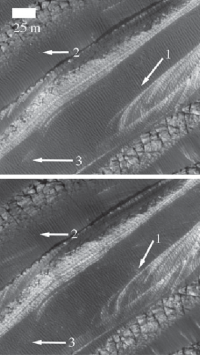
Images taken 1363 days apart.
In two different papers published in two different journals in the past month, scientists have concluded that — despite the thinness of the planet’s atmosphere — the dunes and sands of Mars are being continually shaped and changed by its winds. In both papers the data from which this conclusion was drawn came from high resolution images taken by the HiRISE camera on Mars Reconnaissance Orbiter.
What is especially interesting about this conclusion is that the climate models that had been developed for the Martian atmosphere, combined with wind measurements gathered by the various Martian landers, had all suggested that the kind of strong winds necessary to move sand were rare. To quote the abstract of the paper published on Monday in the journal Geology, Bridges, et al,
Prior to Mars Reconnaissance Orbiter data, images of Mars showed no direct evidence for dune and ripple motion. This was consistent with climate models and lander measurements indicating that winds of sufficient intensity to mobilize sand were rare in the low-density atmosphere.
Similarly, the second paper, Silvestro, et al, published on October 22 in Geophysical Research Letters, stated that
results from wind tunnel simulations and atmospheric models show that such strong wind events should be rare in the current Martian atmospheric setting.
Yet, both studies found significant evidence that such winds do occur on Mars, and are moving sand in many different places.
» Read more