
The long minimum continues

Though it has been very clear for the past few months that the sun has finally transitioned from solar minimum and begun its ramp up to solar maximum, that ramp up has also been very slow and wimpy.

On October 9, 2011 the scientists at Physikalisch- Meteorologisches Observatorium Davos (PMOD) posted an updated summary of the satellite data that has been carefully measuring the variation of the sun’s total solar irradiance since 1978. The graph below, which can be found here [pdf], brings that data up through the present. (I had posted the previous update about a year ago.)
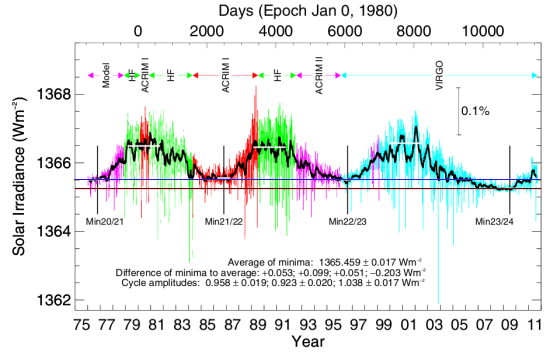
Total solar irradiance

I have added a brown line to illustrate how deep the recently ended solar minimum was, compared to previous minimums. Note also that this most recent minimum would also be far below the minimum prior to 1975. I have also added a blue line to show that the sun has only very recently finally brightened enough to finally exceed the previous minimum. All told, the sun remained dimmer than the previous minimum for over five years!
» Read more
2 comments

Another global warming scientist is accused of hiding the decline

The lead scientist in a recent climate study has been accused of hiding the fact that the global temperature has been flat for more than a dozen years.

The new study, led by Richard Muller, had taken raw land data and re-analyzed it in an attempt to clear up the doubts caused by the climategate scandal. In an announcement last week, Muller claimed that their work had proven that the climate had been warming continuously since 1950.

Now, another climate scientist, Judith Curry, has accused Muller of failing to point out that his same re-analysis had also shown that climate temperatures have been totally flat for the past 13 years, even as carbon dioxide levels in the atmosphere continue to rise. As Curry told the Daily Mail, “This is nowhere near what the climate models were predicting. Whatever it is thatโ€™s going on here, it doesnโ€™t look like itโ€™s being dominated by CO2.”

Curry is also accusing Muller of going to the press to spin the results in favor of global warming, before the research was complete.
» Read more

0 comments

Humans do it quickly

Marshall Islands

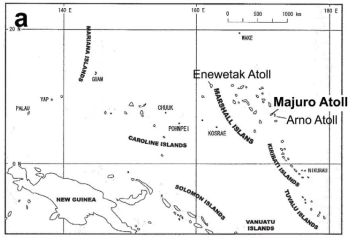
A team of scientists from Japan have found evidence that the human settlement of the Marshall Islands in the central Pacific Ocean occurred almost immediately after those islands emerged from beneath the sea. Though it had been previously believed that a thousand years had to pass until these newly emerged islands had developed sufficient vegetation for humans to occupy them, the evidence from this study shows that humans not only showed up almost immediately, they acted to vegetate the island themselves in order to make it habitable.

The scientists drilled four cores just off the western shore of Laura Island, the largest island of Majuro Atoll, as well as thirteen trenches on that same island, in order to determine when the island first emerged from under the sea. They also excavated a well-preserved bank at the center of Laura Island to study the human occupation of the island.

What they found was that the Atoll emerged from underwater approximately 2000 years ago, triggered by a fall in sea level. More surprising, the first evidence of human settlement appeared to occur at almost the same time.
» Read more

2 comments

Chile’s powerful Cerro Hudson volcano is threatening to erupt

Chile’s powerful Cerro Hudson volcano has come back to life and is threatening a major eruption.

Patagonians are worried. Many remember Mount Hudson’s catastrophic eruptions of 1971 and 1991. The latter eruption was one of the most violent registered eruptions in Chile, and lasted for five months. At its peak it turned day into night, making the banks of nearby Huemules, Cupquelan and Ibรกรฑez Rivers collapse with ash. Many areas in the region are still covered with ash, pumice and other volcanic rocks. “These are the characteristics of this highly explosive volcano,” said Juan Cayupi, a volcanologist at the National Emergency Office.

0 comments

LHC’s first year’s hunt for the Higgs is ending

The first year’s hunt by the Large Hadron Collider for the Higgs particle is ending.

Vivek Sharma of the University of California, San Diego, who heads the search for the Higgs at [one experiment], points out that results . . . have already ruled out, with a confidence of 2 sigma, a Higgs mass of between about 145 and 400 gigaelectronvolts, and that the LHC’s predecessor, the Large Electron Positron collider, ruled out a Higgs mass below about 114 gigaelectronvolts. So the Higgs, if it exists, almost certainly lies in the gap between the two. According to Sharma, the extra data to be collected in 2012 once proton-proton collisions resume in March will allow the CERN scientists to “either find the Higgs in this mass range, or wipe it out”.

If the Higgs particle turns out not to exist, it will mean that physicists will have to go back to the drawing board to explain all the phenomenon seen in the subatomic world.

0 comments

Two hacker attacks of American climate satellites in the past four years

A congressional report today revealed that two American climate satellites were attacked by hackers in the past four years.

In October 2007 and July 2008, a NASA-managed Landsat-7 satellite experienced 12 or more minutes of interference, and a Terra AM-1 satellite was disrupted for two minutes in June 2008 and again that October for nine minutes, according to Bloomberg Businessweek’s analysis of the annual report by the U.S.-China Economic and Security Review Commission. The report says the hackers gained access to the satellites โ€” both are used for Earth climate and terrain monitoring โ€” through the Svalbard Satellite Station in Spitsbergen, Norway. It’s believed the attackers may have hijacked the Internet connection at the Norway ground station to interfere with the operation of the satellites.

0 comments

According to Zubrin, Obama about to terminate all NASA science

According to Robert Zubrin, the Obama administration is planning to terminate all funding to NASA’s planetary program, while cutting back significantly on its astronomy program.

Word has leaked out that in its new budget, the Obama administration intends to terminate NASAโ€™s planetary exploration program. The Mars Science Lab Curiosity, being readied on the pad, will be launched, as will the nearly completed small MAVEN orbiter scheduled for 2013, but that will be it. No further missions to anywhere are planned. After 2013, Americaโ€™s amazing career of planetary exploration, which ran from the Mariner probes in the 1960s through the great Pioneer, Viking, Voyager, Pathfinder, Mars Global Surveyor, Mars Odyssey, Spirit, Opportunity, Mars Reconnaissance Orbiter, Galileo and Cassini missions, will simply end.

Furthermore, the plan from the Office of Management and Budget (OMB) also leaves the space astronomy program adrift and headed for destruction. The now-orbiting Kepler Telescope will be turned off in midmission, stopping it before it can complete its goal of finding other Earths. Even worse, the magnificent Webb Telescope, the agencyโ€™s flagship, which promises fundamental breakthroughs in our understanding of the laws of the universe, is not sufficiently funded to allow successful completion. This guarantees further costly delays, with the ensuing budgetary overruns leading inevitably to eventual cancellation.

I suspect these cuts have been leaked now, months before the budget is publicly released, in order to whip up support for funding these programs. I also find it distressing that these programs, which cost practically nothing, are targets, while others that cost many many more billions (in NASA and elsewhere) remain fully funded.

10 comments
1 632 633 634 635 636 729