
Craters, craters, everywhere

Below the fold are two images released today, one from Dawn at Vesta and the other from Messenger at Mercury. What makes them interesting to me is that, though the surfaces of both Vesta and Mercury are crater-packed, there are definitely distinct differences between them that one can spot if you look closely, all highlighting the fundamentally different environments of both worlds.

First, the Vesta photograph. The image looks out past the asteroid’s horizon, showing clearly that this dwarf planet is not spherical, with the south pole depression that puzzles scientists just on the planet’s limb. The parallel long deep grooves that are associated with this depression can be seen on the right. Notice also that the inside walls of all the craters slope downward in a very shallow manner. This gives the impression that the impacts that formed these craters smashed into an almost beachlike sandy surface. Note too the that the center of some craters have what appear to be flat small “ponds,” a phenomenon seen by the spacecraft NEAR when it orbited the asteroid Eros. These ponds are not liquid, but are actually made up of fine-grained particles that settle in the hollows of the asteroid.
» Read more
1 comment

NASA announces awards for three technology demonstration space missions

NASA has announced three awards for technology demonstration space missions, all set to fly within four years. More details here.

The three missions are:

  • A solar sail demonstration mission, flying a sail 38 by 38 meter sail.
  • A demonstration of in-space laser/optical communications technologies.
  • The use of a high-precision atomic clock in space.

I especially like the solar sail mission because of its long range possibilities, though the other technologies would probably be put to practical use more quickly.

0 comments

New images from Opportunity

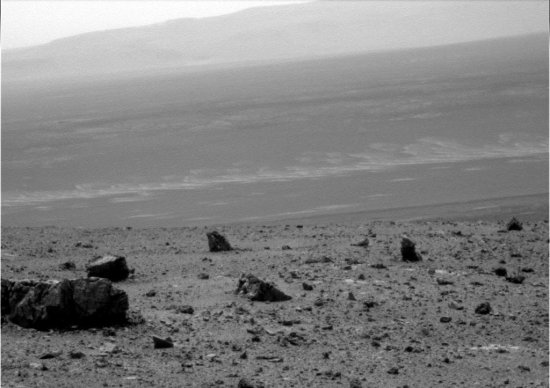
Opportunity begins exploring the rim of Endeavour Crater, taking a bunch of new images . I especially like this one, of which I’ve posted a cropped scaled-down version below. The image looks across the 13-mile-wide Endeavour Crater to its far rim on the horizon. Note the haze. Mars very clearly has an atmosphere, even though it is far thinner than Earth’s. In the foreground are scattered rocks, ejecta produced from the impact that formed a smaller nearby crater now named Opportunity Crater.

Endeavour Crater as seen by Opportunity

1 comment

The Pioneer anomaly is fading

The Pioneer anomaly is fading.

The analysis shows that the anomaly is not constant, as researchers had believed, but is decreasing with time. The finding points toward a conventional explanation of the phenomenon, most likely asymmetric radiation of heat, and against some of the more exotic proposals.

0 comments

Archeologists reap treasures from a newly-discovered POW camp from the Civil War

Archeologists reap treasures from a newly-discovered POW camp from the Civil War.

Camp Lawton’s obscurity helped it remain undisturbed all these years. Built about 50 miles south of Augusta, the Confederate camp imprisoned about 10,000 Union soldiers after it opened in October 1864 to replace the infamous Andersonville prison. But it lasted barely six weeks before Sherman’s army arrived and burned it during his march from Atlanta to Savannah.

Barely a footnote in the war’s history, Camp Lawton was a low priority among scholars. Its exact location was never verified. While known to be near Magnolia Springs State Park, archaeologists figured the camp was too short-lived to yield real historical treasures. That changed last year when Georgia Southern archaeology student Kevin Chapman seized on an offer by the state Department of Natural Resources to pursue his master’s thesis by looking for evidence of Camp Lawton’s stockade walls on the park grounds.

0 comments
1 645 646 647 648 649 729