
Amazon Chief’s Spaceship Misfires

Bad news for commercial space: A test of Amazon chief’s Blue Origin spaceship ended in failure on Friday.

After The Wall Street Journal reported on the failure, Blue Origin Friday posted a brief note on its website stating the spacecraft, while going faster than the speed of sound, suffered a “flight instability” at an altitude of 45,000 feet and the company’s automated “range safety system” shut off all thrust and led to its destruction. The problem appeared to stem from thrusters that didn’t respond properly to the initial commands, according to one industry official.
1 comment

The Hubble Space Telescope: Movie camera!

Using Hubble Space Telescope images taken over a 14 year period, a team of astronomers led by Patrick Hartigan of Rice University have produced six very short time-lapse movies, showing the changes that have occurred to a variety of interstellar jets and bow shocks over time. The one below is my favorite. They are all worth looking at, as they illustrate forcefully how the changeless heavens are not so changeless.

0 comments

Juno looks back and sees the Earth and the Moon

Earth and Moon

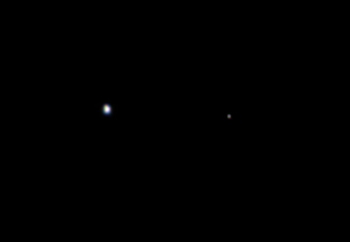
Juno, on its way to Jupiter, took a look back and snapped this picture of the Earth/Moon double planet.

The image was taken by the spacecraft’s camera, JunoCam, on Aug. 26 when the spacecraft was about 6 million miles (9.66 million kilometers) away.

Gives us a glimpse at what our home planet will really look like to future spacefarers, either on they way out or on their way home.

1 comment

Ground controllers replace a failed circuit box on ISS, using the robot Dextre

Ground controllers successfully replaced a failed circuit box on ISS this weekend, using the two-armed Dextre robot.

Up to now, exchanging the boxes was done by spacewalkers, which always carries a certain level of risk. Dextre was designed to reduce the need for astronauts to conduct spacewalks for routine maintenance, therefore freeing up the crewโ€™s time for more important activities, like conducting science.

1 comment

Al Gore and the silencing of debate

Yesterday I posted a link to a story about Al Gore claiming that any expression of skepticism about global warming is to him no different than racism. Here again is what Gore said,

โ€œThere came a time when friends or people you work with or people you were in clubs with โ€” youโ€™re much younger than me so you didnโ€™t have to go through this personally โ€” but there came a time when racist comments would come up in the course of the conversation and in years past they were just natural. Then there came a time when people would say, โ€˜Hey, man why do you talk that way, I mean that is wrong. I donโ€™t go for that so donโ€™t talk that way around me. I just donโ€™t believe that.โ€™ That happened in millions of conversations and slowly the conversation was won. We have to win the conversation on climate.โ€

More than at any other time, Gore here has very successfully illustrated the differences between how climate skeptics debate the scientific questions of climate change versus how global warming advocates do it.
» Read more

6 comments

Archeologists may have found King Arthur’s round table in Scotland

Archeologists may have found King Arthur’s round table in Scotland.

The new survey — funded by Historic Scotland and Stirling City Heritage Trust — used the latest scientific techniques to showing lost structures and features up to a metre below the ground. It also revealed a series of ditches south of the main mound, as well as remains of buildings, and more recent structures, including modern drains which appear at the northern end of the gardens.

Mr Harrison, who has studied the King’s Knot for 20 years, said: “It is a mystery which the documents cannot solve, but geophysics has given us new insights. “Of course, we cannot say that King Arthur was there, but the feature which surrounds the core of the Knot could explain the stories and beliefs that people held.”

0 comments

Sponge in space

Hyperion

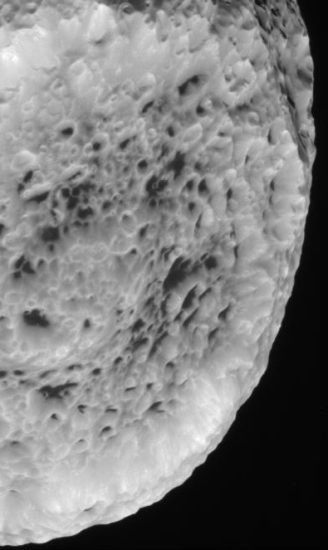
On August 25 Cassini did a close fly-by of the small Saturn moon Hyperion, getting as close as 15,500 miles. The mission has just released images from that fly-by.

Looks like a sponge, doesn’t it? This moon is small, only 168 miles across, which makes it about half the size of the asteroid Vesta that Dawn is presently orbiting. Why it is so peppered with craters is of course the big science question. I would guess this has something to do with the environment around Saturn, with its rings and the innumerable particles that come from it. Yet, other moons of Saturn are not as crater-filled, so there is obviously more to this than meets the eye.

This fly-by was the second closest of Hyperion that Cassini has done, the first passing over the the moon’s surface by only 310 miles. Because the irregularly-shaped moon’s rotation is more like a chaotic tumble, scientists could not predict what part of the surface they would see. To their luck the new images captured new territory.

Another fly-by is scheduled in only three weeks, on September 16, 2011. This time, however, the spacecraft won’t get as close, passing at a distance of about 36,000 miles.

2 comments
1 643 644 645 646 647 729