The closest supernovae in almost 25 years

Astronomers have spotted the closest supernovae in almost 25 years, only 21 million light years away.

The supernova, dubbed PTF 11kly, occurred in the Pinwheel Galaxy, located in the “Big Dipper,” otherwise known as the Ursa Major constellation. It was discovered by the Palomar Transient Factory (PTF) survey, which is designed to observe and uncover astronomical events as they happen. “We caught this supernova very soon after explosion. PTF 11kly is getting brighter by the minute. It’s already 20 times brighter than it was yesterday,” said Peter Nugent, the senior scientist at Berkeley Lab who first spotted the supernova. Nugent is also an adjunct professor of astronomy at UC Berkeley. “Observing PTF 11kly unfold should be a wild ride. It is an instant cosmic classic.”

Astronomers expect the supernova to continue to brighten over the next two weeks, when it should be visible to anyone using binoculars.
1 comment

When dust, pebbles, rocks, and boulders act like liquid

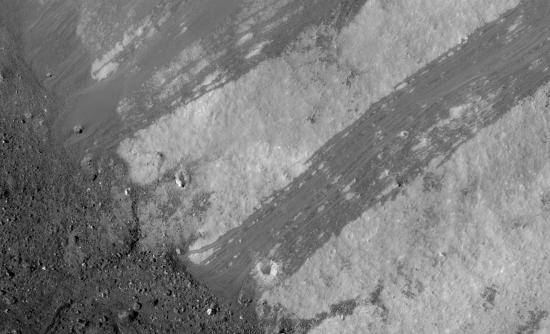
The science team of Lunar Reconnaissance Orbiter released an intriguing picture yesterday of what scientists call a granular flow down the side of a five mile wide crater on the far side of the moon. Looking at the image, one would swear that the darker material flowing down the slope of the crater rim is a lava flow frozen in place.

lunar granular flow

However, according to the scientists, that is not what it is. Instead, this is merely debris left behind from an avalanche.
» Read more

0 comments

Capturing an asteroid into Earth orbit

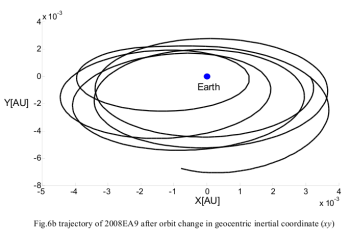
orbital path after asteroid capture

Want to mine an asteroid? Rather than travel to it with all their mining equipment, three Chinese scientists have proposed a better way. In a paper published today on the Los Alamos astro-ph preprint website, they have calculated the energy required to shift the orbits of the six thousand near-Earth asteroids and place them in Earth orbit for later mining. Of these, they found 46 asteroids that had the potential for such an operation, and two likely candidates for a space mission. One 30-foot-wide asteroid, 2008EA9, will actually be in the right place for this technique in 2049. As they write,

It can be seen that the velocity increment of the 2008EA9 is relatively small (-1.00km/s) and it will very close approach [approximately 645,000 miles] to the Earth in [February] 2049. Moreover the size of the NEO 2008EA9 is very small so that the capturing of it is relatively easy.

The real problem, of course, is adding that small “velocity increment” to the asteroid.
» Read more

4 comments

Earthquake in Virginia

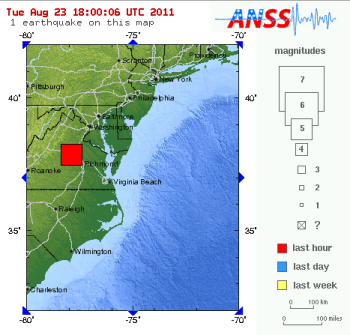
Quake map

A 5.9 magnitude earthquake hit Virginia at about 1:51 pm (Eastern).

I am in Maryland, just outside the beltway, and felt something like an earthquake about five minutes ago. The house started to shake, then settled, then shook again. Quite startling. I opened the front door the same time a neighbor did. She had felt the same thing.

The above quake was more than 90 miles away. I wonder how bad it is there, considering the eastern U.S. rarely experiences quakes and has made no preparations for such a thing.

For updates:
» Read more

47 comments
1 644 645 646 647 648 729