The dying NASA astrophysics program

The dying NASA astrophysics program.

With support from President Barack Obama, the agency’s Earth science budget is at an all-time high. Over the next four months, the planetary science division is due to launch three major missions: to the Moon, to Mars and to Jupiter. And the heliophysics division plans to send a probe plunging into the blistering atmosphere of the Sun, closer than ever before. But because the overall NASA science budget is relatively flat, something had to give. Since 2008, astrophysics funding has plunged relative to other NASA science and relative to physics and astronomy funding at other agencies.

2 comments

The U.S. and the rising Russian space program

The Russians yesterday successfully launched their first space telescope since the fall of the Soviet Union. Here is a Google translation of a Russian article describing Spektr-R’s research goals:

[Spektr-R is] designed to study galaxies and quasars in the radio, the study of black holes and neutron stars in the Milky Way, as well as the regions immediately adjacent to the massive black holes. In addition, using the observatory, scientists expect to receive information about pulsars and the interstellar plasma. It is planned that the “Spektr-R” will work in orbit for at least 5 years.

Though this particular space telescope is probably not going to rewrite the science of astrophysics, its launch is historically significant. It indicates that Russia has just about recovered from the seventy-plus years of bankrupt communist rule that ended in 1990.
» Read more

2 comments

Wither the Arctic Icecap?

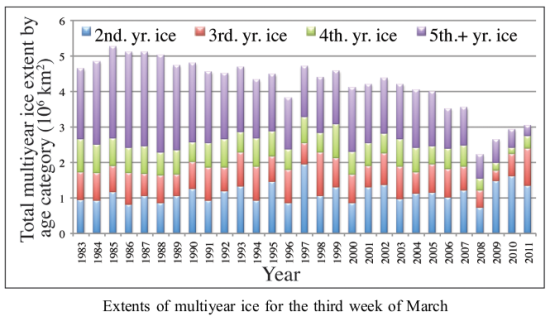
In a paper published today in Geophysical Research Letters, climate scientists have estimated the distribution and trends for the Arctic icecap from 1980 through March 2011. What they have found is a significant decline in older ice on top of an overall declining trend that showed a strong but partial recovery since 2008. The graph below, from the paper, illustrates clearly these trends.

Arctic Ice, 1980 - 2011

What this means for the icecap itself remains unclear. As the scientists themselves note in their conclusion:
» Read more

0 comments

Environmental terrorists destroy genetically modified test plots of wheat and potatoes

Leftwing civility: Environmental terrorists destroy genetically modified test plots of wheat and potatoes.

On the night of 9 July, half a dozen masked attackers overpowered the security guard watching over test fields in Gross Lรผsewitz, near Rostock. They then destroyed a field of wheat resistant to fungal diseases and a field of potatoes engineered to produce cyanophycin, an amino acid polymer that could potentially be used to make plastics. . . . Two nights later, a dozen attackers threatened guards with pepper spray and bats at a demonstration garden in รœplingen, in the state of Saxony-Anhalt. They destroyed a field of potatoes and trampled wheat and maize.

0 comments

Bad news for climate modelers

A new analysis of the orbits of Ceres and Vesta says that in a surprisingly short time those orbits become chaotic and therefore unpredictable. More significantly, those orbits interact with the Earth’s and also make its long term orbit chaotic and unpredictable. From the abstract:

Although small, Ceres and Vesta gravitationally interact together and with the other planets of the Solar System. Because of these interactions, they are continuously pulled or pushed slightly out of their initial orbit. Calculations show that, after some time, these effects do not average out. Consequently, the bodies leave their initial orbits and, more importantly, their orbits are chaotic, meaning that we cannot predict their positions. The two bodies also have a significant probability of impacting each other, estimated at 0.2% per billion year. Last but not least, Ceres and Vesta gravitationally interact with the Earth, whose orbit also becomes unpredictable after only 60 million years. This means that the Earth’s eccentricity, which affects the large climatic variations on its surface, cannot be traced back more than 60 million years ago. This is indeed bad news for Paleoclimate studies. [emphasis mine]

The scientists found that it became impossible to calculate the orbits of the two largest asteroids after only several ten thousand years. They also found that “numerous asteroids in the main belt will behave in the same way with . . . much more chaotic behavior than previously thought.” Worse, the possibility of collisions was far higher than ever thought. Ceres and Vesta have a 1 in 500 chance of colliding with each other every billion years, while other asteroids have chances as low as 1 in 1000.

The importance of this discovery, which still needs to be confirmed by other researchers, cannot be understated.
» Read more

1 comment
1 652 653 654 655 656 729