Ethane lakes in a red haze: Titan’s uncanny moonscape

Titan’s ethane lakes in a red haze.

So far, there are no recognisable signs of organic life. That’s not surprising: by terrestrial standards, Titan is a deep freeze with surface temperatures at a chilly -180Β°C. Yet Titan is very much alive in the sense that its atmosphere and surface are changing before our eyes. Clouds drift through the haze and rain falls from them to erode stream-like channels draining into shallow lakes. Vast dune fields that look as if they were lifted from the Sahara sprawl along Titan’s equator, yet the dark grains resemble ground asphalt rather than sand. It is a bizarrely different world that looks eerily like home. Or as planetary scientist Ralph Lorenz puts it: “our prototype weird-world exoplanet”.

0 comments

More evidence dinosaurs were warm-blooded

A new study has found new evidence that dinosaurs were warm-blooded and active, unlike modern reptiles. Even more surprising,

“The dinosaurs appeared to be even more active than the mammals. We certainly didn’t expect to see that. These results provide additional weight to theories that dinosaurs were warm-blooded and highly active creatures, rather than cold-blooded and sluggish.”

0 comments

Where to find life in the Milky Way galaxy

A paper published today on the Los Alamos astro-ph preprint website has attempted to model the habitable zones within the Milky Way galaxy. From the abstract:

We predict that ~1.2% of all stars host a planet that may have been capable of supporting complex life at some point in the history of the Galaxy. Of those stars with a habitable planet, ~75% of planets are predicted to be in a tidally locked configuration with their host star. The majority of these planets that may support complex life are found towards the inner Galaxy, distributed within, and significantly above and below, the Galactic midplane.[emphasis mine]

They took into consideration the hazard of supernovae for killing off planetary life, as well as other factors such as the where the necessary heavier elements would be available for producing planets.

You can download the paper here [pdf].

0 comments

Highest Water in a Decade Expected at Lake Powell

The highest water level in a decade is expected at Lake Powell by August.

Lake Powell’s rising water level is a result of the long and wet winter this year. An above-average snowpack, with late snows and unseasonably cold weather has lead to a slower melt than usual. As of May, the snowpack that feeds Lake Powell was 30 percent higher than average, with only 50 percent of the accumulated snowpack melted. [emphasis mine]

I thought Al Gore told us this wasn’t going to happen anymore.

0 comments

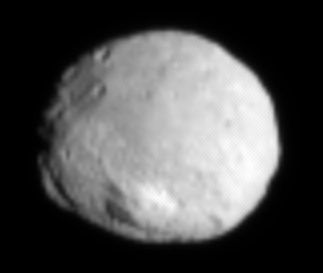
A new image of Vesta from Dawn

Dawn continues to approach the large asteroid Vesta. Below is an image taken July 1st from about 62,000 miles. The image has a resolution of 5.8 miles per pixel.

Despite Vesta’s large size, 330 miles in diameter, it is nonspherical. This fact, combined with data that says it is differentiated with a core and mantle, suggests that it is the remains of a larger object that subsequently broke up.

Vesta from 62,000 miles

0 comments

More stupidity from the Center for Biological Diversity

The Center for Biological Diversity (CBD) today sued the Bureau of Land Management (BLM) in Colorado for allowing caving to take place at the annual convention of the National Speleological Society.

The CBD claims that human activity can spread white nose syndrome, the mysterious ailment that has been killing millions of bats across the eastern United States. To quote:

It is well documented that the fungus believed to cause white-nose syndrome, aptly named Geomyces destructans, can be spread on the clothes and gear of people visiting caves. Scientists strongly suspect that the disease is a recent import from Europe, likely transported by someone who visited a cave there and then came to North America.

To be blunt, this statement is an outright lie.
» Read more

7 comments

Another Iceland volcano appears about to erupt

Another Iceland volcano, Hekla, is showing signs that it is about to erupt.

The volcano, dubbed by Icelanders in the Middle Ages as the “Gateway to Hell,” is one of Iceland’s most active, having erupted some 20 times over the past millennium, most recently on Feb. 26, 2000. It measures 4,891-feet (1,491-meters) and is located about 70 miles (110 kilometers) east of Reykjavik, not far from Eyjafjoell.

0 comments

House proposes to drop NASA’s budget to 2008 levels, eliminate Webb Telescope

The House today proposed cutting NASA’s budget back to 2008 levels while eliminating all funds for the James Webb Space Telescope.

As much as I’d hate to see the Webb telescope die, it has cost far more than planned, is way behind schedule, and carries a gigantic risk of failure. However, if I had a choice, I’d rather they cut the $1.95 billion for Congress’s homemade heavy-lift rocket, the program-formerly-called-Constellation. There is a much better chance that Webb will get completed, launched, and work, than there is for this improvised and impossibly costly Congressionally conceived rocket.

3 comments
1 654 655 656 657 658 729