
Cassini captures a truly huge storm on Saturn.
Cassini has captured an image of a truly huge storm on Saturn. Click on the image below to see the full image.

Cassini has captured an image of a truly huge storm on Saturn. Click on the image below to see the full image.
A serious coolant leak has put the Subaru Telescope in Hawaii out of commission.
The wreckage from the March 11 Japanese earthquake and tsunami, now adrift in the Pacific, is expected to reach the west coast of the United States by 2013.
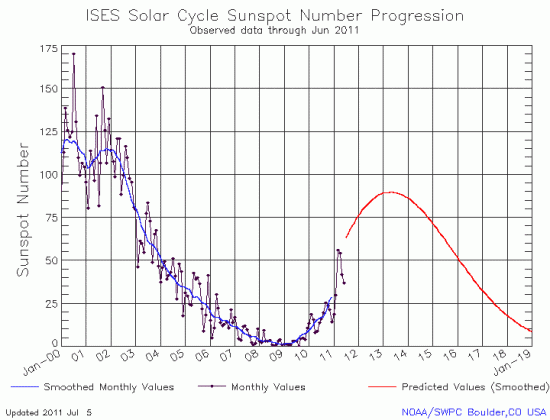
The monthly updated graph of the Sun’s solar cycle sunspot activity was released today by NOAA’s Space Weather Prediction Center. I have posted the June graph below.
For the third month in a row, there was a decline in sunspot activity. Though the sun is producing sunspots quite regularly and there hasn’t been a blank day since January 16, the numbers of sunspots continue to fall far below the predicted level of activity as indicated by the red line.
All this is no longer a surprise or unexpected. As the solar science community noted last month, they have now gathered enough data to convince them that the sun appears to be going quiet, and might even follow this very weak solar maximum — the weakest possibly in 200 years — with a decades-long period of no sunspots at all.
This graph, however, is very intriguing. Even with an expected weak solar minimum, the sun should be producing more sunspots each month, not less, as shown on the graph. This suggests that the most up-to-date predictions for the next solar maximum might still be too high.
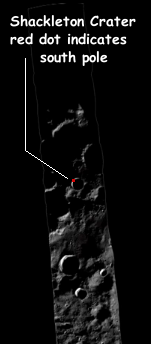
Since the 1990s, scientists have suspected that water-ice might be hidden in the forever-dark floors of the polar craters on the Moon. If so, these locations become valuable real estate, as they not only would provide future settlers water for drinking, the water itself can be processed to provide oxygen and fuel.
Moreover, the high points near these craters, including the crater rims, are hoped to be high enough so that the sun would never set or be blocked by other mountains as it made its circuit low along the horizon each day. If such a place existed, solar panels could be mounted there to generate electricity continuously, even during the long 14-day lunar night.
Below the fold is a six minute video, produced from images taken by Lunar Reconnaissance Orbiter (LRO) from February 6, 2010 to February 6, 2011, in an effort to find out if such a place actually exists. It shows how the sunlight hits the south pole across an entire year.
» Read more
A former NASA official frets about the future lack of scientists to lead small planetary missions.
Global warming scientists have come up with an explanation for the cooling seen in the past decade: The increase of coal burning in China.
In other words, fossil fuels can cause global warming and global cooling!
Or to put it another way, climate scientists really have no clear understanding yet of the climate, and are merely guessing when they try to predict what’s happening.
Hunting meteorites in the medieval Middle East and getting imprisoned because of it.
Mining the moon for water and fuel.
Texas-based Shackleton Energy Company has already begun operations aimed at mining the Moon within the next few years. The company’s plans for mining and refining operations would involve melting the ice and purifying the water, converting the water into gaseous hydrogen and oxygen, and then condensing the gases into liquid hydrogen, liquid oxygen and hydrogen peroxide, all potential rocket fuels.
Shackleton CEO Dale Tietz says the water extracted would be used almost exclusively as rocket fuel to power operations both within Low Earth Orbit (LEO) – such as space tourism and the removal of space-debris – on the Moon, and further out into space. ‘We are a for-profit business enterprise moving forward, and so we are only going there really for one reason and that is to mine, prospect mine and harvest water for rocket propellant production,’ says Tietz.
Getting rare-earth elements, needed for electronics, from ocean floor mud?