
More Than 1000 International Scientists Dissent Over Man-Made Global Warming Claims – Challenge UN IPCC & Gore
This will make things chilly in Cancun: More than 1000 scientists dissent over man-made global warming claims.
This will make things chilly in Cancun: More than 1000 scientists dissent over man-made global warming claims.
The first carbon-rich exoplanet discovered.
Firestorm over arsenic microbe continues to grow. Now the leader author of the paper responds to the criticisms from other scientists that have been popping up on the web.
Sad news: It appears that Japan’s Venus probe failed to enter orbit, and might have flown past Venus.
Update: It is confirmed that the spacecraft flew past Venus. There is a chance Japan could try again, when Akatsuka returns to Venus — in about seven years.
NOAA’s Space Weather Prediction Center today published its monthly update of the Sun’s developing sunspot cycle (see below). The graph shows the slow rise in sunspots (blue/black lines) in comparison with the consensis prediction made by the solar science community in May 2009 (red line).
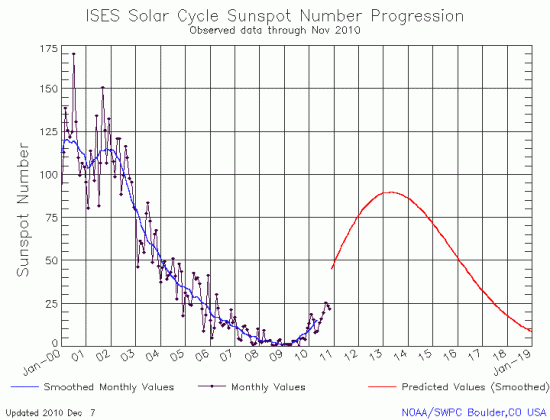
As I noted last month, the rise in sunspots as we ramp up to the next solar maximum has definitely slowed, which indicates clearly that we are heading towards the weakest solar maximum in more than two centuries. And as I have noted repeatedly on this website as well as on the John Batchelor Show, that means very cold weather!
A recent paper published in Hydrological Sciences Journal states that climate models used by IPCC cannot even predict known past climate patterns. Key quote:
It is claimed that GCMs [General Climate Models] provide credible quantitative estimates of future climate change, particularly at continental scales and above. Examining the local performance of the models at 55 points, we found that local projections do not correlate well with observed measurements. Furthermore, we found that the correlation at a large spatial scale, i.e. the contiguous USA, is worse than at the local scale. However, we think that the most important question is not whether GCMs can produce credible estimates of future climate, but whether climate is at all predictable in deterministic terms.
The status of the Japanese probe Akatsuki in its attempt to go into orbit around Venus remains uncertain. The engines fired as scheduled, but radio signal was not regained at the scheduled time. Engineers are analyzing the spacecraft’s position now to see if it was successfully inserted into orbit.
The uncertainty of science! A microbiologist is slamming last week’s NASA discovery that claimed a microbe had incorporated arsenic instead of phosphorus as part of its DNA. Key quote:
In an interview Monday, Redfield said the methods used by the researchers were so crude that any arsenic they detected was likely from contamination. There is no indication that the researchers purified the DNA to remove arsenic that might have been sticking to the outside of the DNA or the gel the DNA was embedded in, she added. Normally, purifying the DNA is a standard step, Redfield said: “It’s a kit, it costs $2, it takes 10 minutes.” She also questioned why the researchers analyzed the DNA while it was still in the gel, making the results more difficult to interpret: “No molecular biologist would ever do that.”
What can we learn from 120 years of climate catastrophe reporting? We are all gonna die! Or to put it more clearly:
1: The mainstream media outlets are going to publish whatever sells. If someone publishes a story about the world getting colder and people buy it, you can be sure there will be many more stories touting the same headline.
2: There is a long lag between what nature is doing and what the media will report. The lag seems to be anywhere from 10 to 15 years after the climate changes. There is an inertia problem with the mainstream media even when the evidence is clear.
3: When all the stories are about warming or cooling, you can be sure they are all wrong.
When government agencies or United Nations Climate Change conferences warn you that the climate is changing you can be sure that is true — the climate is always changing. Determining the direction is the hard part. Based on the past reporting of these changes, be it from global cooling or warming, the trend will have reversed many years earlier than reported.
Incidentally there has been no global warming for a decade. Get a good grip on your long johns. Maybe a trip to Cancun is not such a bad idea after all, but I’ll wait until the delegates have gone home.
What does this tell us? Al Gore’s climate group has significantly scaled back its field operations.
The Japanese spacecraft, Akatsuki, is set to enter orbit around Venus tomorrow.