Three times more stars exist than previously thought
There are more stars in heaven and earth than have been dreamt of by scientists, three times more it turns out. And they are all dwarves!
There are more stars in heaven and earth than have been dreamt of by scientists, three times more it turns out. And they are all dwarves!
Apropos of the desire of IPCC chief Rajendra Pachauri to re-engineer the climate to battle global warming, including spraying “sulphate particles high in the atmosphere to scatter the sun’s rays back into space,” planetary scientists have pinpointed the source of Venus’s sulphuric acid clouds, and from this believe that the IPCC scheme might backfire badly, doing more harm than good.
Cassini pinpoints the hot spots in the cracks on Enceladus.
What could go wrong? Railroad engineer and head of the IPCC Rajendra Pachauri announced at the Cancun climate summit today that he has decided that the threat of global warming is so great that the IPCC is going to recommend in its next report (AR5) that actions be taken to re-engineer the climate. Key quote:
“The AR5 has been expanded and will in future focus on subjects like clouds and aerosols, geo-engineering and sustainability issues,” [Pachauri] said.
Later this year IPCC “expert groups” will meet in Peru to discuss geo-engineering. Options include putting mirrors in space to reflect sunlight or covering Greenland in a massive blanket so it does not melt. Sprinkling iron filings in the ocean “fertilises” algae so that it sucks up CO2 and “seeding clouds” means that less sunlight can get in. Other options include artificial “trees” that suck carbon dioxide out of the air, painting roofs white to reflect sunlight and man-made volcanoes that spray sulphate particles high in the atmosphere to scatter the sun’s rays back into space.
Progress! The University of Colorado and the Goddard Space Flight Center are forming a collaborative research center to study the Sun’s effect on the Earth’s Climate.
A dark Jupiter may haunt the edge of the solar system.
How one astronomer became the unofficial exoplanet record keeper.
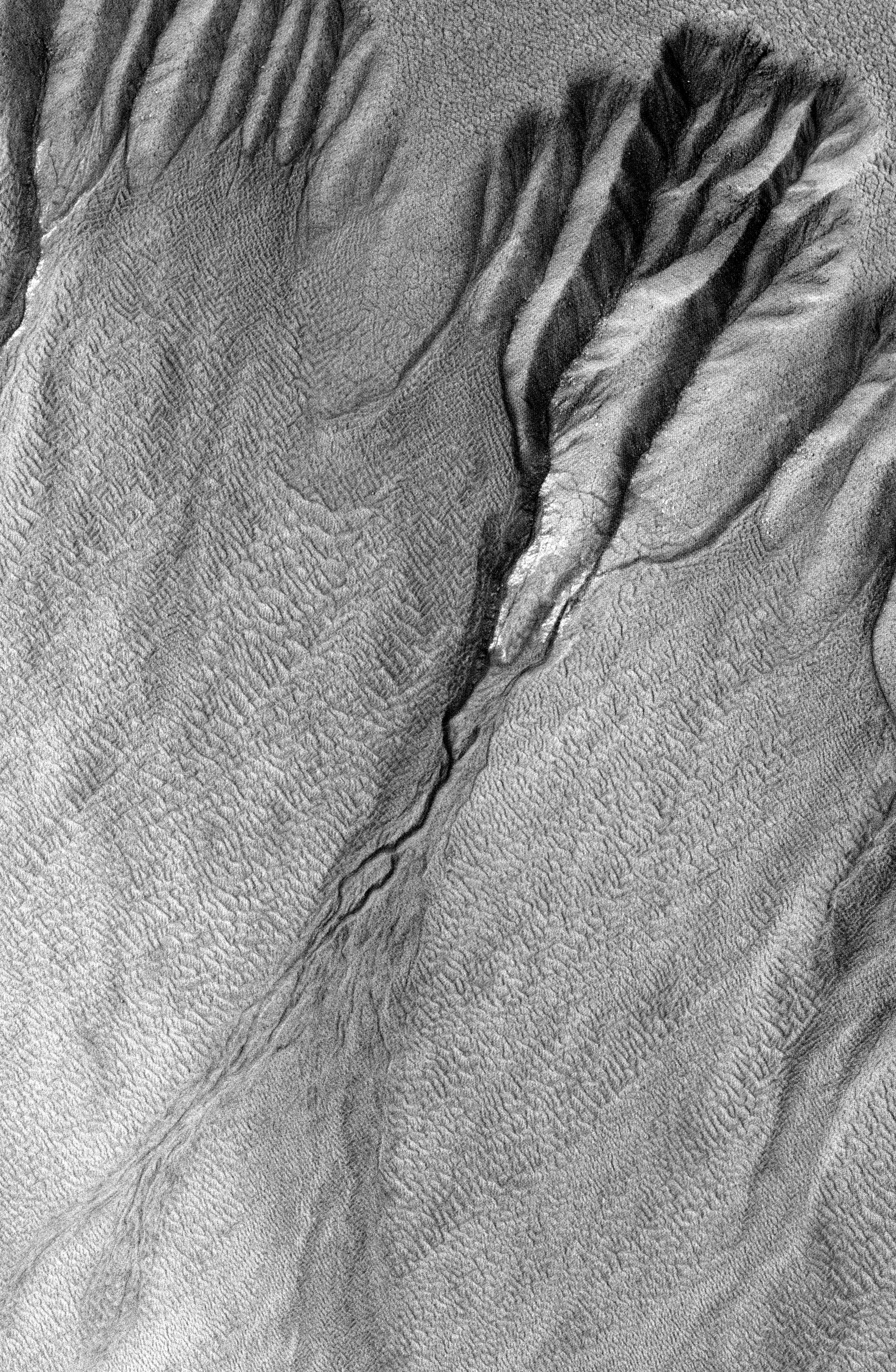
The image below from Mars Reconnaissance Orbiter shows gullies remarkably similar to gullies formed on Earth by flowing water, thus providing striking evidence that at some time in the past liquid water did flow on the Martian surface, something that is not possible now. Key quote from the caption:
The gullies shown in the subimage (approximately 710 x 1100 yards) have well developed alcoves, deeply incised channels, and large depositional fans, and are similar to terrestrial landscapes sculpted by surficial water.
The gullies shown in the subimage experienced several periods of activity, as evidenced by older channels cut by younger ones or by their deposits. The current and recent Martian temperatures and atmospheric conditions would not allow for water to be stable at the surface for extended periods of time: it is so cold that the water would freeze, and then it would sublime quickly, because the air is very thin and dry. These gullies could have formed under a different climate, or maybe by repeated bursts of transient fluids. Current leading hypotheses explaining the origin of gullies includes erosion from seepage or eruption of water from a subsurface aquifer, melting of ground ice, or dust-blanketed surface snow.
The hurricane season is about to end, and though it appears that the predictions for this season were just about right, no hurricanes touched down in North America for the second year in a row. Key quote:
“There was only a 2% or 3% chance of getting this many hurricanes and not having one hit the U.S.”
The radiation risks from the TSA scanners.
Japanese scientists have determined that a programming error was the reason why Hayabusa failed to fire its projectile at the asteroid Itokawa in 2005.