
For the past 15 years, global warming has stopped
They ain’t gonna like this in Cancun: For the past 15 years, global warming has stopped.
They ain’t gonna like this in Cancun: For the past 15 years, global warming has stopped.
An evening pause:
What could possibly go wrong? The environmental global warming activists at the Cancun climate summit appear increasingly eager to encourage governments to tinker with the atmosphere to prevent climate change. The most frightening quote:
Funding may not be far off.
In September, the U.S. Government Accountability Office recommended in a 70-page report that the White House “establish a clear strategy for geoengineering research” within its science office. A month later, a report from U.S. Rep. Bart Gordon, a Democrat from Georgia who chairs the House Science and Technology Committee, urged the government to consider climate-engineering research “as soon as possible in order to ensure scientific preparedness for future climate events.”
The U.S. panel had collaborated in its study with a British House of Commons committee. “We may need geoengineering as a `Plan B,'” the British report said, if nations fail to forge agreement on a binding treaty to rein in greenhouse gases.
Perhaps most significantly, the U.N.-sponsored Intergovernmental Panel on Climate Change, IPCC, the global authority on climate science, agreed in October to take on geoengineering in its next assessment report. Its hundreds of scientists will begin with a session next spring.
In a paper published today in Geophysical Research Letters of the American Geophysical Union, scientists note that the rise of giant volcanic caldara under Yellowstone National Park has slowed significantly since 2006 and since 2008 has actually subsided somewhat. Key quote from the paper:
Here we propose that as the caldera source continues inflating, the accumulated strain energy in the deformed crust could promote earthquakes with mechanisms such as hydrofracturing,, migration of magmatic fluids, and brittle fracturing of rocks. These events can subsequently depressurize the magmatic systems or release the accumulated strain energy, slowing the uplift or even influencing a change in motion to subsidence. In January 2010 the Yellowstone caldera experienced another large earthquake swarm at its northwestern boundary close to the location of the 1985 swarm. . . . In the following five months the caldera experienced the first overall subsidence since the inception of its uplift in 2004. This scenario is similar to that in 1985 where a reverse of caldera uplift to subsidence was temporally correlated with the largest observed Yellowstone earthquake swarm.
Global warming activists today released a report claiming there will be “a million climate change deaths each year” by 2030.
Wanna bet? This article from AFP is typical of what I call press release journalism. The unnamed author shows no skepticism, and simply regurgitates what these activists told him without question. I for one would love to see this so-called report, as I suspect it has more scientific holes than a hunk of swiss cheese.
Update: I just did a quick scan of this so-called “peer-reviewed” report, and it is a piece of junk. (You can see the report’s press release here. The report can be downloaded here [pdf]) Its data is compiled from UN political workshops, not scientific research. Moreover, it uses the 2007 IPCC report as its fundamental source, even quoting some of that report’s now discredited research, such as its claim that the glaciers in the Himalayas will be gone in mere decades.
Images of a snowbound England.
I know it’s weather and not climate, but Europe is experiencing its second cold winter in a row, despite predictions by many in the global warming community that such things would never happen again. My point here is that their claims in the late 1990s that hot streaks and big storms were proof of global warming were patently dishonest, and it is worthwhile to remind ourselves of this fact.
Astronomers are proposing that an early-warning system be built to warn us a week in advance should an asteroid be heading our way.
And damn, do I want to rappel into them!
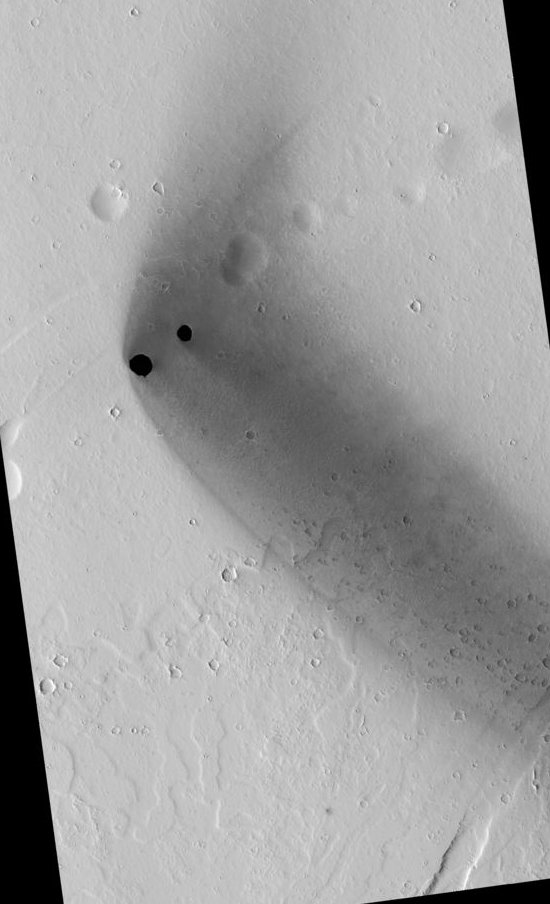
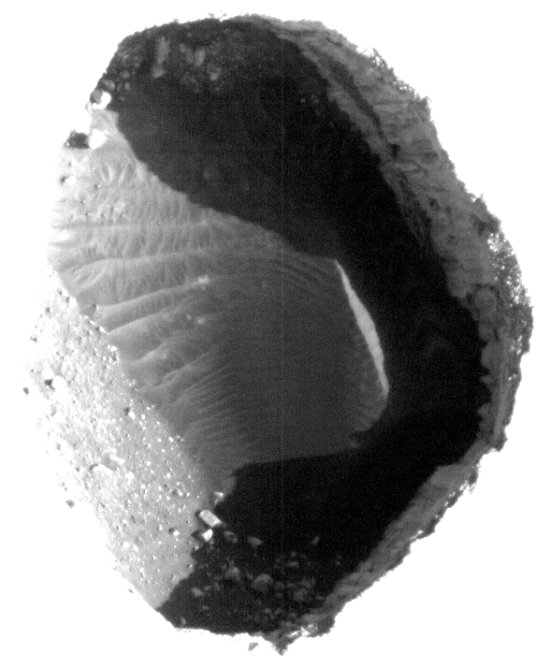
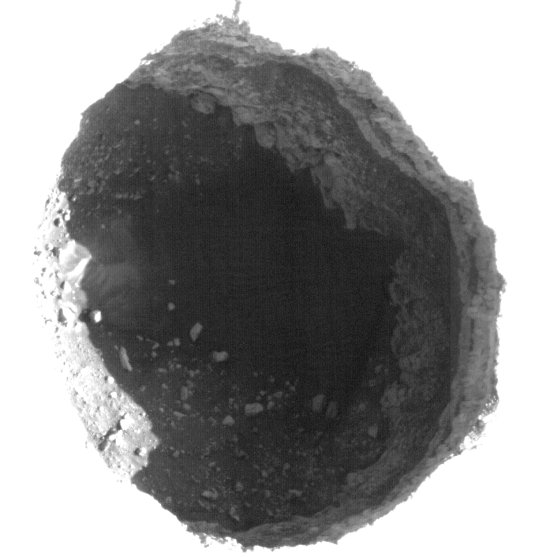
This week’s release of images from the HiRISE camera on Mars Reconnaissance Orbiter included these spectacular photos of two deep pits, approximately 180 and 310 meters in diameter and located aligned with a series of depressions that suggest additional passages at their base.
The first image shows the pits in the context of the surrounding terrain. From the caption:
These pits are aligned with what appears to be larger, degraded depressions. The wispy deposit may consist of dark material that has been either blown out of the pits or from some other source and scattered about by the local winds.
The next two images are heavily processed close-ups of each pit in order to bring out the detail within. From the caption:
The eastern most and smaller of the two pits contains boulders and sediment along its walls and brighter aeolian dune sediments on its floor. The larger, western most pit contains sediment and boulders with faint dune-like patterns visible on the deepest part of the floor. Both pits have steep eastern walls and more gently sloped western walls that transition gradually into the pit floor. Steep resistant ledges containing boulders that overhang and obscure the pit floors form the eastern walls.
A commenter to one of my other posts, ZZMike, asked this question today: ” What is NASA’s Secret Astrobiology Announcement?” and quoted this from another website, “Science fans across the Internet are eagerly awaiting an announcement from NASA’s astrobiology team. All NASA will say about the press conference is that it will “discuss an astrobiology finding that will impact the search for evidence of extraterrestrial life.”
Unfortunately, Mike, this great discovery is not the big news that everyone is hoping for, such as the discovery of life on Mars. Instead, it is about the discovery that a certain microbe can eat and digest arsenic, using it as one of the six vital basic components of life (carbon, hydrogen, nitrogen, oxygen, sulfur, phosphorus) in place of phosphorus. This is very significant since it tells us that alien life could very well be far more alien than previously imagined.
What makes this story interesting, however, is not the discovery itself (which is important). Instead, because NASA was so vague in its press announcement it allowed a large number of irresponsible reporters and bloggers to go nuts trying to guess what the story was about. When these rumors began to get out of control, the magazine Science finally sent out a notice to journalists noting the specific paper and discovery so that they at least would know in advance what the conference was about.
As Mike above as well as several other people noted to me in emails, I had written nothing about this story on behindtheblack. This was intentional. Without knowing what the conference was about, I wasn’t going to speculate about it. Once I knew, I still remained silent because the story was under embargo by Science and I respect these embargos. Now that the embargo has been lifted, I can speak.
What I want to speak about is the danger of speculation, especially among journalists. This is a serious problem today. Too often journalists speculate off the cuff, without knowing a goddamn thing about the subject, And all too often, they are downright wrong, and help contribute to misinforming the public. The result: the field of journalism has a terrible reputation with the public. No one trusts what journalists tell us. Worse, this lack of trust is helping fuel the ignorance and anger that seems to be rising in society, as no one knows what to believe about some of the most important issues of our time.
Journalists need to stop doing this. Rather than fantasize what they don’t know, journalists need to focus on what they do know. If they do that, they will significantly help repair the sagging reputation of their field.
The telescope in an airplane flew its first observation mission today.