Go to sleep for science and space exploration
Go to sleep for science and space exploration.
Go to sleep for science and space exploration.
The first asteroid sample return! Japanese scientists announced today that their probe Hayabusa did capture asteroid dust in its visit to the asteroid Itokawa.
Scientists have exhumed the body of Danish astronomer Tycho Brahe in order to do a new autopsy.
Videos from the Chinese lunar probe, Chang’e 2.
The first tests in Antarctica of a drill designed to drill cores on Mars.
The comet is carbonated!
Is Spirit, the Mars rover, finally dead?
Caver alert! Releases this week from both the Mars Express orbiter and the Mars Reconnaissance Orbiter show a variety of sinkholes and collapse features on Mars, which in turn suggest the possibility of underground passages.
First, there is this picture from Mars Express, showing the area called Phoenicis Lacus (Latin for Phoenix Lake).
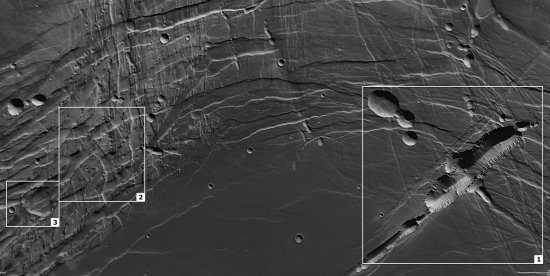
The large and long canyon in box 1 is actually a collapse feature, almost two miles deep and formed as this region was stretched, warped, and cracked by the powerful volcanic activity of the nearby giant volcanoes of the Tharsis plateau, including Olympus Mons, the solar system’s largest volcano. You can also see how this activity causes several sinkholes and craters in all three boxes to become elongated and distorted.
In places where the surface is deformed in this way on Earth, you often find tectonic caves, underground cracks produced as the ground is pulled apart. The large collapse feature suggests the possibility that there are voids below it.
Then there is this subimage from this release of Mars Reconnaissance Orbiter, showing the central peak and southern slope of an old crater in the Terra Sirenum region of the Martian southern hemisphere.
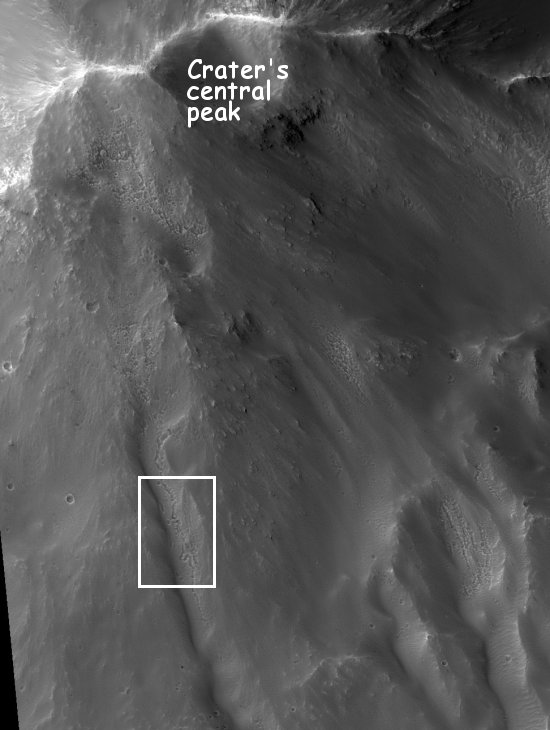
Down that south slope can be seen what look like fluvial-like flows. In the center of these flows as well as near the top of the peak are what appear to be a string of collapse features. Below is the close-up as indicated by the box above:
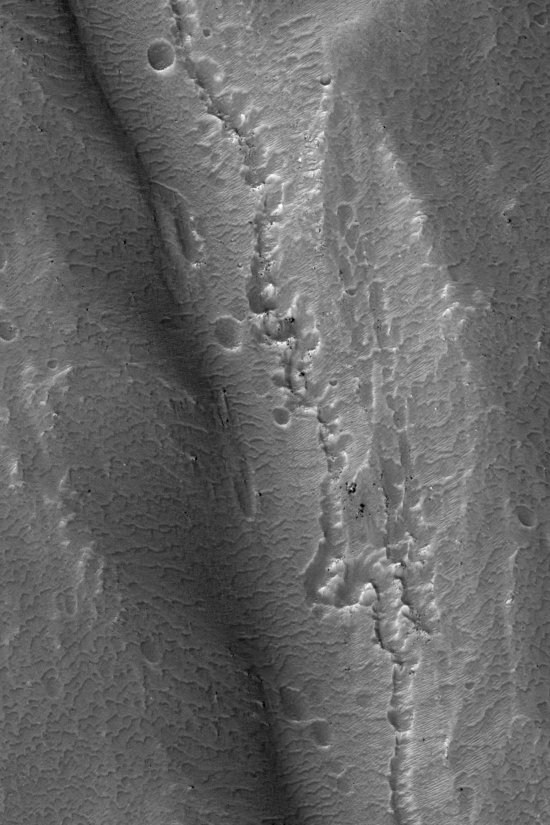
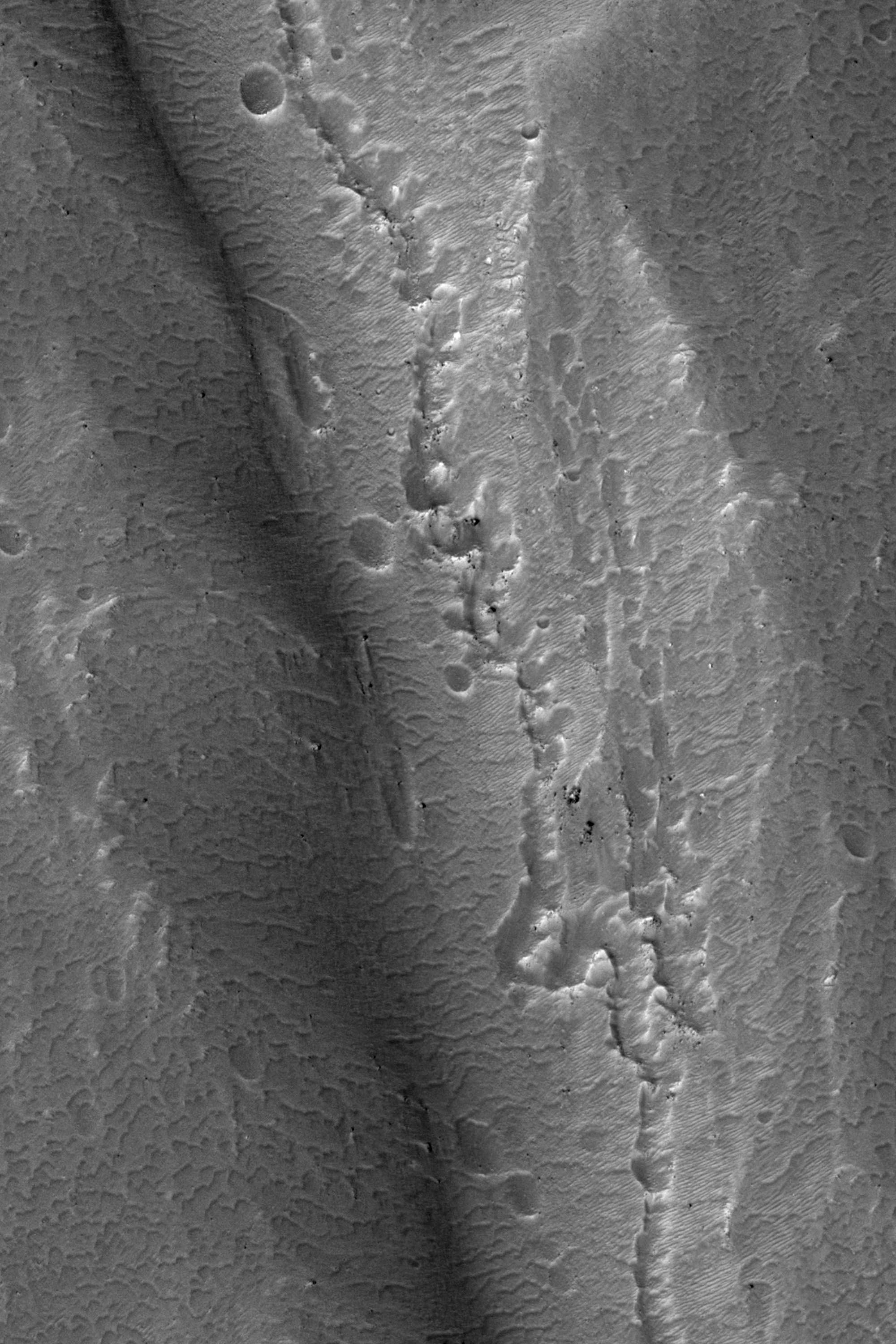
From the caption: “It is possible that these pits are evidence of subsurface piping or hydrothermal activity. Piping occurs when subsurface water flows through soil, takes some soil with it, and causes the overlying ground to collapse. These fluvial-like features and the connected pits may have formed during a late stage of crater formation when temperatures were suitable for liquid water.”
On Earth, this is one of the geological processes that forms sinkholes on the surface as well as caves underground. When cavers go out to look or dig for new caves, we often head for just this kind of string of sinkholes, as they are excellent evidence that an unentered cave lies hidden below, ripe for exploration.
Facts vs ideology in the politics of science.
Take a look at these spectacular images China released from its Chang’e 2 lunar probe that they say show potential landing sites for later Chinese probes.
The James Webb Space Telescope is in trouble again, requiring an addition $1.5 billion and an additional year to get finished.
The EPA is being sued by oil and grocery organizations over its decision to allow more corn-based ethanol in gasoline. Too bad the EPA didn’t listen to environmental organizations like Greenpeace, who say ethanol in gasoline is bad for the environment.