Met Office admits global warming has slowed down over the past 10 years
Progress! The Met Office of the UK admitted in a report today that global warming has slowed down over the past 10 years.
Link fixed. Sorry!
Progress! The Met Office of the UK admitted in a report today that global warming has slowed down over the past 10 years.
Link fixed. Sorry!
Saturn moon has a thin oxygen and carbon dioxide atmosphere. Key quote:
“The major implication of this finding at Rhea is that oxygen atmospheres at icy moons, until now only detected at Europa and Ganymede, may in fact be commonplace around those irradiated icy moons throughout the universe with sufficient mass to hold an atmosphere,” said study leader Ben Teolis of the Southwest Research Institute in San Antonio, Texas.
Better stop using that SUV! Global warming will not only destroy the Earth, a food scientist now claims that it will also destroy your Thanksgiving dinner!
Pasty, dry turkey meat along with expensive fruits, vegetables and potatoes could be on the horizon if more variable extremes in regional weather patterns continue as a likely result of climate change, indicates author Neville Gregory.
Jupiter’s south equatorial stripe appears to be reappearing.
Cassini back in operation.
The struggle to find $1.5 billion to save NASA’s astrophysics budget as well as the overbudget James Webb Space Telescope. Note that this article once again allows a variety of NASA managers and scientists push the false story that Webb is a replacement for Hubble. It is not. Hubble looks at the universe mostly in optical wavelengths, as our eyes do. Webb will be an infrared telescope. It will do wonderful things, but different things than Hubble.
The numbering ain’t really that precise, but today scientists announced the discovery of the 500th extrasolar planet.
Scientists are once again debating whether Pluto really is a planet.
A glimpse at the universe before the Big Bang?
Those who visit this website regularly know that I repeatedly post images from the various Mars orbiters and rovers. I do this not only because the images have scientific interest or that they are cool, but because it is simply fun to sightsee, even if it is done by proxy using a robot many millions of miles away. Here are two more images of the sights of Mars.
The first is a mosiac image of a small crater that the rover Opportunity strolled past on November 9 in its four year journey to Endeavour Crater.
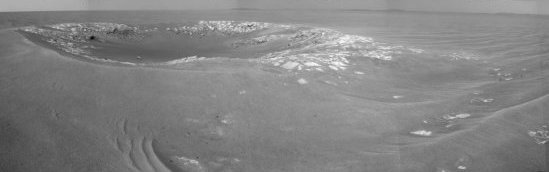
What always amazes me about the images that Opportunity has taken as it travels across the Martian desert is how totally lifeless this desert is. You would be very hard-pressed to find any desert on Earth like this. On Earth, life is everywhere, even in deserts with their harsh environment. Moreover, life on Earth has reshaped the surface drastically. Environmentalists like to whine about the havoc humans wreck on nature, but the truth is that all life does this continually. Plants and trees help soften the terrain. Animals (not just humans) mold the surface to their needs.
On Mars, however, all one sees is wind-strewn sand across barren bedrock. What this suggests is that, if there is life on Mars, it is well buried, not very visible, and possibly quite rare. It will thus be difficult to spot.
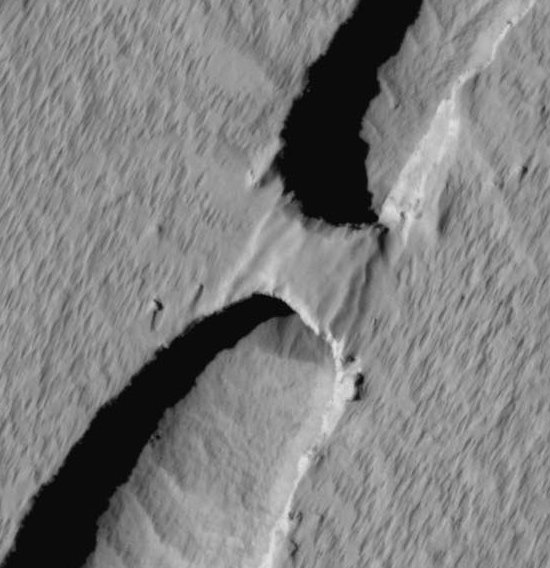
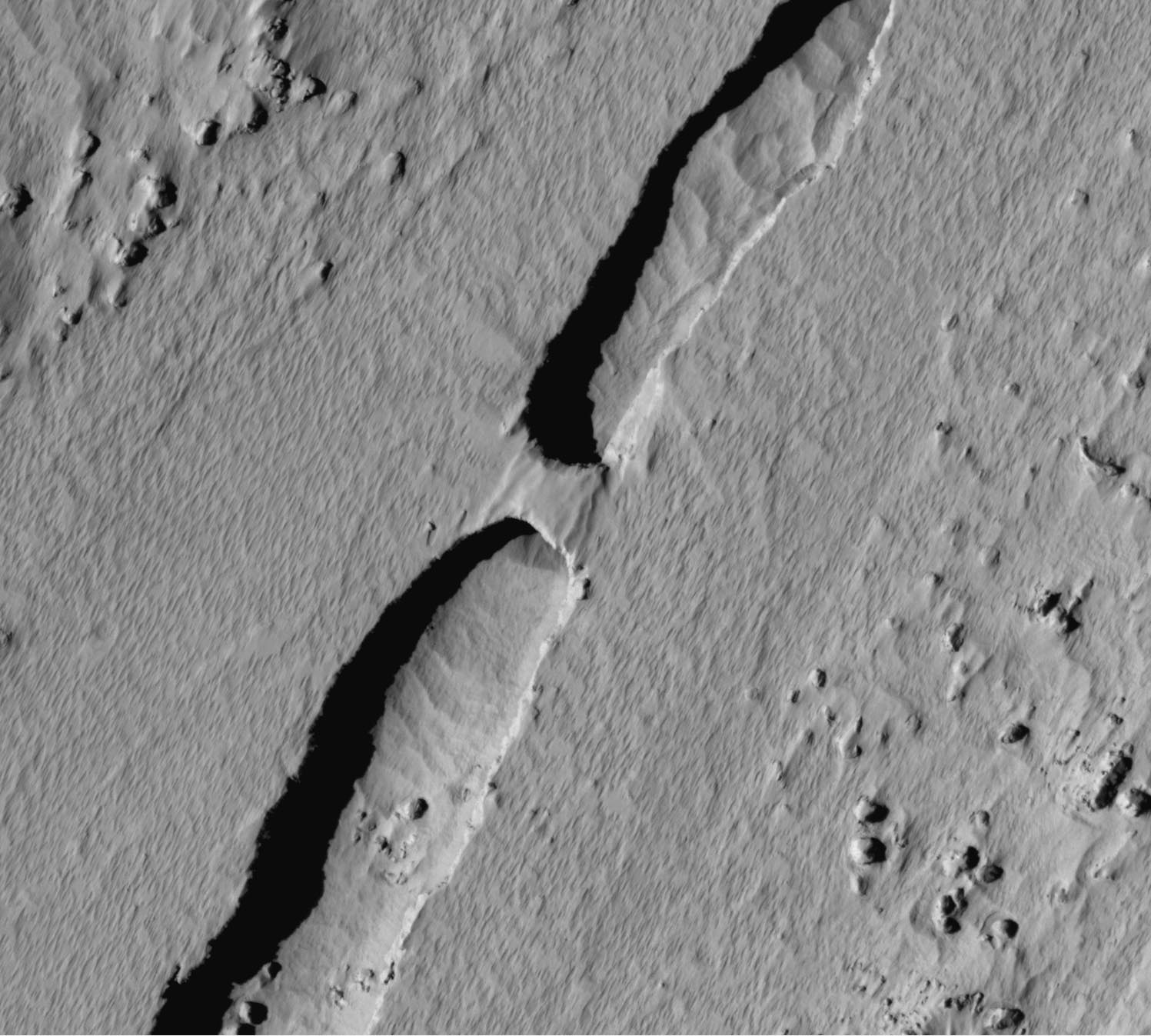
The second image is another one of those Martian collapse features, where some form of fluid flow under the surface washed out the supporting material. causing the surface to eventually collapse. In this case, however, the collapse left at least one natural bridge. Based on the scale (25 cm = 1 pixel), this bridge is about 80 feet wide and 100 feet long. (To calculate its height requires more mathematical skills than I have.)
Boy, wouldn’t this be a magnificent thing to hike under and across!